


Surya Siddhanta: The Astronomical Truth of Rahu’s Bite- Real, Not Myth
Introduction
In Western academia, Hindu scriptures are often relegated to the realm of “mythology,” a categorization that overlooks the profound scientific insights these texts offer. This blog post seeks to bridge the gap between the perceived mythological aspects of Hindu scriptures and their actual scientific value, particularly through the lens of astronomical phenomena like eclipses. In our previous entries, we explored the cosmic vision of creation in the Nasadiya Sukta and the geological metaphors in the tale of Bhagwan Varaha. By examining how ancient texts such as the Surya Siddhanta articulate the mechanics of solar and lunar eclipses, we uncover the rich scientific heritage encoded within. Our exploration reveals not only the intricate relationships between celestial bodies as understood by ancient Hindu scholars but also challenges the modern dismissal of these texts as mere myths.
Like Nostradamus’s 16th-century prophecies, the Vedic verses were written in a symbolic language, far ahead of their time. These verses were designed to help understanding weave into daily life through customs and traditions, encoding scientific knowledge in a way that’s both accessible and enduring.
Historical Context and Hindu Scriptural Insights
Hindus don’t pack pews weekly—wisdom hums in rituals. The Mahabharata (Adi Parva, 19) spins Rahu’s tale: during the ocean’s churning, he sneaks amrita—immortality’s nectar—only to be beheaded by Vishnu’s disc. Head and tail live on—Rahu bites the sun, Ketu the moon—eclipses flare. The Surya Siddhanta, a Vedic text (~400-500 CE), pins these to lunar nodes—points where the moon’s orbit crosses Earth’s [Ref 2]. During various rituals such as festivals and sixteen sanskaras priests chant verses from various Vedic Texts—most Hindus don’t know or name the source, yet feel the sky’s shift.
These narratives are embedded in the fabric of everyday life, influencing routine practices such as the ritual washing of hands and feet before pujas, underscoring an ancient understanding of hygiene akin to modern health standards, especially evident during health crises like COVID-19. This practice highlights a blend of practicality and spirituality, demonstrating how scriptural stories extend beyond spiritual guidance to include practical teachings that advocate for cleanliness and health.
Through these practices, the scriptures offer more than myths; they provide practical guidelines for living that respect both celestial influences and human welfare, enriching the daily life of practitioners.
Advanced Eclipse Predictions in Ancient India
Surya Siddhanta’s Eclipse Calculation Description
The Surya Siddhanta, a seminal text in Indian astronomy, exemplifies the profound understanding of celestial mechanics held by ancient Indian astronomers. This text is particularly renowned for its detailed methods of eclipse prediction, which blend astronomical observations with mathematical precision.
Image Description:
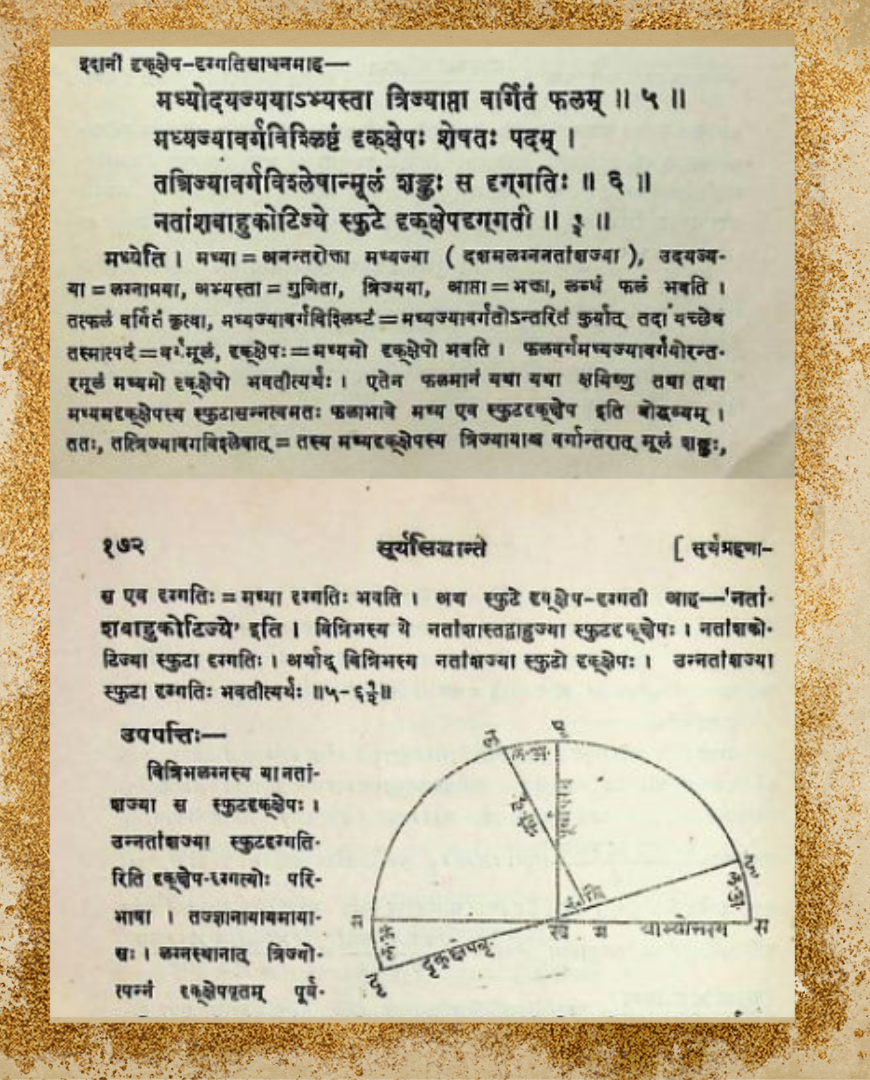
The image below is a page from Chapter 6 of the Surya Siddhanta, dedicated to the mathematical projection of solar and lunar eclipses. Written in Sanskrit using the Devanagari script, it outlines complex calculations required to determine the positions of the sun, moon, and lunar nodes—Rahu and Ketu. These calculations are not widely known in modern scientific communities, yet they are crucial for predicting when and where an eclipse will occur with remarkable precision. The page also includes a geometric diagram that visually represents the celestial paths and angles involved in eclipse mechanics. Annotations such as “विमण्डलस्य माता” (measure of the disc) and “छायाकोटि” (shadow’s edge) help clarify the components involved in these calculations.
This visual representation underscores the precision with which ancient Indian astronomers approached the study of celestial events, a testament to their advanced knowledge and techniques.
Today’s Relevance
Although most modern astronomers use recent software for eclipse predictions, the Surya Siddhanta’s methods showcase an advanced understanding of celestial mechanics from ancient times. These age-old techniques offer a compelling insight into how early astronomers used meticulous calculations and observations to explore the universe.
Scientific Explanation of Eclipses
The Surya Siddhanta’s insights into eclipses, grounded in the movements at the lunar nodes Rahu and Ketu, have historically guided the scheduling of agricultural activities, maritime navigation, and the timing of religious and social events, reflecting the profound societal reliance on celestial timing. These nodes are critical junctures where the Moon’s orbit crosses the ecliptic, the apparent path of the Sun viewed from Earth.
The advanced calculations provided by the Surya Siddhanta not only allowed ancient astronomers to predict the exact timing and visibility of both solar and lunar eclipses but also had profound impacts on society. These predictions were crucial for scheduling agricultural activities, navigating seas, and planning religious and social events that are sensitive to celestial timings. This integration of astronomical knowledge into everyday life helped in the development of a calendar system that synchronized societal functions with celestial phenomena.
Demonstration through Quote:
For example, the Mahabharata (Adi Parva, 19:9) poetically describes this celestial battle:
ततो वैरविनिर्बन्धः कृतो रहुमुखेन वै ।
शश्वतश्चन्द्रसूर्याभ्यां ग्रसत्यद्यापि चैव तौ ॥९॥
Translation: “Since then, the mouth of Rahu has formed a fierce and lasting enmity with the Moon and the Sun; thus, he still eclipses them to this day.”
The Broader Implications and Modern Relevance
The Surya Siddhanta’s approach to eclipses exemplifies the advanced astronomical knowledge of ancient India and illustrates how scholars of the time managed to embed profound scientific understanding within mythological frameworks, ensuring the knowledge’s relevance and longevity. This integration of astronomy with cultural narratives makes it clear that these texts are not just myths but sophisticated encodings of scientific phenomena.
Scientific Analysis and Vedic Astronomy
Science backs this. Solar eclipses hit when the moon blocks the sun—lunar nodes align, shadows fall. Lunar eclipses dim the moon in Earth’s shade—nodes again. Babylonians (700 BCE) saw this late; India’s Surya Siddhanta charts it earlier, predicting dates with math—sine tables, orbital cycles—Aryabhata (499 CE) refined [Ref 3]. Rahu’s “bite” isn’t caprice—it’s a “rule of thumb” for nodes’ dance, observed sans gadgets. Sages watched—eclipses weren’t random; they timed them.
Effects ripple. Tides surge—lunar pull spikes at nodes, flooding coasts [Ref 4]. Animals shift—birds hush, bats wake—studies from 2017 eclipses confirm [Ref 5]. Humans feel it too—Rigveda (10.114) ties chants to calm fear, a nod to psychology’s grip on awe [Ref 6]. The Brihat Samhita (5th century) warns of omens—floods, quakes—linking eclipses to nature’s pulse. Not superstition—sages saw, science proves.
Comparative Analysis
Building on the advanced astronomical insights detailed in the Surya Siddhanta, it becomes compelling to compare how Hindu scholars’ understanding of eclipses during ancient times paralleled or differed from their contemporaries around the world. This comparison is not only essential for recognizing the scientific accuracy in Vedic texts, which are often dismissed as mere myths, but also for appreciating the broader historical context of these insights.
Hindu astronomers understood that the Earth was spherical and recognized that it revolved around the Sun, a concept documented in various Vedic texts long before it was accepted in the West. This profound understanding contrasts sharply with the situation in Western cultures, where figures like Copernicus and Galileo faced persecution for promoting heliocentric theories, reflecting a stifling of scientific expression and a deep-rooted adherence to erroneous beliefs.
In the context of eclipses, while the West often resorted to supernatural explanations—Greeks blamed their gods (Homer, ~1200 BCE), Romans feared doom (Livy, 1st century BCE), and the authors of Genesis envisioned a flat Earth—the scholars of Hindu astronomy used their knowledge to enhance societal understanding. Europe’s astronomical advancements lagged, with Ptolemy’s geocentric models prevailing until Copernicus (1543) dared to assert otherwise. In stark contrast, the Jyotisha Shastra of ancient India accurately described celestial mechanics using the nodes Rahu and Ketu, not as mythological demons but as pivotal astronomical points, all without the aid of telescopic technology.
This profound disparity in handling astronomical facts highlights how Hindu texts, often poetic, encoded scientific sutras (formulas) that guided daily and spiritual life seamlessly, suggesting a society where knowledge and freedom of thought were deeply interwoven into the cultural fabric, unhampered by the dogmatic constraints seen in many other parts of the ancient world.
Impacts and Modern Relevance
In recent years, the interplay between ancient methodologies and modern science has gained increasing recognition.
British muddled it. The 1835 Education Act scorned Sanskrit, swapped Surya Siddhanta for English—eclipses became “pagan tales” [Ref 7]. Yet, India’s 25% global GDP (Maddison, 2001) once rode this—astronomy timed crops, tides guided trade [Ref 8]. Studies into the Surya Siddhanta’s calculations have shown their potential utility in modern astronomy, validating techniques that determine the precise timings and locations of eclipses. These explorations not only affirm the text’s accuracy but also illustrate the broader applicability of these ancient methods in contemporary scientific practices.
This revival and acknowledgment show a growing appreciation of how deeply integrated astronomical knowledge was with the daily life and governance of ancient Indian societies—from agriculture and navigation to ritual timings—reflecting a sophisticated understanding of celestial cycles. Today, organizations like NASA often find parallels between their findings and those described in ancient Hindu scriptures, confirming that these texts contain much more than mythological tales—they offer substantial scientific insights.
Conclusion
Our journey through the astronomical dimensions of Hindu texts reveals that the depiction of Rahu biting the sun or moon offers much more than mythological entertainment. These narratives are grounded in the precise observation of eclipses, embodying a deep understanding of celestial mechanics that predates many modern scientific discoveries. As we have seen, the tales of Rahu and Ketu are not mere creations of fantasy but are reflective of an advanced ancient knowledge of the cosmos. Stay tuned as we continue to uncover the layers of scientific knowledge hidden within Hindu scriptures in our next posts. What further ancient wisdom will we rediscover in these venerable texts?
As this series progresses, we will further investigate the depth of scientific knowledge hidden within Hindu texts, next turning our attention to the intriguing descriptions of celestial phenomena such as the eclipses attributed to Rahu. This exploration deepens our appreciation for Hindu heritage and challenges us to reconsider the modern understanding of these ancient texts.
Call to Action
Stay with us as we continue to decode the scientific insights embedded within Hindu narratives, challenging outdated perceptions and enriching our understanding of these ancient texts. What insights can you draw from these stories, and how do they shift your view of what constitutes scientific knowledge? Share your thoughts and join the conversation as we delve deeper into Hinduism’s scientific heritage in our next post.
Feature Image: Click here to view the image.
Visit the previous blogs on Creation of Universe as described in Nasadiya Sukta of Rigveda and the geological metaphors in the tale of Bhagwan Varaha Pulling Out Landmass out of Ocean.
Also watch educational videos on the blogs
Glossary of Terms
- Surya Siddhanta: An ancient Indian astronomical treatise that provides systematic methods to calculate the motions of heavenly bodies and is known for its detailed mathematical calculations regarding celestial phenomena like eclipses.
- Rahu and Ketu: In Vedic astronomy, Rahu and Ketu represent the points of intersection of the paths of the Sun and the Moon as they move on the celestial sphere. Traditionally, these are considered to be the north and south lunar nodes, respectively.
- Ecliptic: The path that the Sun appears to trace through the stars each year as Earth orbits around it, which is also the plane of Earth’s orbit around the Sun.
- Lunar Nodes: The points where the moon’s orbit crosses the ecliptic plane. Rahu (ascending node) and Ketu (descending node) are the points where eclipses can occur.
- Amrita: Often translated as “nectar,” it is referred to in Hindu mythology as the elixir of immortality, traditionally consumed by gods to gain eternal life.
- Sanskaras: In Hindu philosophy, sanskaras are rites of passage that mark the various stages of a person’s life, guiding them from birth to death, integrating spiritual and social life.
- Geometric Diagram: Visual representations involving shapes and lines used in astronomical calculations to demonstrate the positions and movements of celestial bodies.
- Jyotisha Shastra: The traditional Hindu system of astronomy and astrology. It is also one of the six ancient Vedangas, or supportive scriptures that support the Vedas, the sacred texts of Hinduism.
- Mahabharata, Adi Parva: The first book of the Mahabharata, one of the major Sanskrit epics of ancient India, which includes stories and teachings important to Hindu culture.
- Vedic Verses: The verses found in the Vedas, the oldest sacred texts of Hinduism, composed in Vedic Sanskrit and forming the basis of Vedic traditions.
References:
- Mahabharata, Adi Parva, 19. Sacred-Texts.com.
- Surya Siddhanta. Translated by Burgess (1860). Archive.org.
- Pingree, D. (1978). “History of Mathematical Astronomy in India.” Dictionary of Scientific Biography. Archive.org.
- NOAA (2020). “Tidal Variations.” OceanService.noaa.gov.
- Wheeler, B. W., et al. (2017). “Eclipse effects on animals.” Journal of Ethology. Springer.com.
- Rigveda, 10.114. Sacred-Texts.com.
- Macaulay, T. B. (1835). Minute on Education. Columbia.edu.
- Maddison, A. (2001). The World Economy. OECD.org.
#SuryaSiddhanta #AncientAstronomy #HinduScriptures #EclipsePrediction #VedicScience
Good
Very good
Good
[…] spiritual progress reflects the same analytical rigor found in ancient Hindu texts like the Surya Siddhanta’s astronomical calculations and the Vedic mathematics principles. Just as Vedic scholars classified knowledge into precise […]
[…] है जो प्राचीन हिन्दू ग्रन्थों में सूर्य सिद्धान्त की खगोलीय गणनाओं तथा वैदिक गणित के सिद्धान्तों में […]
[…] […]
[…] Related: Surya Siddhanta — The Astronomical Truth of Rahu’s Bite → […]
[…] https://hinduinfopedia.com/surya-siddhanta-astronomical-truth-of-rahus-bite/ […]