

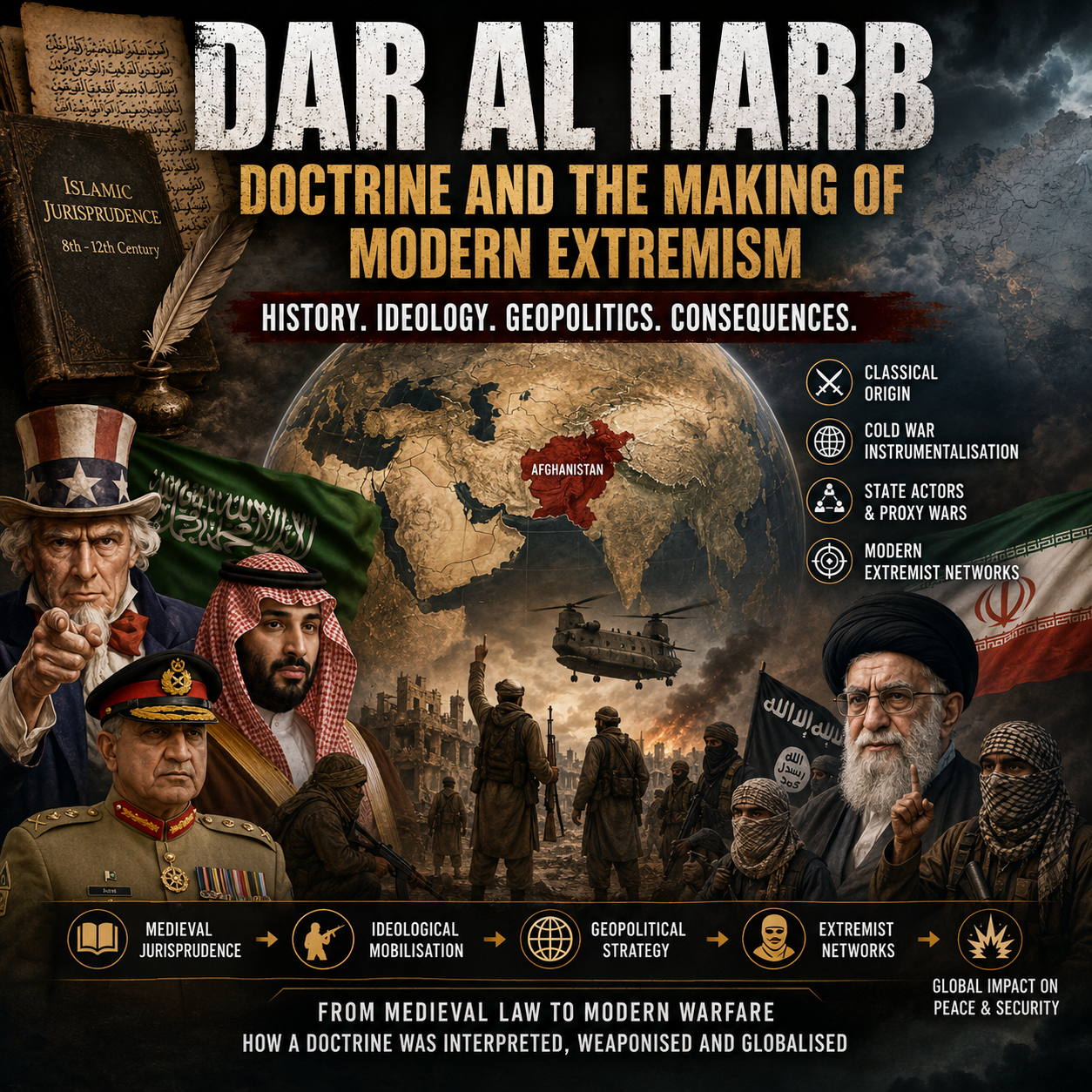
Dar Al Harb Doctrine: A Reckoning of West Asia’s Endless War (60)
Part 60 of the West Asia’s Endless War Series
भारत / GB
The Framework Is Real. What Has Been Done to It Is Not the Framework. This Blog Establishes the First Half. Three Blogs Follow to Document the Second.
Blog 59 (Israel Cause or Cover) established that the binary between genuine cause and cover is wrong — Israel is both, and the distinction between them is the argument. Blog 60 opens the ideology arc by establishing the precise classical content of the Dar Al Harb Doctrine — the theological framework several parties to the Hormuz conflict invoke, weaponise, or are accused of holding. The series approach to this doctrine is sequential: this blog states the framework precisely; three subsequent blogs examine what three separate actors have done to it. The reason for sequencing is analytical discipline — every analysis of the Dar Al Harb Doctrine that conflates the classical framework with its modern weaponised form produces conclusions that serve the conflator’s political interests rather than the truth. The series refuses the conflation. This blog is the refusal’s starting point.
Dar Al Harb Doctrine: The Classical Framework Stated Precisely
Dar Al Harb Doctrine: The House of Islam and the House of War. Classical doctrine, historically contingent, never divinely mandated for permanent warfare. What has been done to it is not the doctrine — it is the manufacture. Three blogs follow to prove it. The doctrine originates in classical Islamic jurisprudence, primarily developed between the 8th and 12th centuries CE by scholars of the Hanafi, Maliki, Shafi’i, and Hanbali schools — legal scholars attempting to categorise the relationship between expanding Islamic states and the non-Muslim world they encountered. Britannica defines Dar al-Islam as the region in which Islam has ascendance, traditionally matched with Dar al-Harb, the region into which Islam could and should expand.
The historical context is not decoration. It is the argument. The RSIS Singapore analysis documents that classical Muslim scholars operated in a world where states resolved even trivial disputes through war — the Dar al-Harb framework reflected the political reality of its era, not a divine command for permanent warfare against all non-Muslims for all time. The scholars were not theologians of perpetual war. They were jurists providing legal categories for a world in which war was the default relationship between states. Their framework assumed that world. The world has changed. The framework’s applicability to the changed world is what Muslim scholars have debated ever since.
The internal complexity of the doctrine is the first thing its modern weaponisers erase. Muslim scholars have always disagreed on definition and application. The PMC-published Badar and Nagata analysis confirms that scholars have differed fundamentally on whether treaty-holding states belong to Dar al-Harb or the tertiary category Dar al-Sulh — the House of Truce. The classical scholars introduced Dar al-Sulh precisely because the binary of war and Islam was insufficient to describe the world they actually inhabited. The Wikipedia entry on divisions of the world in Islam confirms that a state of war was presumed between Dar al-Harb and Dar al-Islam but that this did not necessarily imply that hostilities must occur — it was the ruler’s sovereign decision when, where, and against whom to wage war. The doctrine was a framework for sovereign decision-making. It was not a standing order.
The modern mainstream scholarly position is unambiguous and consistently ignored by every actor that finds its ambiguity useful. The RSIS analysis concludes that since the basis and context of the classical classification has fundamentally changed, Muslims in the contemporary era are not bound to adopt it — “there is no divinity to the classification” — and that any Muslim-ruled UN member state is by default in peaceful agreement with all other UN members through the Charter. This is not a reformist fringe position. It is the position of mainstream Islamic scholarship globally. The Dar Al Harb Doctrine in its classical form does not mandate permanent war against the non-Muslim world. It never did.
📌 The Ummah Delusion the Doctrine Is Invoked to Sustain
Iran fired on a fellow OPEC Muslim state. OPEC provided zero institutional protection. The gap between Dar Al Harb Doctrine as theological framework and Muslim solidarity as operational reality — confirmed at the institutional level by the Hormuz war itself.
Dar Al Harb Doctrine: Three Observations That Require Three Blogs
Establishing the classical framework is necessary. It is not sufficient. Three observations from the series’ analytical process make it clear that the Dar Al Harb Doctrine cannot be dispatched in a single blog without producing the very conflation the series is designed to refuse. Each observation opens a dimension that deserves its own examination — and each exposes a comfortable misreading that the series is required to dismantle.
Observation One — The doctrine’s maximalist modern form was not produced by Muslim scholars. Washington forced a dormant seed into a poisonous tree in under two decades.
A precise objection must be answered before the argument is made: if Saudi Arabia carried the Wahhabi seed for centuries, why call what Washington did “manufactured”? The answer is in the timeline. The Wahhabi tradition existed since Muhammad ibn Abd al-Wahhab’s 18th century compact with the House of Saud. It carried within it the theological DNA of Dar al-Harb maximalism — the takfir doctrine, the obligation of jihad against un-Islamic governance, the rejection of accommodation with the non-Muslim world. For two centuries, this seed remained contained — geographically within the Arabian Peninsula, institutionally within the Wahhabi-Saudi political compact, operationally limited to the Arabian context it had grown in. It had not produced a global jihadist movement in two hundred years. What Washington did in the 1980s was not invent the seed. It was inject it with the water, the fertiliser, and the greenhouse conditions that forced centuries of potential into two decades of actuality. The seed had existed. The poisonous tree was manufactured.
The Afghanistan cultural evidence — east-west, pre-post: Pre-Soviet Kabul: female students, female teachers, music, cinema, mixed gender education. Post-2021: women banned from education, music prohibited, Dar al-Harb maximalism that could not produce a single global terrorist organisation in two centuries producing Al-Qaeda, Taliban, ISIS-K, and dozens of affiliated movements in under two decades. The Durand Line east-west comparison — the Pakistani side’s radicalisation vs the Afghan side’s pre-war cultural practice — is the empirical proof that the acceleration was manufactured, not organic.
The jihadist Dar al-Harb — every non-Muslim territory as a legitimate target of permanent jihad — did not reach global operational scale through organic theological development. It was materially accelerated by the CIA, Saudi Arabia, and Pakistan’s ISI as a Cold War proxy instrument against the Soviet Union in Afghanistan. The theological infrastructure was deliberate and documented: Wahhabi madrassas exported into Pakistan’s border regions at unprecedented scale and funding to produce fighters whose Dar al-Harb maximalism would sustain a decade-long insurgency. The Washington Post documented that USAID-funded textbooks printed at the University of Nebraska glorified violent jihad and were later adopted by the Taliban. Approximately 90,000 fighters were trained across a decade. The evidence of what this acceleration produced is not theoretical. It is geographic and cultural — and it is documented in the single most clarifying comparison available: Afghanistan before and after.
Pre-Soviet invasion Afghanistan was a Muslim country with Sufi traditions, mixed gender education in Kabul, music, cinema, and a constitutional monarchy attempting modernisation. The Pashtun areas east of the Durand Line were conservative but not operationally jihadist. The areas west of the line — the Afghan side — maintained the cultural practices that centuries of Hanafi Islam and Afghan tribal tradition had produced. The UN documented Afghanistan’s pre-war literacy and education statistics — Kabul University had female students, female teachers taught in schools, and the cultural gap between Kabul and Kandahar was measurable but not the civilisational rupture it became after 1989. Post-2001, and conclusively post-2021, that country is unrecognisable from its pre-1978 self. Women are banned from education, music is prohibited, and the Dar al-Harb maximalism that could not produce a single global terrorist organisation in two centuries of Saudi Wahhabi existence produced Al-Qaeda, the Taliban, ISIS-K, and dozens of affiliated movements in under two decades of American-funded acceleration. The cultural transformation of Afghanistan is the empirical evidence that the peer review demands. The doctrine existed. The scale, the speed, and the global reach were manufactured.
After 1989 the 90,000 trained fighters dispersed into Algeria, Bosnia, Chechnya, Somalia — and formed the nucleus of Al-Qaeda. The state that manufactured this acceleration is the state that now wages the War on Terror against its own product. The Dar Al Harb Doctrine’s modern maximalist form is the first great manufactured extremism of the post-Cold War era — and its manufacturer left no fingerprints on the theology while leaving very clear fingerprints on the funding, the textbooks, the training camps, and the ISI channels through which the acceleration was administered. Blog 61 (Dar Al Harb Hardened) examines this sequence in full.
Observation Two — The public condemnation of the doctrine does not reach its private substrate.
There is a pattern in the observation of Islamic extremism that produces a systematic misreading — seeing a rope on the ground and concluding it is a snake, or seeing a snake and concluding it is a rope. The Dar Al Harb Doctrine has been publicly condemned by Muslim scholars, governments, and Iran’s religious establishment. Reading this condemnation as the full picture commits the first error. The condemnation is real in some cases and performative in others — but in both cases it leaves the theological substrate intact while the institutional and financial infrastructure that sustains the maximalist form continues operating beneath the condemned surface.
Saudi Arabia’s Wahhabi establishment condemns ISIS publicly and simultaneously teaches the takfir doctrine — the declaration of fellow Muslims as apostates — and the obligation of jihad against un-Islamic governance that ISIS theologians use as their primary justification. The same Saudi Arabia funds and staffs the Islamic University of Medina, whose graduates have been documented in extremist movements globally. The Washington Post documented that Saudi Arabia’s decades of Wahhabi educational export created the ideological ecosystem in which ISIS grew — the condemnation of the fruit while continuing to water the root. Most precisely: Saudi Arabia formalised its SMDA mutual defence pact with Pakistan in September 2025 — a state whose ISI has been documented by the US State Department, the FATF, and multiple judicial proceedings as maintaining operational relationships with organisations including Lashkar-e-Taiba, Jaish-e-Mohammed, and the Haqqani Network. The US State Department’s own Country Reports on Terrorism documented Pakistan-based groups responsible for cross-border attacks while Pakistan’s government publicly condemned terrorism. Saudi Arabia condemns Dar al-Harb maximalism. Saudi Arabia signs a military alliance with its primary institutional exporter.
Qatar condemns terrorism in every multilateral forum. Blog 26 (Qatar Mediator Vacuum) documented Qatar’s positioning as the Gulf’s neutral channel. The positioning is partially real and substantially manufactured. Qatar funds the Muslim Brotherhood through Al Jazeera and multiple documented financial channels across the Arab world — providing the Brotherhood’s primary Arabic-language media platform and the financial networks that sustain its political organising from Morocco to Indonesia. The Qatar-gate scandal — in which Belgian police arrested European Parliament Vice-President Eva Kaili in December 2022, recovering €150,000 in cash traced to Qatari influence operations, with Italian MEP Antonio Panzeri and others subsequently charged and convicted — documented Qatar’s systematic purchase of European institutional silence on precisely these activities. Qatar condemned terrorism publicly. Qatar paid European parliamentarians to prevent institutional scrutiny of how it funds political Islam privately. The Badar and Nagata analysis confirms that modern extremist groups have intentionally misconstrued classical doctrines — but the misconstruction is only possible because the substrate from which it draws remains institutionally maintained and financially supported. Blog 62 (Dar Al Harb Ambivalence) examines the condemnation industry’s full architecture — the gap between what is condemned in public and what is sustained in private, and why the gap is not accidental but structural.
Observation Three — Iran’s silence on the doctrine is strategic constraint, not theological abandonment.
Iran operates Velayat-e Faqih — governance of the Islamic jurist — as its formal framework and does not publicly invoke Dar al-Harb. This is accurate and incomplete simultaneously. Iran’s 1979 revolutionary constitution, Article 154, declares the aspiration for the happiness of every individual in all human societies and the liberation of all human beings — the export of the Islamic revolution was Khomeini’s explicit doctrine, not a peripheral ambition. Iran’s operational architecture — Hezbollah in Lebanon, Hamas in Gaza, the Houthis in Yemen, Shia militias in Iraq — represents the active expression of a revolutionary commitment that Dar al-Harb logic informs even when the vocabulary is different. The absolute economic isolation and military pressure Iran faces has made explicit Dar al-Harb declarations strategically irrational — a state that cannot fight openly cannot declare permanent war on every non-Islamic state without accelerating its own destruction. The silence is the calculation of the strategically constrained, not the conviction of the theologically converted. Blog 21 (Persian Civilisation War) established Iran as a civilisational state. Blog 63 (Iran’s Revolutionary Doctrine) examines what the revolutionary constitution, the proxy architecture, and the strategic constraint reveal when read together rather than separately.
The Dar Al Harb Doctrine’s closing argument for this foundational blog is its most precise formulation: the classical framework is real, historically contingent, internally contested, and never divinely mandated for permanent warfare against all non-Muslims. What circulates today as Dar al-Harb maximalism is not this framework. It is what three separate sets of actors — a superpower’s Cold War strategists, a condemnation industry that maintains the substrate it publicly disowns, and a revolutionary state whose strategic constraint is mistaken for theological moderation — have done to this framework. Blog 35 (Manufactured Instability Reckoning) documented Washington’s pattern of manufacturing the instability it then uses to justify intervention. The Dar Al Harb Doctrine’s modern maximalist form is that manufacture’s theological dimension. The series names it here. The three blogs that follow document it precisely.
📌 The Narrative War That Made the Conflation Possible
How the Western Narrative War manufactured the theological framing that made the Hormuz conflict legible to Western populations as a civilisational conflict rather than a commercial and strategic war over oil pricing and dollar dominance.
Next: Dar Al Harb Hardened — Blog 61 in West Asia’s Endless War documents the manufacturing of the doctrine’s modern maximalist form: CIA Operation Cyclone, Saudi Arabia’s exported Wahhabi madrassas, USAID-funded textbooks glorifying violent jihad, and the 90,000 fighters trained by ISI who dispersed after 1989 to form the nucleus of Al-Qaeda. The weapon Washington built in Peshawar in 1980. The weapon that destroyed the Twin Towers in 2001. The weapon that fires Iranian-supplied rockets today. The manufacturer and the War on Terror are the same state. Part of the West Asia’s Endless War Series on hinduinfopedia.com.
Feature Image: Click here to view the image.
Videos
Glossary of Terms
- Dar Al Harb Doctrine: A classical Islamic jurisprudential concept describing territories outside Islamic political authority, historically interpreted within medieval geopolitical conditions rather than as a permanent command for global warfare.
- Dar Al Islam: The “House of Islam,” referring to territories governed by Islamic political authority or where Islamic social dominance historically existed.
- Dar Al Sulh: The “House of Truce,” a classical Islamic legal category describing non Muslim territories maintaining treaty or peaceful relations with Islamic states.
- Takfir Doctrine: An extremist theological practice of declaring fellow Muslims apostates or outside Islam, frequently used by jihadist organisations to justify violence against Muslim governments and communities.
- Velayat e Faqih: Iran’s revolutionary governing doctrine meaning “Guardianship of the Islamic Jurist,” under which supreme political authority is vested in senior Shia clerical leadership.
- Operation Cyclone: The United States CIA program during the Cold War that supported anti Soviet fighters in Afghanistan through funding, weapons, and training networks.
- Wahhabism: A puritanical Islamic reform movement originating in eighteenth century Arabia through the alliance between Muhammad ibn Abd al Wahhab and the House of Saud.
- Proxy War: A conflict in which powerful states support armed groups, militias, or allied governments instead of engaging in direct military confrontation.
- Manufactured Instability: A key phrase used in this series describing the creation or amplification of regional disorder by major powers to justify strategic intervention, dependency, or geopolitical control.
- Cold War Jihad Infrastructure: A series term describing the network of madrassas, training camps, intelligence operations, and ideological systems developed during the Soviet Afghan war.
- Hormuz Conflict: The broader geopolitical confrontation surrounding the Strait of Hormuz involving Iran, Gulf monarchies, oil transport routes, sanctions, and global power competition.
- Strategic Constraint: A condition in which a state avoids open escalation or explicit declarations because of military pressure, economic isolation, or geopolitical vulnerability.
- ISI: Inter Services Intelligence, Pakistan’s primary intelligence agency, historically associated with Afghan jihad operations and regional proxy networks.
- ISIS K: Islamic State Khorasan Province, the Afghanistan and Pakistan branch of ISIS active in regional insurgency and terrorist operations.
- Narrative War: A recurring phrase in the series describing the struggle to shape global public opinion, legitimacy, and geopolitical interpretation through media, diplomacy, and ideological framing.
#DarAlHarb #WestAsia #Afghanistan #ColdWar #Geopolitics #Islam #Iran #SaudiArabia #CIA #HinduinfoPedia
West Asia’s Endless War: Why This Series Exists
Refer to Various Arks Referred to in the Blog
[…] Blog 60 (Dar Al Harb Doctrine) established the classical framework precisely — historically contingent, internally contested, never divinely mandated for permanent warfare — and named the first observation that requires its own blog: the maximalist jihadist form of Dar al-Harb was not produced organically from the classical tradition. The seed existed in Saudi Wahhabi theology for two centuries without producing a global jihadist movement. Washington injected it with the water, the fertiliser, and the greenhouse conditions that forced centuries of potential into two decades of actuality. Blog 61 documents the injection — its architects, its funding, its institutional channels, its textbooks, its graduates, and the blowback that the series has been tracking from its first blog to its sixty-first. […]
[…] https://hinduinfopedia.com/dar-al-harb-doctrine-a-reckoning-of-west-asias-endless-war-60/ […]
[…] the theological infrastructure: the Manufactured Extremism arc that Blogs 60-63 documented in the Dar Al Harb sequence, now assembled as the complete historical argument. From the Dagdhabeej seed losing […]
[…] उस मुख्य सुधार से आरम्भ होता है जिसे ब्लॉग 60 (दार अल हरब सिद्धांत) ने स्थापित किया था: वॉशिंगटन ने गन्ने […]
Really love how you make learning feel natural and enjoyable for everyone 🌈