

Dar Al Harb Hardened: A Reckoning of West Asia’s Endless War (61)
Part 61 of the West Asia’s Endless War Series on hinduinfopedia.com
भारत / GB
$695,000 in 1979. $630 Million Per Year by 1987. The CIA Did Not Create the Dar Al Harb Doctrine. It Bought It, Scaled It, Armed It, and Released It Into the World. The Invoice Arrived on September 11 2001 — and the World Has Been Paying Ever Since.
Blog 60 (Dar Al Harb Doctrine) established the classical framework precisely — historically contingent, internally contested, never divinely mandated for permanent warfare — and named the first observation that requires its own blog: the maximalist jihadist form of Dar al-Harb was not produced organically from the classical tradition. The seed existed in Saudi Wahhabi theology for two centuries without producing a global jihadist movement. Washington injected it with the water, the fertiliser, and the greenhouse conditions that forced centuries of potential into two decades of actuality. Blog 61 documents the injection — its architects, its funding, its institutional channels, its textbooks, its graduates, and the blowback that the series has been tracking from its first blog to its sixty-first.
Dar Al Harb Hardened: The Decision and the Architecture
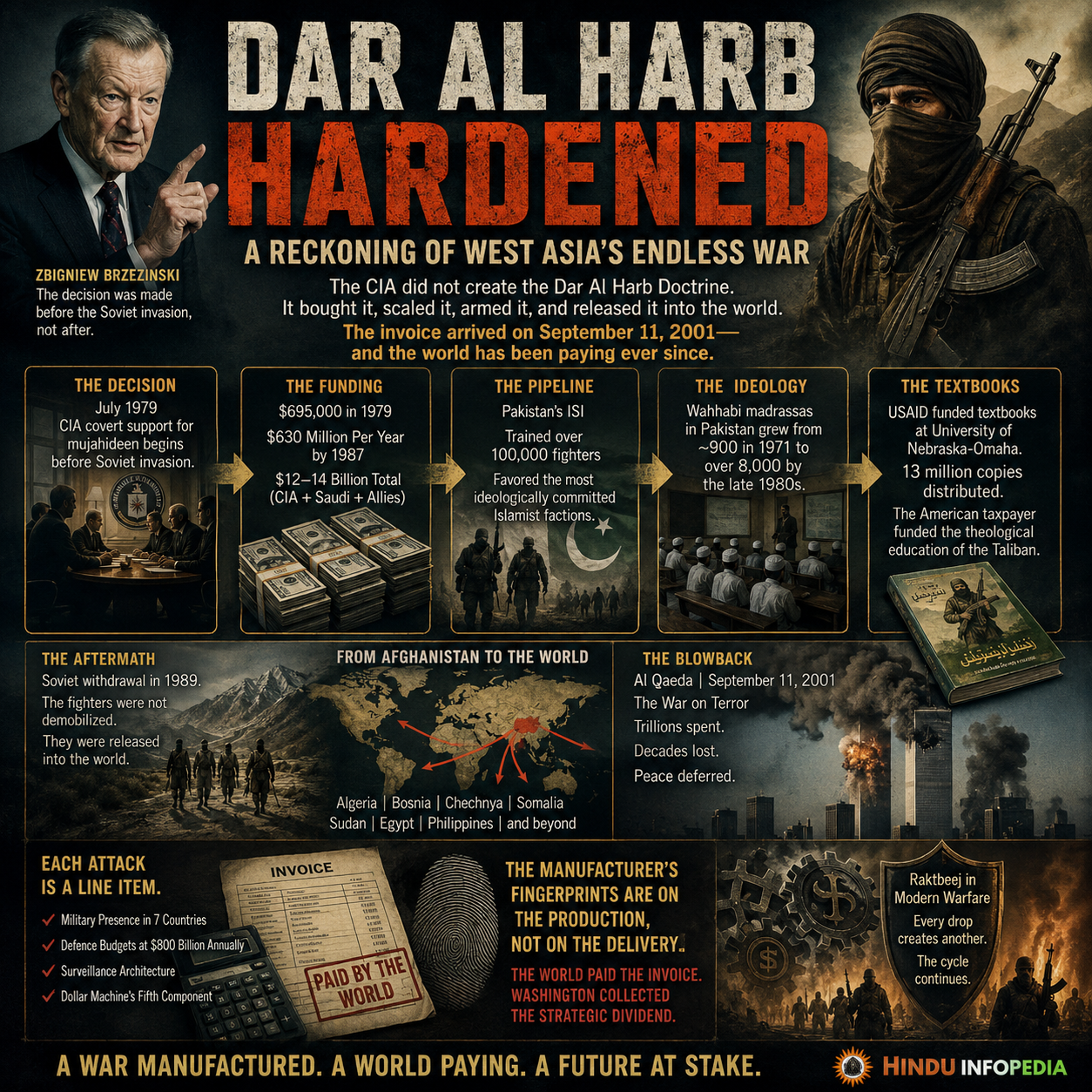
Dar Al Harb Hardened: They did not invent jihadist extremism. They industrialised it. The weapon built in Peshawar in 1980 destroyed the Twin Towers in 2001. The manufacturer now wages the War on Terror against its own product. The decision was made before the Soviet invasion, not after. Zbigniew Brzezinski, National Security Advisor to President Carter, confirmed in a 1998 interview that American covert support for the mujahideen began in July 1979 — six months before the Soviet invasion of December 1979 — specifically designed to provoke a Soviet military response. Brzezinski was asked whether he regretted the operation given what it produced. His answer was precise: “What is most important to the history of the world? The Taliban or the collapse of the Soviet empire? Some stirred-up Moslems or the liberation of Central Europe?” The manufacturer knew what he was making. He considered the cost acceptable.
Operation Cyclone was the CIA’s code name for what became one of the longest and most expensive covert operations in American history. Funding began at $695,000 in 1979, grew to $20-30 million per year in 1980, and reached $630 million per year by 1987 — with Saudi Arabia matching American contributions dollar for dollar throughout the programme. The combined American, Saudi, and allied total across the decade is estimated between $12 and $14 billion. Pakistan’s ISI was the essential intermediary — controlling distribution of funds and weapons, managing the training of over 100,000 fighters, and exercising sovereign discretion over which factions received the most generous support. The ISI consistently favoured the most ideologically committed Islamist factions — of seven mujahideen groups supported, the four most fundamentalist received the bulk of funding. This was not an accident of distribution. It was a deliberate selection for theological commitment, because theologically committed fighters fight harder and longer than mercenaries. The CIA understood this. The ISI understood this. Saudi Arabia understood this. All three chose the maximalist theological fuel for the insurgency they were running.
Dar Al Harb Hardened: The Theological Infrastructure
The military funding is the most visible dimension of the Dar Al Harb Hardened argument. The theological infrastructure is the more consequential one — because it outlasted the war by three decades and is still producing its graduates.
Saudi Arabia’s financial contribution to the mujahideen was matched by its theological contribution. The same decade that saw Saudi Arabia matching CIA dollars also saw the most aggressive Saudi export of Wahhabi madrassas in Pakistani history. Human Rights Watch documented that the number of madrassas in Pakistan grew from approximately 900 in 1971 to over 8,000 by the late 1980s — an almost tenfold increase funded substantially by Saudi Arabia and Gulf donors during precisely the Operation Cyclone period. These were not schools teaching classical Hanafi Islam — the predominant Pakistani tradition, which had maintained the country’s relatively moderate religious culture for centuries. They were schools teaching the Saudi-Wahhabi-Deobandi synthesis: the maximalist Dar al-Harb interpretation, the takfir doctrine applied to secular Muslim governments, and the obligation of jihad against Soviet occupation that was easily generalisable to jihad against any non-Islamic power that is impacting Pakistan also today.
The most documented American contribution to this theological infrastructure is the one that requires no inference — it is a published record. The Washington Post documented that the United States Agency for International Development funded the production of textbooks at the University of Nebraska-Omaha specifically designed to teach Afghan children jihadist values — the books were filled with violent images and militant Islamic teaching, with illustrations showing Kalashnikov rifles, swords, and Koranic verse encouraging mujahideen to kill Soviets. Approximately 13 million copies were printed and distributed. After the Soviet withdrawal, the Taliban — the graduates of the madrassa system the same operation had funded — used these textbooks in their schools through the 1990s. The American taxpayer funded the theological education of the Taliban. The document trail exists. The Washington Post found it. It is not a conspiracy theory. It is a procurement record.
📌 The Doctrine’s Classical Foundation Before the Hardening
What the Dar Al Harb Doctrine actually says in its classical form — historically contingent, internally contested, never mandating permanent warfare — and the three observations that make the modern form unrecognisable from its classical origin.
Dar Al Harb Hardened: The Graduates and the Blowback
Operation Cyclone produced approximately 100,000 trained fighters across its decade of operation. The Soviet withdrawal in February 1989 did not demobilise them. It released them — with training, weapons experience, international networks, and a theological framework that had been specifically cultivated for its generalisability. The graduates dispersed into Algeria, Bosnia, Chechnya, Egypt, Somalia, Sudan, and the Philippines — carrying the maximalist Dar al-Harb interpretation that the decade of CIA-Saudi-ISI investment had hardened from a dormant theological potential into an operational combat doctrine. The network that connected them — the Maktab al-Khidamat, the Services Bureau, founded by Abdullah Azzam and his associate Osama bin Laden to coordinate Arab volunteer fighters in Afghanistan — became the organisational skeleton of Al-Qaeda after 1988.
The Dar Al Harb Hardened argument’s most precise formulation in the Reagan administration’s own language. President Reagan hosted mujahideen leaders at the White House and described them as the moral equivalent of America’s founding fathers. The same men Washington celebrated as founding fathers in 1985 were designated terrorist leaders by Washington’s State Department in 2001. The theological framework did not change between 1985 and 2001. The geopolitical utility did. When the Dar al-Harb maximalism served Washington’s Cold War objectives, it was celebrated. When the same graduates applied the same framework to Washington itself — as Osama bin Laden’s 1996 and 1998 fatwas against America explicitly did, invoking the same jihadist arguments that had been cultivated in Peshawar — it became the ideology that required a global war to suppress.
The Dar Al Harb Hardened blowback is the series’ most documented case of the Dagdhabeej thread at civilisational scale. Blog 35 (Manufactured Instability Reckoning) documented Washington’s pattern of manufacturing instability it then uses to justify intervention. The Dar Al Harb Hardened argument is that pattern applied to theology: Washington manufactured the jihadist interpretation of Dar al-Harb to win a Cold War, lost control of the graduates, and has been fighting the theological consequences through military intervention in Afghanistan (2001), Iraq (2003), Libya (2011), Syria (2015), and now Iran (2026) — each intervention producing conditions that further harden the doctrine among the populations it targets.
The invoice Washington handed the world in Peshawar in 1980 has been presented at multiple windows across four decades. September 11 2001 — 2,977 killed in New York, Washington, and Pennsylvania by Al-Qaeda graduates of the Afghan training network. July 7 2005 — 52 killed in London’s underground and buses by British citizens radicalised through networks whose theological lineage runs directly to the madrassa infrastructure Operation Cyclone funded. July 11 2006 — 209 killed across seven Mumbai local train carriages in simultaneous bombings by Lashkar-e-Taiba, a Pakistan-based organisation that grew from the same ISI-managed Islamist funding channels that distributed CIA money to the mujahideen. November 26-29 2008 — 166 killed across Mumbai in the 26/11 attacks by Lashkar-e-Taiba operatives trained in Pakistan, an operation whose ISI adjacency has been documented in legal proceedings across three countries. Each attack is a line item. The manufacturer’s fingerprints are on the production, not on the delivery. The world paid the invoice. Washington collected the strategic dividend — the War on Terror that justified military presence in seven countries, defence budgets that reached $800 billion annually, and the surveillance architecture that China Sanctions War (Blog 55) documented as the Dollar Machine’s fifth component.
The tree Washington planted by injecting the Wahhabi seed with $12-14 billion of Cold War investment has grown. It bears fruit. It spreads its own kind. The ancient framework that names this process most precisely is not a modern strategic concept. The Raktbeej thesis — documented on hinduinfopedia.com — names the demon whose every drop of blood produces a new demon: each decapitation creates more heads, each military intervention produces more fighters than it kills, each drone strike generates three recruits. The Raktbeej and Starfish thesis extends the framework: the organism has no centre to decapitate, no hierarchy to dismantle, no headquarters to bomb — it is a 1,400-year-old distributed network that no modern military framework can contain because every containment attempt adds blood to the floor. The 90,000 trained in Afghanistan trained others. Al-Qaeda trained ISIS. ISIS trained its affiliates. The Dar Al Harb Hardened tree is the Raktbeej demon at civilisational scale — and Washington’s Global Control War is being prosecuted against a theological infrastructure Washington built, using a military whose costs are financed by the Gulf’s petrodollar recycling into US Treasuries that Blog 49 (Gulf Petrodollar Drain) established earns zero real return. The manufacturer is fighting its own product with the victim’s money.
The most precise formulation is not that Washington manufactured extremism from nothing. Washington found a seed that, left in the ground through the natural passage of time, might have lost its potency entirely — as yearly seeds lose viability when neglected across seasons. Instead Washington created the Raktbeej condition: a self-replicating multiplication mechanism like starfish that makes the seed’s original growth rate irrelevant. The multiplication no longer needs Washington to sustain it. It is self-empowering. Washington is fighting a Raktbeej condition it created — with instruments that deepen the condition every time they are applied.
📌 The War on Terror That the Hardened Doctrine Produced
Washington’s Global Control War — named in Blog 46 — is the commercial and strategic architecture of the War on Terror. The Hormuz war is its latest theatre. The Dar Al Harb Hardened argument names its theological genealogy.
Next: Dar Al Harb Ambivalence — Blog 62 in West Asia’s Endless War examines the condemnation industry — Saudi Arabia condemning ISIS while teaching its substrate, Qatar condemning terrorism while funding the Brotherhood and bribing European parliamentarians, Pakistan condemning Al-Qaeda while the ISI maintained its operational relationships. The public condemnation of the doctrine does not reach its private maintenance. The gap between the two is not accidental. It is structural — and it is the argument. Part of the West Asia’s Endless War Series on hinduinfopedia.com.
Feature Image: Click here to view the image.
Videos
Glossary of Terms
- Dar Al Harb Hardened: A term coined in the series describing the transformation of a dormant theological doctrine into a global militant infrastructure through Cold War funding, training, and ideological expansion.
- Operation Cyclone: The CIA’s covert Afghanistan operation from nineteen seventy nine to nineteen eighty nine that funded, armed, and trained anti Soviet mujahideen groups through Pakistan’s ISI.
- Dar al Harb Doctrine: A classical Islamic jurisprudential concept historically describing territories outside Islamic political authority, presented in the series as later hardened into a militant geopolitical framework.
- Mujahideen: Islamist guerrilla fighters supported during the Soviet Afghan War by the CIA, Saudi Arabia, and Pakistan through covert military and financial networks.
- ISI: Inter Services Intelligence, Pakistan’s intelligence agency that distributed Operation Cyclone funding, weapons, and training support to Afghan militant groups.
- Wahhabi Deobandi Synthesis: A doctrinal combination of Saudi Wahhabi ideology and South Asian Deobandi teachings presented in the blog as the theological foundation of hardened jihadist networks.
- Takfir Doctrine: The practice of declaring other Muslims insufficiently Islamic or apostate, often used by extremist groups to justify violence against Muslim governments and societies.
- Maktab al Khidamat: The Services Bureau established by Abdullah Azzam and Osama bin Laden to coordinate Arab fighters in Afghanistan, later forming the organisational base of Al Qaeda.
- Blowback: The unintended long term consequences of covert geopolitical operations, particularly the spread of militant networks originally supported during the Cold War.
- War on Terror: The global military campaign launched by the United States after the September eleventh attacks, involving interventions across Afghanistan, Iraq, Libya, Syria, and other regions.
- Manufactured Instability: A recurring series concept arguing that geopolitical powers deliberately create unstable conditions later used to justify intervention, surveillance expansion, or military presence.
- Dollar Machine: A term coined in the series describing the interconnected structure of sanctions, military spending, surveillance systems, petrodollar recycling, and global financial control.
- Raktbeej Thesis: A framework derived from the Indian mythological demon Raktbeej, used in the series to explain how militant movements replicate and expand through repeated military intervention.
- Raktbeej and Starfish Thesis: A series concept describing decentralised militant networks as adaptive systems without a single command centre, making them resistant to conventional military destruction.
- Petrodollar Recycling: The process through which Gulf oil revenues are reinvested into United States Treasury systems and financial markets, linked in the series to sustaining permanent war structures.
#HinduinfoPedia #CIA #Afghanistan #ColdWar #WarOnTerror #Taliban #AlQaeda #Pakistan #Geopolitics #ISI
West Asia’s Endless War: Why This Series Exists
Refer to Various Arks Referred to in the Blog
[…] भारत / GB […]
[…] https://hinduinfopedia.com/dar-al-harb-hardened-a-reckoning-of-west-asias-endless-war-61/ […]
[…] liberal policy architecture it now fights. The series has documented Washington manufacturing the jihadist movement in Afghanistan (Blog 61). Blog 67 documents the prior and more consequential manufacture: the Islamic Republic of Iran […]