

Dar Al Harb Ambivalence: A Reckoning of West Asia’s Endless War (62)
Part 62 of the West Asia’s Endless War Series on hinduinfopedia.com
भारत / GB
Seeing a Rope and Calling It a Snake Is Fear. Seeing a Snake and Calling It a Rope Is Complicity. The Dar Al Harb Ambivalence Is the Second — Institutional, Documented, and Ongoing.
Blog 61 (Dar Al Harb Hardened) documented the manufacturing sequence — CIA, Saudi Arabia, and Pakistan ISI industrialising the Wahhabi seed into a global jihadist movement through $12-14 billion of Cold War investment, USAID textbooks, and 100,000 trained fighters whose graduates presented the invoice across four decades and four continents. Blog 62 examines what has happened since: the three primary state actors most structurally connected to the doctrine’s maximalist form publicly condemning the product while privately maintaining the infrastructure that sustains it. This blog examines Saudi Arabia and Qatar — the theological substrate’s primary funders and media platforms. Blog 63 examines Pakistan — the operational channel whose ambivalence is not a gap but a doctrine — and the universal institutional pattern that prevents the analysis from being read as a civilisational indictment.
Dar Al Harb Ambivalence: The Condemnation That Does Not Reach the Root
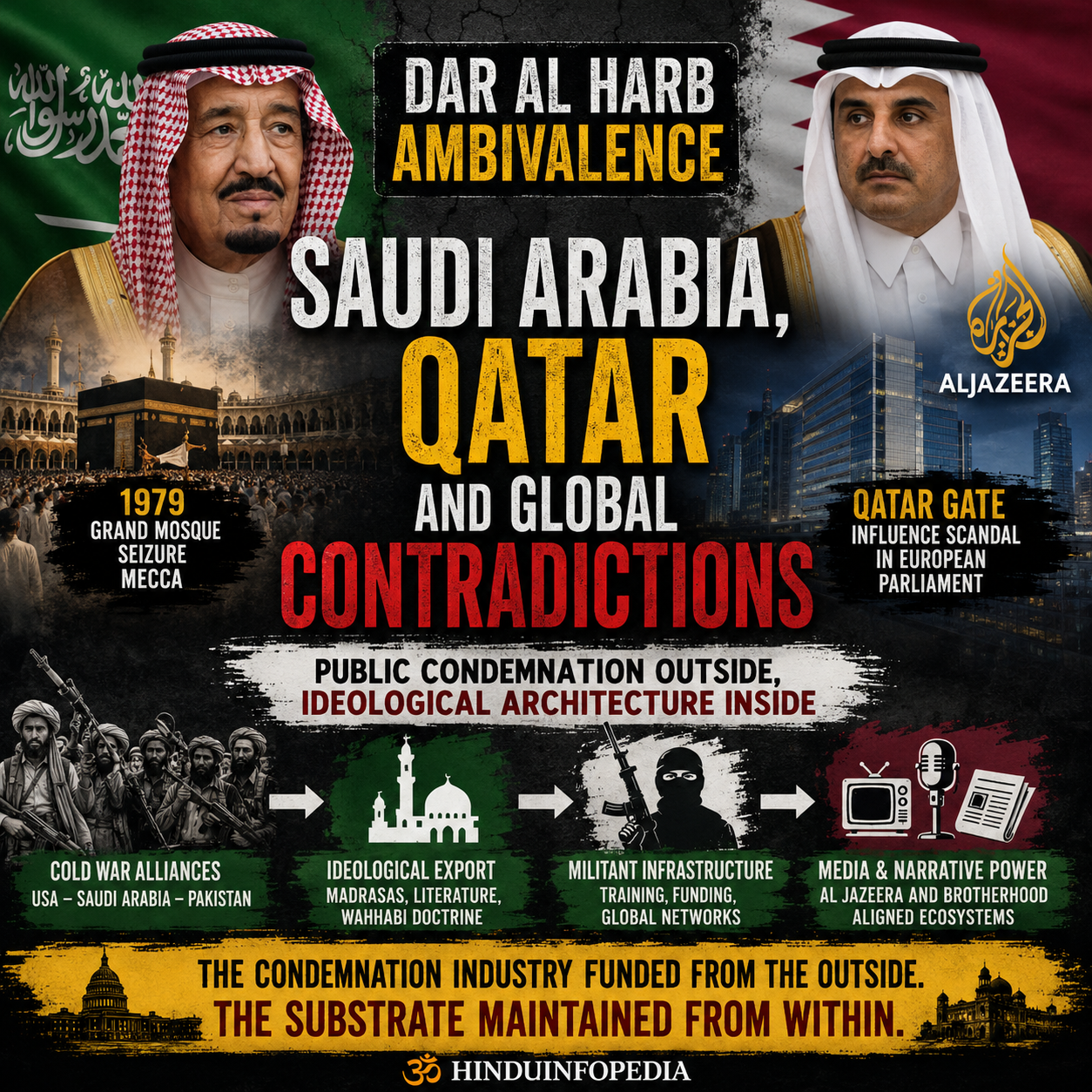
Dar Al Harb Ambivalence: Saudi Arabia condemns ISIS and teaches its theology. Qatar condemns terrorism, funds the Brotherhood, and paid European parliamentarians to prevent scrutiny. The condemnation and the substrate are the same institution. The analytical framework Blog 60 identified — seeing a snake and calling it a rope — has its most precisely documented application in two Gulf states whose international relationships require the condemnation and whose domestic political legitimacy requires the substrate simultaneously. The condemnation has been ongoing for thirty years. The substrate has been maintained for the same thirty years. The product — global jihadist terrorism — has killed thousands across dozens of countries, among Muslims and non-Muslims without distinction. The Dar al-Harb maximalism that targets non-Muslims has killed more Muslims than any other demographic — in mosque bombings in Pakistan, in market attacks in Iraq, in the Shia-Sunni sectarian violence that the maximalist doctrine specifically licenses. The gap between the condemnation and the substrate is not a communication failure. It is policy.
Dar Al Harb Ambivalence: Saudi Arabia and Qatar
Saudi Arabia — the founding contradiction.
The House of Saud’s relationship with Wahhabism is the original Dar Al Harb Ambivalence — predating Operation Cyclone, predating Al-Qaeda, predating ISIS. The 1744 compact between Muhammad ibn Abd al-Wahhab and Muhammad ibn Saud created the political architecture of modern Saudi Arabia: the Al-Saud family provides political power and military protection, the Wahhabi establishment provides religious legitimacy. The compact has survived for 280 years because both parties need each other. The Al-Saud cannot rule without the Wahhabi legitimacy. The Wahhabi establishment cannot institutionalise without the Al-Saud protection.
The tension within that compact produced the most clarifying single event of the Saudi-Wahhabi relationship’s internal contradictions: the November 1979 Grand Mosque seizure in Mecca. Juhayman al-Otaybi — himself a product of the Wahhabi religious establishment — led 400-500 militants in seizing Islam’s holiest site and declaring the House of Saud apostate and un-Islamic. The Saud monarchy could not retake the mosque using its own forces — the religious prohibition against violence in the Haram required an emergency fatwa. French special forces were converted to Islam for the duration of the operation and brought in through tunnels. The compact’s founding contradiction was exposed in real time: the Wahhabi theology that legitimises the Al-Saud also produces the jihadist critique that the Al-Saud are insufficiently Islamic. The Western military presence deployed to protect the Sauds from the theology the Sauds fund became Osama bin Laden’s primary justification for declaring war on the United States.
The theological content of Wahhabism includes the takfir doctrine — the declaration of fellow Muslims as apostates — and the obligation of jihad against un-Islamic governance. These are not peripheral elements of Wahhabi teaching. They are structural. Human Rights Watch documented that Saudi-funded madrassas across Pakistan, Indonesia, and Central Asia taught curricula that explicitly condemned secular Muslim governments as apostate and taught the obligation of jihad against them. Saudi Arabia then designated ISIS a terrorist organisation in 2014 and has condemned every ISIS attack since.
The condemnation is of ISIS’s political authority claim — its declaration of a Caliphate that implicitly delegitimises the Saudi monarchy — not of the theological framework ISIS uses. The RAND Corporation’s analysis of Saudi Arabia and terrorism documented that while the Saudi government has taken significant steps against Al-Qaeda since 2003, the kingdom’s religious establishment continues to produce and distribute literature containing intolerant and sometimes violent content. The Saudi Arabian state simultaneously uses American military forces to contain the domestic Wahhabi threat — the same presence that bin Laden’s fatwa cited as its primary justification — while funding the Wahhabi theological infrastructure abroad through madrassa networks, religious publishing, and mosque construction. The architecture is precise: the domestic threat from Wahhabi forces that regard the monarchy as apostate is contained by external military power. The international Wahhabi projection that creates strategic depth and religious legitimacy for Saudi Arabia’s regional leadership is maintained by petrodollar surplus. Washington provides the first. Saudi Arabia’s Treasury — earning zero real return in US Treasuries as Blog 49 documented — provides the second. The manufacturer of the ideological infrastructure and the security guarantor against its blowback are the same state.
📌 How the Seed Was Forced Into the Tree
$695,000 in 1979. $630 million per year by 1987. The CIA, Saudi Arabia, and Pakistan ISI industrialised the Wahhabi seed. The manufacturing sequence that made the Dar Al Harb Ambivalence’s Saudi dimension possible.
Qatar — the condemnation industry’s most documented case.
Qatar is the Dar Al Harb Ambivalence’s most precisely documented actor because Qatar-gate converted the ambivalence from a pattern of inference into a court record. Qatar publicly condemns terrorism in every multilateral forum. Qatar simultaneously funds the Muslim Brotherhood — the primary vehicle for democratising political Islam across the Arab world — through Al Jazeera and documented financial channels spanning Morocco to Indonesia.
The BBC documented Qatar’s financial support for the Brotherhood — describing how Qatar became the Brotherhood’s primary state patron after the 2013 Egyptian military coup expelled Brotherhood leadership, with Qatar providing asylum, financial support, and Al Jazeera’s Arabic platform to Brotherhood-aligned commentators and organisations across the region. Al Jazeera’s Arabic service — distinct from its English service, which maintains journalistic standards recognisable to Western audiences — has functioned as the Brotherhood’s primary media legitimisation apparatus. The distinction between the two Al Jazeeras is itself a form of Dar Al Harb Ambivalence: one face presented to the Western world that funds and hosts Qatar’s military bases, a different face presented to the Arabic-speaking audiences whose political mobilisation the Brotherhood requires. The pattern has appeared repeatedly across the series. Blog 26 on Qatar’s mediator role, Blog 38 on the EU mediator vacuum, the France intelligence reporting on Muslim Brotherhood influence, and the Palestine voting-pattern analysis together documented the same dual-track structure: international moderation externally, ideological amplification selectively, and narrative management continuously.
The ambivalence reached its most documented expression in the European Parliament. Belgian police arrested European Parliament Vice-President Eva Kaili in December 2022, recovering €150,000 in cash from her father’s luggage traced to Qatari influence operations. Italian MEP Antonio Panzeri subsequently provided a full confession implicating multiple MEPs and parliamentary staffers in a systematic Qatari lobbying operation designed to soften EU criticism of Qatar’s labour practices and political Islam promotion. Qatar was paying European parliamentarians to prevent institutional scrutiny of the precise activities that European counterterrorism frameworks are designed to monitor. The condemnation industry funded from the outside. The substrate maintained from within. The gap between them managed through the cash that Belgian police found in a suitcase.
The Dar Al Harb Ambivalence’s Saudi-Qatar dimension closes with the observation that connects it to the series’ financial architecture. The Dollar’s Gulf Mint (Blog 50) established that Saudi Arabia’s petrodollar surplus — earning zero real return after fifty years — finances the American military that guards the Saud monarchy from the Wahhabi forces the same surplus funds abroad. Qatar’s American military base — Al Udeid, the largest US airbase in the Middle East — protects the same state whose Al Jazeera Arabic service provides the Brotherhood’s primary media legitimisation. The condemnation and the substrate are not in tension. They are in equilibrium — each sustaining the other through the security and financial relationships that make both simultaneously necessary.
📌 The Classical Doctrine Beneath the Ambivalence
What Dar al-Harb actually says in its classical form — and why the three observations that Blogs 62, 63, and 64 examine are necessary before the doctrine can be understood as it operates today.
Next: Dar Al Harb Ambivalence — Pakistan — Blog 63 in West Asia’s Endless War examines the third actor whose ambivalence is not a gap between public condemnation and private maintenance but a bifurcated state architecture in which two parallel policies operate simultaneously as official strategy. FATF grey-listed, geopolitically rescued, Pahalgam 2025 — and still outside the grey list. Then the universal closing argument: the pattern documented across Saudi Arabia, Qatar, and Pakistan is not Islamic. It is institutional — and its mirrors in the Western world are exact. Part of the West Asia’s Endless War Series on hinduinfopedia.com.
Feature Image: Click here to view the image.
Videos
Glossary of Terms
- Dar Al Harb Ambivalence: A term coined in this series describing the contradiction where states publicly condemn extremism while preserving ideological, financial, media, or institutional structures linked to its continuation.
- Wahhabism: A strict Sunni Islamic reform movement founded in eighteenth century Arabia by Muhammad ibn Abd al Wahhab, historically connected with the Saudi state and frequently discussed in debates on religious extremism.
- Takfir Doctrine: The practice of declaring other Muslims apostates or non believers, often used by extremist groups to justify violence against fellow Muslims and governments.
- Grand Mosque Seizure: The nineteen seventy nine armed takeover of Islam’s holiest mosque in Mecca by Juhayman al Otaybi and his followers challenging the Saudi monarchy’s legitimacy.
- Operation Cyclone: The covert American program during the Cold War that funded and armed anti Soviet fighters in Afghanistan with support from Saudi Arabia and Pakistan.
- Muslim Brotherhood: A transnational Islamist political movement founded in Egypt in nineteen twenty eight advocating governance based on Islamic principles through political and social mobilisation.
- Al Jazeera Arabic: The Arabic language division of Qatar based Al Jazeera media network, often discussed for its influence on political narratives across West Asia.
- Qatar Gate Scandal: A corruption investigation involving alleged Qatari influence operations targeting members of the European Parliament through money and lobbying networks.
- Petrodollar System: The global financial arrangement in which oil sales are largely conducted in American dollars, strengthening strategic ties between Gulf states and the United States.
- Madrassa Networks: Religious educational institutions that, in the context of this series, are discussed as channels for ideological dissemination funded across multiple countries.
- Blowback: A geopolitical term referring to unintended consequences of covert or strategic operations that later harm the sponsoring powers themselves.
- Cold War Jihad Infrastructure: A phrase used in this series to describe the military, ideological, financial, and recruitment systems created during the Soviet Afghanistan conflict.
- Al Udeid Air Base: The largest American military air base in West Asia located in Qatar, symbolising the strategic alliance between Washington and Doha.
- Brotherhood Influence Ecosystem: A phrase used in this series describing media, social, political, and advocacy structures connected with Muslim Brotherhood aligned narratives and organisations.
- Condemnation Industry: A phrase coined in this series referring to the international political, diplomatic, media, and counterterrorism structures that publicly denounce extremism while avoiding deeper institutional causes.
#SaudiArabia #Qatar #Wahhabism #PoliticalIslam #MiddleEast #Geopolitics #ISIS #AlJazeera #ColdWar #HinduinfoPedia
West Asia’s Endless War: Why This Series Exists
Refer to Various Arks Referred to in the Blog
Dar Al Harb Ambivalence: A Reckoning of West Asia’s Endless War (62)
[…] https://hinduinfopedia.com/dar-al-harb-ambivalence-a-reckoning-of-west-asias-endless-war-62/ […]
[…] Blog 62 (Dar Al Harb Ambivalence) examined Saudi Arabia and Qatar — the theological substrate’s primary funders and the condemnation industry’s precisely documented cases in the Gulf. Blog 63 examines Pakistan — the third actor in the ambivalence, and qualitatively different from the first two. Saudi Arabia maintains a gap between its public condemnation and its private theological funding. Qatar maintains a gap between its diplomatic statements and its financial channels. Pakistan maintains no gap — it operates two parallel policies simultaneously as official state strategy, one for international consumption and one for operational deployment. Blog 63 then closes the three-blog ambivalence arc with the universal argument: the pattern is not Islamic. It is institutional. And its mirrors in the Western world are exact. […]
[…] ब्लॉग 62 (दार अल हरब द्वैधता) ने सऊदी अरब और क़तर का अध्ययन किया था। दोनों देशों को वैचारिक आधार के प्रमुख वित्तपोषक और निंदा उद्योग के स्पष्ट उदाहरणों के रूप में प्रस्तुत किया गया था। ब्लॉग 63 पाकिस्तानी दार अल हरब द्वैधता की समीक्षा करता है। यह इस द्वैधता का तीसरा पक्ष है और पहले दोनों से भिन्न है। सऊदी अरब सार्वजनिक निंदा और निजी वैचारिक वित्तपोषण के बीच अंतर बनाए रखता है। क़तर कूटनीतिक कथनों और वित्तीय माध्यमों के बीच अंतर बनाए रखता है। पाकिस्तान कोई अंतर नहीं रखता। वह दो समानांतर नीतियों को एक साथ आधिकारिक राज्य रणनीति के रूप में संचालित करता है। एक नीति अंतरराष्ट्रीय प्रस्तुति के लिए है। दूसरी परिचालन उपयोग के लिए है। ब्लॉग 63 इस तीन-भागीय द्वैधता क्रम को एक व्यापक तर्क के साथ समाप्त करता है: यह स्वरूप केवल इस्लामी नहीं है। यह संस्थागत है। और पश्चिमी विश्व में इसके समान उदाहरण भी स्पष्ट दिखाई देते हैं। […]
[…] ब्लॉग 62 (Dar Al Harb Ambivalence) ने सऊदी अरब और कतर का परीक्षण किया था। ये दोनों वैचारिक आधार के प्रमुख वित्तपोषक तथा निंदा उद्योग के सबसे स्पष्ट खाड़ी उदाहरण थे। ब्लॉग 63 (Dar Al Harb Ambivalence Pakistan) ने तीसरे पक्ष का अध्ययन किया। वहाँ दो समानांतर नीतियाँ एक साथ संचालित होती हैं। FATF अभिलेख, भू-राजनीतिक संरक्षण और पहलगाम की घटना ने इस ढाँचे की पुष्टि की। ब्लॉग 64 समकक्ष समीक्षा के तीसरे अवलोकन की तीन-भागीय समीक्षा को पूर्ण करता है। ईरान सार्वजनिक रूप से दार अल-हरब का उपयोग नहीं करता। वह जिहादी अधिकतमवादी ढाँचे को औपचारिक रूप से नहीं चलाता। वह अलग संवैधानिक संरचना का उपयोग करता है। यह शृंखला ईरान को निरंतर एक सभ्यतागत राष्ट्र के रूप में देखती रही है। ब्लॉग 21 (Persian Civilisation War) ने इसे स्थापित किया था। ब्लॉग 64 यह परीक्षण करता है कि उस सभ्यतागत राष्ट्र का संस्थापक दस्तावेज वास्तव में किस दायित्व को स्थापित करता है। यह भी स्पष्ट करता है कि इस्लामी गणराज्य का संचालन सिद्धांत दार अल-हरब नहीं है। ब्लॉग 65 में यह वैचारिक क्रम होरमुज युद्ध की वर्तमान स्थिति से पुनः जोड़ा जाएगा। […]
[…] मस्जिद घटना के बाद स्पष्ट हुई थी। ब्लॉग 62 (दार अल हरब द्वैधता) ने दिखाया था कि सऊदी अरब घरेलू वहाबी […]
[…] पढ़ें: दार अल हरब की द्विविधा → […]