

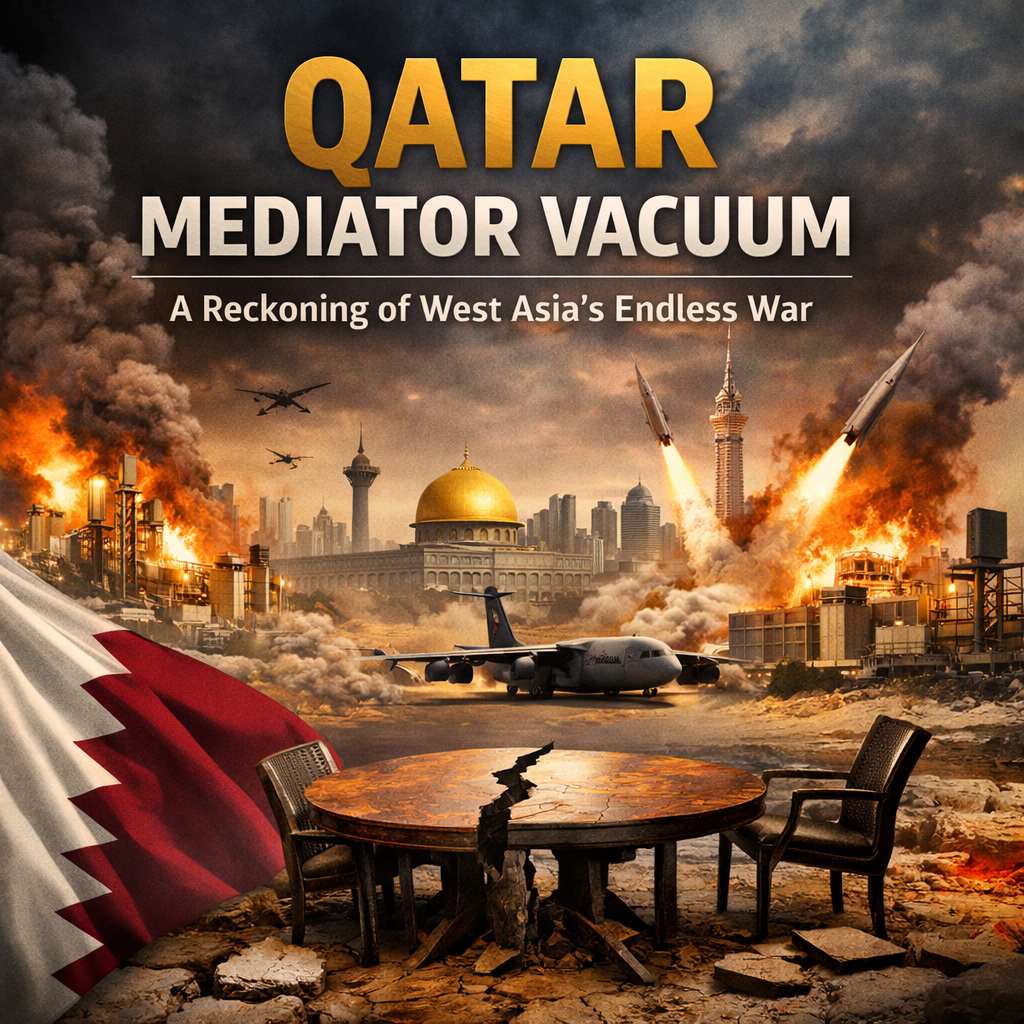
Qatar Mediator Vacuum: West Asia’s Endless War Reckoning (26)
Part 26 of the West Asia’s Endless War Series
भारत / GB
How the War Destroyed the One State Capable of Building an Off-Ramp
Qatar Mediator Vacuum: Impact Analysis
Blog 25 established why Iran will not blink — the calculus of nothing left to lose, the political clock mismatch, the chess game removing Washington’s own institutional pieces. This blog examines the diplomatic consequence of that sustained refusal: a war that has now exhausted its primary off-ramp architecture. The Qatar Mediator Vacuum is not a side effect of this conflict. It is one of its most consequential structural outcomes.
Qatar Mediator Vacuum: What Qatar Was
Qatar Mediator Vacuum: The indispensable broker struck by both sides — and why the war now has no credible off-ramp. To understand the Qatar Mediator Vacuum, it is necessary to understand what Qatar had built across two decades of methodical diplomatic positioning. Qatar is a state of approximately 300,000 citizens sitting on the world’s third-largest proven natural gas reserves. It cannot project military power. It cannot achieve geopolitical relevance through size or population. What it built instead was indispensability — the specific architecture of being useful to all parties simultaneously, which gave a small state outsized diplomatic leverage in a region of large and hostile powers.
The architecture had four pillars. Qatar hosts Al Udeid Air Base — the largest American military installation in the Middle East, housing approximately 10,000 US personnel and the forward headquarters of US Central Command. It simultaneously maintained functional commercial and diplomatic relations with Iran, sharing the world’s largest gas field across their common maritime boundary. It hosted Hamas’s political bureau in Doha — the only internationally accessible address through which Western governments could reach Gaza’s political leadership without formal recognition. And it had accumulated sufficient sovereign wealth and diplomatic credibility to be accepted as a trusted channel by Washington, Tehran, and the Gulf simultaneously. Qatar mediated the 2023 US-Iran prisoner exchange and the unfreezing of $6 billion in Iranian funds. It hosted Taliban negotiations. It provided the back-channel through which every escalation cycle between Washington and Tehran over the preceding decade was managed short of open war.
This was not neutrality in the principled sense. It was transactional positioning — Qatar selling access and credibility to all sides and calling it diplomacy. Every party accepted Qatar’s role not because they trusted its impartiality but because they found its access indispensable. That distinction matters now, because it explains exactly how the Qatar Mediator Vacuum was created.
Struck From Both Sides
The Qatar Mediator Vacuum was not created by one event. It was created by the same conflict striking Qatar from both directions within the same three-week window, destroying the structural position that made mediation possible.
On 18 March, Israel struck Iran’s South Pars gasfield — the world’s largest natural gas reserve, shared geologically with Qatar’s North Field. Qatar condemned the strike immediately, calling it a “dangerous and irresponsible step.” The condemnation was noted. Then Iran responded. Iranian missiles struck Ras Laffan Industrial City — the processing hub through which Qatar exports approximately one-fifth of global LNG supply. QatarEnergy’s CEO confirmed that 17% of Qatar’s LNG export capacity had been destroyed, with repairs expected to take three to five years and annual revenue losses of approximately $20 billion. QatarEnergy declared force majeure on long-term contracts with customers in Italy, Belgium, South Korea, and China. European gas prices surged sharply as also in Asian.
Iran struck Qatar — the state that had condemned Israel’s strike on Iran’s own gas infrastructure — because Qatar also hosts the base from which Operation Epic Fury was launched. The condemnation was heard. The base was remembered. Qatar’s position of simultaneous usefulness to all parties had reached the moment where the contradictions it contained could no longer be managed. Iran settled both accounts in one strike: the gas field and the base partner. Qatar’s Foreign Ministry condemned the Iranian attack as a “dangerous escalation, flagrant violation of state sovereignty.” Qatar reserved the right to respond in accordance with the right to self-defence. It has not done so. LNG carrier rates jumped from $42,000 on 25 February to over a quarter million dollars by 5 March.
📌 The Petrodollar Trap Underneath Qatar’s Position
How the Gulf monarchies built their prosperity inside the American security architecture — and why 2026 has exposed the full cost of that arrangement.
Qatar Mediator Vacuum: The Apology and the Decline
The diplomatic response from Washington was revealing in its own way. Trump posted on Truth Social that “The United States knew nothing about this particular attack, and the country of Qatar was in no way, shape, or form, involved with it.” He described Israel as having “violently lashed out” at South Pars “out of anger.” Axios subsequently reported that Trump’s claim of no prior knowledge was inaccurate — US and Israeli officials confirmed Trump and Netanyahu had coordinated the strike. The public distancing was not an apology. It was asset protection — Washington signalling to Qatar that it values Al Udeid enough to absorb the political cost of contradicting its own ally’s account of a strike that cost Qatar $20 billion annually. Trump simultaneously warned Iran that any further attack on Qatar’s energy facilities would be met with a US strike that would “massively blow up the entirety of South Pars.” Qatar was being protected and exposed simultaneously — its LNG infrastructure destroyed, its base indispensable, its government managed rather than consulted.
Qatar’s response to all of this was to decline. According to the Wall Street Journal, Qatar formally declined the offer to lead US-Iran negotiations. The state that mediated the 2023 prisoner exchange, the Taliban settlement, and every back-channel between Washington and Tehran across a decade — formally declined to serve as the primary mediator for the most consequential conflict in the region’s modern history. The Qatar Mediator Vacuum is not an absence of willing parties. It is the specific withdrawal of the one party that had the track record, the relationships, and the structural position to make mediation credible to both sides.
Pakistan stepped into the gap. Indirect talks in Islamabad on April 6 produced a proposal for a 45-day ceasefire. Iran rejected it, calling for a permanent solution. Pakistan does not have the two-decade institutional architecture Qatar built. It does not have Qatar’s accepted relationship with Washington at the command level. It does not have Qatar’s credibility with Iran as a gas-field partner and commercial counterpart. The ceasefire proposal remain fragile and contested. The Qatar Mediator Vacuum is being felt in real time — not as a diplomatic inconvenience but as the absence of the structural capacity to construct an off-ramp at the moment one is most needed.
A War Without Exit Architecture
The Qatar Mediator Vacuum connects directly to the argument Blog 25 left open. Why Iran Will Not Blink established that Iran has no rational incentive to accept Washington’s terms. The Qatar Mediator Vacuum establishes that the diplomatic architecture capable of constructing terms Iran might accept has been physically destroyed and institutionally withdrawn. The chess game Blog 25 described is now being played without the one neutral space where the pieces could be examined by both sides.
Iran has presented five conditions for ending the war — including permanent cessation of hostilities, compensation for damage, and international recognition of Iranian sovereignty over the Strait of Hormuz. Washington has presented a 15-point proposal that Iran described as maximalist. The gap between these positions is not bridgeable through Pakistan’s mediation alone. It required the specific trust architecture Qatar had assembled — the simultaneous credibility with both sides that took two decades to build and was destroyed in three weeks. The UN institutional framework that should provide this function has long been diminished to a burden on the global community — where no effective decision-making happens, with no enforcement capacity and no meaningful compliance. The Qatar Mediator Vacuum is the diplomatic face of the same structural conclusion the series has been reaching from multiple directions: this war has no clean ending, and the architecture capable of constructing one has been removed.
📌 The Institutional Paralysis That Preceded This Vacuum
How the UN framework failed to prevent the war that has now destroyed the region’s primary diplomatic architecture.
Next: EU Mediator Vacuum — Blog 27 in West Asia’s Endless War examines Europe’s attempt to step into the diplomatic space Qatar has vacated — a continent that imports 12-14% of its LNG from Qatar through the strait, faces a gas crisis it cannot independently resolve, and is being asked to lead mediation by the same Washington that launched the war without consulting it.
Feature Image: Click here to view the image.
Videos
Glossary of Terms
- Al Udeid Air Base: The largest United States military installation in West Asia, located in Qatar, serving as a forward headquarters for US Central Command.
- South Pars Gas Field: The world’s largest natural gas reserve located in Iran, geologically shared with Qatar’s North Field.
- North Field: Qatar’s section of the shared gas reservoir with Iran, forming the backbone of its LNG exports.
- Ras Laffan Industrial City: Qatar’s primary LNG processing and export hub, critical to global energy supply.
- LNG (Liquefied Natural Gas): Natural gas cooled into liquid form for easier storage and transportation across long distances.
- QatarEnergy: Qatar’s state-owned energy company responsible for gas production and global LNG operations.
- Force Majeure: A contractual clause allowing suspension of obligations due to extraordinary events beyond control.
- Operation Epic Fury: A military operation referenced as being launched from bases in Qatar during the conflict.
- Strait of Hormuz: A strategically vital maritime passage through which a significant portion of global oil and gas supplies transit.
- Back-channel Diplomacy: Informal and confidential communication between parties to manage conflicts outside official negotiations.
- Mediator State: A country that facilitates negotiations between conflicting parties without being a direct combatant.
- Ceasefire Proposal: A temporary agreement between conflicting sides to halt hostilities for negotiation or de-escalation.
- Sovereign Wealth: State-owned financial assets used to influence economic and diplomatic engagements globally.
#Qatar #Iran #Israel #Geopolitics #War #Energy #LNG #Diplomacy #MiddleEast #HinduinfoPedia
[…] भारत / GB […]
[…] https://hinduinfopedia.com/qatar-mediator-vacuum-west-asias-endless-war-reckoning-26/ and https://hinduinfopedia.in/?p=26174 […]
[…] Qatar Mediator Vacuum: A Reckoning of West Asia’s Endless War (26) https://hinduinfopedia.com/qatar-mediator-vacuum-west-asias-endless-war-reckoning-26/ […]
[…] का स्थायी प्रश्न चिन्ह लगा दिया। ब्लॉग 26 ने कतर की भूमिका दर्ज की। कतर एक ऐसा राज्य है जिसने पश्चिमी […]
[…] left a permanent question mark over European institutional independence from Gulf state influence. Blog 26 documented Qatar’s role as a state that had systematically purchased diplomatic influence across Western institutions. […]
[…] Read […]
[…] mobilisation the Brotherhood requires. The pattern has appeared repeatedly across the series. Blog 26 on Qatar’s mediator role, Blog 38 on the EU mediator vacuum, the France intelligence reporting on Muslim Brotherhood […]
[…] श्रृंखला में बार-बार दिखाई दिया है। कतर की मध्यस्थ भूमिका पर ब्लॉग 26, यूरोपीय संघ मध्यस्थ शून्यता पर ब्लॉग […]