

Petrodollar Betrayal And West-Asia War: A Historical Reckoning (18)
Part 18 of the West Asia’s Endless War Series
भारत / GB
The Deal That Turned Oil Into Dollar Hegemony — and the Gulf States Who Are Now Paying the Price
Petrodollar Betrayal And West-Asia War: The History
Blogs 16 and 17 established the Colonial Order of Endless War — the century of external map-drawing and resource extraction — and the New Colonial Enforcement toolkit that replaced territorial occupation. Blog 18 reaches the economic architecture underneath both — fundamentally monetary in nature — centred on the 1974 petrodollar agreement that converted American dollar dominance into a structurally enforced global norm, and the existential dilemma it has now created for the Gulf states who built their prosperity inside it. Petrodollar Betrayal And West-Asia War have mutually nourished each other to reach this point, while silently confronting those who do not conform to the diktat of the West.
Petrodollar Betrayal And West-Asia War: The 1974 Agreement Nobody Teaches
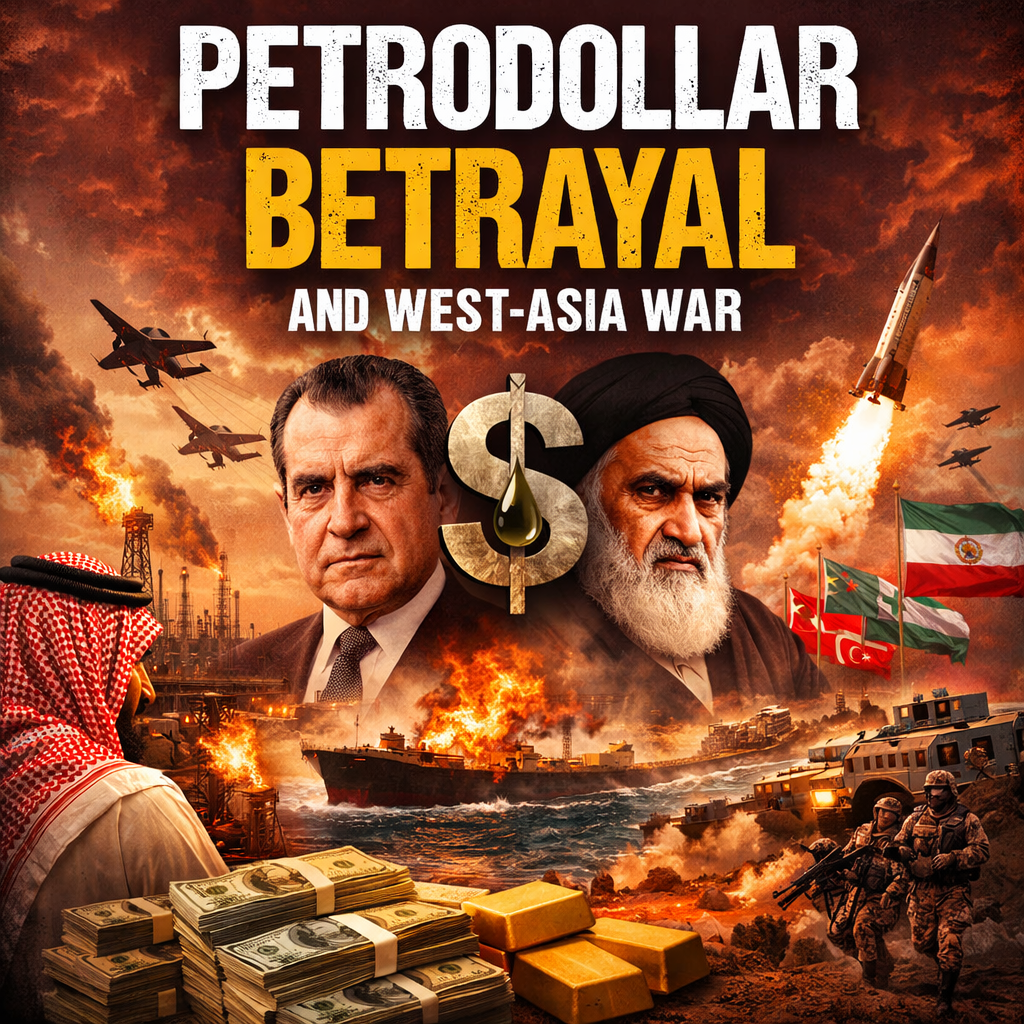
Petrodollar Betrayal And West-Asia War: The 1974 deal that made dollar hegemony structural — and why Iran breaking it had to be answered with bombs. In 1971, President Nixon unilaterally ended the Bretton Woods system by decoupling the US dollar from gold. The dollar lost its external anchor overnight. What replaced it — the mechanism that preserved dollar hegemony in a world where the dollar was no longer backed by a fixed commodity — was negotiated quietly in Riyadh in 1974 by Secretary of State Henry Kissinger and Treasury Secretary William Simon with the Saudi government. The agreement had two components: Saudi Arabia and OPEC would price all oil sales exclusively in US dollars, and the surplus petrodollars earned by Saudi Arabia would be recycled into US Treasury bonds and American financial instruments. In exchange, Washington guaranteed Saudi security and provided military hardware.
The choice of Saudi Arabia as the anchor of this system was not incidental. It reflected a deeper convergence of needs. The Saudi monarchy required a durable external guarantor to ensure regime survival in a volatile region, while the United States required a producer capable of long-term policy alignment. This alignment extended beyond oil pricing into financial and security domains, creating a mutually reinforcing structure. Saudi Arabia’s centralized political system and capacity to sustain market stability made it uniquely suited for this role. The security guarantee, as subsequent developments demonstrated, also reinforced internal regime stability by strengthening the state’s ability to manage domestic challenges. The system, in effect, was built not merely on production, but on predictability—something not all allies could equally provide.
A largely undisclosed bilateral arrangement with Saudi Arabia allowed the United States to anchor global oil trade to the dollar, extending its monetary influence across the international energy system. As other producers followed the Saudi precedent, the framework expanded beyond a single agreement into a global norm. At the same time, states that emphasised sovereign control over pricing and resource policy—most notably Iran—remained structurally misaligned with this emerging order, creating a latent tension that would sharpen in the decades that followed.
The consequences of this agreement for the global monetary architecture were immediate and permanent. Every country on earth that needed to import oil — which meant every country on earth — needed to hold dollars to do so. Central banks from Tokyo to Delhi to Brasília were forced to maintain dollar reserves not because they chose to but because the alternative was an inability to purchase the energy their economies required. The dollar, unmoored from gold, was re-anchored to oil. American monetary dominance, which had been a postwar settlement, became a structurally enforced global norm — maintained not by American productivity or American gold reserves but by the physical necessity of oil and the political decision to price it in one currency exclusively.
Why Iran Had to Be Stopped
Iran’s challenge to the petrodollar system was not ideological posturing. In systems built on enforced norms, sustained structural deviation inevitably invites coercive response. It was a series of concrete operational decisions taken over two decades that incrementally reduced the dollar’s role in Iranian energy trade. Following the 2012 sanctions that excluded Iran from SWIFT, Tehran began settling oil transactions in euros, yuan, rupees, and barter arrangements. The 2015 JCPOA negotiations briefly re-engaged Iran with the dollar system — before Trump’s 2018 withdrawal returned Iran to non-dollar settlement as the only viable option. By 2024, Iran was conducting the majority of its oil trade outside the dollar system entirely, with China as its primary buyer settling in yuan through intermediary arrangements that bypassed both SWIFT and American secondary sanctions.
This was not a rounding error in global oil markets. Iran produces approximately 3-4 million barrels per day. Every barrel settled outside the dollar system is a barrel that does not require a buyer to hold dollar reserves. Multiplied across the volume and extended to the precedent it sets for other producers considering similar arrangements, the Iranian model represented a direct structural challenge to the petrodollar architecture. Russia had moved in the same direction following 2022 sanctions. Venezuela had explored non-dollar settlement for years. China had launched the petroyuan — a yuan-denominated oil futures contract on the Shanghai International Energy Exchange — in 2018. The petrodollar system was under coordinated pressure from multiple directions simultaneously. Iran was the most advanced, most documented, and most operationally complete example of what non-dollar oil settlement looked like at scale. The Global South was watching to see whether it worked. The February 2026 strikes signalled how such challenges would be treated.
📌 The Economic Architecture of the War
The petrodollar system is the economic foundation that the oil motive and the enforcement toolkit are both designed to protect.
Petrodollar Betrayal And West-Asia War: The Gulf Monarchies’ Existential Dilemma
The 1974 agreement gave the Gulf monarchies prosperity, security guarantees, and integration into the American financial architecture. It also locked them into a position of structural dependency from which the 2026 war has now exposed the full cost.
The Petrodollar Betrayal of the blog title cuts in two directions simultaneously — Iran’s betrayal of the dollar system, and Washington’s betrayal of the Gulf states who built their entire political economy inside that system.
Saudi Arabia, the UAE, Qatar, Kuwait, and Bahrain host American military bases. Their sovereign wealth funds hold significant assets in dollar-denominated instruments. Their oil revenues, priced in dollars, flow through American-aligned financial infrastructure. Their security from external threats — including the Iranian threat — has been guaranteed by American military presence for fifty years. This security architecture has also had an internal dimension: by reinforcing regime stability and deterrence capacity, it has strengthened the ability of Gulf monarchies to manage domestic challenges during periods of stress. This is the full architecture of the petrodollar deal as it landed in the Gulf: oil priced in dollars, surplus recycled into American instruments, security provided in return.
The 2026 war has broken this architecture from within. Washington launched strikes on Iran from bases on Gulf soil, reportedly, without consulting the host governments about the consequences. The Hormuz closure that followed cut approximately 70% of GCC crude export capacity — the very energy revenue the petrodollar system was designed to protect and recycle. Qatar faces a projected 14% GDP contraction. Kuwait faces the same. The Petrodollar Betrayal that the Gulf monarchies are now calculating is not abstract: the security guarantor used their territory to start a war whose economic consequences are falling on them, not on Washington. The United States, as a net energy exporter since 2019, does not need Hormuz open. The Gulf states need it open to survive economically. The asymmetry is total.
The De-Dollarisation Acceleration
The 2026 war has done more to accelerate de-dollarisation than any preceding event. The lesson drawn by central banks from Beijing to Brasília is direct: dollar-denominated reserves are an instrument Washington can weaponise, dollar-priced oil is a dependency Washington can exploit, and the security guarantees that come with the petrodollar arrangement can be activated to start wars whose costs fall entirely on the guarantee recipients. The de-dollarisation impulse documented in Blog 9 of this series — described there as strategic risk management — has hardened into urgent policy priority across the Global South.
For the Gulf monarchies themselves, the dilemma is existential in the precise sense. Remaining inside the petrodollar architecture means continued dependency on a guarantor that has demonstrated it will use Gulf territory and disrupt Gulf revenues in pursuit of its own strategic objectives. Moving outside the petrodollar architecture means confronting the security vacuum that American withdrawal would create — in a neighbourhood that includes a wounded but surviving Iran, an expansionist Turkey, and the residual proxy networks that decades of regional intervention have left behind. Even more importantly, the risk of internal unrest rooted in ideological tensions within the Wahhabi framework cannot be entirely discounted. The Gulf states did not choose this dilemma. The 1974 agreement that built their prosperity also built the trap that the 2026 war has now sprung.
📌 The Chokehold That Sprung the Trap
How 71% of GCC crude exports became locked to the strait Washington has now made a war zone — and what the revenue catastrophe looks like.
Next: Why Iran Will Not Blink — Blog 19 in West Asia’s Endless War examines why Iran, stripped of conventional military capacity, facing no worse outcome from total resistance than from capitulation, and operating from a civilisational framework that treats martyrdom as strategic rather than catastrophic, has no rational incentive to end the Hormuz closure on Washington’s terms.
Feature Image: Click here to view the image.
वीडियो
Glossary of Terms
- Petrodollar Betrayal: The dual betrayal at the heart of the 2026 war — Iran’s operational dismantling of the dollar-oil pricing system through non-dollar oil settlement, and Washington’s betrayal of the Gulf monarchies who built their political economies inside the petrodollar architecture and are now absorbing the economic consequences of a war started from their soil without their consultation.
- Petrodollar System: The arrangement formalised through the 1974 Kissinger-Simon-Saudi agreement under which all OPEC oil is priced and traded exclusively in US dollars. Requires all oil-importing states to hold dollar reserves, structurally enforcing global dollar demand regardless of American economic performance. Replaced the gold standard as the anchor of American monetary dominance.
- Bretton Woods System: The post-World War II international monetary framework establishing the US dollar as the global reserve currency, convertible to gold at $35 per ounce. Ended unilaterally by President Nixon in August 1971 when he suspended gold convertibility — the “Nixon Shock.” The petrodollar system was constructed to replace Bretton Woods as the mechanism sustaining dollar hegemony.
- De-dollarisation: The strategic shift by non-Western central banks and governments away from the US dollar as primary reserve currency and trade denomination — accelerated by Washington’s use of dollar-system access as a coercive instrument. Described in Blog 9 as risk management; hardened into urgent policy priority across the Global South following the 2026 war.
- Hormuz Reckoning: The civilizational, economic, and geopolitical reckoning triggered by the Strait of Hormuz closure in the 2026 West Asia war.
- Bretton Woods System: A post-World War II monetary framework that linked global currencies to the US dollar, which was convertible to gold until 1971.
- Nixon Shock: The 1971 decision by President Richard Nixon to end the dollar’s convertibility into gold, reshaping the global monetary system.
- OPEC (Organization of the Petroleum Exporting Countries): A group of major oil-producing countries that coordinate production policies to influence global oil prices.
- Petrodollar Recycling: The process by which oil-exporting countries invest their dollar earnings into US financial assets like Treasury bonds.
- SWIFT System: An international financial messaging network used by banks to facilitate secure cross-border transactions.
- JCPOA (Joint Comprehensive Plan of Action): The 2015 nuclear agreement between Iran and major world powers that temporarily eased sanctions.
- Petroyuan: A yuan-denominated oil trading mechanism introduced by China to challenge dollar dominance in energy markets.
- Strait of Hormuz: A strategic waterway through which a significant portion of the world’s oil supply passes, making it critical to global energy security.
- GCC (Gulf Cooperation Council): A regional alliance of Gulf countries including Saudi Arabia, UAE, Qatar, Kuwait, Bahrain, and Oman.
- Sanctions Regime: Economic and financial restrictions imposed by countries to influence or restrict another nation’s behavior.
- Sovereign Wealth Funds: State-owned investment funds that manage national revenues, often derived from natural resources like oil.
- Dollar Reserves: Holdings of US dollars by central banks to facilitate international trade and stabilize national currencies.
- Energy Trade Settlement: The method and currency used by countries to pay for oil and gas in international markets.
#HormuzReckoning #PetrodollarBetrayal #IranWar2026 #WestAsiaEndlessWar #Petrodollar #Dedollarisation #GulfMonarchies #DollarHegemony #GlobalSouthWarNarrative #NewColonialEnforcement #ColonialOrderEndlessWar #HinduinfopediaGeopolitics #Sarvananda
Previous Blog
- https://hinduinfopedia.com/war-zone-in-hormuz-a-reckoning/
and https://hinduinfopedia.in/?p=25537 - https://hinduinfopedia.com/hormuz-world-war-ladder-a-reckoning-of-west-asias-endless-war-2/
and https://hinduinfopedia.in/?p=25545 - https://hinduinfopedia.com/west-asia-war-ethics-a-reckoning-of-west-asias-endless-war-3/
and https://hinduinfopedia.in/?p=25550 - https://hinduinfopedia.com/west-asia-war-economics-a-reckoning-of-west-asias-endless-war-4/
and https://hinduinfopedia.in/?p=25557 - https://hinduinfopedia.com/nuclear-pretext-of-west-asia-war-a-reckoning-of-west-asias-endless-war-5/
and https://hinduinfopedia.in/?p=25588 - https://hinduinfopedia.com/nuclear-hypocrisy-of-usa-a-reckoning-of-west-asias-endless-war-6/
and https://hinduinfopedia.in/?p=25593 - https://hinduinfopedia.com/ummah-delusion-during-war-a-reckoning-of-west-asias-endless-war-7/
and https://hinduinfopedia.in/?p=25614 - https://hinduinfopedia.com/western-narrative-war-a-reckoning-of-west-asias-endless-war-8/
and https://hinduinfopedia.in/?p=25650 - https://hinduinfopedia.com/global-south-war-narrative-a-reckoning-of-west-asias-endless-war-9/
and https://hinduinfopedia.in/?p=25680 - https://hinduinfopedia.com/israel-survival-logic-a-reckoning-of-west-asias-endless-war-10/
and https://hinduinfopedia.in/?p=25755 - https://hinduinfopedia.com/chokehold-oil-economics-a-reckoning-of-west-asias-endless-war-11/
and https://hinduinfopedia.in/?p=25763 - https://hinduinfopedia.com/chokehold-food-security-a-reckoning-of-west-asias-endless-war-12/
and https://hinduinfopedia.in/?p=25786 - https://hinduinfopedia.com/chokehold-industrial-chain-a-reckoning-of-west-asias-endless-war-13/
and https://hinduinfopedia.in/?p=25816 - https://hinduinfopedia.com/gulf-war-responsibility-blockade-a-reckoning-of-west-asias-endless-war-14/
and https://hinduinfopedia.in/?p=25854 - https://hinduinfopedia.com/un-institutional-paralysis-a-reckoning-of-west-asias-endless-war-15/
and https://hinduinfopedia.in/?p=25885 - https://hinduinfopedia.com/colonial-order-endless-war-a-reckoning-of-west-asias-endless-war-16/
and https://hinduinfopedia.in/?p=25935 - https://hinduinfopedia.com/new-colonial-enforcement-in-war-a-reckoning-of-west-asias-endless-war-17/
and https://hinduinfopedia.in/?p=25953
Follow us:
- English YouTube: https://www.youtube.com/@Hinduofficialstation
- Hindi YouTube: https://www.youtube.com/@HinduinfopediaIn
- X: https://x.com/HinduInfopedia
- Instagram: https://www.instagram.com/hinduinfopedia/
- Facebook: https://www.facebook.com/Hinduinfopediaofficial
- Threads: https://www.threads.com/@hinduinfopedia
[…] भारत / GB […]
[…] Petrodollar Betrayal And West-Asia War: A Historical Reckoning (18) […]
[…] https://hinduinfopedia.com/petrodollar-betrayal-and-west-asia-war-a-historical-reckoning-18/ and https://hinduinfopedia.in/?p=25965 […]
[…] Petrodollar Betrayal And West-Asia War: A Historical Reckoning (18) […]
[…] https://hinduinfopedia.com/petrodollar-betrayal-and-west-asia-war-a-historical-reckoning-18/ and https://hinduinfopedia.in/?p=25965 […]
[…] Petrodollar Betrayal And West-Asia War: A Historical Reckoning (18) […]
[…] https://hinduinfopedia.com/petrodollar-betrayal-and-west-asia-war-a-historical-reckoning-18/ and https://hinduinfopedia.in/?p=25965 […]
[…] https://hinduinfopedia.com/petrodollar-betrayal-and-west-asia-war-a-historical-reckoning-18/ and https://hinduinfopedia.in/?p=25965 […]
[…] https://hinduinfopedia.com/petrodollar-betrayal-and-west-asia-war-a-historical-reckoning-18/ and https://hinduinfopedia.in/?p=25965 […]
[…] https://hinduinfopedia.com/petrodollar-betrayal-and-west-asia-war-a-historical-reckoning-18/ and https://hinduinfopedia.in/?p=25965 […]
[…] https://hinduinfopedia.com/petrodollar-betrayal-and-west-asia-war-a-historical-reckoning-18/ and https://hinduinfopedia.in/?p=25965 […]
[…] https://hinduinfopedia.com/petrodollar-betrayal-and-west-asia-war-a-historical-reckoning-18/ and https://hinduinfopedia.in/?p=25965 […]
[…] https://hinduinfopedia.com/petrodollar-betrayal-and-west-asia-war-a-historical-reckoning-18/ and https://hinduinfopedia.in/?p=25965 […]
[…] https://hinduinfopedia.com/petrodollar-betrayal-and-west-asia-war-a-historical-reckoning-18/ and https://hinduinfopedia.in/?p=25965 […]
[…] Israel launched its largest strikes on Lebanon within hours of the ceasefire announcement — and said Lebanon was not included in the ceasefire, contradicting Pakistan’s Prime Minister who said it was. Israel’s opposition leader called it “the worst diplomatic disaster in our history.” The Gulf states have said nothing. The states that absorbed Iranian missile strikes, lost LNG capacity, hosted American bases, and watched their security architecture negotiated away in Islamabad — are silent. The Hormuz ceasefire terms were negotiated without direct input from the Gulf states. This series has previously examined shifting energy and financial dynamics in the region. […]
[…] Petrodollar Betrayal: A Reckoning of West Asia’s Endless War (18) https://hinduinfopedia.com/petrodollar-betrayal-and-west-asia-war-a-historical-reckoning-18/ […]
[…] significant dollar-denominated positions. The 1974 oil-for-security arrangement was reciprocal: Gulf states priced oil in dollars and recycled surpluses into US financial systems, and in return Washington guaranteed their external security. The Gulf Betrayal Reckoning […]
[…] priced oil exclusively in dollars and recycled surpluses into US Treasuries. The arrangement that Blog 18 of this series documented as the foundation of dollar hegemony — the 1974 Kissinger-Saudi deal […]
[…] Read: Petrodollar Betrayal → […]
[…] Read: Petrodollar Betrayal → […]
[…] Read: Petrodollar Betrayal → […]
[…] — without the bodyguard. The 1974 Kissinger-Saudi petrodollar deal that this series documented in Blog 18 is remembered as a moment of diplomatic architecture. What it actually was is more precise: a […]
[…] to seize. The Petrodollar Duress Reckoning rewrites the origin story of the arrangement that Blogs 18, 19, 32, and 34 have built […]
[…] while Washington managed the consequences of the decision that created Russia’s windfall. The petrodollar architecture that Washington built to control global energy flows produced, in its moment of maximum stress, a […]
[…] से आई जिसे वॉशिंगटन ने स्वयं लिया था। पेट्रोडॉलर व्यवस्था वॉशिंगटन ने बनाई थी। इसका उद्देश्य […]
[…] is commercially useful. The endless war produces the commercial conditions that fifty years of petrodollar architecture were designed to create: global energy demand flowing toward American supply at American […]
[…] Read […]
[…] SMDA was formed against Washington’s revealed conditionality — a rational response to the Gulf Betrayal Reckoning’s documented failure. But the alliance it has produced carries three structural contradictions […]
[…] सुरक्षा नीति के विरुद्ध हुआ। यह गल्फ विश्वासघात समीक्षा में दर्ज विफलता के बाद उत्पन्न […]
[…] समझौता, जिसका उल्लेख इस श्रृंखला ने ब्लॉग 18 में किया है, अक्सर कूटनीतिक संरचना के […]