

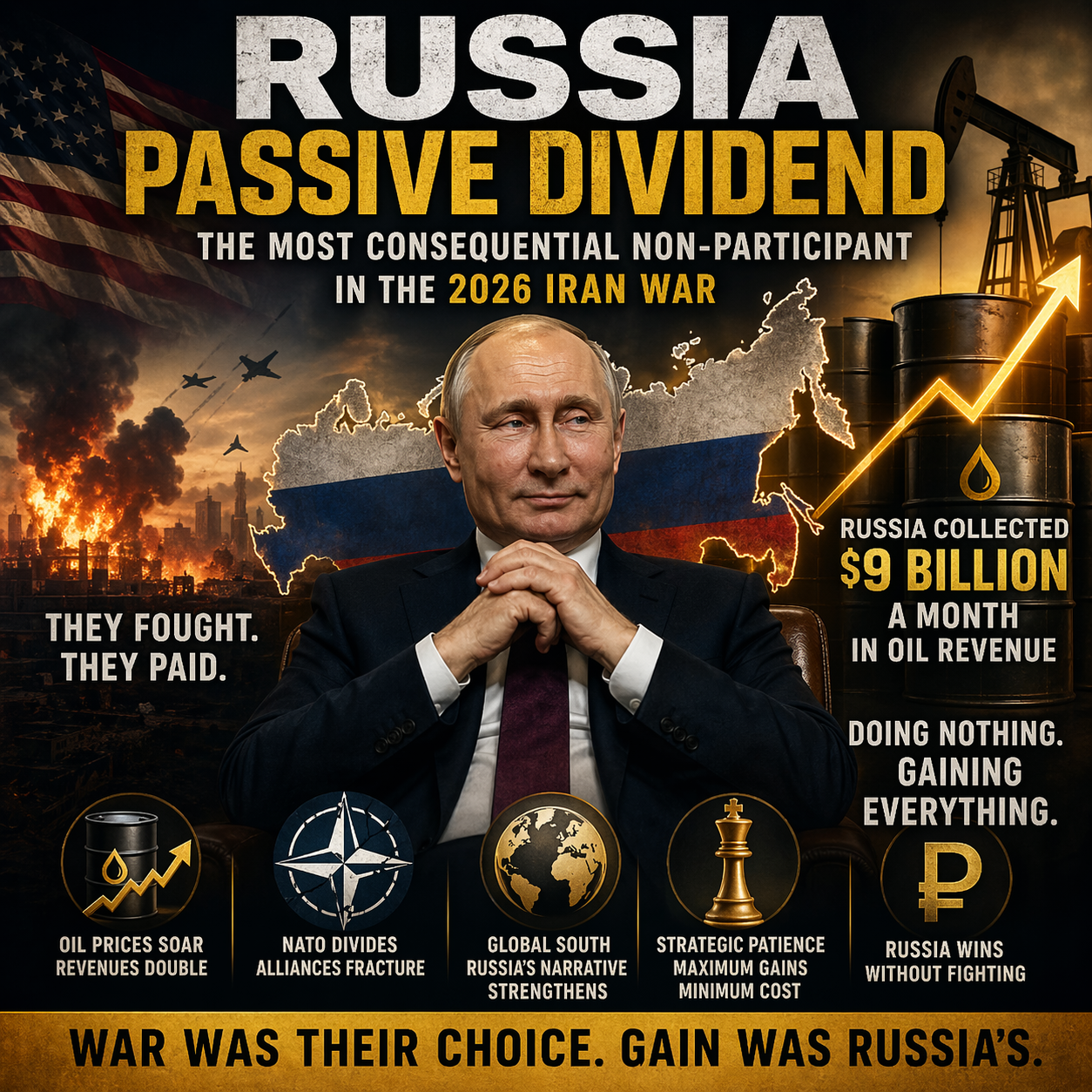
Russia Passive Dividend: A Reckoning of West Asia’s Endless War (42)
Part 42 of the West Asia’s Endless War Series on hinduinfopedia.com
भारत / GB
The Most Consequential Non-Participant in the 2026 Iran War Collected Its Gains Without Fighting
Blog 41 established the Rogue Superpower Doctrine — the Western establishment’s own analytical verdict that Washington now meets its own rogue state criteria more completely than the state it designated with that label. Blog 42 examines the most consequential non-participant in the conflict: Russia, which deployed no forces, absorbed no military cost, took no diplomatic risk, and emerged from a war it did not fight in a strategically stronger position across every theatre than when the conflict began. The Russia Passive Dividend is the series’ most precise expression of a recurring argument — every action Washington takes to enforce its order produces strategic gains for the adversaries it was designed to contain and often significant losses for its own allies as reflected in the next Blog.
Russia Passive Dividend: The Strategy of Doing Nothing
Russia Passive Dividend: Washington paid for the war. Russia collected $9 billion a month in oil revenue without deploying a single soldier. Every other major power in the 2026 Iran conflict made a visible, costly choice: Washington attacked and spent $18 billion in the first three weeks; Iran retaliated and absorbed $300 billion in assessed economic damage; Israel struck and inflamed every relationship it maintained in the region; NATO fractured over a war its members were not consulted on; India walked the tightrope ship by ship; Pakistan brokered and hosted at diplomatic cost.
Russia made no visible choice. It sat out. It issued statements calling the strikes an unprovoked act of aggression — Russia’s Foreign Ministry demanded an immediate halt to the strikes and called them a pre-planned and unprovoked act of aggression — which cost nothing to say and gained everything from being said to a Global South that was already reading the war as precisely that. The Russia Passive Dividend is not an accident of geography or circumstance. It is the structural consequence of a great power that correctly identified its optimal position as the one requiring least action.
The Russia Passive Dividend begins with the most basic observation: in a war between its adversary and its adversary’s adversary, Russia had no rational interest in intervening on either side. Washington was spending blood and treasure to degrade Iran — which serves Russia’s interest in weakening Washington’s military and financial position. Iran was demonstrating distributed resilience and inflicting economic pain on Washington’s allies — which serves Russia’s interest in fracturing Western unity. Russia’s optimal position was to watch both processes simultaneously, collect the revenue that the price spike produced, and wait for the structural consequences to accumulate. This is precisely what Russia did.
Russia Passive Dividend: The Oil Revenue Calculation
The financial dimension of the Russia Passive Dividend is documented with precision. Sergey Vakulenko of the Carnegie Russia Eurasia Center confirmed to CNBC that Russia’s Urals crude price jumped by more than $60 per barrel from pre-war levels, bringing the Russian state almost $9 billion per month in additional revenue. Reuters calculations showed Russia’s Mineral Extraction Tax (MET) revenue doubled to $9 billion in April alone—the energy crisis triggered by US and Israeli strikes on Iran had repriced every barrel at the wellhead.
The mechanism is precise. Blog 11 established how Brent crude reprices all global oil — Hormuz closure affects not just Gulf oil but the global benchmark, which prices every barrel sold anywhere in the world. Russia was selling Urals crude at $44.59 per barrel in February 2026. By March it had jumped to $77 per barrel — a 73% increase — and peaked at $116.05 on April 2, nearly double the $59 per barrel Russia had budgeted for in its 2026 state budget. It is trading at abut $106 a barrel as on the date of this post. Russia did not cause the Hormuz closure. It did not plan it, fund it, or coordinate it. Iran closed the strait. The Brent mechanism repriced Russian oil automatically. The Russia Passive Dividend arrived in the treasury without Russian action.
The deepest irony in the financial dimension is this: Washington, having created the oil price spike by launching the war, was then forced to temporarily suspend its own sanctions architecture to manage the consequences. The White House issued a 30-day waiver specifically targeting sanctioned Russian oil already at sea before March 5—a desperate move to unlock ‘stranded’ inventory Washington had previously frozen. By begging the market for these Russian molecules to tame the price hikes its own war created, the administration effectively surrendered its own sanctions architecture. Russia’s main oil tax revenue doubled in April — the Kremlin confirmed a huge number of requests for Russian energy from across the world amid the grave global energy crisis.
Washington paid to launch the war. Washington’s war created the oil price spike. Washington then suspended its own Russia sanctions to manage the spike. Russia collected $9 billion a month while Washington managed the consequences of the decision that created Russia’s windfall. The petrodollar architecture that Washington built to control global energy flows produced, in its moment of maximum stress, a direct financial transfer to the adversary that architecture was designed to contain.
📌 The Energy Architecture That Made This Transfer Automatic
How the Brent repricing mechanism ensures that any Hormuz disruption reprices every barrel of oil sold anywhere in the world — including Russia’s — regardless of who caused the disruption.
Russia Passive Dividend: The Strategic Gains Across Every Theatre
The Russia Passive Dividend extends well beyond the oil revenue calculation. Across every strategic theatre that matters to Russia’s long-term position, the Iran war produced gains that no Russian action could have achieved at comparable cost.
NATO fracture without Russian involvement.
Russia’s forty-year objective — weaken the Atlantic alliance, create divisions between Washington and European capitals — was achieved in six weeks of a war Russia had nothing to do with. Blog 40 documented the sequence: Spain blocking American airspace, Italy closing American bases, Czech President Pavel saying Trump was undermining NATO more than Putin, Rutte confirming no consultation before the strikes.
Putin did not produce this fracture. Trump did. The adversary dismantled its own alliance architecture. Russia watched and collected the strategic dividend of a weakened NATO without spending a rouble on the outcome.
The Iran relationship deepened at no cost.
Iran and Russia had built a documented strategic alignment — Iranian Shahed drones deployed in Ukraine, Russian diplomatic cover for Iran at the UNSC, a growing no-limits partnership framework. Iran survived the war with its nuclear programme intact, its distributed military architecture operational, and its negotiating position stronger than before the conflict. Iran’s Supreme National Security Council assessed nearly all war objectives as achieved. Russia’s primary regional partner emerged from twelve weeks against the world’s most powerful military in a negotiated position that Tehran described as strategic victory. Russia’s investment in the Iran relationship paid dividends it did not have to fight for.
The Global South alignment shifted further.
The Global South War Narrative that Blog 9 documented — six billion people reading the conflict as resource imperialism — deepened across every week the war continued. Every civilian casualty, every Hormuz toll, every instance of Washington suspending its own rules while enforcing them on others, moved non-aligned states further from the American-anchored order and closer to the multipolar architecture that Russia and China have been constructing. Russia did not need to argue for this shift. Washington made the argument on Russia’s behalf, with operational evidence.
The Ukraine pressure reduced.
The Iran war consumed Washington’s military attention, political bandwidth, and financial resources simultaneously. The Gulf Dollar Exit Reckoning documented the financial architecture fracturing. The Pentagon requested a further $200 billion by March 19 — the cost of the war to the US military in its first three weeks alone was estimated at $18 billion. European governments were simultaneously managing a Hormuz energy crisis and a Ukraine war — the attention and resources available for Ukraine support were compressed by a conflict Washington had launched without European consultation. Russia’s position in Ukraine did not improve dramatically during the Iran war. But the pressure on Russia from Western unity and resource commitment was reduced at no Russian cost.
📌 The Rogue Superpower Doctrine That Made Russia’s Position Credible
When the Western establishment calls Washington a rogue superpower, it validates the framing that Russia and China have been advancing for a decade. The Russia Passive Dividend is partly financial. Partly it is narrative.
The Russia Passive Dividend is the series’ purest expression of the unintended consequences argument. Washington designed the Iran war to eliminate a regional threat, strengthen the rules-based order, demonstrate American resolve, and consolidate Gulf alignment. It produced a fractured NATO, a strengthened Iran, a distancing Gulf, and a Russia that collected strategic gains across every theatre without spending a rouble on the conflict that delivered them. Washington paid for the war in blood and treasure. Russia collected the dividend in oil revenue, NATO fracture, and strategic positioning — without firing a shot. The passive dividend is what happens when a war’s costs are borne entirely by its architect and its benefits flow to those who did nothing at all.
The Dividend Framing
This series is not pro-Russia or anti-anyone. It is a reckoning of observable reality. The financial transfers, strategic dividends, and unintended consequences described here are matters of record — not interpretation. If these facts appear to favour Russia, it is only because Washington’s own actions produced that result. The contradiction lies not in the analysis, but in the gap between what actually happened and the Western narrative built around it.
Next: China Oil Revenge — Blog 43 in West Asia’s Endless War examines China’s position in the conflict: not passive like Russia but active in a specific and calculated direction. China’s oil continued flowing through Hormuz under Iranian authorisation while American-allied shipping was blocked. China called for a ceasefire without joining one. China condemned the strikes without paying any price for the condemnation. But the deeper argument is structural — the Iran war has accelerated the architecture of Chinese energy independence from the dollar system that Washington spent fifty years building, and every week the Gulf war continued made China’s alternative more credible to more governments. Part of the West Asia’s Endless War Series on hinduinfopedia.com.
Feature Image: Click here to view the image.
Videos
[…] भारत / GB […]
[…] https://hinduinfopedia.com/russia-passive-dividend-a-reckoning-of-west-asias-endless-war-42/ […]
[…] Blog 42 established the Russia Passive Dividend — how Russia collected $9 billion a month in oil revenue without deploying a single soldier, watched NATO fracture without involvement, and emerged from a war it did not fight in a strategically stronger position across every theatre. Blog 43 examines the mirror image: what Europe lost across the same period, and why Europe has never publicly admitted the structural cause of those losses. The EU Energy Umbrella Reckoning is the argument Europe makes in private but never in the press conference. […]
[…] ब्लॉग 42 ने रूस के निष्क्रिय लाभ को स्था… — कैसे रूस ने बिना एक भी सैनिक तैनात किए हर महीने 9 अरब डॉलर का तेल राजस्व प्राप्त किया। रूस ने बिना हस्तक्षेप के नाटो में दरारें देखीं। रूस उस युद्ध से मजबूत स्थिति में निकला जिसे उसने लड़ा ही नहीं। ब्लॉग 43 इसका प्रतिबिंब देखता है। यह देखता है कि उसी अवधि में यूरोप ने क्या खोया। यह भी देखता है कि यूरोप ने इन हानियों के मूल कारण को सार्वजनिक रूप से क्यों नहीं स्वीकार किया। यूरोप ऊर्जा छत्र हिसाब वह तर्क है जिसे यूरोप निजी रूप से स्वीकार करता है, पर प्रेस सम्मेलन में नहीं कहता। […]
[…] in the 2026 Iran conflict is the distinction between passive collection and active positioning. Blog 42 established the Russia Passive Dividend — Russia sat out, absorbed no cost, and collected $9 billion monthly in oil revenue from a price […]
[…] समाप्त हुई, अफ्रीकी ऊर्जा उभरी, रूस ने अपना लाभ प्राप्त किया, यूरोपीय ऊर्जा नियंत्रण में आई, […]
[…] संग्रह और सक्रिय तैयारी का अंतर है। ब्लॉग 42 ने रूस के निष्क्रिय लाभ को स्था… — रूस अलग रहा। रूस ने कोई लागत नहीं […]
[…] परिणामों में दिखाई देता है। रूस ने युद्ध से उत्पन्न तेल मूल्य वृद्… चीन ने अपने तेल राजस्व लाभ को प्राप्त […]
[…] divergence is most precisely visible in the war’s commercial outcomes. Russia collected $9 billion monthly in oil windfall from a price spike the war created. China collected its oil revenue advantage through a decade of […]
[…] Read […]
[…] has documented each of these architectures across individual blogs — Blog 47 (China Oil Revenge), Blog 42 (Russia Passive Dividend), Blog 48 (UAE OPEC Split), Blog 58 (India Strategic Neutrality). Blog 68 examines all three in […]