

Axis of Convenience: A Reckoning of West Asia’s Endless War (68)
Part 68 of the West Asia’s Endless War Series
भारत / GB
Every Alliance the Hormuz War Has Produced Was Formed Against Something, Not For Something. Alliances of Convenience Hold Until the Convenience Ends — and the End Is Already Written Into Each Architecture.
Blog 67 (The West That Built Its Enemy) established that the Hormuz war’s two principal adversaries — the Islamic Republic and the global jihadist movement — were both products of Western policy, activated in the same year through opposite policy channels. Blog 68 examines the alliance architectures the war has produced or formalised around those adversaries: the Iran-Russia-China convergence on one side, the UAE-India-Israel triangle and the Saudi-Pakistan-Turkey SMDA framework on the other. The Axis of Convenience argument is not that these alliances are insignificant. It is that none of them are principled — each was formed against a shared adversary rather than around a shared vision — and each carries within it the structural contradiction that will produce the next conflict even as the current one remains unresolved.
Axis of Convenience: Three Architectures, One Pattern
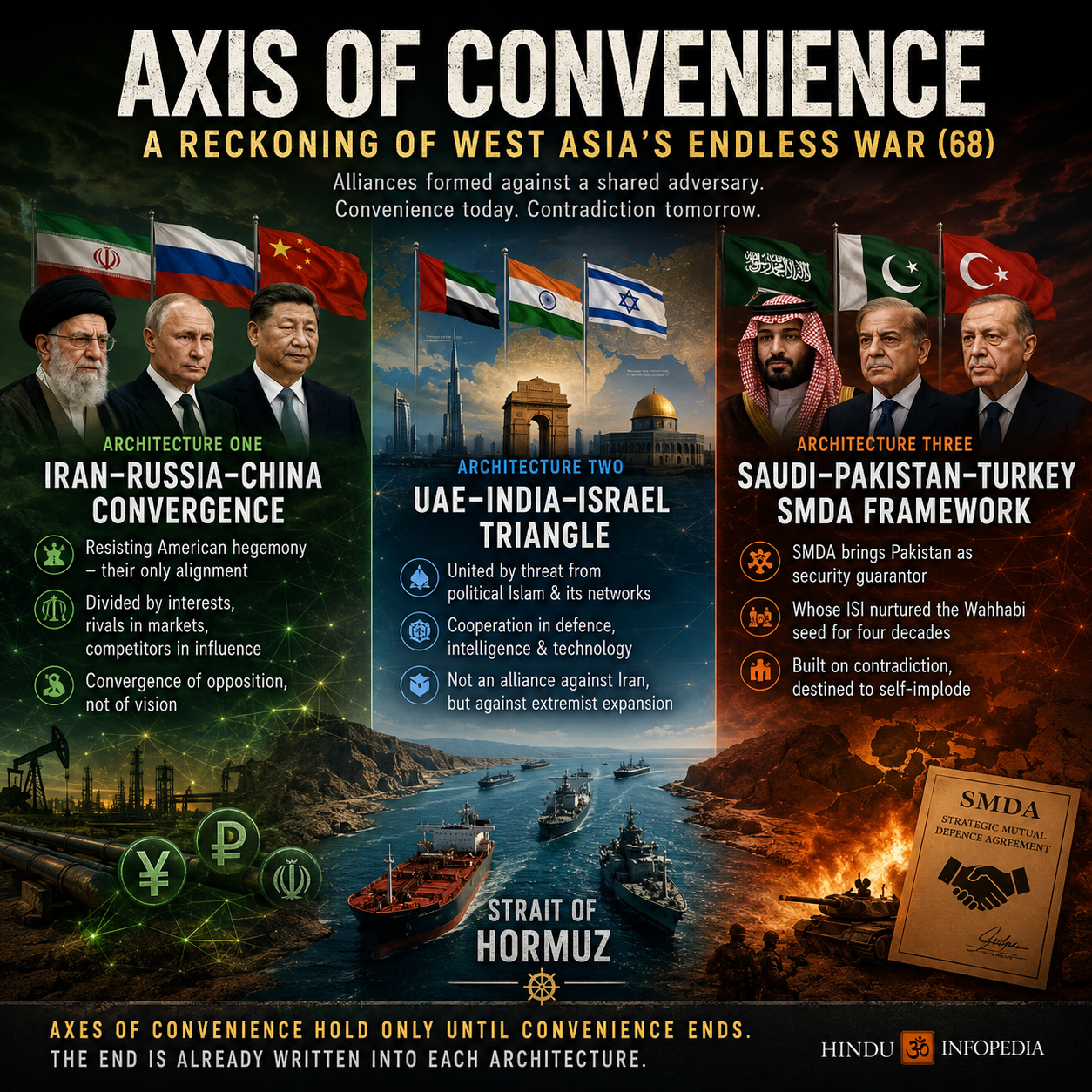
Axis of Convenience: Three alliances the Hormuz war has formalised. Iran-Russia-China. UAE-India-Israel. Saudi-Pakistan-Turkey. None principled. Each formed against a shared adversary. Each carrying the contradiction that produces the next war. The series has documented each of these architectures across individual blogs — Blog 47 (China Oil Revenge), Blog 42 (Russia Passive Dividend), Blog 48 (UAE OPEC Split), Blog 58 (India Strategic Neutrality). Blog 68 examines all three in parallel — not what each alliance does individually but what the pattern of their formation reveals about the order replacing Washington’s declining unipolar architecture.
Architecture One — Iran-Russia-China convergence.
The Iran-Russia-China Axis of Convenience is the one Washington has named most loudly and understood least precisely. Iran, Russia, and China share one thing: Washington as their primary strategic adversary. They share almost nothing else. Iran is a theocratic Shia revolutionary state whose Mustad’afin Doctrine commits it to supporting the oppressed against the oppressors globally regardless of religion. Russia is a nationalist Orthodox Christian power seeking restored imperial prestige and buffer state architecture. China is a secular authoritarian state pursuing commercial dominance through Belt and Road, petroyuan, and mBridge. Their interests align on one axis — resisting American military and financial hegemony — and diverge across every other.
Russia wants high oil prices. China wants low oil prices. Blog 42 established that Russia collected $9 billion monthly in windfall from the Hormuz price spike — a windfall that came at China and Iran’s commercial expense. China’s 25-year comprehensive cooperation agreement with Iran — signed in 2021 — gives China discounted Iranian oil access in exchange for investment and diplomatic cover. Russia is Iran’s competitor in the global arms market — SIPRI data confirms both are suppliers to overlapping regional clients, creating commercial friction beneath the political alignment. Blog 55 (China Sanctions War) documented China’s blocking order protecting its Iran oil trade — China acting in its own commercial interest, not in Iran’s defence interest. The convergence is real at the level of resisting Washington. It dissolves at the level of shared strategic vision. Foreign Affairs documented that the Iran-Russia-China alignment is unified by opposition to American hegemony and divided by almost everything else.
Architecture Two — UAE-India-Israel triangle.
The UAE-India-Israel Axis of Convenience is the series’ most analytically original argument. It has no formal name, no joint command structure, no public treaty. It operates through the Abraham Accords normalisation framework, India’s defence procurement from Israel, the UAE-India Strategic Defence Partnership signed January 19 2026, shared intelligence architecture, and a shared threat calculus in which political Islam’s Brotherhood expansion threatens all three simultaneously. UAE fears the Brotherhood and Qatar’s Salafi promotion. Israel fears Hamas, Hezbollah, and Iranian proxy encirclement. India fears Pakistan-linked Islamist movements and their Gulf financing channels. The triangle is not an alliance against Iran per se — it is an alignment against the specific form of political Islam that Qatar promotes and Pakistan accommodates.
The Axis of Convenience here is exposed by its own internal contradiction. Blog 58 (India Strategic Neutrality) documented that India simultaneously maintains Chabahar investment in Iran — the triangle’s primary common threat state in Israeli strategic planning. Israel’s survival logic requires Iran’s nuclear capability eliminated. India’s strategic interest requires Iran’s Chabahar port operational. These are not compatible long-term objectives. India is also seeking from Israel the intelligence architecture and pre-emptive capability that Mossad applies to external threats — adapted for India’s internal and external terrorism problem. The triangle holds in the current moment because Washington’s war against Iran has aligned all three states’ immediate interests against a common pressure. It will fracture when Iran’s nuclear question and India’s Chabahar question require incompatible answers from the same state simultaneously.
📌 The UAE OPEC Split That Formalised the Triangle
UAE exits OPEC May 1 2026 without consulting Saudi Arabia — nineteen days after signing the India Strategic Defence Partnership. The commercial and security architecture of the UAE-India-Israel alignment expressed through commercial action.
Axis of Convenience: The Saudi-Pakistan-Turkey Architecture and Its Self-Undermining Logic
Architecture Three — Saudi-Pakistan-Turkey SMDA framework.
The Saudi-Pakistan-Turkey Axis of Convenience is the series’ most politically significant and most structurally unstable alliance formation. The Strategic Mutual Defence Agreement signed between Saudi Arabia and Pakistan on September 17 2025 — with Turkey’s formal observer status and bilateral security commitments to both — creates an Article 5-equivalent collective defence architecture for a Sunni-majority bloc. Blog 34 (Manufactured Stability Reckoning) documented the SMDA as Saudi Arabia’s insurance policy against the American security guarantee’s revealed conditionality.
The self-undermining logic of this architecture is the one the analysis has established precisely. Saudi Arabia is replacing the American security guarantee — which was commercially extractive but ideologically neutral toward the Saud monarchy’s domestic legitimacy — with a Pakistan-Turkey security architecture that is less commercially extractive but ideologically connected to the Brotherhood challenge that Qatar is building. Blog 62 (Dar Al Harb Ambivalence) documented Qatar funding the Brotherhood whose democratisation of political Islam is existentially threatening to hereditary monarchy. Blog 63 (Dar Al Harb Ambivalence Pakistan) documented Pakistan’s bifurcated state architecture maintaining operational relationships with Brotherhood-adjacent organisations. The SMDA that Saudi Arabia signed with Pakistan in September 2025 brings in as replacement security guarantor the state whose ISI became the principal operational channel through which the Wahhabi seed’s Raktbeej-like multiplication was administered across four decades.
Turkey under Erdoğan adds the third dimension of the self-undermining logic. Turkey has been the Brotherhood’s primary state patron — hosting Brotherhood leadership expelled from Egypt, providing diplomatic cover for Brotherhood-aligned movements across the Arab world. Saudi Arabia designated the Brotherhood a terrorist organisation in 2014. Saudi Arabia simultaneously signed a mutual defence framework with the Brotherhood’s primary state patron — a contradiction the SMDA architecture carries at its founding. The Axis of Convenience’s Saudi-Pakistan-Turkey architecture is the most internally contradictory of the three — Saudi Arabia is seeking protection from Iranian military pressure through an alliance whose members are institutionally connected to the ideological movement that threatens Saudi political legitimacy more sustainably than Iranian missiles do.
Every alliance the Hormuz war has produced was formed against a shared adversary rather than around a shared vision. The Iran-Russia-China convergence holds against Washington and dissolves when Russia’s price interests conflict with China’s price interests and Iran’s Mustad’afin doctrine conflicts with Russia’s Orthodox nationalist one. The UAE-India-Israel triangle holds against the Brotherhood’s expansion and dissolves when India’s Chabahar dependency and Israel’s Iran elimination doctrine require incompatible decisions from the same partner. The Saudi-Pakistan-Turkey SMDA holds against Washington’s revealed conditionality and dissolves when the Brotherhood movements that Pakistan and Turkey accommodate become the primary challenge to the Saudi monarchy they have been brought in to protect. Washington’s Global Control War produced three Axes of Convenience as its adversarial response. Each carries within it the structural contradiction that will produce the next conflict. The warriors are setting fire to the alliances they built to extinguish the current one — and the fire spreads because every alliance was built against something rather than for something, which means every alliance’s internal logic is the negation of its own foundation.
📌 The Gulf Betrayal That Made These Alliances Necessary
The four-pillar Gulf-Washington dependency collapsed simultaneously — the manufactured stability that made the Praetorian Guard appear indispensable until the moment it proved conditional.
Next: Palestine Cause or Instrument — Blog 69 in West Asia’s Endless War examines Palestine through the same dual analytical lens Blog 59 applied to Israel — not as a moral question but as an analytical one. Is Palestine a genuine cause driving West Asia’s endless war or the instrument through which regional and global powers prosecute interests that have nothing to do with Palestinian statehood? The answer, like Blog 59’s, is not binary. Part of the West Asia’s Endless War Series on hinduinfopedia.com.
Feature Image: Click here to view the image.
Videos
Glossary of Terms
- Hormuz War: The ongoing geopolitical and military confrontation centered around the Strait of Hormuz, involving global powers, Gulf monarchies, Iran, and proxy networks across West Asia.
- Axis of Convenience: A key phrase coined in the series describing alliances formed against a shared adversary rather than around shared ideology, civilisation, or long-term strategic coherence.
- Iran-Russia-China Convergence: The informal strategic alignment between Iran, Russia, and China primarily driven by resistance to American military and financial dominance.
- Mustad’afin Doctrine: Iran’s revolutionary doctrine obligating support for the oppressed against perceived oppressors globally, regardless of religion or ethnicity.
- Petroyuan: China’s effort to conduct international oil trade in Chinese yuan instead of US dollars as part of wider dedollarisation efforts.
- mBridge: A cross-border central bank digital currency platform involving China and partner states aimed at reducing dependence on Western financial systems.
- Abraham Accords: The US-backed normalization agreements between Israel and several Arab states, including the UAE, reshaping West Asian strategic alignments.
- UAE-India-Israel Triangle: A strategic alignment identified in the series involving intelligence, defence, and commercial cooperation against shared concerns over political Islam and regional instability.
- Chabahar Port: Iran’s strategically important port developed with Indian involvement to secure trade access bypassing Pakistan and connecting India to Central Asia.
- SMDA (Strategic Mutual Defence Agreement): The Saudi-Pakistan defence framework signed in September 2025 establishing a collective security architecture with Turkish involvement.
- Article 5-Equivalent Architecture: A defence arrangement resembling NATO’s collective defence principle where an attack on one member may trigger coordinated security response.
- Brotherhood Expansion: The spread of Muslim Brotherhood-linked political Islam movements across the Arab and Muslim world through ideological, political, and institutional influence.
- Revealed Conditionality: A phrase used in the series describing how American security guarantees appeared dependable until moments of crisis exposed their limitations and selective application.
- Raktbeej-like Multiplication: A phrase adapted from Hindu mythology describing ideological or militant movements that multiply when fragmented or suppressed, similar to a decentralised starfish model.
- Washington’s Unipolar Architecture: The post-Cold War global order dominated by American military, financial, and geopolitical primacy.
#WestAsia #Iran #SaudiArabia #Israel #China #Russia #Pakistan #Turkey #Geopolitics #MiddleEast #Oil #Hormuz #India #NATO #HinduinfoPedia
West Asia’s Endless War: Why This Series Exists
[…] भारत / GB […]
[…] https://hinduinfopedia.com/axis-of-convenience-a-reckoning-of-west-asias-endless-war-68/ […]