

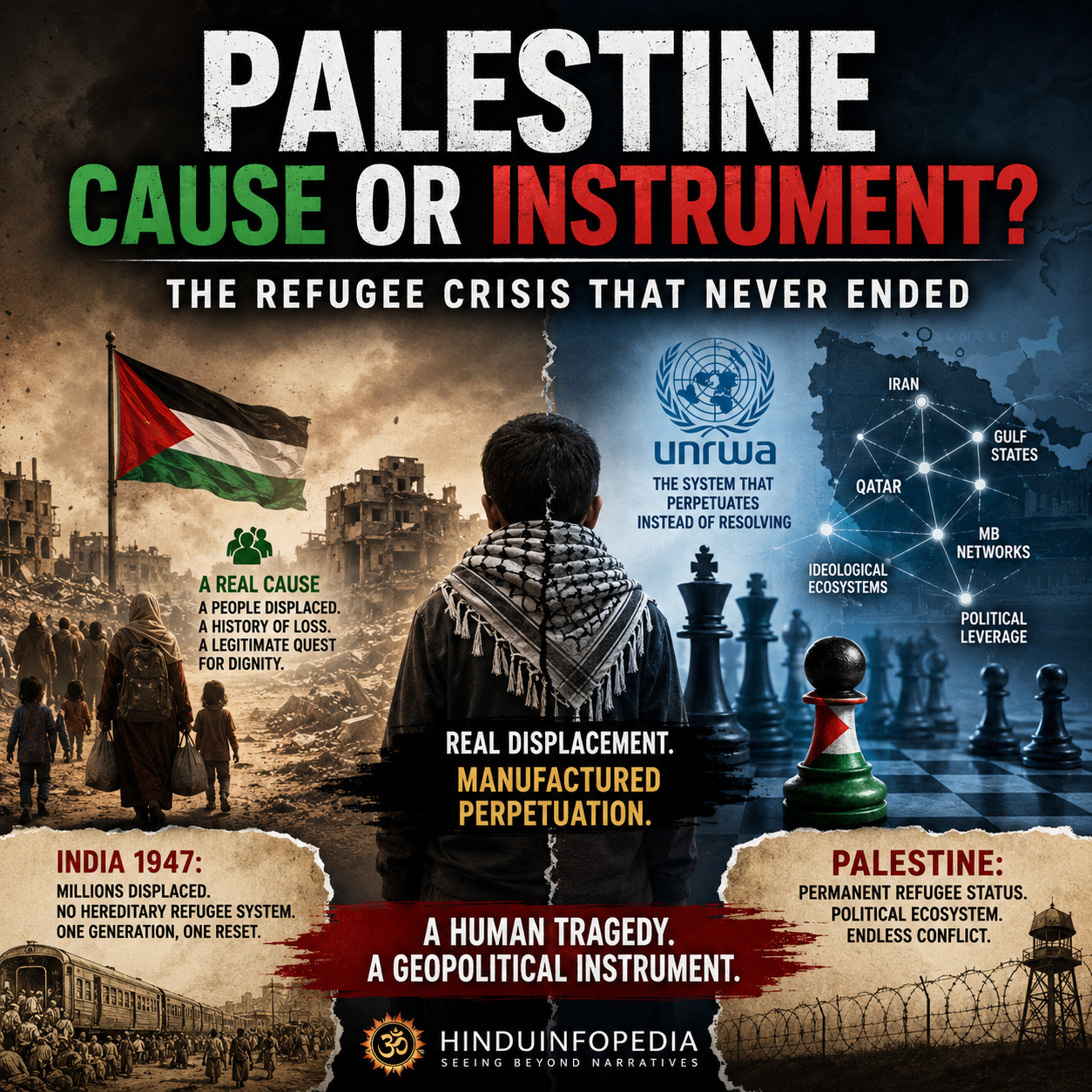
Palestine Cause or Instrument: A Reckoning of West Asia’s Endless War (69)
Part 69 of the West Asia’s Endless War Series
भारत / GB
Palestine as a State Was Never Allowed to Exist by Its Muslim Neighbours or Their Former Rulers- the British. None of Them Wanted It to Exist. Statehood Has Never Been the Point for Most of the Actors Who Invoke It. Only After Israel Occupied Territory as the Consequence of Each War Launched Against It Did Palestine Become a Point of Concern to Muslims and the Rest of the World.
Blog 68 (Axis of Convenience) established that every alliance the Hormuz war has produced was formed against a shared adversary rather than around a shared vision — and that each carries within it the structural contradiction that will produce the next conflict. Blog 69 applies the same dual analytical lens Blog 59 applied to Israel: is Palestine a genuine cause driving West Asia’s endless war, or the instrument through which regional and global powers prosecute interests that have nothing to do with Palestinian statehood? The answer, like Blog 59’s, is not binary. Both are simultaneously true. The distinction between them — and the India 1947 control group that proves it — is the argument.
Palestine Cause or Instrument: The Real People, The Manufactured Cause
Palestine Cause or Instrument: Not binary. The displacement of populations during the conflict is documented historical fact. Palestine is also the instrument through which every regional power prosecutes interests unrelated to Palestinian statehood. The India 1947 control group proves which variable determines the outcome. The Palestine Cause or Instrument genuine cause argument requires stating precisely.
Blog 10 (Israel Survival Logic) established the security logic on the Israeli side. Blog 69 establishes the demographic and administrative reality on the Palestinian side — not as a moral verdict but as a documented historical sequence without which the analysis is incomplete.
The 1948 displacement — the Nakba — produced approximately 700,000 Palestinian refugees from a population of approximately 1.2 million. UNRWA documents that the Palestinian refugee population, through its hereditary definition unique in international refugee law, now exceeds 5.9 million registered refugees across five areas of operation. Population movement during a war launched by Arab states. Real people moved. The apparatus constructed around that movement — hereditary refugee status, Martyr Fund, the statehood vocabulary — was the manufactured layer built on top of a real but ordinary wartime population movement. It is documented historical consequence of a specific political event — the 1948 war and its population displacement — whose effects have been maintained and propagated, rather than resolved across seventy-seven years.
The genuine cause argument does not require accepting every political claim made in Palestine’s name. It requires only acknowledging that the original wartime population displacement was real, that its consequences remain real for a specific documented population, and that any analysis that dismisses the human element entirely in favour of the instrument argument is analytically incomplete. Blog 59 (Israel Cause or Cover) applied the same dual lens to Israel — existential survival logic, also cover for Washington’s commercial interests. Blog 69 applies the same lens to Palestine — the reality of a displaced population, also an instrument for every actor whose interests it serves.
Palestine Cause or Instrument: The Instrument Argument
The Palestine Cause or Instrument instrument argument is documented across four independent experiments that the Raktbeej and Starfish Thesis on hinduinfopedia.com calls the four-country proof. Jordan, Lebanon, Kuwait, and Syria each hosted Palestinian refugee populations in different political contexts. In each case the outcome was identical — destabilisation of the host state — and in each case the Israeli variable was absent. The organism’s mechanics operated regardless of geography, ethnicity, or the presence of the original adversary. Jordan gave Palestinians citizenship and parliamentary representation. The PLO attempted to overthrow the monarchy. Kuwait hosted 400,000 Palestinians and expelled them after their leadership supported Saddam Hussein’s invasion. Lebanon accepted refugees and watched its state dissolve across fifteen years of civil war and now under seize of a parallel government of Hezbollah that refuses to disarm. Syria maintained camps under iron control — and they became battlegrounds when civil war began.
The 57 Muslim-majority nations that refuse Palestinian refugees — while maintaining verbal solidarity at zero cost — are the most precise documented evidence that the Palestine Cause or Instrument distinction is understood by every state actor in the region. Every neighbour of Palestine is trying to build a wall as high and as deep as that between Gaza and Egypt.
The structural economic interest of host governments in perpetuating rather than resolving the Palestinian refugee condition is documented in UNRWA’s own operational architecture. UNRWA operates in each host country “in coordination with host authorities” — every dollar flowing through UNRWA in Syria, Lebanon, and Jordan passes through a relationship the host government controls. With over 30,000 staff — the overwhelming majority local Palestinian employees — UNRWA functions as a host-state social service provider funded entirely by international donors. The host government outsources its obligation to house, educate, and provide healthcare to a population it refuses to absorb — and international donors pay for it permanently. The Assad regime made this arrangement explicit: it simultaneously besieged Yarmouk with barrel bombs while controlling UNRWA’s aid access as a political lever, easing the siege only when international pressure required a demonstration of compliance. Not crude corruption. Structural outsourcing — with zero incentive to resolve a condition that costs the host government nothing and serves it completely.
The BBC documented the Gulf states’ unanimous refusal to accept Palestinian refugees despite their financial capacity and their public solidarity declarations — Egypt maintains an 18-metre deep steel wall on the Gaza border, Jordan has reinforced its border architecture repeatedly, and no Arab state has opened its territory to Palestinian resettlement. The states that invoke Palestine most loudly in multilateral forums have taken the most deliberate physical measures to ensure the Raktbeej mechanism does not germinate in their own soil.
Iran’s use of Palestine as an instrument is the most precisely documented case in this series. Blog 64 (Iran’s Revolutionary Doctrine) established that Iran’s support for Hamas simultaneously serves three purposes: the Mustad’afin constitutional mandate, strategic encirclement of Israel, and displacement of Saudi Arabia’s claim to lead the Palestinian cause. Iran does not offer Palestinians resettlement. Iran offers Hamas rockets. The distinction is the instrument argument’s most precise expression: genuine solidarity with a cause produces offers of solution. Instrumental use of a cause produces offers of perpetuation.
📌 The Mustad’afin Doctrine Iran Applies to Palestine
Iran’s constitutional mandate to support the oppressed everywhere regardless of religion — and why the Hamas relationship simultaneously challenges Saudi Sunni leadership of the Palestinian cause.
Palestine Cause or Instrument: The India 1947 Control Group
The Palestine Cause or Instrument distinction’s most powerful analytical instrument is not in West Asia. It is in South Asia — the India 1947 control group that the Raktbeej and Starfish Thesis identifies as the definitive controlled experiment.
India, 1947. The same partition trauma as Palestine, 1948. The same refugee condition — arguably worse in scale: 10-14 million people displaced across the India-Pakistan border in the largest forced migration in human history, accompanied by communal violence that killed between 200,000 and 2 million people depending on the estimate. The same loss of land, community, and political certainty. The BBC documented the 1947 partition as the largest forced migration in human history — 10-14 million people displaced, between 200,000 and 2 million killed, entire communities erased from territories where they had lived for generations. No UNRWA. No hereditary refugee status transmitted across generations. No international life support system maintaining the displacement as a permanent political condition. No Martyr Fund paying pensions indexed to violence. Forced finality — the refugees absorbed into the receiving states, the trauma metabolised into reconstruction rather than transmitted into perpetual replication.
The result: India is a space-faring economy within two generations. The refugee populations built cities, created industries, established democratic institutions, and within one generation their children were citizens rather than refugees. The partition trauma produced no hereditary victim identity transmitted to grandchildren. No curriculum teaching that the lost territory must be reclaimed through infinite generational warfare. No pension architecture rewarding violence against the neighbour state.
The contrast with the Palestinian ecosystem is the argument’s most precise formulation — not about the people but about the ecosystem. The Raktbeej and Starfish Thesis states it precisely: same wartime population movement, opposite metabolic pathways. India’s ecosystem converted displacement into reconstruction. The Palestinian ecosystem — fueled and maintained by UNRWA’s unique hereditary refugee status, the Martyr Fund, and the theological architecture that converts martyrdom into the highest aspiration — converts displacement into perpetual replication. The difference is not in the trauma. It is in the ecosystem that metabolises the trauma. The difference is the potter, not the clay who can create a chellum that fires itself throughout its life while killing the user or the water pot that keeps itself and other cool.
UNRWA is not an anomaly in international refugee law. It is the primary construction mechanism through which a wartime population movement was manufactured into a permanent, expanding, hereditary political grievance. Every other refugee population in the world is governed by UNHCR’s standard definition — refugee status ends when the individual acquires citizenship elsewhere or when the original displacement is resolved. UNRWA’s definition does the opposite: it transmits refugee status hereditarily across every subsequent generation regardless of citizenship held, country of birth, or economic circumstances. A Palestinian born in Jordan with Jordanian citizenship in 2024 is an UNRWA-registered refugee. His children will be. Their children will be. An Indian whose family was expelled from Lahore in 1947 is not a refugee and neither are his grandchildren. UNRWA did not maintain a refugee population. It manufactured one — retroactively transmitting refugee status to people who were never displaced themselves, who have never seen the territory they are registered as displaced from and, in fact, that never ever existed, and who hold citizenship in functioning states.. The result is a refugee population that grows rather than resolves — from 700,000 in 1948 to 5.9 million registered today — not because displacement continued but because the apparatus was designed to replicate the status rather than resolve it. This is not ecosystem design as a neutral observation. It is the deliberate architectural choice of every actor — Arab states, Iran, the international community — that needed the grievance maintained rather than resolved.
India’s 1947 ecosystem applied all three sterilisations simultaneously — not through deliberate policy design but through the forced finality that the international community has systematically refused to apply to the Palestinian case. The Palestine Cause or Instrument argument’s closing observation is this: every actor that uses Palestine as an instrument has a structural interest in maintaining the Raktbeej germination essentials rather than applying the Dagdhabeej sterilisation. Iran offers rockets, not resettlement. UNRWA maintains hereditary status, not finalisation. The regional powers invoke solidarity, not absorption. The cause is real. The perpetuation of the cause is the instrument. The two are not in contradiction. They are in symbiosis.
📌 The Raktbeej Mechanism the Ecosystem Maintains
The organism in which destruction produces replication rather than elimination. The three germination essentials — subsidised identity, financial incentive, theological supremacy — and why every actor that uses Palestine as an instrument maintains rather than removes them.
Next: Palestine: The Territorial Record — Blog 70 in West Asia’s Endless War digs deeper into the geographic and administrative data of the region, tracing the physical shifting of borders and titles from the Ottoman collapse through the 1948 armistice lines to isolate the exact moments where legal ownership and territorial claims diverged. Part of the West Asia’s Endless War Series on hinduinfopedia.com.
Feature Image: Click here to view the image.
Videos
Glossary of Terms
- Nakba: The 1948 displacement of approximately 700,000 Palestinian Arabs during and after the Arab–Israeli war following Israel’s creation.
- UNRWA: United Nations Relief and Works Agency for Palestine Refugees in the Near East, created in 1949 specifically for Palestinian refugees and known for its hereditary refugee-status framework.
- UNHCR: United Nations High Commissioner for Refugees, the global refugee body whose standard framework generally ends refugee status after resettlement or citizenship acquisition.
- Palestine Cause or Instrument: The blog’s central analytical framework examining whether Palestine functions as a genuine humanitarian-national cause or as a geopolitical instrument used by regional and global actors.
- Raktbeej and Starfish Thesis: A HinduInfopedia geopolitical framework arguing that certain ideological ecosystems replicate and regenerate after every confrontation, similar to the mythological Raktbeej.
- Dagdhabeej Principle: A concept derived from Hindu philosophy referring to a “sterilised seed” incapable of germination, used in the series to describe permanently disabling ideological replication mechanisms.
- Martyr Fund: A term used for compensation systems linked to Palestinian prisoners, militants, or families of those killed in conflict, criticised by opponents as incentivising violence.
- Black September: The 1970 conflict in Jordan between the Jordanian monarchy and Palestinian armed groups after the PLO developed parallel authority structures inside the country.
- PLO (Palestine Liberation Organization): The political and militant umbrella organisation founded in 1964 that historically represented Palestinian nationalist movements internationally.
- Mustad’afin Doctrine: Iran’s constitutional and ideological principle of supporting the “oppressed,” used in the series to explain Tehran’s backing of Palestinian militant organisations.
- Hereditary Refugee Status: The unique UNRWA policy under which Palestinian refugee status passes across generations regardless of birthplace or citizenship acquired elsewhere.
- India 1947 Control Group: The blog’s comparative framework contrasting the India–Pakistan Partition refugee crisis with the Palestinian refugee system to analyse different political and institutional outcomes.
- Theological Supremacy: A recurring term in the series describing ideological or doctrinal frameworks that treat one religious worldview as politically or civilisationally dominant over others.
- Yarmouk Camp: A major Palestinian refugee camp in Syria that became a battleground during the Syrian Civil War and a symbol of refugee vulnerability in regional conflicts.
- Hormuz War: A recurring term in the series referring to the expanding strategic confrontation around Iran, the Persian Gulf, Israel, and Western-aligned regional powers.
#Palestine #Israel #Gaza #UNRWA #Iran #Hamas #Jordan #Lebanon #Refugees #Nakba #MiddleEast #WestAsia #PLO #Geopolitics #HinduinfoPedia
West Asia’s Endless War: Why This Series Exists
Refer to Various Arks Referred to in the Blog
[…] भारत / GB […]
[…] Blog 69 (Palestine Cause or Instrument) established that real people were displaced during a war that was thrust upon Israel by the Arab States, that UNRWA manufactured hereditary refugee status from that displacement, and that every actor invoking Palestine as a cause has a structural interest in the misery rather than attempting to solve it. Blog 70 examines the territorial record that provides the historical foundation for that analysis: what Palestine actually was before 1948, who controlled the territory after 1948 and what they did with it, and what each attempt to eliminate Israel has produced in territorial terms. The Palestine Territorial Record is the documented sequence stripped of the narrative layers that every interested party has constructed around it. […]
[…] pattern. It is the operational consequence of the Raktbeej or starfish organism ecosystem that Blog 69 (Palestine Cause or Instrument) established — the three germination essentials (UNRWA hereditary status as earth, Martyr Fund as […]
[…] संरचनात्मक तंत्र का परिणाम था जिसे ब्लॉग 69 (फिलिस्तीन: कारण या उपकरण) ने स्पष्ट किया था। उस तंत्र के तीन मूल […]
[…] https://hinduinfopedia.com/palestine-cause-or-instrument-a-reckoning-of-west-asias-endless-war-69/ […]
[…] पढ़ें: फिलिस्तीन — कारण या उपकरण → […]
[…] sense. It is the structural output of the Raktbeej (or starfish biological system) ecosystem that Blog 69 (Palestine Cause or Instrument) established. The ecosystem’s three germination essentials — UNRWA hereditary status as […]