

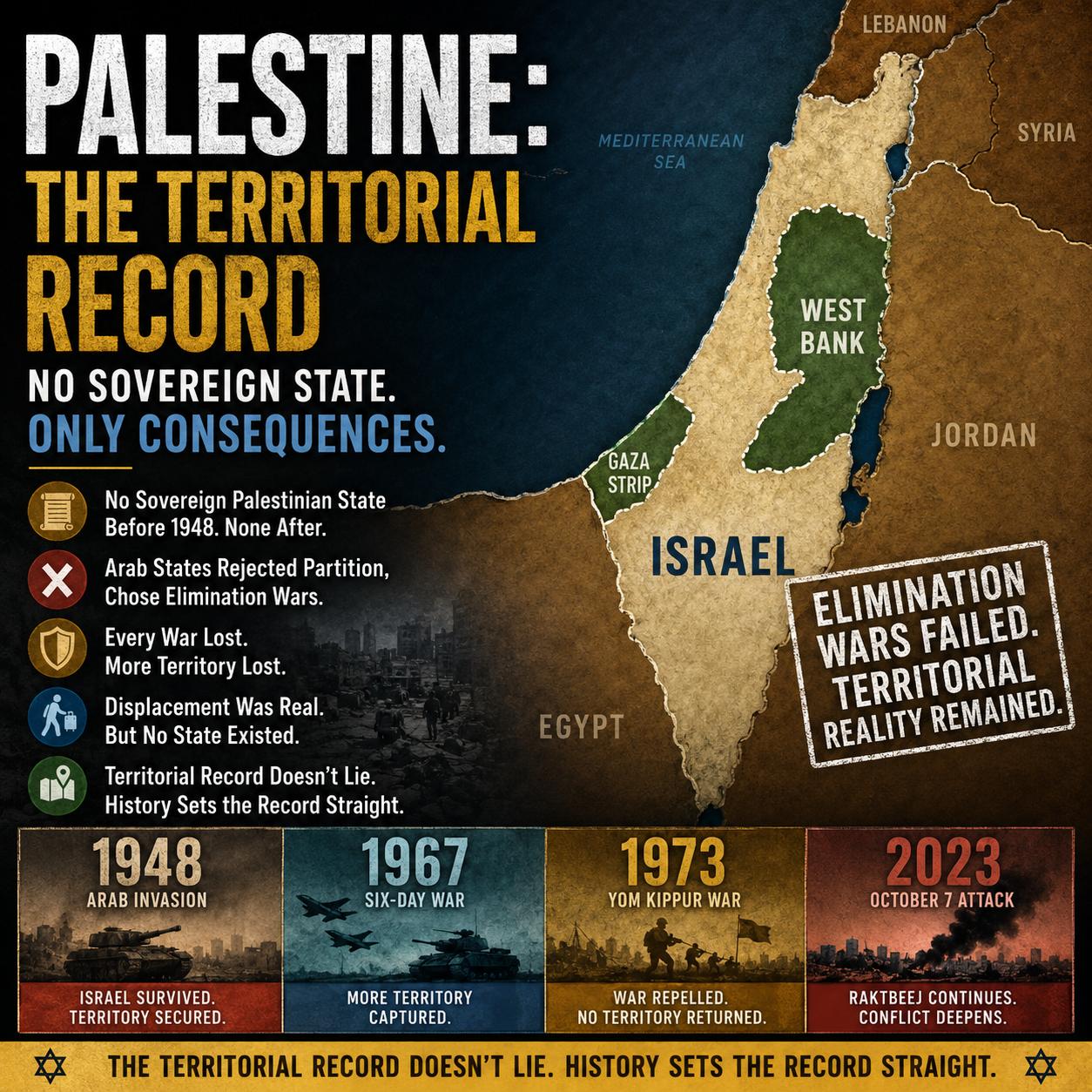
Palestine Territorial Record: A Reckoning of West Asia’s Endless War (70)
Part 70 of the West Asia’s Endless War Series
भारत / GB
Palestine as a Sovereign State Never Existed in Recorded History. The Territory Was a British Administrative Zone Carved From an Ottoman Province. No Arab State Established a Palestinian State During Nineteen Years of Direct Territorial Control. Each Arab Attempt to Eliminate Israel Produced a Larger Israel. The Elimination Doctrine Created the Occupation It Claims to Reverse.
Blog 69 (Palestine Cause or Instrument) established that real people were displaced during a war that was thrust upon Israel by the Arab States, that UNRWA manufactured hereditary refugee status from that displacement, and that every actor invoking Palestine as a cause has a structural interest in the misery rather than attempting to solve it. Blog 70 examines the territorial record that provides the historical foundation for that analysis: what Palestine actually was before 1948, who controlled the territory after 1948 and what they did with it, and what each attempt to eliminate Israel has produced in territorial terms. The Palestine Territorial Record is the documented sequence stripped of the narrative layers that every interested party has constructed around it.
Palestine Territorial Record: What Palestine Actually Was
Palestine Territorial Record: Palestine as a sovereign state never existed. The territory called Palestine was a British administrative zone carved from an Ottoman province. No Arab state allowed establishment of a Palestinian state during nineteen years of direct territorial control. Each Arab attempt to eliminate Israel produced a larger Israel. The elimination doctrine created the occupation it claims to reverse. The foundational historical fact the Palestine Territorial Record requires stating before anything else: there was no Palestinian state before 1948 whose destruction produced the refugee condition. There was no Palestinian sovereignty, no Palestinian citizenship, no Palestinian government, no Palestinian army, no Palestinian currency, and no Palestinian borders recognised by any international body at any point before the 1948 war.
The territory called Palestine was an Ottoman province — one administrative unit within the Ottoman Empire’s Levantine territories — until 1917. The British captured it from the Ottomans in 1917 and administered it as a Mandate territory under the League of Nations framework — not as a colonial possession of Britain but as a temporary administrative zone pending the determination of its final political status. The Arab population living in this zone was real — their presence, their culture, their attachment to the land is documented across centuries. What did not exist was a Palestinian state. The distinction is not semantic. It is the foundational historical fact on which every subsequent territorial argument depends.
When the British Mandate ended in 1948, the UN proposed the creation of two new states — one Jewish, one Arab — in a territory that had never previously been a state of any kind.
UN General Assembly Resolution 181 of November 1947 proposed the creation of these two states from the British administrative zone — allocating the Jewish state approximately 56% of the territory, disproportionately the Negev desert which was arid, sparsely inhabited, and agriculturally marginal.
The Arab state received the West Bank highlands and Gaza — the more fertile, more populated, and more economically viable portions. The Jewish state accepted the proposal. The Arab League declared the proposal illegal and announced it would use force to prevent the establishment of a Jewish state.
The Arab states were not rejecting a partition of their existing territory. They were rejecting the creation of a Jewish state in a territory where no state of any kind had previously existed — and in doing so, they simultaneously rejected the creation of the Arab state the same proposal would have established.
📌 The Ecosystem Built on the 1948 Displacement
UNRWA’s unique hereditary refugee status, the Martyr Fund, and the theological architecture — the three Raktbeej germination essentials maintained by every actor that needs the grievance perpetuated rather than resolved.
Palestine Territorial Record: Nineteen Years of Arab Control, Zero Palestinian States
The 1948 war — launched by Arab states to prevent Israel’s creation — produced the armistice lines known as the Green Line. The West Bank came under Jordanian military administration and was formally annexed by Jordan in 1950. Gaza came under Egyptian military administration. The Palestine Territorial Record’s most analytically significant fact follows: for nineteen years — 1948 to 1967 — the territories now called “occupied Palestinian territories” were under Arab state military and administrative control. No Arab state established a Palestinian state on any part of them.
Jordan’s annexation of the West Bank in 1950 was recognised by only Britain and Pakistan. Jordan extended Jordanian citizenship to West Bank Palestinians — making them Jordanian nationals — while simultaneously refusing to establish a Palestinian state. Egypt administered Gaza without extending Egyptian citizenship to Gazans and without establishing a Palestinian state.
The Palestinian Liberation Organisation was founded in 1964 — while Jordan controlled the West Bank and Egypt controlled Gaza. The PLO’s founding charter called for the destruction of Israel and the liberation of all of historic Palestine — not the establishment of a state in the West Bank and Gaza, which were already under Arab control and where a Palestinian state could have been established at any point.
The nineteen-year vacancy is the Palestine Territorial Record’s most precise evidence that Palestinian statehood has never been the actual objective of Arab state policy. Jordan controlled the West Bank for nineteen years. Egypt controlled Gaza for nineteen years. Saudi Arabia, Iraq, and Syria spent the same period in vocal public solidarity with the Palestinian cause. None established a Palestinian state. None pressured Jordan or Egypt to do so. The cause was more valuable as a cause than any Palestinian state it might have produced would have been — which is the Palestine Cause or Instrument argument (Blog 69) confirmed through the behaviour of the states invoking it during the nineteen years when the state they claimed to want was available to be created.
Palestine Territorial Record: The Elimination Doctrine’s Territorial Invoice
The Palestine Territorial Record’s most important pattern is the one that connects every Arab military action against Israel to its territorial consequence — and the pattern is consistent across every application: each attempt to eliminate Israel produced a more territorially extensive Israel than existed before the attempt.
The 1948 war launched by Arab states to prevent Israel’s creation produced Israel’s armistice lines — which in several areas exceeded the 1947 UN allocation. Israel entered the war defending a proposed state. It emerged from the war with a functioning state whose lines reflected the military outcome rather than the diplomatic proposal. The Arab states that launched the war to prevent Israel’s creation produced, through that war, a more solidly established Israel than the diplomatic proposal alone would have created.
The 1967 war’s pre-war sequence is documented precisely: Egypt expelled UN peacekeeping forces from the Sinai, closed the Straits of Tiran to Israeli shipping — an internationally recognised act of war — massed 100,000 troops and 1,000 tanks on Israel’s border, and entered a military alliance with Jordan and Syria. Egypt’s President Nasser declared publicly: “Our basic objective will be the destruction of Israel.” Israel struck first. Within six days it had occupied the Sinai Peninsula, the West Bank, Gaza, and the Golan Heights — territory three times the size of pre-war Israel. The Arab states launched the war to eliminate Israel. The war produced an Israel three times larger than the one they had sought to eliminate.
The 1973 Yom Kippur War — Egypt and Syria’s coordinated surprise attack on the Jewish holy day — produced the eventual return of the Sinai to Egypt through the Camp David process but consolidated the other occupied territories. The Camp David Accords of 1978 demonstrated the precise distinction between the Arab state approach and the Palestinian leadership approach: Egypt recovered the entire Sinai — 61,000 square kilometres including oil fields — through negotiation and recognition of Israel’s right to exist. Egypt chose negotiation. Egypt received its territory. The Palestinian leadership chose the elimination doctrine. The Palestinian territorial position deteriorated with each application. The Jews of Israel lost again on account of tolerance.
The pattern’s most recent expression: the October 7 2023 Hamas attack — on the anniversary of the 1973 Yom Kippur War’s launch date and the day of Simchat Torah celebrations for he jews — produced the most extensive Israeli military operation in Gaza since 1967, the destruction of Hamas’s governmental infrastructure, and the displacement of Gaza’s population. The IRGC Mosaic architecture (Blog 39) that made the attack possible was built through the same Raktbeej mechanism the attack triggered — each defensive Israeli operation produces more capable adversaries among the survivors, each survivor’s experience becomes the training curriculum for the next generation. The elimination doctrine and the Raktbeej mechanism or star fish biological system are the same process viewed from opposite sides: from the Palestinian side, each blood drop produces a new fighter; from the Israeli side, each attack produces a larger defensive perimeter. Both observations are accurate historically. Both confirm that the elimination doctrine is the most consistently counterproductive strategy in the conflict’s history — and the most consistent producer of the territorial outcome it claims to oppose. Blog 10 (Israel Survival Logic) established why this outcome is rational from Israel’s perspective. The Palestine Territorial Record establishes why it is self-defeating from the Palestinian perspective. The strategy deployed in the name of Palestinian liberation has produced, at each application, a Palestinian territorial position worse than the one that preceded it.
The historical foundation that makes this defensive consolidation pattern comprehensible — rather than merely aggressive — is documented on hinduinfopedia.org: a people who experienced systematic genocide precisely because their tolerance and peaceful coexistence were exploited as vulnerabilities will not again make the same calculation when surrounded by declared elimination intent.
The Israeli security doctrine is not irrational expansionism. It is the rational response of a civilisation that learned and existential threat, at a cost of six million lives, what happens to a tolerant people that does not respond to elimination threats with sufficient defensive force.
📌 The Axis of Convenience That Uses This Record
Three alliance architectures — Iran-Russia-China, UAE-India-Israel, Saudi-Pakistan-Turkey — each invoking Palestinian cause for purposes unrelated to Palestinian statehood, each with structural interest in maintaining the Raktbeej essentials rather than applying the Dagdhabeej sterilisation.
Next: Palestine: The State That Was Never Born — Blog 71 in West Asia’s Endless War examines what the Palestine Territorial Record’s foundational observation means for the conflict’s future: if Palestine never existed as a sovereign state, what exactly is the two-state solution proposing to establish? And if every peace concession Israel has made has been used to prepare the next elimination attempt — Oslo, Gaza 2005, Camp David 2000 — what does a genuine resolution require that the current framework consistently refuses to name? Part of the West Asia’s Endless War Series on hinduinfopedia.com.
Feature Image: Click here to view the image.
Videos
Glossary of Terms
- British Mandate for Palestine: A League of Nations administrative territory governed by Britain from 1920 to 1948 after the collapse of the Ottoman Empire, from which both proposed Jewish and Arab states were to emerge.
- Ottoman Province: Administrative territory of the Ottoman Empire that governed much of West Asia, including the region later called Palestine, until Britain captured it in 1917.
- UN General Assembly Resolution 181: The November 1947 United Nations partition proposal recommending creation of separate Jewish and Arab states in the British Mandate territory.
- Green Line: The 1949 armistice demarcation lines established after the first Arab–Israeli war, separating Israel from the West Bank, Gaza, and neighbouring Arab territories.
- West Bank: Territory west of the Jordan River controlled by Jordan from 1948 to 1967 and later captured by Israel during the Six-Day War.
- Gaza Strip: Coastal territory administered by Egypt between 1948 and 1967 before Israeli capture during the Six-Day War.
- PLO (Palestine Liberation Organisation): Organisation founded in 1964 advocating Palestinian nationalism and originally calling for the elimination of Israel and liberation of all historic Palestine.
- Six-Day War: The June 1967 Arab–Israeli war in which Israel captured the Sinai Peninsula, Gaza, West Bank, and Golan Heights after regional military mobilisation against it.
- Camp David Accords: The 1978 agreement between Egypt and Israel that led to peace and the return of the Sinai Peninsula to Egypt.
- UNRWA (United Nations Relief and Works Agency): UN agency established in 1949 to support Palestinian refugees, uniquely extending refugee status across generations.
- Elimination Doctrine: A key phrase in the series describing repeated ideological and military attempts to destroy Israel rather than negotiate coexistence.
- Territorial Invoice: A coined series phrase describing the territorial consequences paid after each failed war launched against Israel.
- Raktbeej Mechanism: A term borrowed from Hindu mythology and adapted in the series to describe conflict systems where every military defeat or casualty generates new ideological or militant successors.
- IRGC Mosaic Architecture: A series term describing Iran-backed decentralised proxy warfare networks organised through ideological, militia, and regional cells.
- Two-State Solution: International diplomatic proposal advocating separate Israeli and Palestinian states living side by side within negotiated borders.
#Israel #Palestine #Gaza #WestBank #MiddleEast #Hamas #UN #Jerusalem #War #Geopolitics #HinduinfoPedia
West Asia’s Endless War: Why This Series Exists