

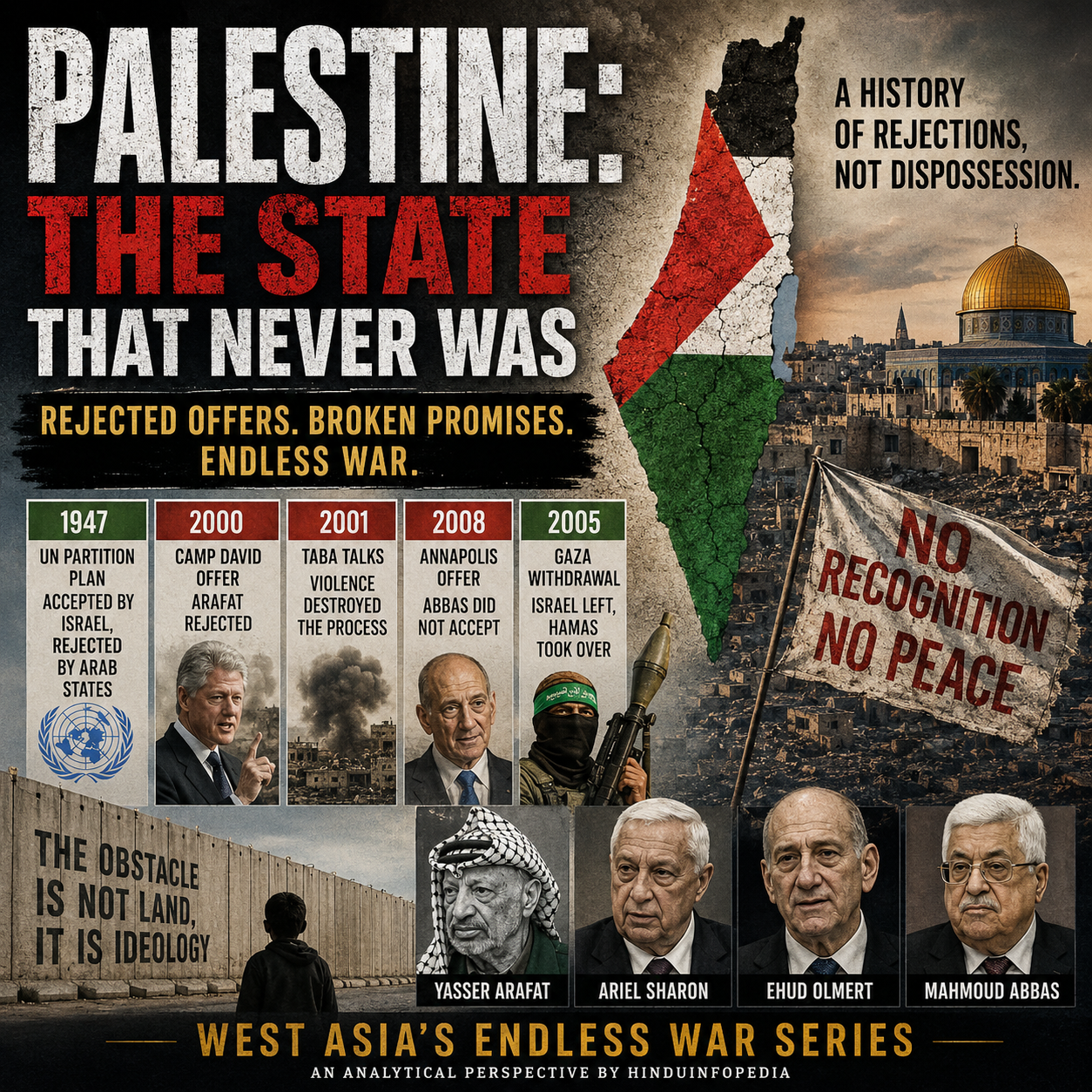
Palestine: The State That Never Was: A Reckoning of West Asia’s Endless War (71)
Part 71 of the West Asia’s Endless War Series
भारत / GB
The Two-State Solution Is Not Restoring Something That Was Lost. It Is Proposing to Create Something That Was Never Built — Including During Nineteen Years When the Arab States Who Now Demand It Controlled the Territory and Chose Not to Build It. Every Concession Israel Made Was Used to Prepare the Next Elimination Attempt. The Framework Refuses to Name What Genuine Resolution Requires.
Blog 70 (Palestine: The Territorial Record) established the documented sequence — Palestine never existed as a sovereign state, Arab states controlled the West Bank and Gaza for initial nineteen years after UN established two states without establishing one, and each elimination attempt produced a more territorially extensive Israel. Blog 71, Palestine: The State That Never Was, examines what that record means for the resolution frameworks the international community has proposed and the Palestinian leadership has consistently rejected — and names the one requirement that every proposed solution has contained and the elimination doctrine has consistently refused to accept.
Palestine: The State That Never Was — What the Two-State Solution Actually Proposes
Palestine: The State That Never Was: Not restoring something lost — proposing to create something never built. The two-state solution has been offered and rejected. Every concession Israel made was used to prepare the next war. The framework refuses to name what resolution actually requires. The international community’s two-state solution framework rests on a foundational premise that the Palestine Territorial Record (Blog 70) demonstrates is historically inaccurate: that a Palestinian state existed, was destroyed by Israel’s creation, and must be restored.
The accurate historical statement is different: a Palestinian state never existed. Its creation was proposed in 1947 and rejected by Arab states. It was available for creation during nineteen years of Arab state territorial control and was not created. What the two-state solution proposes is not restoration — it is creation. The distinction matters because restoration implies a wrong that must be remedied. Creation implies a political decision that must be made — and that decision requires the consent of both parties, including the party whose permanent existence the elimination doctrine has never accepted.
Palestine: The State That Never Was is documented most precisely in the three formal offers. The two-state solution has been offered formally three times with substantive terms. Each time it was rejected by Palestinian leadership.
The rejection record is the Palestine: The State That Never Was argument’s most precise evidence — because it documents that the obstacle to Palestinian statehood has not been Israeli refusal but Palestinian leadership’s unwillingness to accept the condition that any two-state solution requires: acknowledgment of Israel’s permanent existence within internationally recognised borders.
Camp David 2000:
US President Clinton’s bridging proposals offered the Palestinian Authority approximately 94-96% of the West Bank, all of Gaza, East Jerusalem as the capital of a Palestinian state, Palestinian sovereignty over the Temple Mount’s surface, and a $30 billion international compensation fund for Palestinian refugees. Yasser Arafat rejected the offer without a counter-proposal. Within weeks, the Second Intifada began. The Guardian reported that Palestinian negotiators later acknowledged the Second Intifada had been prepared in advance of the Camp David talks — the Intifada that destroyed a state-building process whose failure was blamed on Israeli intransigence.
The state that would have existed from 2001 was available. The Palestinian leadership chose the Intifada instead.
Taba 2001:
Negotiations continued at Taba after Camp David with even more generous terms on territorial exchange. They were abandoned by the Palestinian side when the Intifada’s escalation made any agreement politically impossible for both parties — an Intifada the Palestinian Authority’s own security apparatus was participating in.
Annapolis 2008:
Israeli Prime Minister Ehud Olmert offered Palestinian Authority President Mahmoud Abbas a state on 93.5% of the West Bank with land swaps to compensate for the remainder, a Palestinian capital in East Jerusalem, and an international committee to govern the Old City. Abbas took the maps, said he needed to consult, and never returned. The offer expired. No counter-proposal was made. The New York Times documented Abbas’s acknowledgment that he had not responded to Olmert’s offer — an offer Abbas himself described as more generous than any previous Israeli position.
📌 The Territorial Record That Preceded These Offers
Palestine never existed as a sovereign state. Nineteen years of Arab control produced no Palestinian state. Each elimination attempt produced a larger Israel. The historical sequence that makes the three rejected offers comprehensible.
Palestine: The State That Never Was — Every Concession Prepared the Next War
Palestine: The State That Never Was through negotiation is established by the three rejected offers. Palestinian statehood was available and was rejected. The peace process’s second dimension establishes that every territorial concession Israel made unilaterally — outside the negotiated framework — was used to prepare the next elimination attempt rather than to build a Palestinian state.
Oslo 1993 — guns into the West Bank and Gaza:
The Oslo Accords brought the PLO from Tunis exile, granted it governance authority over Palestinian populations in the West Bank and Gaza, and permitted it to maintain armed security forces. The Oslo process gave the Palestinian Authority the institutional infrastructure, the international recognition, and the armed capacity that a state-building process requires. The Second Intifada 2000-2005 deployed those armed forces against Israeli civilians — suicide bombings in markets, buses, and restaurants that killed over 1,000 Israelis in five years. The weapons Israel permitted the Palestinian Authority to hold for internal security governance were turned against the population on whose behalf the governance authority had been granted.
Gaza 2005 — complete evacuation, complete takeover:
Ariel Sharon’s unilateral withdrawal from Gaza in August 2005 was the most complete territorial concession in the conflict’s history. Every Israeli settlement was dismantled. Every Israeli soldier was evacuated. Gaza was handed over to the Palestinian Authority with its infrastructure intact.
The result: Hamas won the Palestinian legislative elections in 2006, executed a military coup against the Palestinian Authority in Gaza in 2007, and spent the following fifteen years constructing a massive tunnel network and rocket infrastructure—diverting cement and concrete meant for civil infrastructure, like water supply pipelines, to prepare for what ultimately became the October 7, 2023 attacks. The territory Israel vacated was not used to build a Palestinian state. It was used to build a military infrastructure for the next elimination attempt. The state that could have been built in Gaza between 2005 and 2023 — with international aid flowing, territory under Palestinian control, no Israeli military presence — was not built. The tunnels were.
The pattern Palestine: The State That Never Was documents across the negotiated offers and the unilateral concessions is identical: every opportunity to build a Palestinian state has been converted into preparation for the next elimination attempt. This is not a coincidental pattern. It is the operational consequence of the Raktbeej or starfish organism ecosystem that Blog 69 (Palestine Cause or Instrument) established — the three germination essentials (UNRWA hereditary status as earth, Martyr Fund as fertiliser, martyrdom curriculum as water) produce a political ecosystem in which state-building is structurally subordinate to resistance maintenance. The Palestinian leadership that rejected Camp David 2000 was not making a miscalculation. It was making the only decision available within the ecosystem it governs — because accepting permanent Israeli existence would have required dismantling the ecosystem’s theological foundation, which is the only source of its political legitimacy.
Palestine: The State That Never Was — What Resolution Actually Requires
The Palestine: The State That Never Was argument’s closing observation is the one the international community’s two-state solution framework consistently refuses to name: genuine resolution requires not another offer of territory but the prior acceptance of one condition that all three rejected offers contained and the elimination doctrine has never accepted — the permanent, irrevocable, non-negotiable acknowledgment that Israel exists and will continue to exist within internationally recognised borders.
This is not a political demand. It is the minimum logical requirement for any two-state solution. A Palestinian state alongside Israel is only possible if 57 Muslim majority countries in general and Palestinian leadership in particular acknowledges Israel’s right to be alongside. Every offer that has been rejected has required this acknowledgment. Every rejection has been, at its core, a refusal of this acknowledgment. The Martyr Fund pays pensions for killing Israelis. The UNRWA curriculum teaches that the land must be recovered. The theological architecture designates martyrdom in the cause of Palestine’s liberation — from Israeli existence — as the highest aspiration. Collectively, these factors have left Palestine with a rapidly growing population tethered to a heavily dependent economy. None of these three Raktbeej germination essentials is compatible with the acknowledgment that a two-state solution requires. The Dagdhabeej sterilisation — as Blog 69 established — requires removing all three. What the international community calls the peace process has never required the removal of any of them. It has simply offered territory while the ecosystem that prevents accepting territory remains fully operational.
The historical foundation that makes Israeli insistence on this acknowledgment comprehensible — rather than an obstacle to peace — is documented on hinduinfopedia.org: a people who experienced systematic genocide precisely because their tolerance was exploited as a vulnerability will not accept a territorial arrangement that leaves the ecosystem producing the next elimination attempt intact. The state that was never born will not be born through another offer of territory. It will only be born when the ecosystem that prevents its birth — the Martyr Fund, the UNRWA hereditary status, the martyrdom curriculum — is dismantled. The India 1947 control group that Blog 69 documented is not only the proof of concept for what Palestinian reconstruction could produce. The Raktbeej and Starfish Thesis establishes it as the operational template for what the Dagdhabeej sterilisation looks like when applied without the UNRWA architecture maintaining the Raktbeej germination essentials indefinitely.
📌 The Raktbeej Ecosystem That Prevents the State’s Birth
UNRWA hereditary status as earth, Martyr Fund as fertiliser, martyrdom curriculum as water — and the India 1947 control group that proves what happens when all three are absent.
Next: Islamic NATO Reckoning — Blog 72 in West Asia’s Endless War examines the Saudi-Pakistan-Turkey SMDA as an attempted Islamic collective defence architecture — its operational void, its nuclear umbrella creating existential conflict with Pakistan’s own 30-40 million Shia, and whether an alliance formed against Washington’s revealed conditionality can survive the internal contradictions written into its founding architecture. Part of the West Asia’s Endless War Series on hinduinfopedia.com.
Feature Image: Click here to view the image.
Videos
Glossary of Terms
- Two-State Solution: A diplomatic framework proposing separate Israeli and Palestinian states existing alongside each other within internationally recognised borders.
- Camp David 2000: US-mediated negotiations between Israel and the Palestinian Authority in which extensive territorial proposals for Palestinian statehood were discussed but ultimately rejected.
- Second Intifada: A violent Israeli-Palestinian conflict from 2000–2005 marked by suicide bombings, armed clashes, and military operations following the collapse of peace negotiations.
- Annapolis Process: The 2007–2008 US-backed peace initiative during which Israeli Prime Minister Ehud Olmert proposed a Palestinian state with territorial swaps and East Jerusalem arrangements.
- Oslo Accords: The 1993 agreements between Israel and the PLO that established limited Palestinian self-governance in parts of the West Bank and Gaza.
- UNRWA: The United Nations Relief and Works Agency responsible for Palestinian refugee support, criticised in the series for perpetuating hereditary refugee status.
- Martyr Fund: Financial assistance programs associated with payments to families of Palestinians imprisoned, injured, or killed in conflict with Israel.
- Temple Mount: A religiously significant site in Jerusalem sacred to Judaism, Islam, and Christianity, central to Israeli-Palestinian negotiations.
- Gaza Withdrawal 2005: Israel’s unilateral evacuation of settlements and military presence from Gaza under Prime Minister Ariel Sharon.
- Raktbeej Ecosystem: A unique term coined in this series describing a self-regenerating ideological and institutional conflict structure sustained through refugee status, militant incentives, and indoctrination.
- Dagdhabeej Sterilisation: A unique term coined in this series referring metaphorically to dismantling the institutional mechanisms believed to perpetuate recurring conflict generation.
- Elimination Doctrine: A key phrase in the series referring to ideological or political positions that reject Israel’s permanent existence as a sovereign state.
- Intifada: Arabic term meaning “uprising,” commonly used for periods of Palestinian revolt and violence against Israeli control.
- Palestinian Authority (PA): The governing administrative body established under the Oslo Accords to administer parts of the West Bank and Gaza.
- West Asia’s Endless War Series: The broader HinduinfoPedia analytical series examining historical, ideological, geopolitical, and institutional dimensions of the Arab-Israeli conflict.
#Palestine #Israel #Gaza #WestBank #Hamas #UNRWA #MiddleEast #Intifada #Jerusalem #PeaceTalks #TwoStateSolution #IsraelPalestine #Geopolitics #HinduinfoPedia
West Asia’s Endless War: Why This Series Exists
Refer to Various Arks Referred to in the Blog
https://hinduinfopedia.com/proof-of-endless-war-master-reference-table/
[…] भारत / GB […]
[…] Blog 71 (Palestine: The State That Was Never Born) established that a Palestinian state was formally offered three times through negotiation and rejected each time — the obstacle not Israeli refusal but Palestinian leadership’s unwillingness to accept the one condition any two-state solution requires: acknowledgment of Israel’s permanent existence. Blog 72 examines the military dimension of the same pattern: what each Arab attempt to eliminate Israel through force has produced territorially, and how the cumulative invoice of the elimination doctrine has created the occupation that the doctrine itself claims to oppose. […]
[…] https://hinduinfopedia.com/palestine-the-state-that-never-was-a-reckoning-of-west-asias-endless-war-… […]