

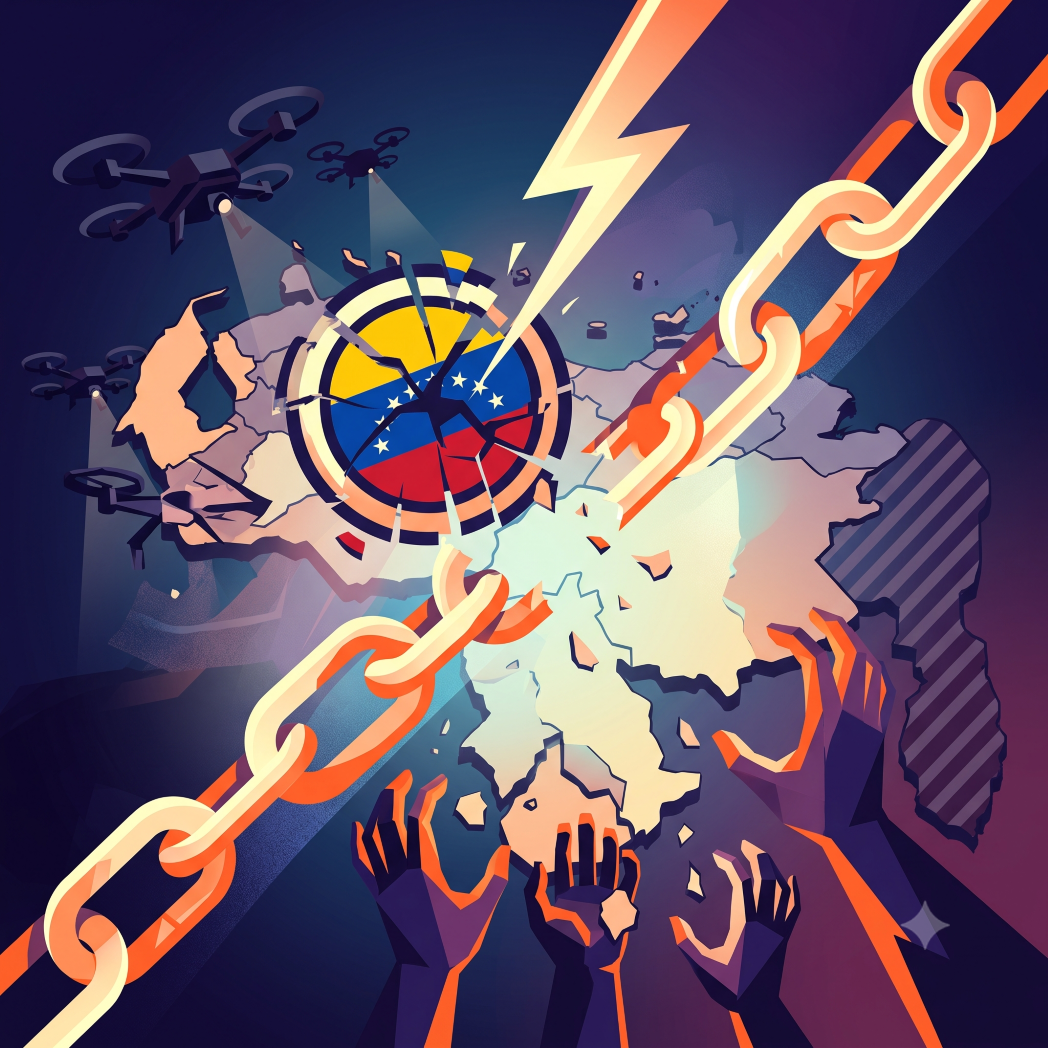
Venezuela Invasion Precedent: Sovereignty Stolen in Broad Daylight (9)
भारत/ GB
Part 9: Destabilization Doctrine of America
Venezuela Invasion Precedent: The Precedent That Repeats Itself
Venezuela Invasion Sovereignty stopped being a geopolitical hypothesis on January 3, 2026, at approximately 1:00 a.m. Caracas time. US Delta Force breached the private residence of a sitting head of state, extracted him under fire, placed him aboard USS Iwo Jima, and perp-walked him into DEA headquarters in New York — all before sunrise. The United Nations Security Council held an emergency session. A hundred and twenty-five nations of the Non-Aligned Movement condemned the act. And precisely nothing changed.
That silence is the real story. Not Maduro. Not Venezuela’s oil. Not even Trump. The story is that the rules-based international order — the architecture painstakingly assembled at San Francisco in 1945 — was openly, theatrically, and irreversibly broken. And the world’s response confirmed it no longer has the teeth to enforce itself.
For every nation that is not a nuclear power, not a US ally, and sits atop a resource Washington covets, Venezuela Invasion Sovereignty is not history. It is a preview.
The Escalation Ladder: How You Arrive at an Invasion
The Venezuela operation was not improvised. It was the final rung of a documented escalation sequence that this series has tracked across six prior blogs. Understanding that sequence is essential — because it is replicable.
Step 1 — Recognition warfare (2019): The US recognized Juan Guaidó as Venezuela’s “legitimate president” despite him controlling zero government institutions, zero territory, and zero military units. Forty-five countries followed Washington’s lead. The goal: delegitimize Maduro internationally while funding internal opposition.
Step 2 — Economic strangulation (2019–2025): Comprehensive sanctions targeted Venezuelan oil exports, the central bank, and individual officials. A maritime blockade began in December 2025 when US special forces seized a Venezuelan crude tanker off the coast.
Step 3 — Terrorism designation (July 2025): The US designated Venezuela’s Cartel of the Suns as a Foreign Terrorist Organization and alleged Maduro led it — a charge Latin American crime experts described as overstated. Critically, this bypassed any declaration of war requirement: military force against “terrorists” needs no congressional authorization.
Step 4 — Airspace closure (November 2025): Trump unilaterally declared Venezuelan airspace closed in a Truth Social post. Venezuela’s Foreign Minister called it “a colonialist threat.” No international body enforced anything.
Step 5 — Kinetic strikes (September–December 2025): US forces conducted the first airstrikes inside Venezuelan territory, targeting port facilities. Military infrastructure around Caracas was hit in a sustained campaign through December.
Step 6 — Decapitation (January 3, 2026): Delta Force breached Maduro’s residence at Fort Tiuna at 1 a.m., captured him and his wife Cilia Flores, extracted them under fire — a US helicopter was struck — and flew them to USS Iwo Jima. By 3:30 a.m., US forces were out of the country.
Every nation currently subject to US economic sanctions, terrorism designations, or “democracy promotion” programs now has a six-step model to study.
Three Official Pretexts — And the One Real Reason
Washington offered simultaneous justifications. Each deserves precise analysis.
Drug trafficking: Maduro was indicted by the US Justice Department in 2020 on cocaine-conspiracy charges. The terrorism designation followed in 2025. The legal architecture was constructed sequentially: designate → authorize force → act. This template is infinitely reusable. Any government targeted for removal can receive a narcotics designation first. It requires no evidence admissible in a neutral court — only a US attorney general willing to sign.
Democracy restoration: Venezuela’s 2024 election was widely assessed as fraudulent. The opposition candidate Edmundo González produced vote tallies showing a landslide victory; the government-controlled electoral council declared Maduro the winner. But as Chatham House’s international law program noted, classical practice holds that those exercising effective control over a nation’s territory are the government — regardless of legitimacy. The US has never applied the democracy standard to Saudi Arabia, Egypt, Bahrain, or any of two dozen allied autocracies.
Oil — the honest answer: Trump did not hide it. At his January 3 press conference, he stated Venezuelan oil revenues would flow to the Venezuelan people, to US oil companies, and “to the United States of America in the form of reimbursement” — claiming Venezuela had “stolen” oil from American companies through nationalization. Venezuela holds the world’s largest proven reserves: an estimated 300 billion barrels, 17% of global total. Trump did not contradict him — and within days the administration announced the United States would market Venezuelan oil “indefinitely,” with proceeds settling first in U.S.-controlled accounts.
Drug trafficking + disputed election + 300 billion barrels = the complete Venezuela Invasion Sovereignty formula. Nations that match this profile should read carefully.
What the UN Security Council Session Actually Proved
The emergency UNSC session held days after the operation was revealing — not for what it accomplished, but for what it exposed about the system’s architecture.
The Non-Aligned Movement — 125 states — formally condemned the operation. Russia, China, Iran, Brazil, Colombia, Mexico, Chile, and Uruguay spoke against it. Russia was given the grotesque opportunity to present itself as a defender of the international prohibition on the use of force — despite its own Ukraine invasion. The irony was not lost on anyone.
The UK and most Western allies declined to call the operation unlawful.
They cited Maduro’s democratic deficit and drug trafficking links — without actually providing a legal justification for the action. This diplomatic formulation — “we won’t call it illegal but we’ll mention his crimes” — is itself a new precedent. It means: we will not enforce international law when the violator is our primary patron.
US Secretary of State Marco Rubio, when challenged on the absence of congressional authorization, stated: “This wasn’t an invasion, we didn’t occupy a country.” But Brookings Institution analysts noted that the operation involved strikes on military targets around Caracas, the forcible abduction of a sitting head of state, and his transportation across international borders under armed guard. By every established definition in international humanitarian law, this was an act of armed aggression against a sovereign state.
Democratic Senator Mark Warner put it plainly: “Does this mean any large country can indict the ruler of a smaller adjacent country and take that person out? This would lead to total chaos.” He was speaking within hours of the operation. That chaos is already the operating environment.
The Monroe Doctrine Corollary: A Global Signal
The Atlantic Council described the operation as proof that the “Trump Corollary” to the Monroe Doctrine is officially in effect: the Western Hemisphere as a US sphere where Washington acts without authorization from any international body. But the audience was never just Latin America. NPR reported the Atlantic Council called it “a global reestablishment of deterrence” — a signal to Beijing and Moscow. The operation’s timing — days after the Chinese PLA was reported war-gaming operations in the Western Hemisphere — was not coincidental.
For Bharat, this matters structurally. The sovereignty arguments this network has made for years are now empirically confirmed. Financial sovereignty, strategic autonomy, indigenous defense production — these are not aspirational ideals. They are the minimum hardware required to remain outside the Venezuela Invasion Sovereignty scenario.
Executive Power Unbound: The Domestic Dimension
The operation was launched without congressional notification. Congressional leadership was informed only after operations concluded. The 1973 War Powers Resolution was treated as irrelevant. Brookings noted that the operation served a second agenda — using “a wartime footing to further expand presidential power domestically.” The America’s Boomerang thesis applies in full: a president who can unilaterally bomb a capital, extract its leader, and declare that the US will run the country — while oversight bodies learn about it from the news — has accumulated a power concentration that domestic institutions were specifically designed to prevent.
Colombia: The Threat Deployed Immediately
The Venezuela Invasion Sovereignty operation was barely 48 hours old when Trump, in a Fox News interview, threatened Colombia. He called President Gustavo Petro “a drug trafficker” running “cocaine mills and cocaine factories.” When asked directly whether military intervention like Venezuela was on the cards for Colombia, Trump said: “It sounds good to me.”
Petro rejected the accusations and said his “name does not appear in court records.” But the structural point is made: the Venezuela precedent was leveraged as active deterrent threat against the next sovereign government within 48 hours of the operation concluding. The precedent was not historical — it was operational.
What Panama 1989 and Venezuela 2026 Share — And How They Differ
The closest historical parallel is Panama 1989: US forces captured Manuel Noriega, the UN General Assembly condemned it as a “flagrant violation of international law,” Noriega was tried in the US and convicted, and the world moved on. But 1989 offered Cold War containment logic, and the US performed hesitation. In 2026, Trump held a press conference calling it “one of the most stunning, effective and powerful displays of American military might in American history” and declared the US would “run the country” until a transition could be arranged.
The openness is the doctrine. Rules were broken demonstrably — with a press conference, a perp walk, and a declaration of administration. The audience was not Venezuela. It was every government that holds resources America wants, disputes an election America dislikes, or pursues foreign policy alignment America disapproves of.
The Nuclear Deterrence Validation
Ukraine surrendered its nuclear arsenal in 1994 under the Budapest Memorandum in exchange for security guarantees from the US, UK, and Russia. Russia invaded in 2014 and again in 2022. Venezuela, without nuclear deterrent, received the complete escalation ladder from recognition warfare to decapitation strike in seven years.
This is not an argument for proliferation. It is an observation about the structural incentives the current environment creates for nations that wish to remain sovereign. The deterrence conversation — long considered settled — has been reopened by events that no amount of diplomatic language can close.
The Precedent That Cannot Be Undismissed
The Venezuela Invasion Sovereignty crisis crossed a threshold that cannot be walked back through diplomatic language or UN resolutions. A sitting head of state was extracted from his own fortified military compound by a foreign special operations unit, transported aboard a foreign warship, and arraigned in a foreign court — all without a declaration of war, without Security Council authorization, and without congressional approval.
That openness is the doctrine. Rules were not broken quietly — they were broken demonstrably, as a signal to every government watching. Every nation that holds resources a great power covets, every government that pursues an independent foreign policy, every state without nuclear deterrence — all received the same memo on January 3, 2026. Venezuela Invasion Sovereignty is the clearest articulation of the post-UN-Charter order yet delivered. There will be more.
Blog 8 documents the next chapter: The Houthi Strikes of February 2026 — pure executive military action, no congressional declaration, no UN authorization, redefining warfare as normalized foreign policy. The acceleration does not pause.
Feature Image: Click here to view the image.
Videos
Glossary of Terms
- Venezuela Invasion Sovereignty: A coined term in this series describing the January 2026 U.S. military operation against Venezuela as a precedent redefining the practical limits of national sovereignty.
- Destabilization Doctrine: A series-specific concept describing a structured sequence of diplomatic, economic, political, informational, and military measures used to weaken or replace targeted governments.
- Escalation Ladder: The sequential progression from diplomatic recognition campaigns and sanctions to military intervention and leadership removal.
- Recognition Warfare: The practice of granting diplomatic legitimacy to an alternative political leadership to weaken the internationally recognized government.
- Cartel of the Suns: The alleged Venezuelan criminal network that the United States designated as a Foreign Terrorist Organization in 2025 and linked to Nicolás Maduro.
- Decapitation Strike: A military operation aimed at capturing or eliminating the political or military leadership of a state.
- Rules-Based International Order: The post-1945 international system built around the United Nations Charter, international law, and multilateral institutions.
- Monroe Doctrine Corollary (Trump Corollary): The interpretation that the Western Hemisphere constitutes a U.S. sphere of influence where Washington may act without international authorization.
- Budapest Memorandum: The 1994 agreement under which Ukraine surrendered its nuclear arsenal in exchange for security assurances from the United States, the United Kingdom, and Russia.
- Nuclear Deterrence: The strategic concept that possession of nuclear weapons discourages external military aggression by raising the potential cost of attack.
- Executive Military Action: Military operations initiated primarily through executive authority without a formal congressional declaration of war.
- Financial Sovereignty: A nation’s ability to maintain economic independence through monetary, financial, and strategic control without excessive external dependence.
- Strategic Autonomy: The ability of a nation to make independent security and foreign policy decisions without external coercion.
- Non-Aligned Movement (NAM): An international grouping of states that traditionally avoid formal alignment with major power blocs and collectively addressed the Venezuela operation.
- DEA (Drug Enforcement Administration): The U.S. federal agency responsible for enforcing controlled substances laws and the authority before which Nicolás Maduro was presented after his capture.
#Venezuela #Maduro #Trump #Geopolitics #Sovereignty #UN #ForeignPolicy #Military #Sanctions #Oil #America #NAM #WorldPolitics #InternationalLaw #HinduinfoPedia
Earlier Blog of the Series
- https://hinduinfopedia.com/destabilization-doctrine-how-americas-foreign-policy-boomerang-is-striking-home/
- https://hinduinfopedia.com/activation-of-destabilization-doctrine-the-india-deployment-begins/
- https://hinduinfopedia.com/rahuls-gen-z-call-activation-of-destabilization-doctrine/
- https://hinduinfopedia.com/target-india-action-phase-doctrine-in-motion/
- https://hinduinfopedia.com/regime-change-playbook-a-manual-for-color-revolution-operations/
- https://hinduinfopedia.com/ukraine-proxy-war-2014/
- https://hinduinfopedia.com/us-hypersonic-destabilization-trumps-triple-threat-doctrine-acceleration/
- https://hinduinfopedia.com/americas-inversion-of-causality-the-manufactured-enemies-1950s-2020s/
Hindi Version Blogs
- https://hinduinfopedia.org/%e0%a4%af%e0%a5%82%e0%a4%95%e0%a5%8d%e0%a4%b0%e0%a5%87%e0%a4%a8-%e0%a4%aa%e0%a5%8d%e0%a4%b0%e0%a4%a4%e0%a4%bf%e0%a4%a8%e0%a4%bf%e0%a4%a7%e0%a4%bf-%e0%a4%af%e0%a5%81%e0%a4%a6%e0%a5%8d%e0%a4%a7-2014/
- https://hinduinfopedia.in/?p=24956
- https://hinduinfopedia.in/?p=25329
Related Reading:
- Destabilization Doctrine: How America’s Foreign Policy Boomerang Is Striking Home
- Understanding the Abrahamic Alliance Targeting India
- Media Manipulation: The False Causality Matrix
- How Global Media Manipulation Works
- The Human Rights Paradox
- Rights-Based Solutions as Strategic Deception
Follow us:
- English YouTube: https://www.youtube.com/@Hinduofficialstation
- Hindi YouTube: https://www.youtube.com/@HinduinfopediaIn
- X: https://x.com/HinduInfopedia
- Instagram: https://www.instagram.com/hinduinfopedia/
- Facebook: https://www.facebook.com/Hinduinfopediaofficial
- Threads: https://www.threads.com/@hinduinfopedia