

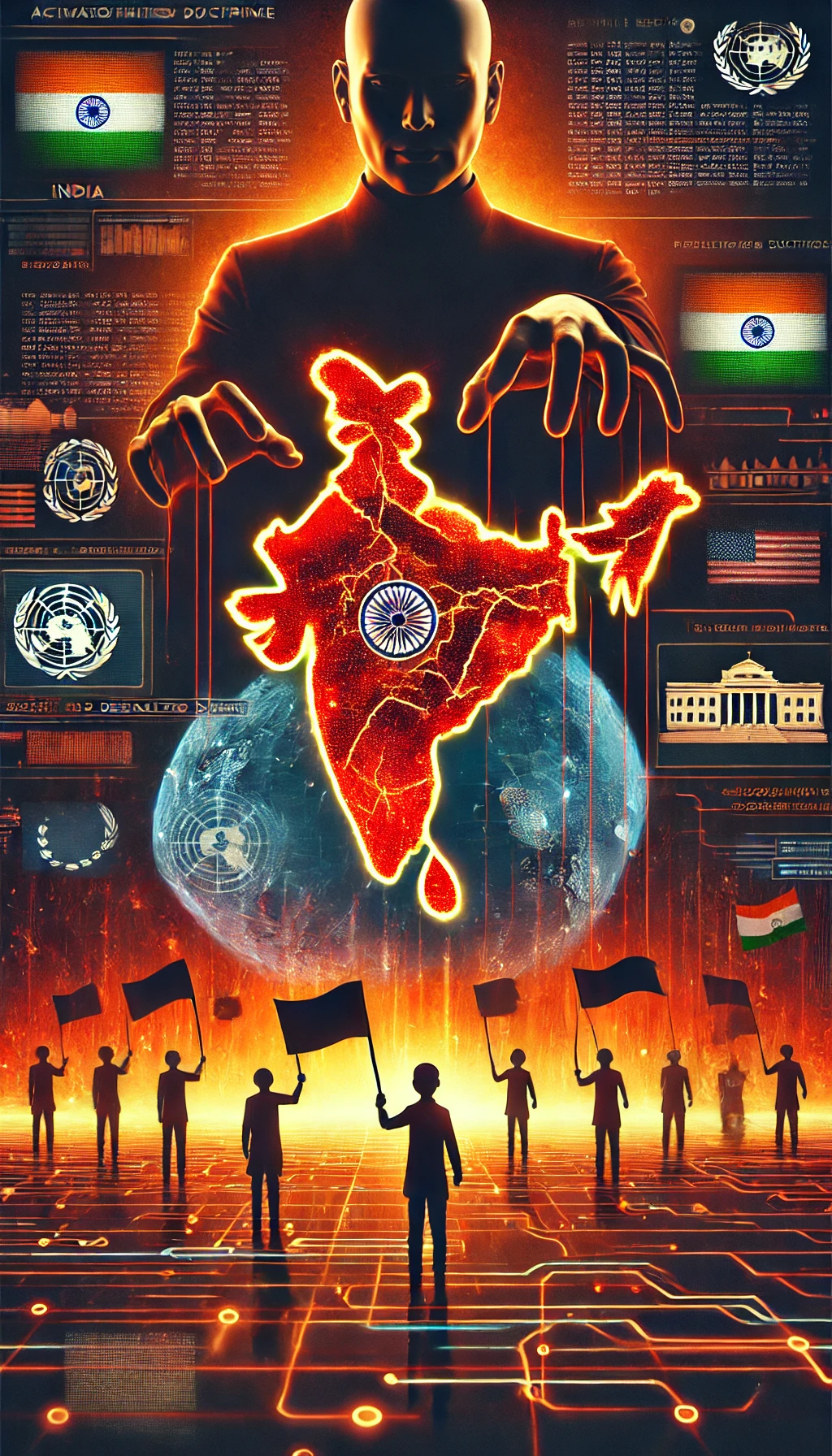
Activation of Destabilization Doctrine: The India Deployment Begins
Part 1.5A| #2: Destabilization Doctrine of America
Activation of Destabilization Doctrine
Following from the previous blog that describes how the US’s Destabilization Doctrine is now hurting the United States itself, we had to write a snap series—necessitated by the explicit call for Gen-Z protests by a senior politician from Bharat. There is adequate evidence in the public sphere that the activation of destabilization doctrine has already begun in Bharat.
The Activation of Destabilization Doctrine marks the point where analysis ends and operations begin. What was once a theoretical model—or one tested in smaller states—tracing America’s pattern of engineered regime shifts from Afghanistan to Ukraine, from Sri Lanka to Bangladesh, has now entered its operational stage inside Bharat. The doctrine’s activation is not speculative; it is visible through explicit political signaling, coordinated youth mobilization, and the replication of tested regional templates.
India now stands where Dhaka stood in mid-2024 and Kathmandu in late-2025 — at the convergence of a generational movement and a geopolitical design. The infrastructure built over decades — NGOs, academic cells, media amplifiers, and digital mobilization grids — is no longer dormant. The Destabilization Doctrine has been switched on, and its first live theater of deployment is unfolding within Bharat.
This blog documents that shift — how the template that dismantled governments across South Asia is being refined, adapted, and executed in India’s context. It is the chronicle of the active phase, where coordinated narratives, generational psychology, and international alignment converge into one operation: the India deployment.
This is not a drill. This is the active phase.
Having established that the doctrine is now active, we turn to the blueprint that underpins every operation—the tested template that has already toppled three governments in South Asia.
This blog documents that shift — how the template that dismantled governments across South Asia is being refined, adapted, and executed in India’s context.
It is the chronicle of the active phase, where coordinated narratives, generational psychology, and international alignment converge into one operation: the India deployment.
This is not a drill. This is the active phase.
This is not a drill. This is the active phase.
The Template – How Governments Fall in 90 Days
Having established that the doctrine is now active, we turn to the blueprint that underpins every operation—the tested template that has already toppled three governments in South Asia. Now, before understanding what’s being deployed in India, we must understand the proven template that worked in three neighboring countries within 18 months.
Sri Lanka 2022: The Aragalaya Prototype
Timeline: March-July 2022
Outcome: President Gotabaya Rajapaksa fled the country
The Pattern:
- Economic crisis provided the grievance (fuel shortages, inflation, debt default)
- Youth-led protests branded as “Aragalaya” (struggle) occupied key sites
- Sustained mobilization for months (not spontaneous, required organization and resources)
- International amplification transformed local crisis into global human rights issue
- Government paralysis as protests made governance impossible
- Leader flees rather than face violent escalation
Key Innovation: Youth framing. Not traditional opposition parties, but Gen Z presented as apolitical, authentic, representing “the people.”
Bangladesh 2024: The Perfected Model
Timeline: July-August 2024
Outcome: Prime Minister Sheikh Hasina fled to India on August 5, 2024
The Infrastructure (Documented in Blog 1):
- $1.73 billion USAID funding (2020-2024) built civil society networks
- NED/IRI training created youth activist cadres
- Funded rap artists produced protest anthems mobilizing urban youth
- Opposition coordination linked student protests to political objectives
- International pressure activated immediately (UN, Western governments, media)
The Trigger:
- Quota system protests (legitimate student grievance)
- Rapid escalation from campus issue to regime-threatening crisis
- “Gen Z vs. Autocracy” narrative dominated international coverage
- Violence (over 300 killed) attributed entirely to government brutality
- Sheikh Hasina forced to flee within weeks
The Critical Element: Hasina refused to cede Saint Martin’s Island for a US military base and rejected military agreements pushed by Victoria Nuland. When the opportunity arose, pre-positioned infrastructure was activated, and she was removed.
Lesson: $1.73 billion and four years of preparation can topple a government in 30 days when the moment arrives.
Nepal 2025: The Violence Escalates
Timeline: September 2025
Outcome: Prime Minister KP Sharma Oli resigned on September 9, 2025; at least 72 killed
The Context:
- $900 million+ in US funding through NED/IRI/USAID (documented)
- Explicit grants for “Promoting Youth Civic Engagement and Movement Building”
- Training programs teaching youth activists to “put pressure” on political establishment
- Strategic objective: Counter Indian and Chinese influence in Nepal
The Trigger:
- Anti-corruption protests by youth and students
- Rapid escalation to regime-threatening violence
- 72+ deaths (more violent than Bangladesh)
- PM Oli forced to resign within days
- Nepal became another example when neighbors become templates
The Innovation: Even more explicit Gen Z branding. Not “students” or “youth”—specifically “Gen Z” as generational identity transcending traditional political categories.
Nepal became another example when neighbors become templates.
The Innovation: Even more explicit Gen Z branding.
The Proven Template: Five Phases in 90 Days
The Proven Template: Five Phases in 90 Days
Phase 1 (Days 1-15): The Trigger
- Legitimate grievance emerges (economic crisis, controversial policy, election dispute)
- Pre-trained activists immediately organize
- “Gen Z” branding establishes youth as protagonists
- Social media amplification (#StudentProtest, #GenZRevolution)
- International media picks up narrative
Phase 2 (Days 16-30): Escalation
- Protests expand from initial issue to broader “democracy” demands
- Strategic locations occupied (government buildings, symbolic sites)
- Violence emerges (provocateurs? government overreaction? both?)
- International pressure begins (Western governments express “concern”)
- Opposition parties coordinate with street movements
Phase 3 (Days 31-60): Ungovernable Situation
- Daily protests sustained (requires funding and organization)
- Economic disruption (strikes, blockades, business closures)
- Media narrative: “Democracy vs. Dictatorship”
- International isolation (sanctions threats, diplomatic pressure)
- Government forced into security response (documented as “brutality”)
Phase 4 (Days 61-75): International Intervention
- UN statements, human rights organizations condemn government
- Western governments threaten sanctions
- International media saturation
- Alternative leadership recognized/legitimized
- Government loses ability to govern effectively
Phase 5 (Days 76-90): Regime Collapse
- Leader flees (Rajapaksa, Hasina) or resigns (Oli)
- OR government capitulates to demands (as in India’s farm-laws repeal)
- Opposition/protesters claim victory
- New government aligned with Western interests emerges
- In the Bharat context, such mobilizations culminate in flashpoints similar to Shaheen Bagh—where prolonged occupation, external amplification, and provocation risk ending in violence rather than resolution.
This exact template succeeded three times in 18 months. Now it’s being deployed in India.
The success of these operations was not spontaneous. Each required years of infrastructure development—civil, media, academic, and legal. In India, that infrastructure already exists and is waiting for activation.
This exact template succeeded three times in 18 months. Now it’s being deployed in India.
The success of these operations was not spontaneous. Each required years of infrastructure development
The Infrastructure is Already Built and Activated
The Infrastructure is Already Built and Activated.
The Bangladesh and Nepal operations required years of infrastructure development. In India, that infrastructure already exists—built over decades and recently exposed during the farmers’ protests.
The Toolkit Gang: Proven Coordination

• Digital Strike campaigns with coordinated hashtags (#FarmersProtest #StandWithFarmers)
• Embassy protest coordination on specific dates (February 13–14, 2021)
• International pressure targets: “Tag @PMOIndia… IMF, WTO, FAO, World Bank”
• Narrative framing templates: “Neo-colonial,” “corporate takeover,” “farmer exploitation”
• Global coordination instructions: “Organize action near Indian Embassy, Media House, Government office”
The revelation: This wasn’t organic solidarity—it was orchestrated intervention with professional coordination, predetermined dates, talking points, and international pressure mechanisms.
The outcome: Farm laws repealed in November 2021. The playbook worked.
The outcome: Farm laws repealed in November 2021. The playbook worked.
The Current Infrastructure: Multi-Vector Attack
The same coordination channels that achieved this outcome did not dissolve afterward; they evolved. What began as a protest toolkit became the operational skeleton for a larger, multi-domain architecture now spanning NGOs, media, academia, and digital activism.
The same networks revealed in the toolkit remain operational and have expanded:
1. NGO Networks
• Numerous organizations operate with foreign funding under FCRA, concentrated within specific advocacy and rights sectors.
• Select civil-society groups align advocacy with external agendas while projecting social or developmental causes
• Legal support networks ready to defend arrested activists
• Rights-based solutions frameworks that function as strategic deception

2. Media Amplification
• Funded outlets amplifying specific narratives aligned with regime change objectives
• Media as manipulator creating false causality matrices
• Global template manipulation showing identical deception patterns across democracies
• International media prepared to amplify “democracy crisis” narrative

3. Academic Networks• Leading academic institutions reflect post-colonial frameworks often critical of national policy narratives
• Faculty and students trained in activism and mobilization
• Universities as recruitment and training grounds for Gen Z activists
• Intellectual legitimacy provided to regime change narratives

4. Social Media Infrastructure
• Coordinated hashtag campaigns (proven capability from farmers’ protests)
• Influencer networks ready to amplify (domestic and international)
• Coordinated digital teams and automated accounts amplify protest-related trends online
• Platform algorithms understood and exploitable
5. Legal Warfare

• Strategic litigation to obstruct governance
• PIL (Public Interest Litigation) weaponization
• Judicial interventions and repeated PILs occasionally stall or delay key policy decisions
• Human rights organizations providing international legitimacy
6. Religious Mobilization Networks

• Transnational religious advocacy groups with shared ideological roots converge on India-related issues
• Demographic narratives and identity blocs are strategically leveraged for political mobilization
• Expanding faith networks provide organizational structures capable of rapid mobilization
• International religious organizations providing funding and coordination
This infrastructure is not in formation—it exists, functional and adaptable for rapid activation. It isn’t being tested—it was tested successfully in farmers’ protests. It’s operational, activated, and awaiting the triggering event.
Manufacturing the Triggers – Multiple Vectors Activated Simultaneously
With the infrastructure in place, the next phase involves manufacturing the triggers—the spark events that convert dormant networks into full-scale mobilization.
Unlike Bangladesh (quota system) or Nepal (corruption), the India operation employs multiple simultaneous triggering vectors—ensuring that if one fails, others can succeed.
Vector 1: Electoral Legitimacy Crisis (“Vote Chori”)
The Narrative: Election Commission is compromised, EVMs are manipulated, democracy is being stolen
The Evidence: Gandhi’s Haryana presentation making detailed but unsubstantiated allegations
The Function:
- Delegitimize electoral outcomes (even when Congress loses fairly)
- Create framework for refusing to accept future results
- Justify extra-constitutional mobilization (“restoring stolen democracy”)
- Parallel to Venezuela’s opposition claiming election fraud
The Activation Moment: Any major electoral loss can trigger “stolen election” protests, with Gen Z mobilized to “save democracy.”
Vector 2: Communal Flashpoints (“I Love Mohammad”)
The Pattern: Manufacture or amplify incidents involving religious sentiments to trigger communal mobilization
Recent Example: “I Love Mohammad” incident designed to inflame religious tensions
The Function:
- Test social media mobilization capability
- Create communal polarization that can escalate to violence
- Force government security responses that can be documented as “minority persecution”
- Activate religious demographic dynamics already in place
The Danger: Unlike electoral disputes, communal flashpoints can spiral rapidly into violence, creating international “humanitarian crisis” pretext for intervention.
Vector 3: Strategic Location Protests (Ladakh)
The Context: Ladakh protests combining legitimate local concerns with strategic destabilization
The Strategic Value:
- Ladakh borders China and Pakistan (geopolitically sensitive)
- Environmental framing appeals to international groups
- Tribal rights narrative provides human rights angle
- Timing during geopolitical tensions maximizes impact
The Function:
- Create instability in strategically critical region
- Force security responses in sensitive border area
- Provide international pretext for “concern” about “authoritarian” handling
- Demonstrate government weakness in securing borders
Vector 4: Economic Grievances (Inflation, Unemployment)
The Reality: Real economic challenges provide legitimate grievances
The Weaponization:
- Amplify economic difficulties through media.
- Attribute all problems to government policy (ignore global factors).
- Frame as a “failure of democracy” rather than policy challenges.
- Link to broader “authoritarianism” narrative.
The SIR Factor:
SIR has strategically amplified the economic-grievance line—particularly inflation and unemployment—within youth-facing communication. By framing every fiscal or employment setback as a moral and systemic failure, SIR’s messaging transforms legitimate economic pain into political mobilization fuel.
The Youth Angle: Unemployment particularly affects youth, making them receptive to Gen Z mobilization around economic issues.
Vector 5: Farmer Mobilization (Redux)
The Proven Model: 2020-21 farmers’ protests succeeded in forcing farm laws repeal
Current Status: Farmer demands continue (MSP guarantees), infrastructure remains operational
The Potential: Re-activate farmer networks in coordination with Gen Z urban mobilization, creating urban-rural alliance that government cannot isolate
The Multi-Vector Strategy
Why simultaneous activation matters:
- Overwhelms government response – Cannot address all crises simultaneously
- Creates coalition – Different grievances bring different groups (youth, farmers, minorities, etc.)
- Provides narrative flexibility – International media can focus on whichever vector gains traction
- Ensures success – If electoral fraud narrative fails, communal tensions might work; if neither works, economic grievances remain
- Accelerates timeline – Multiple crises create “ungovernable” situation faster
The Bangladesh parallel: Quota system protests + political opposition + economic grievances + international pressure = regime collapse in 30 days.
The India deployment: Electoral fraud + communal tensions + Ladakh protests + economic grievances + farmer demands + international pressure = ?
The Activation Confirmed
The evidence across vectors makes one fact indisputable—the Activation of Destabilization Doctrine is no longer theoretical. The template that dismantled governments in Sri Lanka, Bangladesh, and Nepal has moved into its Indian phase, adapted for a larger democracy and a more complex information ecosystem. Each operational element—youth mobilization, economic grievance amplification, communal flashpoints, and international narrative framing—is active and synchronised. Bharat’s challenge is no longer to identify the threat but to understand its internal alignment and external sponsorship.
The doctrine’s success elsewhere was rooted not only in street energy but in the invisible mesh of funding, training, and coordination that sustained it. That same mesh now connects NGOs, digital influencers, academic nodes, and political actors inside Bharat. The sequence has entered the deployment stage; the next phase will reveal the activation networks driving it.
Update – Jaipur Incident, 20 November 2025:
The Youth Congress’s attempted breach of police barricades in Jaipur directly aligns with the “activation phase” highlighted in this blog. With no societal grievance and no civilian support, the unrest was almost entirely cadre-manufactured. This is a textbook activation step—testing street mobilisation, police response, media angles, and Gen-Z involvement exactly as outlined in the doctrine.
Read Blog 2 → Rahul’s Call to Gen Z: The Seeding and Activation Phase.
Feature Image: Click here to view the image.
Videos
Glossary of Terms
- Gen Z Mobilization: The activation of India’s younger generation (born roughly 1997-2012) as the primary demographic for protest movements and political activism.
- Destabilization Doctrine: A strategic framework by which external and internal actors deploy coordinated multi-vector campaigns—combining youth protest, digital operations, media framing and legal pressure—to effect regime change or governance destabilization.
- Color Revolution Template: A standard sequence of phases (trigger → escalation → ungovernable situation → intervention → collapse) by which previous government-change operations have functioned in a dozen countries.
- Multi-Vector Strategy: The simultaneous use of disparate mobilization channels—electoral legitimacy narratives, communal flashpoints, economic grievance, rural-urban alliances—to create an “ungovernable” crisis.
- Tool-Kit Activism: Pre-prepared modules of hashtags, protest instructions, influencer scripts, campaign templates and international pressure nodes circulating ahead of major mobilizations.
- FCRA NGO Networks: Non-governmental organizations registered under India’s Foreign Contribution (Regulation) Act which receive foreign funds and may engage in social-political advocacy.
- Digital Strike Campaign: Coordinated online activity (hashtags, viral posts, influencer amplification, bot networks) designed to disrupt normal discourse and mobilize youth across platforms.
- Legal Warfare / PIL Mobilization: The use of Public Interest Litigations, strategic court filings, and judiciary pressure as part of broader protest operations to create policy paralysis and generate media narrative.
- Narrative Framing Matrix: The method by which specific language—such as “democracy under threat,” “vote theft,” “Gen Z revolution”—is systematically deployed across media, NGOs and social platforms to shape perception.
- India Deployment: The current phase in which the doctrine and template tested elsewhere is claimed to be actively applying inside Bharat / India.
#GenZ #VoteChori #ActivismIndia #DestabilizationDoctrine #HinduinfoPedia
#DestabilizationDoctrineofAmerica
Earlier Blog of the Series
Later Blog of the Series
- https://hinduinfopedia.com/rahuls-gen-z-call-activation-of-destabilization-doctrine/
- https://hinduinfopedia.com/target-india-action-phase-doctrine-in-motion/
Follow us:
- English YouTube: https://www.youtube.com/@Hinduofficialstation
- Hindi YouTube: https://www.youtube.com/@HinduinfopediaIn
- X: https://x.com/HinduInfopedia
- Instagram: https://www.instagram.com/hinduinfopedia/
- Facebook: https://www.facebook.com/Hinduinfopediaofficial
- Threads: https://www.threads.com/@hinduinfopedia
[…] The Ridda Wars (632-633 CE) occurred immediately after Muhammad’s death, when several Arabian tribes attempted to leave Islam or refused to pay zakat to the new caliph, Abu Bakr. The response was swift and merciless: total war against apostates. […]
[…] रिद्दा युद्ध (632–633 ई.) मुहम्मद की मृत्यु के तुरंत बाद हुए, जब अरब की कई जनजातियों ने इस्लाम त्यागने या नए ख़लीफ़ा अबू बक्र को अनिवार्य कर देने से इनकार किया। प्रतिक्रिया त्वरित और निर्दय थी— धर्मत्यागियों के विरुद्ध पूर्ण युद्ध। […]
[…] respect—it’s demanding supreme emotional allegiance that supersedes self-preservation. The activation of destabilization doctrine in India uses similar psychological mechanisms, but here we see the original […]
[…] activation of destabilization doctrine’s India deployment […]
[…] https://hinduinfopedia.com/activation-of-destabilization-doctrine-the-india-deployment-begins/ […]
[…] unique to Bengal. See how similar tactics operate globally in our Regime Change Playbook and Destabilization Doctrine series, and how courts fail to hold power accountable in our Judicial Accountability Crisis […]
[…] हमारे शासन परिवर्तन कार्यविधि और अस्थिरीकरण सिद्धांत शृंखला में देखी जा सकती हैं, तथा […]
[…] https://hinduinfopedia.com/activation-of-destabilization-doctrine-the-india-deployment-begins/ […]
[…] The UK’s Palestine Support Template reached critical mass. Starmer faced impossible math: research showed approximately 92-120 constituencies had Muslim populations exceeding 10%. In 21 constituencies, Muslims comprised over 30% of the electorate. Labour’s 2024 majority of 411 seats meant Starmer could theoretically lose every Muslim-majority seat and still govern. But the electoral threat wasn’t about actual seat loss—it was about perception management and political will destruction. […]
[…] international response mirrored Palestine patterns. Pakistan mobilized OIC support, Western media emphasized Muslim victimhood, and human rights organizations condemned Indian […]
[…] फिलिस्तीन पैटर्न की नकल करती है। पाकिस्तान ने OIC समर्थन जुटाया, पश्चिमी मीडिया ने मुस्लिम पीड़ितता […]
[…] Read the analysis → […]
[…] […]
[…] Activation of Destabilization Doctrine: The India Deployment Begins […]
[…] […]
[…] The India Deployment: Activation of Destabilisation Doctrine […]
[…] The India Deployment: Activation of Destabilisation Doctrine […]
[…] 🌍 Civilizational Warfare Patterns: Israel’s multi-front war reflects broader patterns of civilizational conflict: • Partition-Holocaust Parallels: Systematic Targeting Patterns • Destabilization Doctrine: South Asia Patterns […]
[…] Court banned a school textbook for citing its own pendency data, geopolitical analysts tracking India’s institutional landscape have noted a convergence of pressure points: international media narratives about Indian […]
[…] the very enemies it later claims it must heroically defeat. This process mirrors the current Activation of Destabilization Doctrine being deployed in other theaters […]
[…] अन्य क्षेत्रों में तैनात किए जा रहे Activation of Destabilization Doctrine के समान […]
[…] → सक्रियता: भारत में तैनाती का प्रारंभ […]
[…] → Activation: The India Deployment Begins […]
[…] में मुस्लिम ब्रदरहुड के अभियान और भारतीय धर्मांतरण अभियानों में दस्ताव… उसकी आधुनिक संस्थागत अभिव्यक्ति […]
[…] doctrines tested abroad return domestically. The Venezuela operation is this thesis made kinetic. Activation of Destabilization Doctrine: The India Deployment Begins — The same ladder Venezuela climbed is already assembled around Bharat. Which rung are we […]
[…] Activation of Destabilization Doctrine: The India Deployment Begins […]
[…] Activation of Destabilization Doctrine: The India Deployment Begins […]
[…] Activation of Destabilization Doctrine: The India Deployment Begins […]
[…] Activation of Destabilization Doctrine: The India Deployment Begins […]
[…] Activation of Destabilization Doctrine: The India Deployment Begins […]
[…] Activation of Destabilization Doctrine: The India Deployment Begins […]
[…] whose costs fall entirely on the guarantee recipients. The de-dollarisation impulse documented in Blog 9 of this series — described there as strategic risk management — has hardened into urgent policy […]
[…] डेस्टेबलाइजेशन डॉक्ट्रिन का सक्रियण:… […]
[…] Modern Indian destabilization follows a Destabilization Doctrine that mirrors European patterns of “demographic positioning” and “color […]
[…] https://hinduinfopedia.com/activation-of-destabilization-doctrine-the-india-deployment-begins/ […]
[…] Read “Activation of Destabilization Doctrine: The India Deployment Begins” → […]