

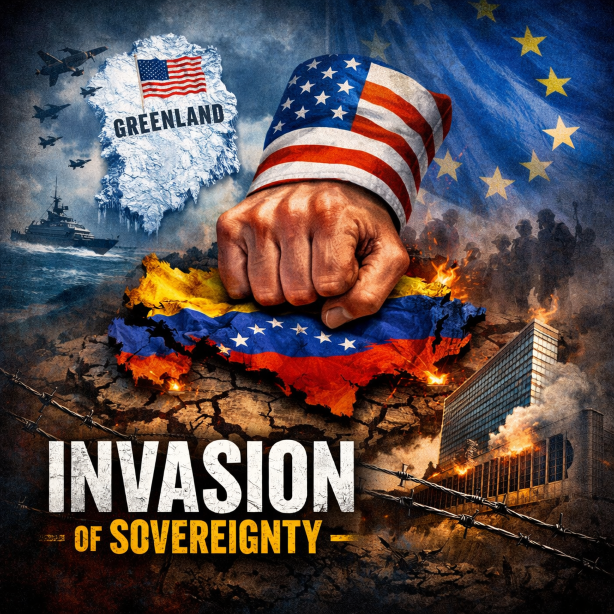
Venezuela’s Invasion of Sovereignty: When the Rules-Based Order Collapsed
Part 7/#10: Destabilization Doctrine of America
भारत / GB
Venezuela’s Invasion of Sovereignty: The Night the Rules-Based Order Broke
Venezuela’s Invasion of Sovereignty stopped being a geopolitical hypothesis on January 3, 2026, at just after midnight. Caracas time. US Delta Force breached the private residence of a sitting head of state, extracted him under fire, placed him aboard USS Iwo Jima, and perp-walked him into DEA headquarters in New York — all before sunrise. The United Nations Security Council held an emergency session. One hundred and twenty-five nations of the Non-Aligned Movement condemned the act. Yet none of the movement’s major powers spoke with comparable force, reflecting either strategic caution or the quiet pressure of geopolitical reality. And precisely nothing changed.
That silence is the real story. Not Maduro. Not Venezuela’s oil. Not even Trump. The story is that the rules-based international order — the architecture painstakingly assembled at San Francisco in 1945 — was openly, theatrically, and irreversibly broken. And the world’s response confirmed it no longer possesses either the will or the teeth to enforce itself.
For every nation that is not a nuclear power, not a US ally, and sits atop a resource Washington covets, Venezuela’s invasion of sovereignty is not history. It is a preview. The pattern was displayed earlier in Iraq in 2003 and again in Libya in 2011.
The Venezuela’s Invasion of Sovereignty Escalation Ladder
The Venezuela operation was not improvised. It was the final rung of a documented escalation sequence that this series has tracked across six prior blogs. Understanding that sequence is essential — because it is replicable.
Step 1 — Recognition warfare (2019):
The US recognized Juan Guaidó as Venezuela’s “legitimate president” despite him controlling zero government institutions, zero territory, and zero military units. Forty-five countries followed Washington’s lead. The goal: delegitimize Maduro internationally while funding internal opposition.
Step 2 — Economic strangulation (2019–2025):
Comprehensive sanctions targeted Venezuelan oil exports, the central bank, and individual officials. A maritime blockade began in December 2025 when US special forces seized a Venezuelan crude tanker off the coast.
Step 3 — Terrorism designation (July 2025):
The US designated Venezuela’s Cartel of the Suns as a Foreign Terrorist Organization and alleged Maduro led it — a charge Latin American crime experts described as overstated. Critically, this bypassed any declaration of war requirement: military force against “terrorists” needs no congressional authorization.
Step 4 — Airspace closure (November 2025):
Trump unilaterally declared Venezuelan airspace closed in a Truth Social post. Venezuela’s Foreign Minister called it “a colonialist threat.” No international body enforced anything.
Step 5 — Kinetic strikes (September–December 2025):
US forces conducted the first airstrikes inside Venezuelan territory, targeting port facilities. Military infrastructure around Caracas was hit in a sustained campaign through December.
Step 6 — Decapitation (January 3, 2026):
Delta Force breached Maduro’s residence at Fort Tiuna at 1 a.m., captured him and his wife Cilia Flores, extracted them under fire — a US helicopter was struck — and flew them to USS Iwo Jima. By 3:30 a.m., US forces were out of the country.
Every nation currently subject to US economic sanctions, terrorism designations, or “democracy promotion” programs now has a six-step model to study.
Venezuela’s Invasion of Sovereignty: Three Official Pretexts Vs Reality
Washington offered simultaneous justifications. Each deserves precise analysis.
Drug trafficking:
Maduro was indicted by the US Justice Department in 2020 on cocaine-conspiracy charges. The terrorism designation followed in 2025. The legal architecture was constructed sequentially: designate → authorize force → act. This template is infinitely reusable. Any government targeted for removal can receive a narcotics designation first. It requires no evidence admissible in a neutral court — only a US attorney general willing to sign.
Democracy restoration:
Venezuela’s 2024 election was widely assessed as fraudulent. The opposition candidate Edmundo González produced vote tallies showing a landslide victory; the government-controlled electoral council declared Maduro the winner. But as Chatham House’s international law program noted, classical practice holds that those exercising effective control over a nation’s territory are the government — regardless of legitimacy. The US has never applied the democracy standard to Saudi Arabia, Egypt, Bahrain, or any of two dozen allied autocracies.
Oil — the honest answer:
Trump did not hide it. At his January 3 press conference, he stated Venezuelan oil revenues would flow to the Venezuelan people, to US oil companies, and “to the United States of America in the form of reimbursement” — claiming Venezuela had “stolen” oil from American companies through nationalization. Venezuela holds the world’s largest proven reserves: an estimated 300 billion barrels, 17% of global total. Maduro said the US was coming for Venezuela’s oil. Trump did not contradict him.
Fact Check: Selective Application of Principles
The pattern is not new. The principles invoked in Venezuela have been applied selectively for decades.
Allies and democracy:
Many governments closely aligned with Washington — including several Gulf monarchies — are hereditary or highly centralized political systems. Yet their political structures have never been used as grounds for regime-change interventions. Strategic alignment, security cooperation, and the global petrodollar system have historically insulated these governments from the “democracy restoration” argument.
Pakistan precedent:
Pakistan offers a recent illustration of geopolitical selectivity. Former prime minister Imran Khan was removed from office in 2022 through a parliamentary vote of no confidence amid intense political pressure. Subsequent elections were widely criticized by observers for irregularities that effectively kept Khan and his party out of power. Despite these controversies, Western governments accepted the outcome without invoking democratic intervention.
Iraq precedent:
In 2003 the United States invaded Iraq on the grounds that Saddam Hussein possessed weapons of mass destruction. No such weapons were ever found after the invasion. The removal of the Iraqi government destabilized the country and contributed to prolonged insurgency, sectarian violence, and regional instability.
Egypt precedent:
In 2013 Egypt’s first elected president, Mohamed Morsi of the Muslim Brotherhood, was removed by a military coup. Despite the democratic mandate that had brought Morsi to power, Western governments quickly normalized relations with the new government led by Abdel Fattah el-Sisi.
Across these cases the principle appears consistent: democracy, terrorism, and criminal charges function as flexible justifications rather than universal rules.
Drug trafficking + disputed election + 300 billion barrels = the complete Venezuela’s Invasion of Sovereignty formula. Nations that match this profile should read carefully.
Venezuela’s Invasion of Sovereignty: Collapse of UN Enforcement
The emergency UNSC session held days after the operation was revealing — not for what it accomplished, but for what it exposed about the system’s architecture.
The entire UN multilateral system remained largely silent. The UN General Assembly did not convene. The Human Rights Council took no meaningful action. The International Court of Justice opened no proceedings. Regional organizations issued brief statements and moved on. Only the UN Security Council held an emergency meeting on January 5, 2026, where speeches were delivered, concerns were noted, and no binding action followed. Uganda, speaking in its capacity as chair of the Non-Aligned Movement, delivered a statement reflecting the concerns of many developing nations.
Then the world returned to business as usual. International law did not collapse with a dramatic rupture; it faded quietly in procedural language. The message was unmistakable: in the current international system, sovereignty survives not through law, but through military and economic power.
The UK and most Western allies declined to call the operation unlawful. They cited Maduro’s democratic deficit and drug trafficking links — without actually providing a legal justification for the action. And in the very same breath, many of these governments accuse Israel of near-genocide while supporting recognition of a Palestinian state whose main stream factions openly declare “death to Israel.” This diplomatic formulation — “we won’t call it illegal but we’ll mention his crimes” — is itself a new precedent. It means: we will not enforce international law when the violator is our primary patron.
US Secretary of State Marco Rubio, when challenged on the absence of congressional authorization, stated: “This wasn’t an invasion, we didn’t occupy a country.” But Brookings Institution analysts noted that the operation involved strikes on military targets around Caracas, the forcible abduction of a sitting head of state, and his transportation across international borders under armed guard. Even his own leader claimed to have “changed the ruler” in Venezuela. By every established definition in international humanitarian law, this was an act of armed aggression against a sovereign state.
Democratic Senator Mark Warner put it plainly: “Does this mean any large country can indict the ruler of a smaller adjacent country and take that person out? This would lead to total chaos.” He was speaking within hours of the operation. That chaos is already the operating environment.
The Monroe Doctrine Corollary: A Global Signal
The Atlantic Council described the operation as proof that the “Trump Corollary” to the Monroe Doctrine is officially in effect: the Western Hemisphere as a US sphere where Washington acts without authorization from any international body. But the audience was never just Latin America. NPR reported the Atlantic Council called it “a global reestablishment of deterrence” — a signal to Beijing and Moscow. The operation’s timing — days after the Chinese PLA was reported war-gaming operations in the Western Hemisphere — was not coincidental.
For Bharat, this matters structurally. The sovereignty arguments this network has made for years are now empirically confirmed. Financial sovereignty, strategic autonomy, indigenous defense production — these are not aspirational ideals. They are the minimum hardware required to remain outside the Venezuela’s Invasion of Sovereignty scenario.
Executive Power Unbound: The Domestic Dimension
The operation was launched without congressional notification. Congressional leadership was informed only after operations concluded. The 1973 War Powers Resolution was treated as irrelevant. Brookings noted that the operation served a second agenda — using “a wartime footing to further expand presidential power domestically.” The America’s Boomerang thesis applies in full: a president who can unilaterally bomb a capital, extract its leader, and declare that the US will run the country — while oversight bodies learn about it from the news — has accumulated a power concentration that domestic institutions were specifically designed to prevent.
Colombia: The Threat Deployed Immediately
The Venezuela’s Invasion of Sovereignty operation was barely 48 hours old when Trump, in a Fox News interview, threatened Colombia. He called President Gustavo Petro “a drug trafficker” running “cocaine mills and cocaine factories.” When asked directly whether military intervention like Venezuela was on the cards for Colombia, Trump said: “It sounds good to me.”
Petro rejected the accusations and said his “name does not appear in court records.” But the structural point is made: the Venezuela precedent was leveraged as active deterrent threat against the next sovereign government within 48 hours of the operation concluding. The precedent was not historical — it was operational.
What Panama 1989 and Venezuela 2026 Share — And How They Differ
The closest historical parallel is Panama 1989: US forces captured Manuel Noriega, the UN General Assembly condemned it as a “flagrant violation of international law,” Noriega was tried in the US and convicted, and the world moved on. But 1989 offered Cold War containment logic, and the US performed hesitation.
In 2026, Trump held a press conference calling it “one of the most stunning, effective and powerful displays of American military might in American history” and declared the US would “run the country” until a transition could be arranged.
The openness is the doctrine. Rules were broken demonstrably — with a press conference, a perp walk, and a declaration of administration.
The audience was never Venezuela. It was every government that holds resources America wants, disputes an election America dislikes, or pursues foreign policy alignment America disapproves of. The demonstration would soon reach Iran.
US-Led Hegemony and Pressure on Sovereign States
Ukraine surrendered its nuclear arsenal in 1994 under the Budapest Memorandum in exchange for security guarantees from the US, UK, and Russia. Russia invaded in 2014 and again in 2022. Venezuela, without a nuclear deterrent, received the complete escalation ladder from recognition warfare to decapitation strike in seven years.
Russia’s actions in Ukraine in 2014 were also shaped by the broader geopolitical environment created by US-led NATO dominance and earlier Western interventions in Kosovo, Afghanistan, Iraq, and Libya — operations that demonstrated how military force could be used to reshape governments and political orders.
NATO Expansion and Russia-Ukraine Wars
The 2022 Russia–Ukraine war is widely presented in Western media as “unprovoked Russian aggression.” This framing largely omits three decades of NATO expansion that steadily brought the alliance closer to Russia’s borders — a development Moscow repeatedly warned would provoke a response.
When the Soviet Union collapsed in 1991, NATO’s founding purpose — containing Soviet communist expansion — effectively disappeared. Instead of dissolving or freezing its membership, NATO expanded eastward, absorbing former Warsaw Pact states and even former Soviet republics. By 2022, the alliance had grown from 16 members to 30, with the Baltic states placing NATO forces directly on Russia’s frontier.
This expansion was not merely political. NATO missile defense systems were deployed in Poland and Romania, while military exercises near Russian borders became routine. Ukraine’s 2019 constitutional amendment declaring NATO membership a strategic goal crossed Russia’s stated red line. In December 2021, Moscow formally demanded security guarantees that Ukraine would not join NATO — a request the West rejected.
NATO’s European Assertion
The 2014 Maidan uprising, which removed Ukraine’s elected president Viktor Yanukovych after he rejected an EU association agreement in favor of closer ties with Russia, reinforced Moscow’s perception that Western influence was moving directly into its strategic space. A leaked phone call involving US official Victoria Nuland discussing Ukraine’s future leadership intensified that perception. Russia’s annexation of Crimea soon followed, securing its long-standing naval base in Sevastopol.
The 2014 Maidan uprising, which removed Ukraine’s elected president Viktor Yanukovych after he rejected an EU association agreement in favor of closer ties with Russia, reinforced Moscow’s perception that Western influence was moving directly into its strategic space. A leaked phone call involving US official Victoria Nuland discussing Ukraine’s future leadership intensified that perception. Russia’s annexation of Crimea soon followed, securing its long-standing naval base in Sevastopol.
In this interpretation, the Ukraine war reflects a broader geopolitical struggle over security, influence, and strategic resources — one that Russian leaders had warned about long before the conflict began, including in Vladimir Putin’s 2007 Munich Security Conference speech criticizing NATO expansion.
When the Soviet Union attempted to deploy nuclear missiles to Cuba in 1962, the United States treated it as an existential threat and was prepared to use force against the ships carrying those missiles. Today, even the possibility of Chinese military presence on islands in Oceania—such as the Solomon Islands—triggers strong concern in Australia and the United States. Yet the same powers expect Russia to accept NATO missile systems and military infrastructure moving steadily toward its own borders.
The Nuclear Deterrence Validation
The pattern across Asia and the Middle East confirms a brutal new reality: once nuclear capability exists, the calculus of intervention changes dramatically. Iran faces intense pressure—and now kinetic strikes—for even the suspicion of pursuing a “latent capability,” while North Korea’s possession of warheads and ICBMs grants it a grim immunity from the “decapitation” logic seen in Caracas. Similarly, Pakistan’s nuclear arsenal, developed while the West looked the other way during the Cold War, forced a regional strategic realignment with Bharat that prevents the kind of unilateral “recognition warfare” used against smaller, non-nuclear states.
Even more striking is the “Dimona Exception”—the case of Israel, which is widely understood to possess an undeclared nuclear arsenal while the United States and its allies maintain a policy of deliberate, selective silence. By refusing to join the Non-Proliferation Treaty (NPT), Israel operates outside the inspection regimes that the US uses as a pretext for sanctions elsewhere. This “amended ambiguity” allows Washington to advocate for a “nuclear-free Middle East” while providing diplomatic cover for its primary patron’s monopoly on deterrence. It is the ultimate proof that international “rules” are not universal laws, but adjustable tools used to protect allies and isolate targets.
This is not an argument for proliferation. It is an observation about the structural incentives the current environment creates for nations that wish to remain sovereign. The deterrence conversation — long considered settled — has been reopened by events that no amount of diplomatic language can close.
The Precedent That Cannot Be Undismissed
The Venezuela’s Invasion of Sovereignty crisis crossed a threshold that cannot be walked back through diplomatic language or UN resolutions. A sitting head of state was extracted from his own fortified military compound by a foreign special operations unit, transported aboard a foreign warship, and arraigned in a foreign court — all without a declaration of war, without Security Council authorization, and without congressional approval.
Previous violations of the UN Charter came with denials, proxies, and plausible deniability. January 3, 2026 came with a Mar-a-Lago press conference, a perp walk livestreamed by the DEA, and a declaration that the US would run Venezuela “until such time as we can do a safe, proper, and judicious transition.”
That openness is the doctrine. The rules were broken demonstrably, as a signal to every government watching, with many Western powers supporting the action and most declining to call it unlawful—even as the same perpetrator was simultaneously pressuring Denmark over Greenland’s sovereignty. Every nation that holds resources a great power covets, every government that pursues an independent foreign policy, every state without nuclear deterrence received the same memo on January 3, 2026. Venezuela’s invasion of sovereignty may be the clearest articulation yet of the post-UN-Charter order. There will be more.
Blog 8 documents the next chapter: The Houthi Strikes of February 2026 — pure executive military action, no congressional declaration, no UN authorization, redefining warfare as normalized foreign policy. The acceleration does not pause.
Feature Image: Click here to view the image.
Glossary of Terms
- Budapest Memorandum: A 1994 political agreement in which Ukraine gave up its inherited Soviet nuclear arsenal in exchange for security assurances from the United States, United Kingdom, and Russia.
- NATO Expansion: The post-Cold War enlargement of the North Atlantic Treaty Organization eastward into former Warsaw Pact and Soviet states, significantly altering Europe’s security architecture.
- Nuclear Deterrence: A strategic doctrine in which possession of nuclear weapons discourages adversaries from attacking due to the risk of devastating retaliation.
- Regime Change: The removal or replacement of a government by external or internal forces, often involving political pressure, covert operations, or military intervention.
- Recognition Warfare: A diplomatic strategy in which foreign governments recognize an opposition figure or alternative authority as legitimate leadership to undermine an existing regime.
- Decapitation Strike: A military or intelligence operation aimed at eliminating or capturing a country’s top leadership to rapidly collapse its command structure.
- Maidan Uprising (2014): The mass protests in Kyiv that led to the removal of Ukrainian President Viktor Yanukovych after he rejected closer integration with the European Union.
- Crimea Annexation: Russia’s 2014 takeover and incorporation of Crimea following Ukraine’s political upheaval, widely condemned by Western governments.
- Missile Defense Systems in Europe: NATO-linked missile interception systems deployed in Poland and Romania, officially aimed at countering missile threats but viewed by Russia as a strategic risk.
- Cuban Missile Crisis: The 1962 confrontation between the United States and the Soviet Union triggered by the deployment of Soviet nuclear missiles in Cuba.
- Solomon Islands Security Agreement: A recent security pact between China and the Solomon Islands that raised concerns in Australia and the United States about Chinese military presence in Oceania.
- Cold War Security Architecture: The global alliance system and military structures established after World War II to counter ideological and geopolitical competition between the United States and the Soviet Union.
- Post-UN-Charter Order: A concept describing a geopolitical environment in which major powers increasingly bypass the legal norms established under the United Nations Charter.
- Strategic Sovereignty: A state’s ability to maintain political independence and security without external coercion or dominance.
##Sovereignty #NATO #UkraineWar #GlobalPolitics #MilitaryIntervention #NuclearDeterrence #WorldOrder #USForeignPolicy #America #USForeignPolicy #RegimeChange #CIA #ISIS #Iran #Afghanistan #Ukraine #Geopolitics #Blowback #Destabilization #USPolicy #RegimeChange #Geopolitics #GlobalConflict #Sanctions #DeDollarization #HinduinfoPedia #ColorRevolution #DestabilizationDoctrineofAmerica
Earlier Blog of the Series
- https://hinduinfopedia.com/destabilization-doctrine-how-americas-foreign-policy-boomerang-is-striking-home/
- https://hinduinfopedia.com/activation-of-destabilization-doctrine-the-india-deployment-begins/
- https://hinduinfopedia.com/regime-change-playbook-a-manual-for-color-revolution-operations/
- https://hinduinfopedia.com/ukraine-proxy-war-2014/
- https://hinduinfopedia.com/us-hypersonic-destabilization-trumps-triple-threat-doctrine-acceleration/
Follow us:
- English YouTube: https://www.youtube.com/@Hinduofficialstation
- Hindi YouTube: https://www.youtube.com/@HinduinfopediaIn
- X: https://x.com/HinduInfopedia
- Instagram: https://www.instagram.com/hinduinfopedia/
- Facebook: https://www.facebook.com/Hinduinfopediaofficial
- Threads: https://www.threads.com/@hinduinfopedia
[…] भारत / GB […]
[…] https://hinduinfopedia.com/venezuelas-invasion-of-sovereignty-when-the-rules-based-order-collapsed/ […]
[…] exports and financial access, effectively restricting its primary revenue source. As examined in Venezuela’s Invasion of Sovereignty, these measures extended beyond leadership pressure and contributed to inflation, shortages, and […]
[…] आय स्रोत प्रभावी रूप से सीमित हो गया। वेनेजुएला की संप्रभुता पर आक्रमण में जांच की गई कि ये उपाय नेतृत्व दबाव […]