

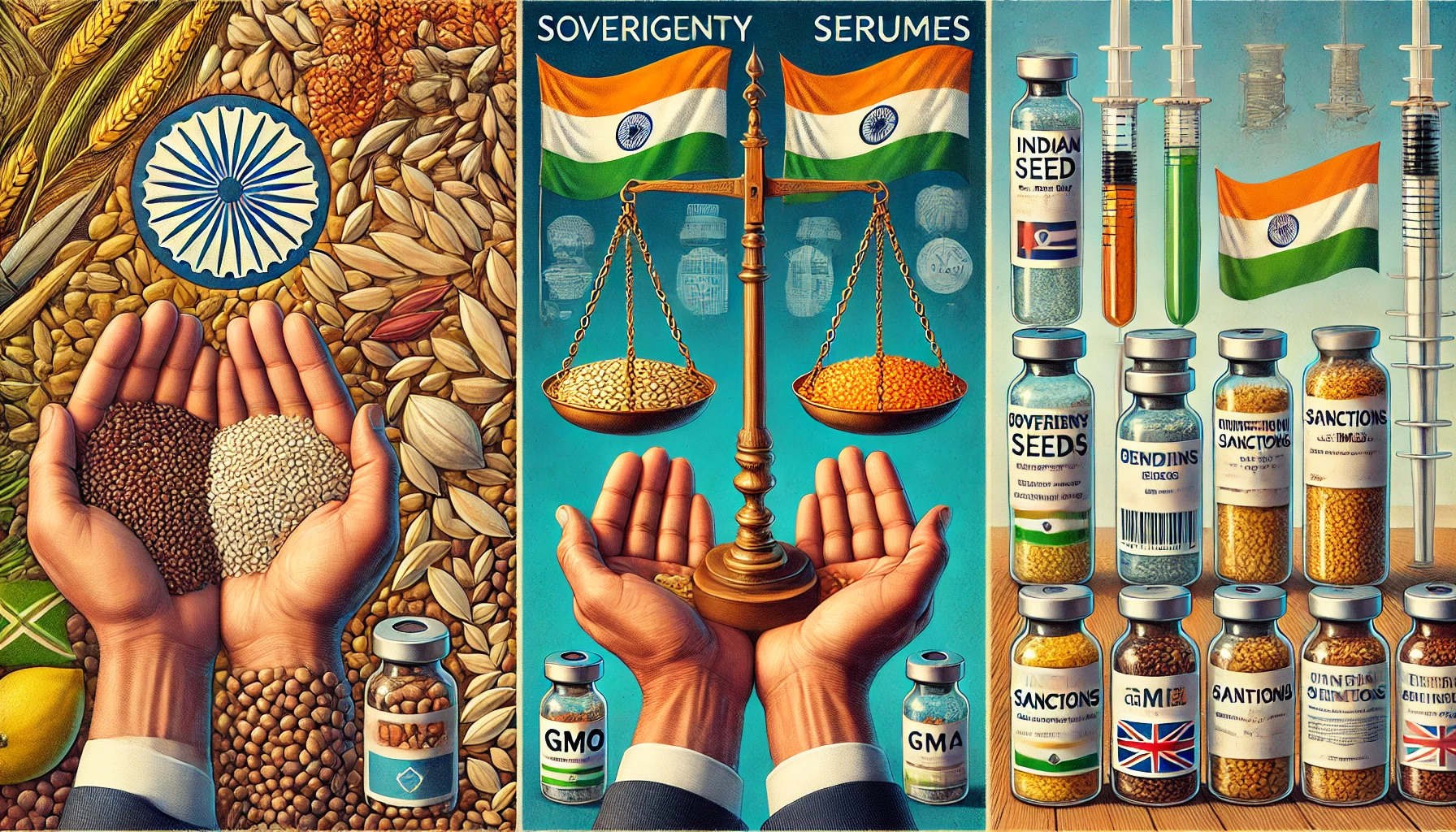
Global Trade vs Bharat’s Sovereignty: Seeds, Serums, and Sanctions
Part I of the India-US Trade War Series
Seeds, Serums, and Sanctions—One Pattern of Control
This blog is the third installment in a series that explores how Bharat’s modern economic, agricultural, and health decisions reflect a deeper battle for sovereignty in a world increasingly dominated by corporate, pharmaceutical, and geopolitical coercion. This is part of a larger global trade war that began when the Trump administration returned to power for a second term in January 2025.
The first two blogs examined:
- How Bharat rejected GMO seed clauses in U.S. trade deals to protect its farmers, biodiversity, and food systems.
- How this rejection was grounded not just in science, but in civilizational logic and satvik values.
This third blog expands the lens. It explores:
- How pandemic-era vaccine diplomacy mirrored the same exploitative pattern as GMO negotiations.
- How Big Tech and global media filtered truth, controlling narratives and silencing dissent.
- And how Donald Trump’s January 2025 announcement of a 50% tariff slab on Indian goods” OR “Trump’s proposed 50% tariff slab on Indian goods fits into the broader arc of coercion—not as policy, but as punishment for defiance.
Taken together, these three domains—seeds, serums, and sanctions—reveal a single strategy:
Control the life systems of a nation, and you don’t need to invade it.
Bharat, in all three cases, refused to be controlled.
This blog is not about crisis. It is about clarity through confrontation—a chronicle of Bharat’s resistance against being turned from a civilization into a client state.
Section 1: Global Trade and The Seed Sovereignty Standoff
This reflects a broader pattern of economic coercion that has intensified since Trump’s return to the presidency in January 2025—a conflict that goes far beyond market access—it was a civilizational test of sovereignty. At the heart of the proposed U.S.–India trade deal was a seemingly technical clause: accept genetically modified (GMO) seeds and the intellectual property (IP) patents of U.S. agribusiness giants like Bayer-Monsanto as a prerequisite for tariff reductions and agricultural cooperation.
But what was marketed as “scientific advancement” was, in reality, a subtle but sweeping power shift. By pushing Bharat to accept GMO seeds, the U.S. trade lobby was asking for the right to privatize the very foundation of Indian agriculture: the seed.
Bharat rejected this clause—not because of “anti-science” bias as some Western media caricatured it, but because of deep civilizational reasoning. In Vedic tradition, seeds are not commodities—they are beeja, the carriers of life and dharma, meant to be shared, protected, and preserved through generations. By accepting patented seeds, Bharat would have surrendered not just farmer autonomy, but the cultural and spiritual continuity of its food systems.
Moreover, the so-called scientific justifications were hollow. GMO seeds had failed to demonstrate long-term yield stability, and their dependence on chemical inputs like glyphosate created new health and ecological risks. What they did succeed in, however, was creating dependency—forcing farmers to buy seeds every season, tying them into legal contracts, and making them vulnerable to foreign lawsuits and price hikes.
The GMO clause was not about “feeding the world.” It was about feeding profits to the biotech lobby under the banner of free trade.
Bharat said no. Not just to the seeds—but to the system.
And that was the beginning of an unspoken retaliation.
Section 2: Pandemic Pressure & Pharma Profits
When COVID-19 hit the world, it didn’t just unleash a public health crisis—it opened a new frontier in global control. The virus may have been biological, but the response quickly became political, economic, and ideological. And in this new crisis, another industry—pharmaceuticals—emerged as the flagbearer of profit under the banner of “saving humanity.”
Behind the scenes, Western pharmaceutical companies pursued aggressive negotiation tactics during the pandemic. According to investigations by The Bureau of Investigative Journalism, Pfizer made unusual demands of Latin American governments, asking them to put up sovereign assets—including federal bank reserves, embassy buildings, and military bases—as collateral for potential legal costs related to vaccine contracts.1
Argentina’s health officials described these requests as unprecedented, with one official noting they had “only heard” such demands “when foreign debt had to be negotiated.”2 Brazil received similar proposals, which their Ministry of Health ultimately rejected, calling the contract clauses “abusive.”3
These negotiations went beyond standard industry practices. While most vaccine manufacturers sought basic indemnification, Pfizer’s contracts included broader liability protections and, in some cases, requirements that countries waive sovereign immunity over their governmental assets.4
The impact was significant: both Argentina and Brazil were unable to reach agreements with Pfizer, affecting vaccine access for their populations while neighboring countries that accepted the terms secured supplies.5 Multiple countries that did sign contracts agreed to terms where they would bear liability costs even in cases involving the company’s negligence.6
This occurred despite vaccines being developed with substantial public research funding, creating a situation where taxpayers funded development costs while also assuming liability risks through their governments’ agreements.7
This was not about health—it was about leverage.
Bharat once again charted a different course. While countries in Latin America, Africa, and Southeast Asia were cornered into vaccine contracts with opaque clauses, Bharat chose self-reliance. It developed indigenous vaccines like Covaxin, resisted corporate pressure, and rolled out a massive public immunization program. Despite early Western media smears about efficacy, Bharat’s strategy was vindicated by results.
But the backlash wasn’t just commercial. The Pentagon launched a covert information war, discrediting Chinese and Russian vaccines across social media in the Philippines and Central Asia. Since India used Russia’s Sputnik V vaccine, this campaign indirectly affected India’s vaccination efforts as well. The U.S. wasn’t just selling vaccines—it was defending a monopoly on narrative and market.
And at the heart of it all stood the same blueprint seen in the GMO fight: convert a crisis into a contract, offer a life-saving product, and slip in clauses that extract long-term economic or sovereign concessions.
Whether it was the seed or the serum, the strategy was the same: make nations kneel not with bombs, but with biotech.
Section 3: Media Filters & Manufactured Consent
As the seed and vaccine battles unfolded, another force worked silently in the background—global media and digital platforms. Not just as spectators, but as active enforcers of acceptable opinion. What couldn’t be imposed through trade clauses or health crises was shaped through narrative control. And this is where the “deep state” stopped being a metaphor and started acting like a system.
During the early stages of the COVID-19 outbreak, any mention of the lab-leak hypothesis was treated as conspiracy. Reputable scientists, including those with U.S. government links, privately discussed the plausibility of a lab-origin scenario—but publicly dismissed it. Big Tech platforms like Twitter, Facebook, and YouTube went further: banning content, deleting accounts, and labeling dissent as “misinformation.” This wasn’t public health policy—it was ideological policing.
The same suppression extended to critiques of mRNA vaccines, adverse effects, and even natural immunity. Medical journals, once forums for scientific debate, became gatekeepers of pharmaceutical orthodoxy. Fact-checkers—many funded directly or indirectly by the very foundations and corporations they claimed to monitor—decided what was “true.”
And the pattern matched exactly what happened during GMO debates. Vandana Shiva, Indian scientists, and farmers who challenged corporate seed patents were ridiculed, labeled as “anti-science,” and erased from the Western conversation. Scientific studies showing ecological risks of GMOs were sidelined, while industry-sponsored research was elevated. The media didn’t investigate—they participated.
In both cases, truth was algorithmically engineered. What could not be legislated was silenced. What could not be coerced through deals was erased through digital filters.
And Bharat, by simply choosing its own path—be it in agriculture or vaccination—was portrayed not as sovereign, but as suspect.
Section 4: Trump’s Tariff Slab – A Retaliatory Strike?
By early 2025, as Bharat had refused to bow to the GMO clause, resisted pharma coercion…” OR “Now, as Bharat continues to refuse the GMO clause and resist pharma coercion, and upheld its own model of pandemic response, the economic pressure tactics took a new turn—this time, through tariffs. But this wasn’t just the U.S. government. This was Donald Trump himself.
In an unambiguous message to Bharat, Trump publicly announced a 50% slab tariff on Indian goods, bypassing diplomatic subtlety and stepping into full-blown economic threat. This wasn’t routine trade policy—it was retaliation wrapped in negotiation.
Trump’s action isn’t isolated. It fits the same pattern seen in the GMO and vaccine chapters:
- Frame the issue as a “fair trade” problem.
- Use crisis or leverage to demand policy shifts.
- Punish resistance with economic consequences.
The tariff announcement followed Bharat’s earlier refusal of U.S. pressure to open its markets to genetically modified agricultural products, pharma patent overreach, and digital service controls. Trump’s move, far from being random, appeared like a penalty for non-compliance with a larger agenda.
By branding it “America First,” Trump framed the tariff as patriotic economics. But in reality, it functioned as an enforcement tool for entrenched corporate and geopolitical interests. The 50% slab wasn’t merely a response to trade imbalance—it was a signal to penalize Bharat’s growing assertiveness on global issues, from rejecting GMO clauses and vaccine pressure to refusing alignment with American strategic agendas. It targeted not surplus, but sovereignty.
Whether it’s the U.S. Trade Representative pushing for Bayer-Monsanto’s entry, Pfizer demanding sovereign collateral, or Trump slapping punitive tariffs, the message remains consistent:
If you don’t play by our rulebook, we’ll rewrite the rules.
But Bharat didn’t flinch. Just as it protected its seeds and its people from foreign dependence, it now faces the trade slab not as a weak nation negotiating market access, but as a civilizational force defending its autonomy.
Trump has previously claimed that he used trade leverage to help defuse a potential conflict between Bharat and Pakistan, presenting himself as a peacemaker. While Bharat acknowledged the gesture through diplomatic channels, it notably refrained from endorsing Trump’s broader narrative—one that he seemed to align with his ambition for international recognition, including the Nobel Peace Prize. Could this have contributed to the imposition of the 50% tariff slab on Bharat? While speculative, the timing suggests the tariff may be less about trade correction and more about sending a message—retaliation for Bharat’s unwillingness to align politically or validate personal agendas.
This is no longer about a product.
It is about the right not to be bought.
Bharat’s Model of Resistance
Across all fronts—agriculture, healthcare, trade, and digital policy—Bharat has demonstrated a rare posture in the 21st century: civilizational sovereignty in the face of coordinated global coercion. It didn’t just negotiate deals; it refused to surrender autonomy for access. And this refusal was not reactive but rooted in a deep worldview that sees life, health, and food not as commodities, but as sacred expressions of dharma.
In agriculture, Bharat protected its farmers and food traditions by rejecting GMO clauses, standing firm against patented seeds that would have turned its villages into corporate dependencies. It chose biodiversity over monoculture, and seed freedom over seed slavery.
In healthcare, Bharat resisted the vaccine diplomacy cartel. It refused to mortgage its sovereignty to Pfizer and instead developed its own vaccines, shared them globally, and retained decision-making power over its public health policies.
In digital narratives, despite being a target of misinformation, suppression, and algorithmic distortion, Bharat stayed committed to evidence-based policy and swadeshi discourse, building parallel media spaces and scientific voices that were not dependent on Western validation.
And now, even as Trump imposes punitive tariff slabs, Bharat has not backed down. Because this is not just trade—it is the latest chapter in a long history of attempts to convert Bharat from a sovereign civilization to a managed market.
But Bharat has remembered what many have forgotten:
That resistance is not rage. It is clarity.
That sovereignty is not isolation. It is self-truth.
And that standing alone is not weakness—when you stand on dharma, you stand with eternity.
Feature Image: Click here to view the image.
Videos:
Glossary of Terms
- Beeja: In Vedic tradition, seeds that are considered carriers of life and dharma, meant to be shared, protected, and preserved through generations rather than treated as commercial commodities.
- Bayer-Monsanto: A multinational agrochemical and agricultural biotechnology corporation formed after Bayer’s acquisition of Monsanto, known for producing genetically modified seeds and associated chemical inputs like glyphosate.
- Covaxin: An indigenous COVID-19 vaccine developed by Bharat Biotech in India, representing the country’s self-reliant approach to pandemic response without dependence on Western pharmaceutical companies.
- Covishield: The Indian-manufactured version of the Oxford-AstraZeneca COVID-19 vaccine, produced by the Serum Institute of India as part of the country’s vaccination strategy.
- Dharma: A fundamental concept in Indian philosophy referring to righteous living, moral law, and the principle of natural order that governs individual conduct and cosmic harmony.
- Glyphosate: A widely-used herbicide associated with genetically modified crops that has raised health and ecological concerns, particularly regarding its long-term effects on soil and human health.
- GMO (Genetically Modified Organism): Seeds or crops that have been genetically engineered in laboratories, often requiring specific chemical inputs and creating farmer dependency through patent restrictions.
- Hijra: Historically referring to migration for religious purposes, but in this context, allegedly used to describe strategic demographic settlement patterns for territorial influence.
- Intellectual Property (IP) Patents: Legal protections that grant exclusive rights to inventors or companies, in this case referring to agricultural biotechnology patents that can control seed usage and farmer practices.
- Pentagon Psychological Operations: Covert military information campaigns designed to influence public opinion and behavior, as documented in the case of anti-vaccine disinformation targeting Chinese and Russian vaccines.
- Pfizer: American multinational pharmaceutical corporation that developed one of the first COVID-19 vaccines and engaged in controversial contract negotiations with developing nations.
- Satvik Values: Principles derived from Sanskrit philosophy emphasizing purity, harmony, and natural balance, often applied to food systems and agricultural practices in Indian tradition.
- Sinovac: Chinese pharmaceutical company that developed the CoronaVac COVID-19 vaccine, which became a target of Pentagon disinformation campaigns in Southeast Asia and other regions.
- Sovereign Assets: National resources including federal bank reserves, embassy buildings, military bases, and other government-owned properties that represent a country’s territorial and economic sovereignty.
- Sputnik V: Russian-developed COVID-19 vaccine that was manufactured under license in India and became a target of U.S. military information operations aimed at undermining non-Western vaccines.
- Swadeshi: An Indian philosophy and movement emphasizing self-reliance, indigenous production, and economic independence from foreign control or influence.
- Tariff Slab: A structured system of import duties or taxes imposed on goods from specific countries, used as an economic pressure tool in trade negotiations and geopolitical conflicts.
- Vaccine Diplomacy: The strategic use of vaccine distribution and access as a tool of international relations and geopolitical influence, particularly during health crises like the COVID-19 pandemic.
#GlobalTrade #Sovereignty #BioPolitics #Geopolitics #HinduinfoPedia
References:
- Bureau of Investigative Journalism, “‘Held to ransom’: Pfizer demands governments gamble with state assets to secure vaccine deal,” February 23, 2021. ↩
- STAT News, “‘Held to ransom’: Pfizer plays hardball in Covid-19 vaccine negotiations with Latin American countries,” February 23, 2021. ↩
- Al Jazeera, “Investigation: Drugmaker ‘bullied’ Latin American nations,” March 11, 2021. ↩
- The Washington Post, “In secret coronavirus vaccine contracts with governments, Pfizer took hard line in push for profit, report says,” October 19, 2021. ↩
- The Mail & Guardian, “‘Held to ransom’: Pfizer demands governments gamble with state assets to secure vaccine deal,” February 28, 2021. ↩
- Public Citizen, “Pfizer’s Power: How Pfizer’s secret deals with governments undermine global vaccine access and threaten public health,” October 2021. ↩
- Bureau of Investigative Journalism, “Pfizer backs down over ‘unreasonable’ terms in South Africa vaccine deal,” April 19, 2021. ↩
8. Reuters Investigation (Primary Source)
- Citation: Reuters, “Pentagon ran secret anti-vax campaign to undermine China during pandemic,” June 14, 2024
- Why Most Relevant: This is the original investigative report that broke the story, with direct interviews of Pentagon officials and documented evidence of the campaign
9. Pentagon Official Acknowledgment
- Citation: Military.com, “Pentagon Stands by Secret Anti-Vaccination Disinformation Campaign in Philippines After Reuters Report,” June 15, 2024
- Why Most Relevant: Contains the Pentagon’s official response and admission that they conducted the campaign, including their justification for the operation
10. Academic Analysis
- Citation: Oxford Academic Journal of Public Health, “International relations in public health: the Pentagon’s anti-vax campaign during COVID-19 pandemic,” December 2024
- Why Most Relevant: Provides scholarly context and analysis of the geopolitical implications, lending academic credibility to the reporting
[…] coordinate Iran support through joint naval exercises and weapons supplies, and regional allies question American security guarantees when faced with an administration that simultaneously invades Venezuela, threatens NATO ally […]
[…] Read more… […]
[…] […]
[…] a Ukrainian farmer plants Bayer-Monsanto or Corteva seeds, they sign a contract that includes a no-saved-seed clause: the farmer may not […]
[…] एक यूक्रेनी किसान बायर-मोनसेंटो या कॉर्टेवा के बीज बोता है, वह एक […]
[…] समर्थन समन्वित, और क्षेत्रीय सहयोगी अमेरिकी सुरक्षा गारंटी पर सवाल जब एक प्रशासन का सामना जो एक साथ […]