

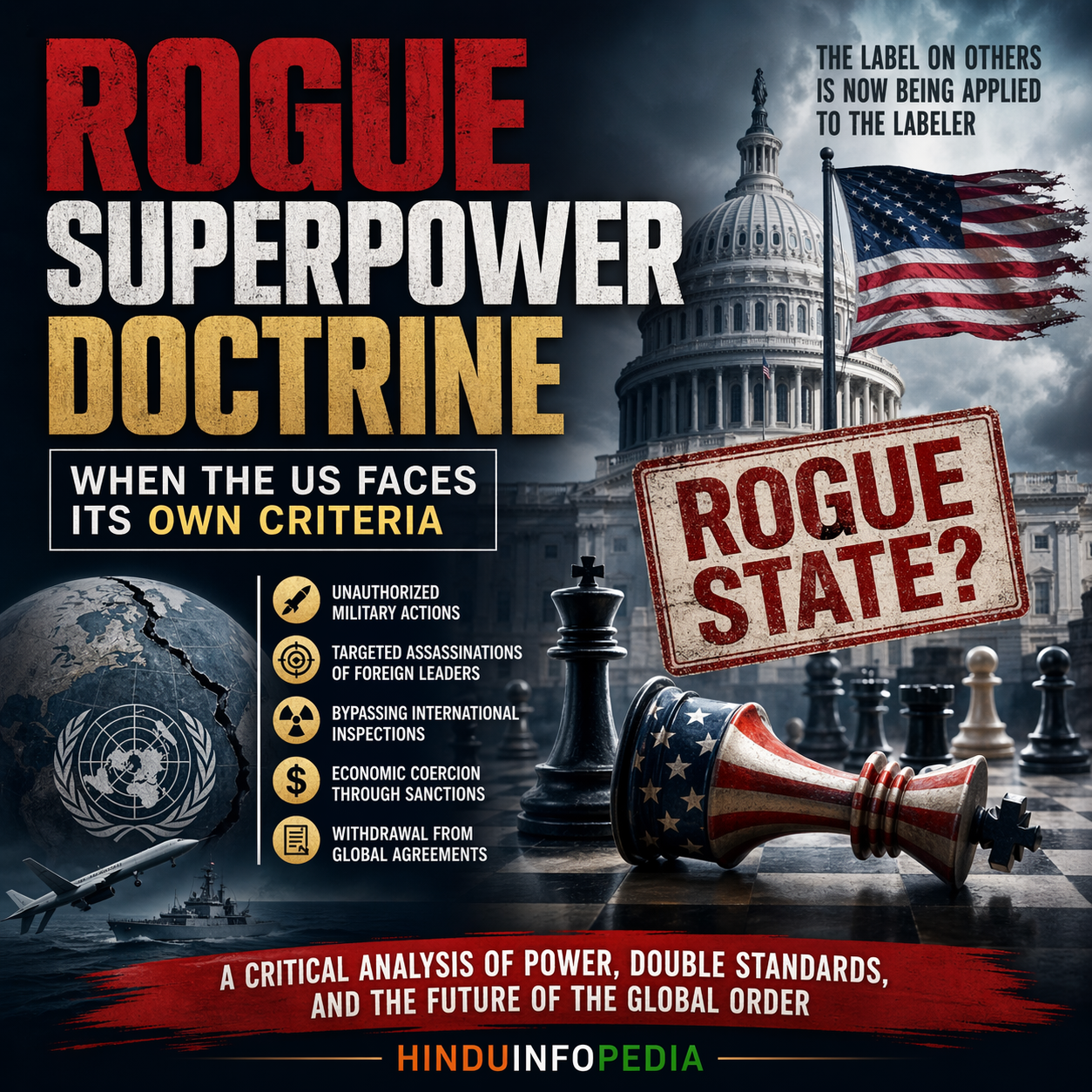
Rogue Superpower Doctrine: A Reckoning of West Asia’s Endless War (41)
Part 41 of the West Asia’s Endless War Series
भारत / GB
The Concept Washington Built to Justify Coercing Others Has Been Applied to Washington by Washington’s Own Analysts
Blog 40 established the NATO Weakening War — how the alliance was not consulted, was not invited, absorbed the consequences, and was condemned by its own founder for applying its own founding principles. Blog 41 examines the analytical verdict that the Iran war has produced from within Western institutions themselves: that Washington now meets its own criteria for a rogue state more precisely than the states it has designated with that label. The Rogue Superpower Doctrine is not a Global South argument. It is the Western establishment holding a mirror to itself.
Rogue Superpower Doctrine: Who Invented the Label and Why
In recent CNN-News18 interviews, Martin Wolf of the Financial Times noted that while Trump calls Iran a “rogue power,” the United States now looks to many as “an unreliable, almost rogue power.” He highlighted America’s erratic actions and expecting allies to fix Hormuz disruptions that “he with Israel created.”Washington invented the rogue state label. The Western establishment applied it back. The mirror is not flattering.
Rogue Superpower Doctrine:
Washington invented the rogue state label. The Western establishment applied it back. The mirror is not flattering. The concept of the rogue state was not a neutral analytical category. It was a political instrument developed by Washington in the 1990s under the Clinton administration — specifically by National Security Adviser Anthony Lake in a 1994 Foreign Affairs essay — to identify states that defied international norms, pursued weapons of mass destruction, sponsored terrorism, and used or threatened force outside legitimate frameworks. The rogue state designation was always simultaneously a legal argument and a power instrument — it classified certain states as outside the normal rules of diplomatic engagement, which justified sanctions, covert operations, and eventually military action without the usual requirement for multilateral authorisation. Iraq, Libya, North Korea, and Iran were the primary targets of the designation across three decades.
The Rogue Superpower Doctrine’s first argument is definitional: run the rogue state checklist against the states it was designed to label, and then run it against Washington. The results are not comfortable for the designation’s architects. Iran was mid-negotiation with IAEA inspectors when the strikes began — it had not withdrawn from the Nuclear Non-Proliferation Treaty, had not conducted nuclear tests, and its enrichment programme was within ranges that Washington’s own intelligence had previously assessed as non-weaponised. Washington, simultaneously, had launched strikes without UN Security Council authorisation, without congressional declaration of war, and without the multilateral framework that international law nominally requires for offensive military action against a sovereign state. The state that invented the rogue state label to describe states that act outside the rules launched a war that met its own definition more completely than the state it was fighting.
Rogue Superpower Doctrine: The Establishment Verdict
What makes the Rogue Superpower Doctrine analytically significant is not who is making this argument. It is where the argument is coming from. Blog 9 documented the Global South War Narrative — six billion people reading the war as resource imperialism, the latest expression of a colonial enforcement architecture. That argument from the Global South was predictable, dismissible by Western audiences as motivated criticism from states with a prior grievance.
The Rogue Superpower Doctrine is not that argument. Stephen Walt — professor of international relations at Harvard’s Kennedy School, writing in Foreign Policy — stated directly: “every country in the world is having to figure out how to deal with an increasingly rogue United States.” Walt is not a Global South voice. He is one of the most cited scholars of international relations in the Western academic establishment. His framework — offensive realism, balance of power theory — is the intellectual architecture through which American foreign policy has understood itself for decades. When Walt applies the rogue state concept to Washington, he is not speaking from outside the system. He is speaking from its centre, using its own analytical tools, and arriving at a conclusion the system did not intend.
Walt’s specific formulation is precise: the United States is “now acting like a predatory hegemon, exploiting positions of leverage built up over decades to exploit allies and adversaries alike — a zero-sum approach to nearly all relations with others, including a deep hostility toward most international institutions and norms, deliberately erratic behaviour, and a tendency to treat other foreign leaders with ill-disguised contempt.” Hal Brands at Bloomberg warned that Trump’s approach could transform the United States into an “out-of-control hegemon” at risk of being “weaker, lonelier and less effective than before.”
Stephen Walt in not alone to fix this label to the United States. Jeffrey Sachs, Director of the Center for Sustainable Development at Columbia, has been equally blunt, labeling the US a “rogue superpower” for its habitual violation of the UN Charter. Sachs argues that Washington now treats international law as an “encumbrance” to be discarded whenever it obstructs unilateral coercion.
This is not moral condemnation. It is a structural description of state behaviour — the same description Washington applied to Iraq, Libya, and Iran when it designated them rogue. The framework is identical. The subject has changed.
📌 The Rules-Based Order That Has No Independent Enforcer
The EU Mediator Vacuum established that the rules-based order has no enforcement mechanism independent of Washington. The Rogue Superpower Doctrine establishes why that structural absence is now the defining crisis of the order itself.
Rogue Superpower Doctrine: The Checklist Applied
The Rogue Superpower Doctrine’s analytical core is the simultaneous application of Washington’s own rogue state checklist to both Iran and Washington. The checklist has five criteria — each one used by Washington to justify decades of pressure against Iran:
Strikes without UN Security Council authorisation.
Iran has not conducted offensive military strikes outside its own territory or proxies without provocation. Operation Epic Fury launched on February 28, 2026 without UNSC authorisation — the Security Council was not consulted, no resolution was sought, and the legal basis offered was self-defence under Article 51, a claim that required Iran to have attacked a NATO member first, which it had not.
Targeted assassination of a foreign head of state.
Iran has not assassinated a foreign head of state. The opening strikes of Operation Epic Fury killed Supreme Leader Ali Khamenei, the constitutional head of state of the Islamic Republic of Iran, in his residential compound. The nuclear hypocrisy argument that Blog 6 established at the level of weapons programmes applies with equal force here: the state that defined assassination of foreign leaders as a rogue state behaviour conducted the largest such operation in modern history.
Defiance of international inspection processes.
Iran remained engaged in diplomatic nuclear talks with the United States (mediated in Geneva on February 16–17, 2026, with IAEA Director General involvement) and had granted inspectors access to several unaffected nuclear facilities in the preceding weeks. However, the IAEA’s February 27, 2026 report noted that Iran continued to restrict access to key sites damaged in prior conflicts and that the Agency “cannot verify whether Iran has suspended all enrichment-related activities” or provide full information on the size and location of its enriched uranium stockpile.
In contrast, the United States — while claiming the role of global enforcer of non-proliferation norms — had unilaterally withdrawn from the JCPOA in 2018, pulled out of the Paris Agreement (twice), the INF Treaty, Open Skies, and WHO membership during a pandemic. Operation Epic Fury was launched on February 28, 2026, without UN Security Council authorisation and without awaiting the outcome of ongoing talks or full IAEA verification processes. The state acting as self-appointed policeman bypassed the very multilateral inspection and diplomatic frameworks it has long demanded others uphold.
Economic coercion of civilian populations.
The New Colonial Enforcement architecture documented in Blog 17 established that forty-seven years of sanctions against Iran constituted collective economic punishment of a civilian population — the pharmaceutical supply chain collapse, the currency destruction, the household income compression. This is the rogue state criterion of economic coercion applied as the primary instrument of Washington’s Iran policy across five decades.
Unilateral withdrawal from multilateral frameworks.
Robert Kagan at The Atlantic noted that Trump has driven “deep and perhaps permanent wedges” between the US and its allies in Europe and Asia — the Iran war launched with “no public debate, no vote in Congress” and no consultation “with allies other than Israel.” Walt observed that the more states begin to balance against Washington — hard or soft — the easier it becomes for others to follow, because even a superpower cannot punish every act of defiance simultaneously. JCPOA withdrawn 2018, Paris Agreement withdrawn twice (e.g., referencing the 2017 and 2025 withdrawals), WHO withdrawn, INF Treaty withdrawn, Open Skies withdrawn. Iran has not unilaterally withdrawn from comparable multilateral frameworks.
Venezuela: Economic Warfare as Regime Change
Venezuela demonstrates how regime change can be pursued through economic coercion and political delegitimization without direct military intervention.
Sanctions imposed from 2017 onward targeted the country’s oil exports and financial access, effectively restricting its primary revenue source. As examined in Venezuela’s Invasion of Sovereignty, these measures extended beyond leadership pressure and contributed to inflation, shortages, and systemic economic instability—placing the burden largely on the civilian population.
In 2019, external recognition of opposition leadership created a parallel legitimacy structure, where authority and access to state assets were influenced by foreign backing rather than internal constitutional control. This marked a shift in how sovereignty was treated—no longer absolute, but conditional.
This pattern reflects a broader strategic logic discussed in America’s Inversion of Causality: economic distress—partly driven by sanctions—is presented as evidence of governance failure, which then justifies continued intervention.
These measures were implemented without UN authorization, relying instead on unilateral enforcement. The result is a clear precedent—economic warfare without formal conflict and external influence over internal legitimacy.
The Rogue Superpower Doctrine is not the conclusion that Washington is uniquely evil among great powers. All great powers have used force to protect their interests. The conclusion is more precise: Washington developed a specific legal and political category — the rogue state — to justify exceptional treatment of states that behaved in certain ways. On every criterion Washington used to designate Iran a rogue state, Washington’s own behaviour in 2026 meets the definition as fully or more fully than Iran’s. The Responsibility Blockade — the mechanism by which Washington assigns consequences to others — has been turned by the establishment’s own analysts against the mechanism’s architect.
📌 The Global South Said This First
Six billion people read this war as resource imperialism before Stephen Walt reached the same conclusion. The Global South War Narrative — why the world’s majority arrived at the rogue superpower verdict years before the Western establishment did.
Next: Russia Passive Dividend — Blog 42 in West Asia’s Endless War examines the most consequential non-participant in the conflict: Russia, which sat out the Iran war entirely, absorbed no military cost, collected elevated oil revenues as prices surged past $126 per barrel, watched NATO fracture without deploying a single soldier, and emerged from a war it did not fight in a strategically stronger position than when it began. The passive dividend is the purest expression of the series argument: every action Washington takes to enforce its order produces strategic gains for the adversaries it was des igned to contain. Part of the West Asia’s Endless War Series on hinduinfopedia.com.
Feature Image: Click here to view the image.
Videos
[…] भारत / GB […]
[…] Read: Rogue Superpower Doctrine → […]
[…] पढ़ें: Rogue Superpower Doctrine → […]
[…] को अप्रत्यक्ष रूप से वित्त देता है। रोग सुपरपावर सिद्धांत ने इस संरचना को नाम दिया, और वॉशिंगटन […]
[…] https://hinduinfopedia.com/rogue-superpower-doctrine-a-reckoning-of-west-asias-endless-war-41/ […]
[…] ब्लॉग 41 (रोग सुपरपावर सिद्धांत) ने यह दर्ज किया कि वाशिंगटन स्वयं उन मानकों को अधिक पूर्ण रूप से पूरा करता है, जिनसे वह अन्य देशों को चिन्हित करता है। महाशक्ति समुद्री लुटेरे की स्वीकारोक्ति का तर्क इसी ढांचे को समुद्री लूट की विशिष्ट विधिक श्रेणी पर लागू करता है। नॉटिंघम ट्रेंट विश्वविद्यालय और स्टर्लिंग विश्वविद्यालय के अंतरराष्ट्रीय विधि विशेषज्ञों ने सार्वजनिक रूप से कहा कि संयुक्त राष्ट्र सुरक्षा परिषद की अनुमति के बिना अंतरराष्ट्रीय जल में अमेरिकी जब्ती समुद्री विधि के अंतर्गत अत्यंत अस्थिर आधार पर है — यह अकादमिक भाषा है, उसी बात की जिसे वेनेजुएला के आंतरिक मंत्री और ईरान के विदेश मंत्रालय ने सीधे कहा: समुद्री लूट। […]
[…] Trap is that the war was launched to eliminate the toll booth and has produced a situation where two powers are fighting over who collects the toll — which is a worse position than the one the war was meant to […]
[…] Read […]
[…] ब्लॉग 41 (अनियंत्रित महाशक्ति सिद्धांत… ने स्टीफन वॉल्ट के निष्कर्ष को दर्ज किया था। उनके अनुसार वॉशिंगटन स्वयं उन मानकों पर ईरान से अधिक खरा उतरता है जिन्हें वह “अनियंत्रित राष्ट्र” की श्रेणी बताता है। इन मानकों में संयुक्त राष्ट्र सुरक्षा परिषद की अनुमति के बिना प्रहार करना, विदेशी राष्ट्राध्यक्ष की लक्षित हत्या, बहुपक्षीय निरीक्षण प्रक्रियाओं की अवहेलना, नागरिक जनसंख्या पर आर्थिक दबाव और बहुपक्षीय व्यवस्थाओं से एकतरफा हटना सम्मिलित हैं। संयुक्त राष्ट्र घोषणापत्र के मूल सिद्धांत — संप्रभु समानता, बल प्रयोग पर प्रतिबंध और विवादों का शांतिपूर्ण समाधान — इन्हीं मानकों की जाँच का आधार हैं। इज़राइल का अस्तित्व तर्क उसके दृष्टिकोण से इनमें से कुछ कार्यों को उचित ठहरा सकता है। वॉशिंगटन के रणनीतिक और वाणिज्यिक हित उन्हें वॉशिंगटन के दृष्टिकोण से उचित ठहराते हैं। दोनों औचित्य समान नहीं हैं। युद्ध वास्तव में किस उद्देश्य से चलाया गया था, इसे समझने के लिए यह अंतर महत्वपूर्ण है। […]
[…] Blog 41 (Rogue Superpower Doctrine) documented Stephen Walt’s verdict: Washington meets its own rogue state criteria more completely than Iran does. The criteria include: strikes without UN Security Council authorisation, targeted assassination of a foreign head of state, defiance of multilateral inspection processes, economic coercion of civilian populations, unilateral withdrawal from multilateral frameworks. The UN Charter’s foundational principles — sovereign equality, prohibition on the use of force, peaceful settlement of disputes — are the standards against which these criteria are assessed. Israel’s survival logic may justify some of these acts from Israel’s perspective. Washington’s strategic and commercial interests justify them from Washington’s perspective. The two justifications are different — and the difference matters for understanding what the war was actually for. […]