

New Colonial Enforcement in War: A Reckoning of West Asia’s Endless War (17)
भारत / GB
Part 17 of the West Asia’s Endless War Series
The Toolkit That Replaced Territorial Occupation
In the preceding parts, we examined how wars were repeatedly initiated on grounds that were often flimsy, if not entirely baseless. Blog 16 established the century of Colonial Order Endless War — from the Sykes-Picot map and mandate system to the systematic reversal of sovereign resource control from Mossadegh to Gaddafi. Then, it was United Kingdom and France leading interventions without broader global consultation. Today, the principal actors have shifted to the United States and Israel, but the pattern remains unchanged: wars initiated without meaningful international consensus. It is worse now, that after the war is initiated efforts made to draw other states into the conflict architecture. The difference is escalation—where earlier interventions operated within limited coalitions, current actions increasingly seek to compel wider participation, pressing actors such as Japan, South Korea, and NATO into roles that extend the conflict beyond its original theatre. Blog 17 examines how this same purpose is now pursued through New Colonial Enforcement in war — a framework of instruments that achieves the outcomes of occupation without the administrative cost of empire or the visibility of direct control.
New Colonial Enforcement in War: The Same Purpose, Updated Instruments
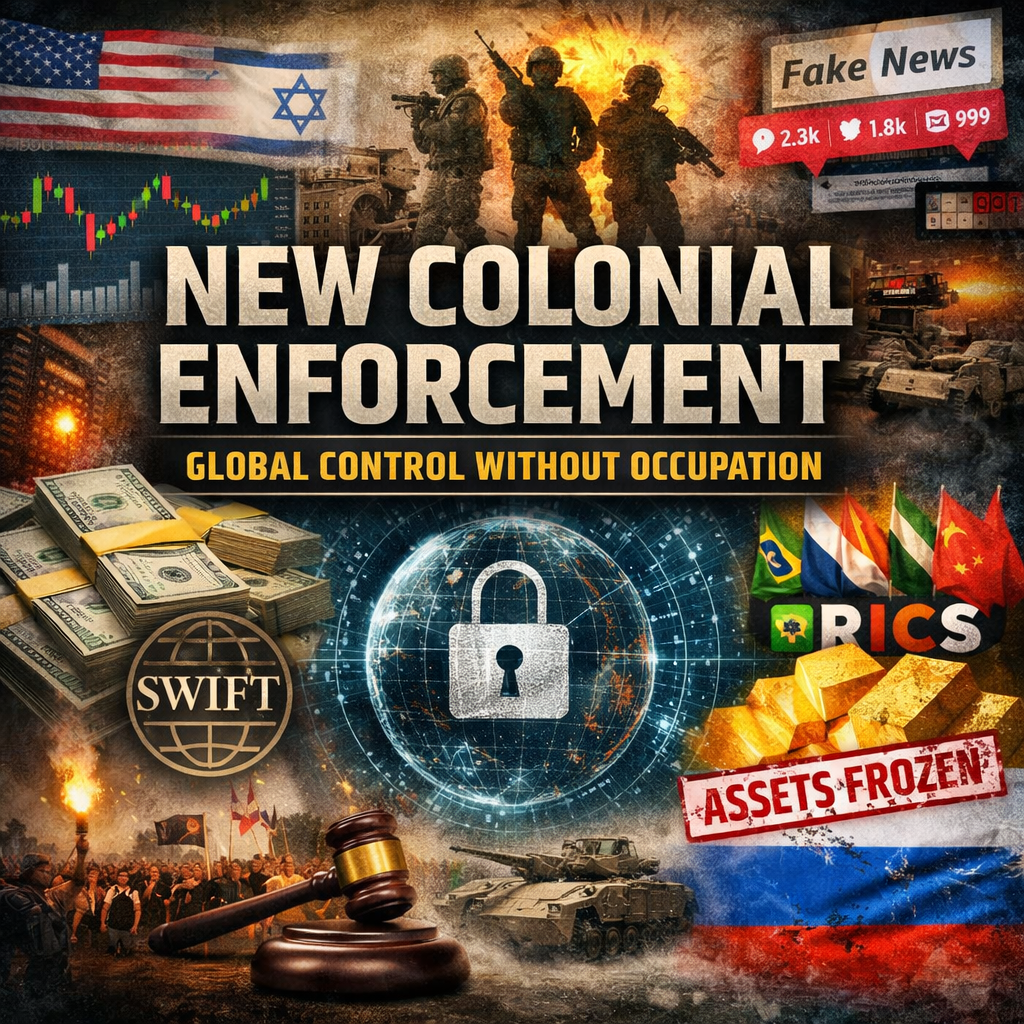
New Colonial Enforcement in war: Occupation without soldiers, control without colonies — the updated toolkit of the Colonial Order. The formal age of colonial territorial administration ended in the mid-twentieth century.
The New Colonial Nature of World Order
Between the end of formal colonial administration and the emergence of today’s enforcement toolkit lies a critical transitional phase. From 1945 to 1979, control did not disappear—it was reorganised through new global structures. The Bretton Woods system institutionalised financial influence via the IMF and World Bank, while Cold War interventions ensured political alignment across newly independent states. Resource control remained central, enforced through coups, proxy conflicts, and strategic alliances rather than direct rule. By the late 1970s, particularly after the oil shocks and the Iran Revolution, this evolving architecture had matured into a system capable of exercising control without territorial occupation. What appears today as a modern toolkit is therefore not a rupture from the past, but the consolidation of three decades of post-colonial adaptation.
The empires withdrew their flags, recognised independence, and departed — in most cases leaving behind borders drawn by Sykes-Picot, governments installed or approved by the departing power, and economic agreements that ensured the resource flows continued in the same direction under new legal arrangements.
Financial Colonisation
The first layer of this transition was financial. The Bretton Woods institutions—the IMF and World Bank—replaced colonial treasury control with conditional lending, currency management, and structural adjustment programmes that ensured newly independent states remained within a Western-defined economic framework.
What replaced direct administration was not the absence of control. During the Cold War, this financial architecture was reinforced by political intervention. Regime change operations, proxy conflicts, and security alliances ensured that governments deviating from this framework were corrected or replaced, preserving alignment without the need for formal colonial authority.
Outcome of Financial Colonisation
It was control by other means — a suite of instruments developed across seven decades, shaped through Bretton Woods financial structures, reinforced by Cold War interventions, and consolidated during the oil shocks of the 1970s, that achieve the same outcomes as territorial occupation while avoiding its administrative cost, its domestic political unpopularity, and its legal exposure under the post-war international framework that nominally prohibits annexation.
The four primary instruments of New Colonial Enforcement in war are economic sanctions, covert political destabilisation, dollar-system leverage, and information warfare. They are not used in isolation. They are layered — each one softening the target for the next, each one escalating in intensity when the previous level fails to produce compliance. The pattern across West Asia, South Asia, and Latin America over the past five decades is consistent enough to constitute a doctrine. This pattern is also visible in parts of Africa and Europe, as demonstrated in Libya and Kosovo. That doctrine has been documented, applied, and refined with each successive deployment.
Economic Sanctions: The Siege Without Walls
Economic sanctions are the first-line instrument of New Colonial Enforcement in war. They function as a medieval siege adapted to the architecture of the modern financial system. Rather than surrounding a city with an army, sanctions cut a state off from the dollar-denominated financial infrastructure through which the majority of global trade is conducted — SWIFT interbank messaging, correspondent banking relationships, insurance markets, and commodity exchanges. A state cut off from SWIFT cannot conduct international transactions. A state whose central bank is sanctioned cannot hold dollar reserves. A state whose oil exports are sanctioned cannot sell its primary revenue-generating asset to the majority of its potential buyers.
A further escalation occurs when sovereign debt structures activate cross-default and cross-acceleration clauses. In such cases, failure to meet a payment obligation to one creditor can trigger demands for immediate repayment across multiple debt instruments.
What begins as a single missed payment can cascade into a system-wide liquidity crisis, cutting off access to credit, freezing financial inflows, and accelerating economic collapse. The result is not merely financial distress but a rapid compression of sovereign economic space, where the state is forced into restructuring, external supervision, or policy concessions under pressure.
Freezing of Sovereign Assets: Coercion Through Financial Custody
An even more direct instrument within sanctions is the freezing of sovereign assets held abroad. Unlike trade restrictions, this does not limit future transactions—it immobilises wealth already earned. Central bank reserves, foreign exchange holdings, and state-linked financial assets can be rendered inaccessible by executive action within the jurisdictions that control the global financial system. Iran’s assets were frozen following the 1979 crisis, Afghanistan’s central bank reserves remain blocked after 2021, and hundreds of billions in Russian state assets were immobilised in 2022. In effect, this converts financial interdependence into custodial control, where access to a nation’s own reserves becomes contingent on political compliance rather than ownership.
The effects are not surgical. Iran under four decades of sanctions saw its currency collapse, its pharmaceutical supply chains disrupted, its industrial equipment import capacity destroyed, and its population’s living standards compressed by a mechanism that targeted the government but landed on the population. Venezuela under sanctions saw its oil production — the basis of its economy — fall from 3.2 million barrels per day in 1998 to under 700,000 by 2020 as spare parts, technical expertise, and investment capital became inaccessible.
The stated purpose of sanctions is always to change government behaviour.
The operational mechanism is always to make the population bear sufficient cost that political change from within becomes more likely. This is collective punishment with a legal letterhead.
Covert Destabilisation: Engineering the Interior
When sanctions alone fail to produce regime change, New Colonial Enforcement moves to its second instrument: covert political destabilisation. The toolkit here is diverse — funding and training opposition movements, supporting separatist pressures, manipulating social media platforms to amplify internal dissent, providing intelligence support to internal adversaries, and using NGO networks as conduits for political influence that bypasses the formal diplomatic channel.
The cases are documented. The colour revolution playbook — refined across Eastern Europe, Central Asia, and the Middle East — follows a consistent sequence: identify a credible internal opposition, provide funding and communications training, amplify grievances through sympathetic media, create a flashpoint, delegitimise the government’s response to the flashpoint, and support the transition to a government more aligned with external interests. The process is deniable at every stage. The funding flows through foundations and NGOs, as explored in manufactured enemy narratives. The media amplification happens through platforms whose content moderation policies are shaped in Washington. The intelligence support is covert.
The South Asian applications of this instrument connect directly to this series. Bangladesh and Nepal experienced engineered political destabilisation using the same mechanisms — IT lobby leverage over social media access, NGO network amplification, and targeted pressure on domestic political factions — supported by financial pathways examined in Nepal’s protest funding networks. Pakistan’s Imran Khan displacement followed the same pattern at the level of parliamentary procedure rather than street protest, a trajectory that aligns with doctrine blowback patterns. These operations share a common design architecture across cases over time. The instruments are updated. The logic is identical.
These are not isolated national events but regional expressions of a single operational design. The same architecture that shaped Iran in 1953 continues to appear, adapted but recognisable, across geographies and political systems. The instruments evolve with technology and context, but the underlying logic — external influence shaping internal political outcomes — remains constant.
📌 The Doctrine in Full
The operational framework connecting sanctions, covert pressure, and military action — documented across seven decades of deployment.
Dollar-System Leverage: Control Through Currency Architecture
The third instrument of New Colonial Enforcement in war operates through the global monetary system. The dominance of the dollar in trade settlement, reserve holding, and financial clearing allows enforcement without direct intervention. Access to liquidity, credit lines, and international markets becomes contingent on compliance. This transforms the financial system into an enforcement mechanism where exclusion is equivalent to economic isolation, and participation is conditional rather than sovereign.
This control is not passive—it is actively maintained. Any attempt to construct alternative financial architectures is met with immediate political and economic signalling. Proposals for non-dollar trade settlement mechanisms, including those discussed within emerging blocs such as BRICS, have been publicly discouraged, with warnings of economic consequences for states attempting to bypass the dollar system. The message is structural: participation in the global economy remains contingent on operating within the existing currency framework.
In effect, monetary dependence replaces territorial control. Where empires once controlled land, the modern system controls access—to capital, to markets, and to the financial infrastructure through which sovereignty is exercised. A state may retain its flag, its borders, and its formal independence, but without autonomous access to the global financial system, that sovereignty operates within externally defined limits.
New Colonial Enforcement: Information Warfare and the Narrative Layer
The third instrument of New Colonial Enforcement in war is information warfare — the management of the narrative within which sanctions and military action are framed for domestic and international audiences. The media template follows a consistent pattern across every intervention examined in this series: the target government is humanised as a threat, its victims are foregrounded while civilian casualties from the intervention are minimised, the legal basis for action is asserted with confidence regardless of its actual standing, and dissenting voices within the intervening state’s own institutions are marginalised. The pattern examined in Blog 8 of this series — the Western Narrative War — is not media bias in the ordinary sense. It is an instrument of enforcement: a narrative architecture that pre-legitimises action before it is taken and post-justifies it after.
The information warfare layer has acquired new precision with the development of social media platforms whose algorithmic architecture is controlled from within the jurisdictions of the states deploying New Colonial Enforcement. Content moderation decisions, trending topic management, account suspension policies, API access for third-party monitoring tools, and even the shaping of narrative content itself — as explored in the false causality matrix — are levers that can be applied to amplify approved narratives, suppress unapproved ones, and structure how events are interpreted — within the target state, among diaspora communities, and in the multilateral forums where legitimacy is contested.
This capability is not theoretical. It has manifested in domestic contexts, as seen in the Delhi Riots 2020 narrative formation, where information flows, amplification patterns, and framing battles shaped both perception and response. At the transnational level, networked activism and narrative alignment can be observed in cases such as the Greta Thunberg mobilisation episode, where coordinated messaging ecosystems demonstrated the ability to synchronise discourse across borders.
The IT lobby’s documented role in Bangladesh and Nepal is the regional application of a global capability.
New Colonial Enforcement and the 2026 Iran War
The 2026 Iran strikes represent the terminal point of New Colonial Enforcement’s escalation ladder against a single target state. Forty-seven years of sanctions failed to produce regime change. Multiple rounds of covert destabilisation — including the 2009 Green Movement, which received covert external support — failed to produce the political transition that sanctions were supposed to generate pressure for. The nuclear negotiations of 2015-2026 were used as a sanctions management mechanism rather than a genuine settlement pathway, with each agreement either withdrawn or superseded before its compliance requirements could normalise relations. When all instruments below the military threshold failed, the nuclear pretext was activated to legitimise the strikes that the enforcement architecture had been building toward for decades.
The Global South reads this sequence correctly — not as a single decision made in February 2026 but as the final escalation of a New Colonial Enforcement in war programme that began in 1979 and exhausted every non-military option before crossing the kinetic threshold. What makes 2026 historically significant is not the strikes themselves but their timing: they came mid-negotiation, after the enforcement toolkit had been fully deployed and had failed, making the underlying purpose — regime compliance, not nuclear safety — structurally visible to any government paying attention.
📌 The Media Template That Sold Each Enforcement Action
The narrative layer of New Colonial Enforcement — how the same media architecture packages each intervention for Western audiences.
Next: Petrodollar Betrayal — Blog 18 in West Asia’s Endless War examines the 1974 Nixon-Kissinger-Saudi agreement that converted dollar hegemony into a structurally enforced global norm — and why Iran’s refusal to price its oil in dollars is the real cause of the 2026 war that the nuclear pretext could not fully obscure.
Feature Image: Click here to view the image.
Videos
Glossary of Terms
- New Colonial Enforcement in War: The suite of non-territorial instruments — economic sanctions, covert political destabilisation, dollar-system leverage, and information warfare — through which states pursue the same objectives as territorial colonialism without its administrative cost or legal exposure. Distinguished from direct colonialism by the absence of formal occupation; indistinguishable from it in operational purpose.
- SWIFT: The Society for Worldwide Interbank Financial Telecommunication — the messaging network through which the majority of international financial transactions are coordinated. Exclusion from SWIFT effectively cuts a state off from the dollar-denominated global financial system. Used as a sanctions instrument against Iran from 2012 and Russia from 2022.
- Colour Revolution: A pattern of externally supported political transition characterised by mass street protest, opposition movements funded and trained through external channels, and delegitimisation of the incumbent government’s response. Named after the Rose Revolution (Georgia 2003), Orange Revolution (Ukraine 2004), and subsequent iterations across post-Soviet states and the Middle East. The operational playbook is consistent across deployments.
- Petrodollar System: The arrangement — formalised through the 1974 Nixon-Kissinger-Saudi agreement — under which all OPEC oil is priced and traded in US dollars. Requires all oil-importing states to hold dollar reserves, structurally enforcing global dollar demand. The subject of Blog 18 in this series.
- Hormuz Reckoning: The civilizational, economic, and geopolitical reckoning triggered by the Strait of Hormuz closure in the 2026 West Asia war.
- Sykes-Picot Agreement: A nineteen sixteen secret agreement between the United Kingdom and France that divided West Asia into zones of control after the Ottoman Empire.
- Bretton Woods System: A post nineteen forty five financial framework establishing institutions like the IMF and World Bank to regulate global finance and currency stability.
- Economic Sanctions: Restrictions imposed on a country’s trade and financial access to pressure changes in government behaviour.
- Cross-Default Clause: A financial condition where failure to repay one debt can trigger immediate repayment obligations on other debts.
- Sovereign Asset Freeze: The blocking of a country’s financial reserves or assets held abroad, restricting access to its own funds.
- Covert Destabilisation: Indirect methods used to influence or weaken a government through internal political, social, or economic pressures.
- BRICS: A group of emerging economies—Brazil, Russia, India, China, and South Africa—seeking greater influence in global economic systems.
- Information Warfare: The strategic shaping and control of narratives through media and digital platforms to influence perception and decision-making.
- Narrative Architecture: The structured way in which information is presented to frame events and guide public understanding.
- Global South: A term referring to developing and emerging countries, primarily in Asia, Africa, and Latin America.
- Nuclear Pretext: The use of nuclear-related concerns as a justification for political or military action against a state.
#HormuzReckoning #NewColonialEnforcement #ColonialOrderEndlessWar #IranWar2026 #WestAsiaEndlessWar #Sanctions #DestabilizationDoctrine #RegimeChange #ColourRevolution #GlobalSouthWarNarrative #NuclearPretext #HinduinfopediaGeopolitics #Sarvananda
Relevant Links and Blogs
- https://hinduinfopedia.com/venezuelas-invasion-of-sovereignty-when-the-rules-based-order-collapsed/
- https://hinduinfopedia.com/americas-inversion-of-causality-the-manufactured-enemies-1950s-2020s/
- https://hinduinfopedia.com/us-hypersonic-destabilization-trumps-triple-threat-doctrine-acceleration/
- https://hinduinfopedia.com/ukraine-proxy-war-2014/
- https://hinduinfopedia.com/domestic-blowback-us-destabilization-campaign-replays-at-home/
- https://hinduinfopedia.com/regime-change-playbook-a-manual-for-color-revolution-operations/
- https://hinduinfopedia.com/target-india-action-phase-doctrine-in-motion/
- https://hinduinfopedia.com/rahuls-gen-z-call-activation-of-destabilization-doctrine/
- https://hinduinfopedia.com/activation-of-destabilization-doctrine-the-india-deployment-begins/
- https://hinduinfopedia.com/destabilization-doctrine-how-americas-foreign-policy-boomerang-is-striking-home/
- https://hinduinfopedia.com/money-trail-analyzing-financial-networks-behind-nepals-protests/
- https://hinduinfopedia.com/unrest-from-bangladesh-to-nepal-is-india-the-real-target/
- https://hinduinfopedia.com/venezuelas-invasion-of-sovereignty-when-the-rules-based-order-collapsed/
Previous Blog
- https://hinduinfopedia.com/war-zone-in-hormuz-a-reckoning/
and https://hinduinfopedia.in/?p=25537 - https://hinduinfopedia.com/hormuz-world-war-ladder-a-reckoning-of-west-asias-endless-war-2/
and https://hinduinfopedia.in/?p=25545 - https://hinduinfopedia.com/west-asia-war-ethics-a-reckoning-of-west-asias-endless-war-3/
and https://hinduinfopedia.in/?p=25550 - https://hinduinfopedia.com/west-asia-war-economics-a-reckoning-of-west-asias-endless-war-4/
and https://hinduinfopedia.in/?p=25557 - https://hinduinfopedia.com/nuclear-pretext-of-west-asia-war-a-reckoning-of-west-asias-endless-war-5/
and https://hinduinfopedia.in/?p=25588 - https://hinduinfopedia.com/nuclear-hypocrisy-of-usa-a-reckoning-of-west-asias-endless-war-6/
and https://hinduinfopedia.in/?p=25593 - https://hinduinfopedia.com/ummah-delusion-during-war-a-reckoning-of-west-asias-endless-war-7/
and https://hinduinfopedia.in/?p=25614 - https://hinduinfopedia.com/western-narrative-war-a-reckoning-of-west-asias-endless-war-8/
and https://hinduinfopedia.in/?p=25650 - https://hinduinfopedia.com/global-south-war-narrative-a-reckoning-of-west-asias-endless-war-9/
and https://hinduinfopedia.in/?p=25680 - https://hinduinfopedia.com/israel-survival-logic-a-reckoning-of-west-asias-endless-war-10/
and https://hinduinfopedia.in/?p=25755 - https://hinduinfopedia.com/chokehold-oil-economics-a-reckoning-of-west-asias-endless-war-11/
and https://hinduinfopedia.in/?p=25763 - https://hinduinfopedia.com/chokehold-food-security-a-reckoning-of-west-asias-endless-war-12/
and https://hinduinfopedia.in/?p=25786 - https://hinduinfopedia.com/chokehold-industrial-chain-a-reckoning-of-west-asias-endless-war-13/
and https://hinduinfopedia.in/?p=25816 - https://hinduinfopedia.com/gulf-war-responsibility-blockade-a-reckoning-of-west-asias-endless-war-14/
and https://hinduinfopedia.in/?p=25854 - https://hinduinfopedia.com/un-institutional-paralysis-a-reckoning-of-west-asias-endless-war-15/
and https://hinduinfopedia.in/?p=25885 - https://hinduinfopedia.com/colonial-order-endless-war-a-reckoning-of-west-asias-endless-war-16/
and https://hinduinfopedia.in/?p=25935
Follow us:
- English YouTube: https://www.youtube.com/@Hinduofficialstation
- Hindi YouTube: https://www.youtube.com/@HinduinfopediaIn
- X: https://x.com/HinduInfopedia
- Instagram: https://www.instagram.com/hinduinfopedia/
- Facebook: https://www.facebook.com/Hinduinfopediaofficial
- Threads: https://www.threads.com/@hinduinfopedia
[…] भारत / GB […]
[…] New Colonial Enforcement in War: A Reckoning of West Asia’s Endless War (17) […]
[…] https://hinduinfopedia.com/new-colonial-enforcement-in-war-a-reckoning-of-west-asias-endless-war-17/ and https://hinduinfopedia.in/?p=25953 […]
[…] New Colonial Enforcement in War: A Reckoning of West Asia’s Endless War (17) […]
[…] https://hinduinfopedia.com/new-colonial-enforcement-in-war-a-reckoning-of-west-asias-endless-war-17/ and https://hinduinfopedia.in/?p=25953 […]
[…] New Colonial Enforcement in War: A Reckoning of West Asia’s Endless War (17) […]
[…] https://hinduinfopedia.com/new-colonial-enforcement-in-war-a-reckoning-of-west-asias-endless-war-17/ and https://hinduinfopedia.in/?p=25953 […]
[…] […]
[…] https://hinduinfopedia.com/new-colonial-enforcement-in-war-a-reckoning-of-west-asias-endless-war-17/ and https://hinduinfopedia.in/?p=25953 […]
[…] https://hinduinfopedia.com/new-colonial-enforcement-in-war-a-reckoning-of-west-asias-endless-war-17/ and https://hinduinfopedia.in/?p=25953 […]
[…] https://hinduinfopedia.com/new-colonial-enforcement-in-war-a-reckoning-of-west-asias-endless-war-17/ and https://hinduinfopedia.in/?p=25953 […]
[…] https://hinduinfopedia.com/new-colonial-enforcement-in-war-a-reckoning-of-west-asias-endless-war-17/ and https://hinduinfopedia.in/?p=25953 […]
[…] https://hinduinfopedia.com/new-colonial-enforcement-in-war-a-reckoning-of-west-asias-endless-war-17/ and https://hinduinfopedia.in/?p=25953 […]
[…] New Colonial Enforcement: A Reckoning of West Asia’s Endless War (17) https://hinduinfopedia.com/new-colonial-enforcement-in-war-a-reckoning-of-west-asias-endless-war-17/ […]
[…] New Colonial Enforcement: A Reckoning of West Asia’s Endless War (17) https://hinduinfopedia.com/new-colonial-enforcement-in-war-a-reckoning-of-west-asias-endless-war-17/ […]
[…] Read: New Colonial Enforcement → […]
[…] पढ़ें: नया औपनिवेशिक प्रवर्तन → […]
[…] The New Colonial Enforcement architecture documented in Blog 17 established that forty-seven years of sanctions against Iran constituted collective economic punishment of a civilian population — the pharmaceutical supply chain collapse, the currency destruction, the household income compression. This is the rogue state criterion of economic coercion applied as the primary instrument of Washington’s Iran policy across five decades. […]
[…] […]
[…] cheap alternatives were eliminated is, in both cases, traceable to Washington’s decisions. The New Colonial Enforcement architecture does not require military occupation. It requires that the subject economy have no […]
[…] Both leave Washington as the primary commercial beneficiary of crises Washington created. The New Colonial Enforcement architecture does not require military occupation of the subject territory. It requires that the subject economy […]
[…] व्यावसायिक लाभ प्राप्त करता है। नया औपनिवेशिक नियंत्रण ढांचा सैन्य कब्जे पर निर्भर नहीं करता। यह […]
[…] collectors. The Agricultural Feudalism Reckoning needs a patent, an F1 seed, and a grain terminal. The New Colonial Enforcement does not require occupation. It requires that the farmer have no viable alternative to the […]
[…] F1 बीज और अनाज टर्मिनल की आवश्यकता है। न्यू कॉलोनियल एनफोर्समेंट को सैन्य कब्जे की आवश्यकता नहीं है। […]
[…] the alternative, is positioned to inherit the trade routes the empire can no longer protect. The New Colonial Enforcement does not outlast the enforcer’s capacity to enforce. Washington fought the war to defend the […]
[…] शक्ति सुरक्षित नहीं रख पा रही है। New Colonial Enforcement लागू करने की क्षमता से अधिक समय तक […]
[…] पेट्रोडॉलर प्रणाली को लागू रखती है। ब्लॉग 17 (नया औपनिवेशिक प्रवर्तन) ने दिखाया कि युद्धोत्तर अमेरिकी […]
[…] Read […]