

Ukraine Agricultural Reckoning: A Reckoning of West Asia’s Endless War (44)
Part 44 of the West Asia’s Endless War Series
भारत / GB
Europe Lost Its Cheap Energy Through Washington’s Design. It Is Now Losing Its Food Market Through the Same Architecture.
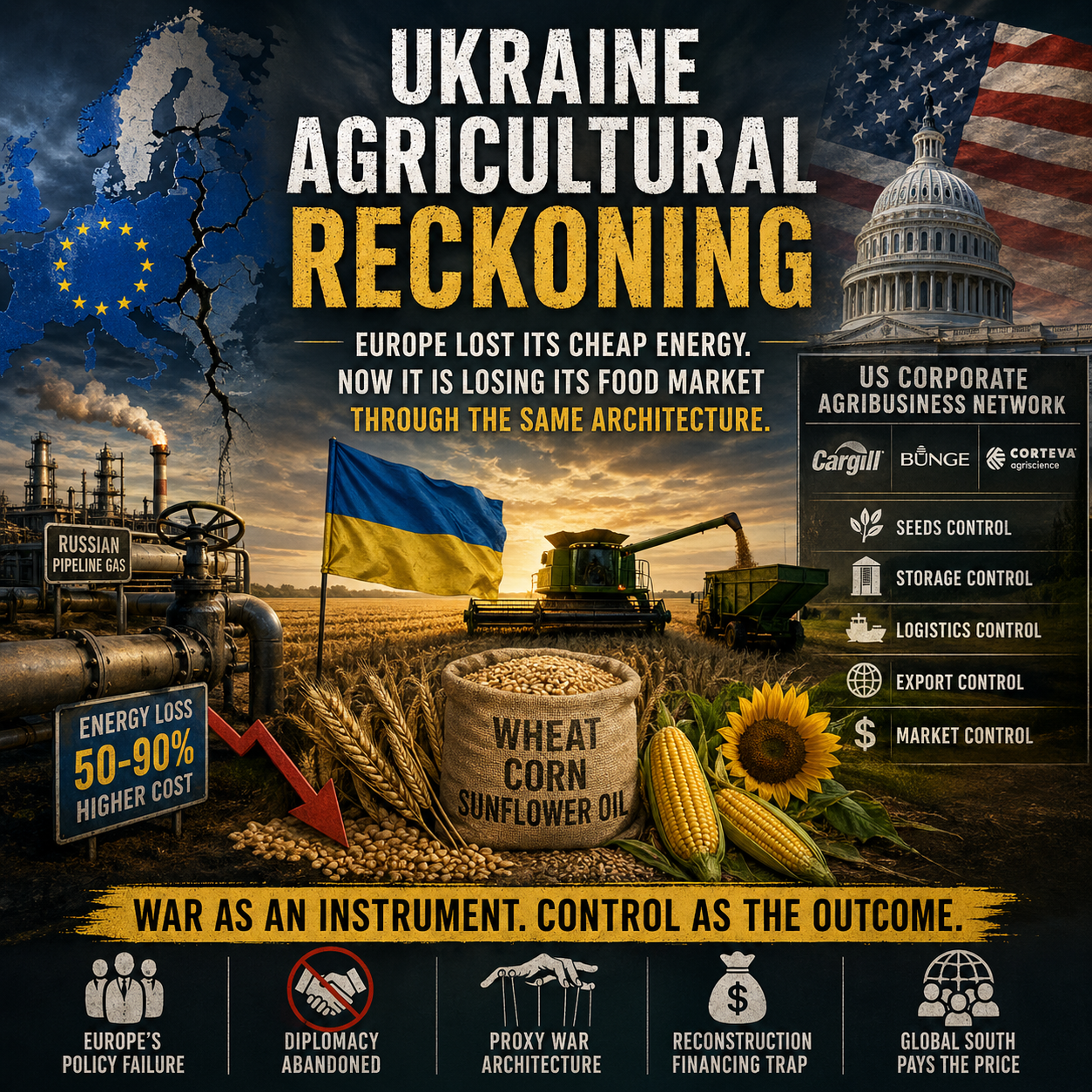
Blog 43 established the EU Energy Umbrella Reckoning—the destruction of cheap regional energy to facilitate a premium American replacement. This Blog examines the second and more devastating commercial capture operating through this same architecture: Ukraine’s Agricultural Reckoning. While the geography has shifted to Eastern Europe, the victim remains the same: the Global South. Just as the closure of the Hormuz Strait threatened the energy of six billion people, the restructuring of Ukraine’s wheat, corn, and sunflower oil markets is a strategic strike against the food security of West Asia and Africa. The Ukraine Agricultural Reckoning argues that this is not a European local conflict, but a global commercial capture where the instrument is war and the outcome is the corporate consolidation of the world’s breadbasket.
Ukraine Agricultural Reckoning: Reflections on Europe’s Policy Failure
Ukraine Agricultural Reckoning: EU had no independent foreign policy to stop a war it did not design. US corporate agribusiness is now collecting the harvest. The Ukraine Agricultural Reckoning begins where the EU Energy Umbrella Reckoning left off — not with the war’s consequences but with the policy failure that allowed it. If NATO lost its founding security purpose in 1991 upon the USSR’s collapse, the EU had a corresponding strategic choice: maintain an independent foreign policy framework capable of managing the security architecture of its own continent, or subordinate that framework to Washington’s institutional requirements. Europe chose the latter — not through a single explicit decision but through the accumulated habit of deference that NATO’s continued existence made structurally comfortable.
Putin’s independent foreign policy was the threat that Washington could not tolerate — not Russian military expansion per se but the assertion that Russia had legitimate security interests that Western architecture should accommodate. The Ukraine proxy war argument documented in this publication traces the sequence from 2004: the Orange Revolution, the 2014 Maidan, Victoria Nuland’s “we have invested over five billion dollars” statement on Ukraine’s democratic development, the leaked Nuland-Pyatt call in which America’s chosen post-Maidan prime minister was selected before the government had fallen. Russia had communicated its red lines with documentary precision — at the Bucharest Summit in 2008, in Putin’s Munich Security Conference speech, and in formal written security guarantee demands submitted to NATO and Washington in December 2021 that were rejected without substantive negotiation within weeks. Europe had the instruments to engage with those red lines independently. The Franco-German Normandy Format existed precisely for this purpose. The Minsk agreements — signed in 2014 and 2015 — provided a documented framework for managing the Donbas conflict without escalation to full-scale war.
Europe abandoned both. EU foreign policy chief Josep Borrell stated in April 2022: “This war will be won on the battlefield, not at the negotiating table.” That statement ended Europe’s independent diplomatic role. It was the moment the EU formally surrendered its foreign policy to Washington’s strategic objective — which was not Ukrainian sovereignty per se but the strategic weakening of Russia and the consolidation of European dependency on American security and commercial architecture. The colonial order argument established in Blog 16 applies here: the EU’s policy failure was not stupidity. It was the institutional consequence of a security architecture that made independent judgement structurally difficult when Washington had already decided.
Ukraine Agricultural Reckoning: What Washington Acquired Through the War
Ukraine is not a marginal agricultural producer. The UN Food and Agriculture Organisation documented Ukraine’s global agricultural position: 12% of global wheat exports, 15% of global corn exports, and 50% of global sunflower oil exports — figures that made Ukraine the most significant agricultural export economy relative to its size anywhere in the world. Before the war, this production capacity served as a competitive regional food supplier to Europe, the Middle East, and Africa at prices that structurally undercut US agribusiness export pricing. Ukraine’s agricultural competitiveness was a commercial problem for American agricultural corporations — specifically Cargill, Bunge, and Corteva (formerly DowDuPont’s agricultural division) — whose export pricing to the same markets was consistently higher than Ukrainian alternatives.
GRAIN documented that US agribusiness corporations had already acquired significant stakes in Ukrainian agricultural infrastructure before the war — Cargill holding equity in terminals and logistics, Bunge operating major grain terminal capacity, Corteva supplying seed systems that created input dependency. The war did not create this corporate presence. It accelerated the conditions for its consolidation. IMF and World Bank reconstruction financing extended to Ukraine carried conditions including agricultural market liberalisation and land reform. The reconstruction financing architecture is converting Ukraine’s agricultural capacity from a competitive sovereign food producer into a US corporate-controlled production system. Washington acquires through post-war reconstruction financing what it could not acquire through commerce in peacetime.
This occurred in the context of Ukraine’s war with Russia, where Ukraine was effectively advancing U.S. strategic interests and was compelled to take these measures to sustain the financial burden of that conflict.
The farm-level arithmetic of this architecture is the Ukraine Agricultural Reckoning in its most concentrated form. The Ukrainian farmer grows more and works harder — yields have increased, acreage under cultivation has expanded, export volume has recovered. But after paying for patented seed and chemical inputs (primarily from Corteva and Bayer systems now dominant across Ukrainian farmland), storage and grain elevator access (Cargill and Bunge controlling major terminal capacity), debt servicing, and export logistics through foreign-linked infrastructure — even as agricultural land title remains legally Ukrainian — the portion of agricultural value that remains in the Ukrainian farmer’s pocket has compressed toward 30%. The balance is captured across the supply chain nodes. And this is done through corporations headquartered in the United States, on financing extended by institutions whose reconstruction conditions created the access in the first place. The Chokehold Industrial Chain argument the series established for the Gulf applies with equal precision to Ukrainian agriculture: when the supply chain’s critical nodes — seed, storage, transport, export terminal — are controlled by a single foreign corporate network, the producer grows the food and the network collects the margin.
Ukraine Agricultural Reckoning: Land Title vs. Economic Control (2026 Reality)
While viral claims of massive direct land purchases by BlackRock or Monsanto have been overstated, the structural shift is real. Foreign ownership of agricultural land remains banned. However, war-driven debt, reconstruction financing, and the need for high-yield exports have accelerated dependency on Western supply chains. Farmers now operate under a triple-lock system: legal (Technology Stewardship Agreements), biological (F1 hybrid seeds that lose vigor if saved), and financial (input credit repaid from harvest). In layman’s terms, the Ukrainian farmer still owns the dirt but functions as a contract manager for corporate assets on their own land — a modern technological variant of sharecropping. The risk stays local. The predictable margins flow to the patent and logistics owners.
📌 The Energy Capture That Preceded the Agricultural Capture
Washington destroyed cheap Russian pipeline gas, then offered American LNG as the replacement at a 50-90% premium. The EU Energy Umbrella Reckoning — the first commercial capture of the same architecture.
Ukraine Agricultural Reckoning: The 1953 Template at Continental Scale
The Ukraine Agricultural Reckoning’s structural argument is the most consequential: the architecture of the Ukraine war follows the same design as the 1953 Iran operation — eliminate independent foreign policy, manufacture or exploit conflict, capture the commercial market — but applied at continental scale rather than to a single state. Blog 37 established the Petrodollar Duress Reckoning — the 1953 template applied to the 1974 petrodollar deal. The Ukraine Agricultural Reckoning applies the same template to European food security.
In Iran 1953: Mossadegh asserted sovereign control over Iranian oil. The CIA removed him. The Shah restored Western corporate access to Iranian oil fields. The commercial capture was the objective; the regime change was the instrument. In Ukraine 2014-2022: Putin asserted an independent Russian foreign policy that refused to subordinate Russian energy and security interests to Washington’s institutional architecture. The Maidan removed a government that had refused EU association. The war that followed destroyed the competitive food supplier that was commercially inconvenient to US agribusiness. The reconstruction financing is now restoring US corporate access to Ukrainian agricultural capacity on terms that no sovereign Ukrainian government would have accepted in peacetime. The Manufactured Instability Reckoning established that African instability was manufactured by the same actors using the same architecture to prevent African states from becoming competitive energy suppliers. Ukraine Agricultural Reckoning is the same argument applied to the world’s most productive agricultural corridor.
The Global South dimension of the Ukraine Agricultural Reckoning is the one least discussed in Western media but most consequential for the six billion people the series has tracked throughout. Blog 12 established how the Hormuz closure threatened food security across the Middle East and South Asia. The Ukraine war destroyed food security for the same populations through a different mechanism: the removal of Ukraine’s competitive agricultural exports from global markets spiked wheat prices 40%, corn prices 25%, and sunflower oil prices 73% in 2022 alone. The World Food Programme documented that the Ukraine war pushed 49 million people to the brink of famine — the highest concentration of which were in Yemen, Somalia, Ethiopia, Sudan, and Afghanistan, none of which had any involvement in the conflict that destroyed their food supply. The Global South War Narrative the series established in Blog 9 — Washington’s strategic wars imposing their costs on populations that had no voice in the decisions — reaches its most concentrated expression here: forty-nine million people pushed toward famine by the consequences of a war they did not choose, in a continent they had never visited, for strategic objectives they had no stake in.
Ukraine Agricultural Reckoning: The Structural Conclusion
Europe’s position after the Ukraine war and the Iran war is now documentable in commercial terms. It has lost cheap Russian pipeline gas — replaced by American LNG at a 50-90% premium. It has lost a competitive regional food supplier — with its agricultural output now operating under significantly increased foreign corporate influence through supply chain, finance and technology nodes. Both losses were produced by Washington’s strategic decisions. Neither was consented to by European populations. Both leave Washington as the primary commercial beneficiary of crises Washington created. The New Colonial Enforcement architecture does not require military occupation of the subject territory. It requires that the subject economy have no viable alternative to the enforcer’s commercial terms — and that the alternatives that previously existed be eliminated through conflict the subject could not prevent, because the subject had no independent foreign policy capable of identifying the design before it was executed.
The EU’s policy failure was not a failure of intelligence or analysis. European economists, security analysts, and diplomatic historians documented these risks throughout the 2014-2022 period. John Mearsheimer’s 2014 Foreign Affairs essay argued with precision that NATO expansion was provocative and that the West was sleepwalking into a catastrophe of its own making. The analysis was available. The policy failure was institutional — the EU had no independent foreign policy mechanism capable of acting on that analysis when Washington had already decided otherwise. That institutional failure is the Ukraine Agricultural Reckoning’s final argument: Europe did not lose its energy independence and its food market sovereignty to superior American strategy. It lost them because it had no independent foreign policy infrastructure capable of saying no to the strategic designs of the power that holds its security umbrella — and that umbrella, as Blog 43 established, is now the commercial arrangement that replaced the cheap alternatives the umbrella’s holder destroyed.
The Global Mirror: From the Persian Gulf to the Black Sea
The Ukraine Agricultural Reckoning is not a departure from the West Asian narrative; it is the ultimate expansion of its architecture. The same “Chokehold” mechanics that weaponized energy transit in the Strait of Hormuz have now been applied to the grain silos of the Ukrainian Steppe. By viewing these events as isolated regional conflicts, Europe fell into the same institutional trap that has long characterized the “Endless War” in West Asia—a failure to recognize that the target is never just the territory, but the commercial capture of the global supply chain. While the bombs fall on European soil, the “Reckoning” is being paid in the currency of famine across Yemen, Somalia, and Afghanistan. This is the globalized expression of the 1953 template: a manufactured instability that eliminates competitive regional alternatives, leaving the Global South and Europe alike dependent on a single corporate and financial enforcer.
📌 The Proxy War Architecture This Series Has Documented
The 2014 Maidan, the NATO expansion eastward, the decade-long construction of conditions that made Russian military action predictable — the Ukraine proxy war argument documented in full.
Next: Agricultural Feudalism Reckoning — Blog 45 in West Asia’s Endless War examines how the commercial capture works at farm level. The Ukrainian farmer grows more and works harder. After paying Bayer-Monsanto for seeds, Cargill for storage, and ADM for shipping, approximately 30% of the value stays in Ukraine. The other 70% moves through a foreign corporate supply chain. This is not a market outcome. It is a triple-lock system of legal, biological, and financial control that converts the farmer into a manager of corporate assets on their own land. Empires once controlled breadbaskets through soldiers. This one uses patents and credit agreements. Part of the West Asia’s Endless War Series on hinduinfopedia.com.
Feature Image: Click here to view the image.
Videos
Glossary of Terms
- Ukraine Agricultural Reckoning: The structural transformation of Ukraine’s agricultural sector through war and reconstruction, resulting in external corporate control over production and supply chains.
- EU Energy Umbrella Reckoning: The economic consequence of Europe losing cheap Russian gas and becoming dependent on higher-cost American LNG under a US-led security framework.
- Commercial Capture: A process where external actors gain control over a region’s economic assets and markets through structural, financial, or policy mechanisms rather than direct ownership alone.
- Proxy War Architecture: A strategic framework where major powers pursue conflict indirectly through another country to achieve geopolitical and economic objectives.
- Chokehold Industrial Chain: A system where critical nodes of production—such as seeds, storage, logistics, and export—are controlled by a single network, limiting producer autonomy.
- Reconstruction Financing: Post-war financial assistance tied to structural reforms, often enabling foreign corporate access to domestic sectors.
- Agricultural Liberalisation: Policy reforms that open domestic agriculture to foreign ownership, investment, and corporate participation.
- Corporate Agribusiness Network: A multinational system of companies controlling agricultural inputs, processing, logistics, and export markets.
- New Colonial Enforcement: A model of control where economic dependency replaces direct political rule, achieved through market restructuring and strategic constraints.
- Manufactured Instability Reckoning: The concept that instability in regions is deliberately created or sustained to prevent independent economic or strategic development.
- Petrodollar Duress Reckoning: The enforcement of global dollar dominance through strategic pressure tied to energy markets and geopolitical alignment.
- Global South War Narrative: The framework describing how wars driven by major powers impose economic and humanitarian costs on uninvolved developing nations.
- Agricultural Feudalism Reckoning: A system where farmers retain operational roles but lose economic control, functioning as managers within corporate-controlled agricultural structures.
#Ukraine #EU #Agriculture #FoodSecurity #Geopolitics #Russia #NATO #Energy #War #Economy #HinduinfoPedia
[…] भारत / GB […]
[…] Blog 44 established the Ukraine Agricultural Reckoning — how Europe’s food market sovereignty is being restructured through war into US corporate-controlled production, and why this follows the same 1953 commercial capture architecture that destroyed Iran’s oil sovereignty and Europe’s energy independence. Blog 45 examines how the capture works at farm level: the triple-lock system of legal, biological, and financial control that converts the Ukrainian farmer from a sovereign food producer into a manager of corporate assets on their own land, and the three-node toll system through which 70% of agricultural value leaves Ukraine before it can be counted as Ukrainian income. […]
[…] ब्लॉग 44 ने यूक्रेन कृषि पुनर्गणना स्थापित की। इसने दिखाया कि युद्ध के माध्यम से यूरोप की खाद्य बाज़ार संप्रभुता का पुनर्गठन हो रहा है। यह प्रक्रिया अमेरिकी कॉर्पोरेट नियंत्रित उत्पादन में परिवर्तित हो रही है। यह वही 1953 का वाणिज्यिक नियंत्रण ढांचा है जिसने ईरान की तेल संप्रभुता को समाप्त किया। इसने यूरोप की ऊर्जा स्वतंत्रता को भी प्रभावित किया। ब्लॉग 45 यह जांच करता है कि यह नियंत्रण खेत स्तर पर कैसे काम करता है। यह कानूनी, जैविक और वित्तीय नियंत्रणों का त्रि-तंत्र है। यह प्रणाली यूक्रेनी किसान को संप्रभु उत्पादक से कॉर्पोरेट संपत्ति प्रबंधक में बदलती है। यह तीन-स्तरीय शुल्क प्रणाली भी दिखाती है। इसके माध्यम से 70% कृषि मूल्य यूक्रेन से बाहर चला जाता है, उससे पहले कि उसे राष्ट्रीय आय माना जाए। […]
[…] complete loop: Washington designs the Ukraine war through the documented architecture Blog 44 established. Europe pays for the war. Washington destroys cheap Russian energy through Nord Stream destruction […]
[…] युद्ध की संरचना तैयार करता है, जैसा कि ब्लॉग 44 ने स्थापित किया, यूरोप इस युद्ध के लिए […]
[…] https://hinduinfopedia.com/ukraine-agricultural-reckoning-a-reckoning-of-west-asias-endless-war-44/ […]
[…] Read […]