

Colonial Order Endless War: A Reckoning of West Asia’s Endless War (16)
Part 16 of the West Asia’s Endless War Series
भारत / GB
A Century of Precedent — Why 2026 Was Never an Anomaly
This series has traced the war’s trigger and escalation mechanics, its ethical and nuclear pretexts, the fracture of Islamic solidarity, the competing narrative wars, Israel’s survival calculus, the Global South’s reading of the strikes as resource imperialism, the three-layer chokehold across oil, food, and industrial supply chains, and the institutional paralysis that watched it all happen without a binding response. Blog 16 steps back from 2026 entirely — to the century of Colonial Order Endless War that made it inevitable.
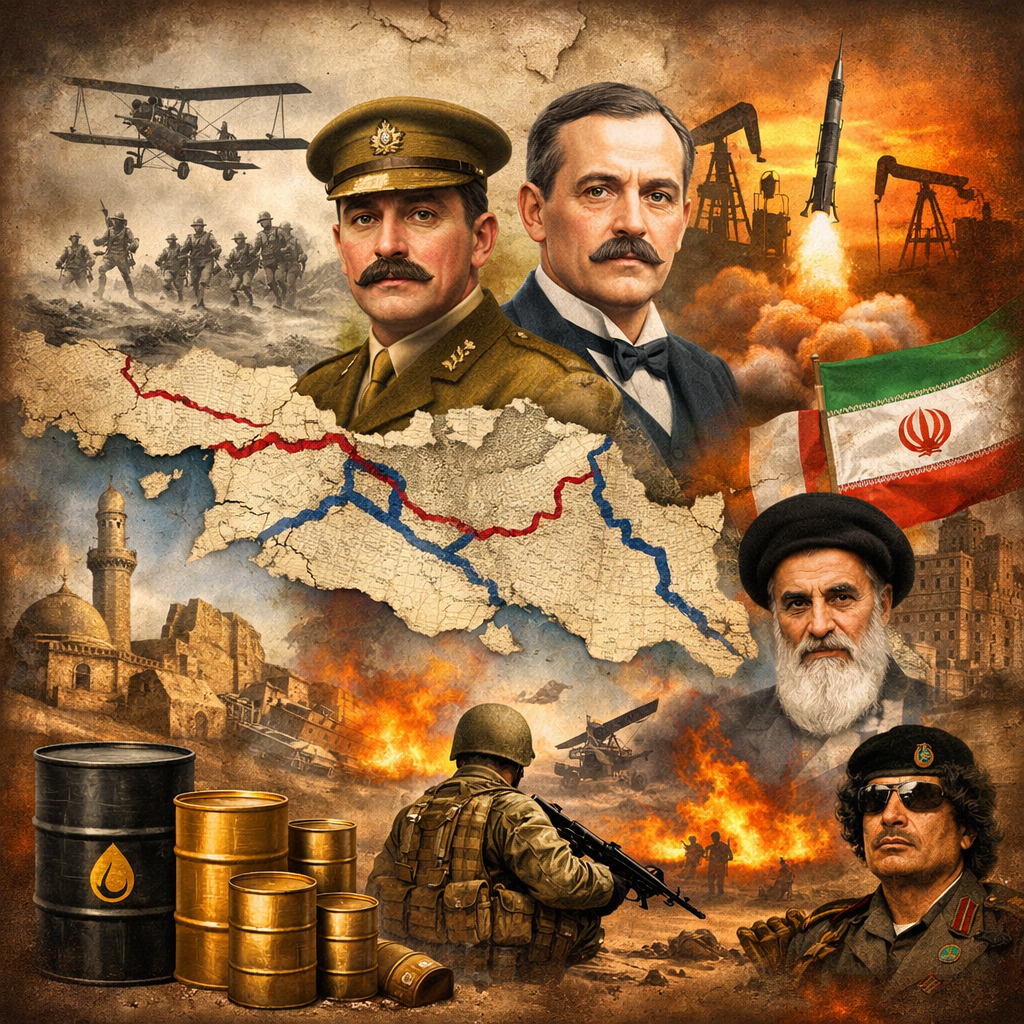
Colonial Order Endless War: The Map Was Drawn Before the War Was Won
Colonial Order Endless War: The map drawn by outsiders, oil taken by outsiders, every act of resistance crushed by outsiders. To understand why West Asia has been in a state of continuous conflict for a century, the starting point is not ideology, not religion, and not the particular cruelties of individual regimes.
The starting point is a map. In May 1916, British diplomat Sir Mark Sykes and French diplomat François Georges-Picot signed a secret agreement dividing the Arab territories of the Ottoman Empire between their two empires — before the war that would deliver those territories had been won, and entirely without consultation with the people who lived inside the lines they were drawing.
Sykes-Picot Agreement
The Sykes-Picot agreement created the borders of the modern Middle East: Iraq, Syria, Lebanon, Palestine, Jordan — all carved from a single administrative reality into separate entities calibrated to British and French imperial interests, not to ethnic, tribal, linguistic, or historical coherence.
The mandate system that followed was colonialism with a League of Nations letterhead. Britain took Iraq and Palestine under mandate authority. France took Syria and Lebanon. The legal framework described these arrangements as temporary tutelage over populations “not yet able to stand by themselves under the strenuous conditions of the modern world” — the colonial civilising mission dressed in the language of international administration. The oil fields that would define the region’s strategic importance for the next century — Mosul, Kirkuk, the fields of southern Iraq — sat inside these mandates. The template of the Colonial Order Endless War was established in those years: external powers draw the map, extract the resources, and install the governance structures that serve their interests. Every subsequent conflict in the region has operated inside this original architecture.
The Nationalisation Wars: Every Act of Sovereign Control Reversed
The Colonial Order Endless War entered its second phase when the states created by Sykes-Picot began attempting to exercise sovereignty over the resources that sat beneath their soil. The pattern of response was consistent across every case and across four decades.
Iranian Nationalisation of Anglo-Iranian Oil Company
Iran, 1951. Mohammed Mossadegh, the democratically elected Prime Minister, nationalised the Anglo-Iranian Oil Company — the British enterprise that had been extracting Iranian oil since 1913 while returning a fraction of its revenues to the Iranian state. The British response was an immediate embargo. When the embargo alone proved insufficient to break the Iranian government, Britain approached the United States. In August 1953, CIA Operation Ajax and MI6 Operation Boot executed the coup that removed Mossadegh from power and restored Shah Mohammad Reza Pahlavi to absolute authority. The Shah signed new oil agreements restoring Western access. The first democratic government in Iranian history was ended because it had sought to own its own oil.
Nationalisation of Iraq Petroleum Company
Iraq, 1972. The Ba’ath government under Ahmed Hassan al-Bakr nationalised the Iraq Petroleum Company — the Anglo-American consortium that had held the concession since 1925. Iraq’s oil revenues, previously flowing primarily to foreign shareholders, were redirected to the Iraqi state. Relations with Washington deteriorated progressively through the 1970s. By 1980, Washington was providing intelligence support to Saddam Hussein’s invasion of Iran — a war that killed approximately half a million people and served the purpose of keeping both states too damaged and too occupied to project regional power. When Saddam subsequently moved beyond Washington’s tolerance by invading Kuwait in 1990 and then proved unwilling to remain a compliant client, the 1991 Gulf War and the 2003 invasion followed — the latter destroying the Iraqi state entirely and opening Iraq’s oil fields to Western majors within five years within five years of the invasion.
Libyan Oil Nationalisation
Libya, 2011. Muammar Gaddafi had nationalised Libyan oil in 1973 and had spent the subsequent decades renegotiating extraction terms with Western companies to increase the Libyan state’s share. By 2011 he was proposing a gold-backed African currency — the dinar — that would price African oil outside the dollar system. The NATO intervention that followed was authorised under UN Security Council Resolution 1973 for the stated purpose of protecting civilians. The mandate was exceeded immediately to pursue regime change. Gaddafi was killed. Libya became a failed state. Its oil sector was reopened to Western companies within months.
📌 The Doctrine Behind the Pattern
The nationalisation wars follow a documented template. Read the operational framework that connects Mossadegh to Gaddafi to the 2026 Iran strikes.
Colonial Order Endless War: Iran as the Final Holdout
Of the states that sat on significant hydrocarbon resources and refused sustained compliance with the external order — Iraq, Libya, Venezuela, Iran — Iran is the last one still producing and still non-compliant after 2026. Iraq was dismembered by invasion. Libya was destroyed by intervention. Venezuela was sanctioned toward collapse. Iran survived the 1979 revolution, the 1980-1988 Iraq war that Washington fuelled from both sides, four decades of escalating sanctions, the 2025 twelve-day conflict, and remained outside the compliance architecture. The nuclear programme was the stated pretext for the February 2026 strikes. But the pattern of the Colonial Order Endless War does not require the pretext to be examined closely. It requires only that the pattern be seen clearly.
The Pattern
Mossadegh nationalised oil — he was removed. Saddam nationalised oil — he was supported, then destroyed. Gaddafi proposed pricing oil outside the dollar — he was killed and his state was dismantled. Iran did not take orders from Washington. Iran priced its oil in non-dollar currencies, pursued energy agreements outside the Western financial architecture, and refused to dismantle its nuclear programme on the terms dictated by President Trump in 2016 under external demand — it was struck mid-negotiation in February 2026. The specific justifications differ across seven decades. The outcome is identical in every case: the non-compliant state is removed, damaged, or destroyed; the compliant successor or the resulting chaos leaves the resource accessible to the external order.
The six billion people who read the 2026 Iran war as resource imperialism are not reading it through ideology. They are reading it through history. The Colonial Order Endless War is not a theory. It is a documented sequence covering one hundred and ten years, three continents of imperial ambition, and a consistent pattern of response to sovereign resource control that has never varied in its fundamental direction regardless of which party held power in Washington, which coalition assembled in Brussels, or which resolution passed in New York.
📌 The Regime Change Playbook
The operational manual connecting every case from Mossadegh to the present — documented, sourced, and consistent across seven decades.
Next: New Colonial Enforcement — Blog 17 in West Asia’s Endless War examines the updated instruments through which the Colonial Order operates today — sanctions, covert destabilisation, dollar-system leverage, and IT lobby pressure — the tools that replaced territorial occupation without replacing its purpose.
Feature Image: Click here to view the image.
Videos
Glossary of Terms
- Colonial Order Endless War: The century-long pattern by which external powers — primarily British and American — have drawn the borders of West Asia, extracted its hydrocarbon resources, and systematically reversed every attempt by regional states to exercise sovereign control over those resources. The 2026 Iran strikes are the most recent iteration of a pattern established with the Sykes-Picot Agreement of 1916.
- Sykes-Picot Agreement: The secret 1916 agreement between British diplomat Sir Mark Sykes and French diplomat François Georges-Picot dividing Ottoman Arab territories into British and French spheres of influence. The agreement created the political borders of the modern Middle East without consultation with the region’s populations. Declassified and published by the Bolshevik government in 1917.
- Mandate System: The post-World War I international framework under which the League of Nations assigned administration of former Ottoman and German territories to European powers. Described as temporary tutelage. Functioned as colonial administration. Britain held mandates over Iraq, Palestine, and Transjordan. France held mandates over Syria and Lebanon.
- Operation Ajax / Operation Boot: The 1953 CIA-MI6 covert operation that removed Iranian Prime Minister Mohammed Mossadegh from power following his nationalisation of the Anglo-Iranian Oil Company. Formally acknowledged by the United States in 2013 through declassified CIA documents. The first documented case of American-engineered regime change in the modern Middle East.
- Iraq Petroleum Company: The Anglo-American consortium holding the Iraqi oil concession from 1925 until its nationalisation by the Iraqi government in 1972. Its shareholders included British Petroleum, Shell, ExxonMobil, Mobil, and the Compagnie Française des Pétroles.
- Hormuz Reckoning: The civilizational, economic, and geopolitical reckoning triggered by the Strait of Hormuz closure in the 2026 West Asia war.
#HormuzReckoning #ColonialOrderEndlessWar #IranWar2026 #WestAsiaEndlessWar #SykesPicot #Mossadegh #RegimeChange #ColonialHistory #PetroDollar #GlobalSouthWarNarrative #DestabilizationDoctrine #HinduinfopediaGeopolitics #Sarvananda
Relevant Links
Previous Blog
- https://hinduinfopedia.com/war-zone-in-hormuz-a-reckoning/
and https://hinduinfopedia.in/?p=25537 - https://hinduinfopedia.com/hormuz-world-war-ladder-a-reckoning-of-west-asias-endless-war-2/
and https://hinduinfopedia.in/?p=25545 - https://hinduinfopedia.com/west-asia-war-ethics-a-reckoning-of-west-asias-endless-war-3/
and https://hinduinfopedia.in/?p=25550 - https://hinduinfopedia.com/west-asia-war-economics-a-reckoning-of-west-asias-endless-war-4/
and https://hinduinfopedia.in/?p=25557 - https://hinduinfopedia.com/nuclear-pretext-of-west-asia-war-a-reckoning-of-west-asias-endless-war-5/
and https://hinduinfopedia.in/?p=25588 - https://hinduinfopedia.com/nuclear-hypocrisy-of-usa-a-reckoning-of-west-asias-endless-war-6/
and https://hinduinfopedia.in/?p=25593 - https://hinduinfopedia.com/ummah-delusion-during-war-a-reckoning-of-west-asias-endless-war-7/
and https://hinduinfopedia.in/?p=25614 - https://hinduinfopedia.com/western-narrative-war-a-reckoning-of-west-asias-endless-war-8/
and https://hinduinfopedia.in/?p=25650 - https://hinduinfopedia.com/global-south-war-narrative-a-reckoning-of-west-asias-endless-war-9/
and https://hinduinfopedia.in/?p=25680 - https://hinduinfopedia.com/israel-survival-logic-a-reckoning-of-west-asias-endless-war-10/
and https://hinduinfopedia.in/?p=25755 - https://hinduinfopedia.com/chokehold-oil-economics-a-reckoning-of-west-asias-endless-war-11/
and https://hinduinfopedia.in/?p=25763 - https://hinduinfopedia.com/chokehold-food-security-a-reckoning-of-west-asias-endless-war-12/
and https://hinduinfopedia.in/?p=25786 - https://hinduinfopedia.com/chokehold-industrial-chain-a-reckoning-of-west-asias-endless-war-13/
and https://hinduinfopedia.in/?p=25816 - https://hinduinfopedia.com/gulf-war-responsibility-blockade-a-reckoning-of-west-asias-endless-war-14/
and https://hinduinfopedia.in/?p=25854 - https://hinduinfopedia.com/un-institutional-paralysis-a-reckoning-of-west-asias-endless-war-15/
and https://hinduinfopedia.in/?p=25885
Follow us:
- English YouTube: https://www.youtube.com/@Hinduofficialstation
- Hindi YouTube: https://www.youtube.com/@HinduinfopediaIn
- X: https://x.com/HinduInfopedia
- Instagram: https://www.instagram.com/hinduinfopedia/
- Facebook: https://www.facebook.com/Hinduinfopediaofficial
- Threads: https://www.threads.com/@hinduinfopedia
[…] भारत / GB […]
[…] Colonial Order Endless War: A Reckoning of West Asia’s Endless War (16) […]
[…] Colonial Order Endless War: A Reckoning of West Asia’s Endless War (16) […]
[…] Colonial Order Endless War: A Reckoning of West Asia’s Endless War (16) […]
[…] Read: Colonial Order Endless War → […]
[…] https://hinduinfopedia.com/colonial-order-endless-war-a-reckoning-of-west-asias-endless-war-16/ and https://hinduinfopedia.in/?p=25935 […]
[…] https://hinduinfopedia.com/colonial-order-endless-war-a-reckoning-of-west-asias-endless-war-16/ and https://hinduinfopedia.in/?p=25935 […]
[…] https://hinduinfopedia.com/colonial-order-endless-war-a-reckoning-of-west-asias-endless-war-16/ and https://hinduinfopedia.in/?p=25935 […]
[…] https://hinduinfopedia.com/colonial-order-endless-war-a-reckoning-of-west-asias-endless-war-16/ and https://hinduinfopedia.in/?p=25935 […]
[…] https://hinduinfopedia.com/colonial-order-endless-war-a-reckoning-of-west-asias-endless-war-16/ and https://hinduinfopedia.in/?p=25935 […]
[…] https://hinduinfopedia.com/colonial-order-endless-war-a-reckoning-of-west-asias-endless-war-16/ and https://hinduinfopedia.in/?p=25935 […]
[…] https://hinduinfopedia.com/colonial-order-endless-war-a-reckoning-of-west-asias-endless-war-16/ and https://hinduinfopedia.in/?p=25935 […]
[…] Colonial Order Endless War: A Reckoning of West Asia’s Endless War (16) https://hinduinfopedia.com/colonial-order-endless-war-a-reckoning-of-west-asias-endless-war-16/ […]
[…] Read: Colonial Order Endless War → […]
[…] Read: Colonial Order Endless War → […]
[…] […]
[…] alliance absorbed Poland, Hungary, the Czech Republic, the Baltic states, Romania, and Bulgaria. The colonial order’s enforcement architecture found a new geography without finding a new purpose. The threat NATO required to remain relevant was Russia — which […]
[…] Read: Colonial Order Endless War → […]
[…] and the consolidation of European dependency on American security and commercial architecture. The colonial order argument established in Blog 16 applies here: the EU’s policy failure was not stupidity. It was the […]
[…] और आर्थिक ढांचे पर निर्भर बनाना था। औपनिवेशिक संरचना का तर्क यहाँ लागू होता है। यह तर्क ब्लॉग 16 में […]
[…] Read […]
[…] Mustad’afin Doctrine challenges every element of this legitimising framework simultaneously. Blog 16 (Colonial Order Endless War) established the post-1945 international order as colonial architecture updated. If the […]
[…] […]
[…] https://hinduinfopedia.com/colonial-order-endless-war-a-reckoning-of-west-asias-endless-war-16/ and https://hinduinfopedia.in/?p=25935 […]