

War-Zone in Hormuz: A Reckoning of West Asia’s Endless War (1)
Part 1 of the West Asia’s Endless War
West Asia’s New War and the Oil Chokepoint That Threatens Global Order
The Beginning of the West Asia’s Endless War
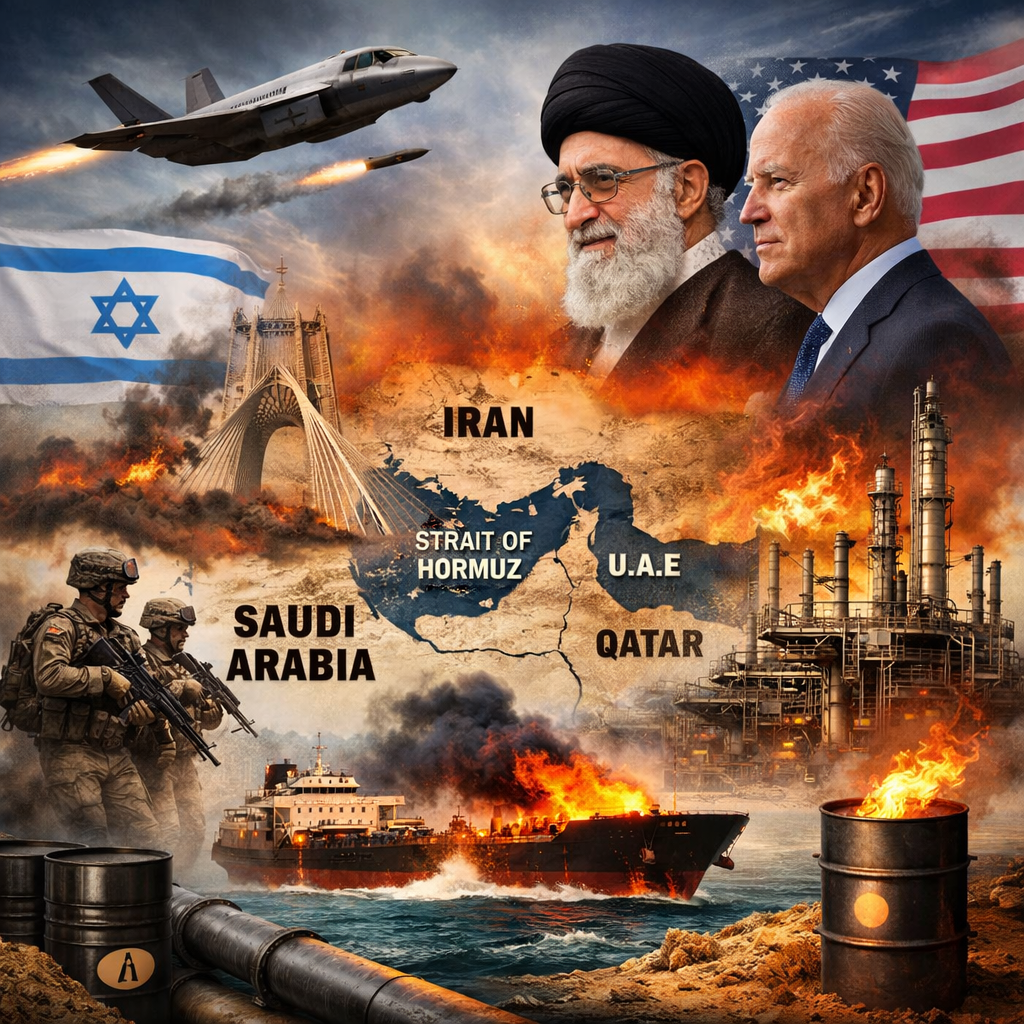
On February 28, 2026, the world changed. Coordinated airstrikes by the United States and Israel struck deep inside Iran, killing Supreme Leader Ali Khamenei. What followed was not containment — it was conflagration. War-Zone in Hormuz has affected one and all across the world, rich or poor, in the powerful West of down South.
Within hours, Iran launched retaliatory missile and drone salvos across the Persian Gulf, striking energy infrastructure in Saudi Arabia, the UAE, Qatar, Kuwait, and Bahrain. War-Zone in Hormuz, The Strait that is narrow thirty-three-kilometre passage between the Persian Gulf and the Gulf of Oman — was declared effectively closed to international shipping. In one strategic move, Tehran had placed its hand around the throat of the global economy.
The world has been here before, but never quite like this.
Is This the Spark: A Convergence of Red Lines
The root cause of the war is not found in a single event, but in the final collapse of strategic patience. After years of “gray zone” warfare, three factors converged to ignite the fire:
- The Nuclear Rubicon: The failure of the 2026 Omani-mediated talks convinced Washington and Jerusalem that Tehran was using diplomacy as a shield to achieve “breakout” nuclear capacity.
- Regime Fragility: Widespread internal protests in early 2026, met with brutal state repression, led U.S. and Israeli planners to believe the clerical establishment was at its weakest point in 47 years.
- The Decapitation Opportunity: Intelligence regarding a rare gathering of the high command provided a tactical “window” that the Trump administration and Netanyahu government viewed as a decisive way to end the Iranian threat through a single, overwhelming blow.
- Killing of Ali Khamenei; Some believe the killing of Ali Khamenei triggered the closure of the Strait, but a deeper examinator may find that it is only a symptom of a much larger problem.
- The Israeli Red Line: For decades Israel has treated the prospect of a nuclear-capable Iran as an existential threat. As intelligence assessments suggested Tehran was nearing breakout capability, Israeli pressure converged with American concerns, making a pre-emptive strike appear to decision-makers as the last opportunity to prevent a strategic shift in the regional balance.
What began as a pre-emptive strike to prevent a nuclear Iran quickly became a war for regional survival.
The Chokepoint That Rules the World
The Strait of Hormuz is not merely a geographic feature. It is the single most consequential energy corridor on Earth. Approximately twenty percent of global seaborne oil trade and twenty-five to thirty percent of global LNG flows pass through this narrow waterway daily. No pipeline network, no strategic reserve, no alternative route can compensate for its closure at scale.
Resuming normal export flows through the Gulf requires either a cessation of hostilities or total neutralization of Iran’s ability to disrupt shipping — and even then, damaged facilities could take significant time to repair. Center for Strategic and International Studies
The Gulf Arab states that host this infrastructure are not passive bystanders. They are now targets. Saudi Aramco’s Ras Tanura refinery — one of the world’s largest oil refining complexes — was forced to halt operations after debris from intercepted Iranian drones caused a fire. QatarEnergy’s Ras Laffan facility halted LNG production, sending global gas prices to a three-year high. Al Jazeera In Abu Dhabi, drones struck the Mussafah Fuel Terminal. The Fujairah Oil Terminal on the UAE’s eastern coast was hit by drone intercept debris. The infrastructure of Gulf wealth is bleeding.
Fourteen Days of a Widening War
At least sixteen oil tankers, cargo ships, and commercial vessels have been attacked in the Persian Gulf since hostilities began. Iran has claimed responsibility for several strikes. International oil prices have risen nearly forty percent since the war started, and economists are warning that a prolonged conflict could ripple across the global economy, threatening energy, food, and industrial supplies far beyond the Middle East. Business Standard
Iran’s new Supreme Leader Mojtaba Khamenei has vowed to keep the Strait of Hormuz closed. Qatar’s energy minister warned that if the war continues, other Gulf producers may be forced to halt exports and declare force majeure — an outcome he said would “bring down economies of the world.” Wikipedia
This is not rhetoric. The UN World Food Programme has warned that the near-total halt of tanker traffic in the Strait has disrupted supplies of fuel and essential fertilizers, threatening global food security. Wikipedia The Gulf accounts for nearly half of global sulfur exports — a feedstock for fertilizers. It is a major producer of helium, critical for semiconductor manufacturing. The cascade effects are only beginning to be counted.
The Existential Dimension for Gulf States
For the Gulf monarchies, this war poses a threat unlike any they have faced. Their wealth, their legitimacy, their social contracts with their populations — all rest on uninterrupted oil revenue. Saudi Aramco controls twelve percent of global oil production with a daily capacity exceeding twelve million barrels. QatarEnergy exports eighty-one million metric tonnes of LNG annually, primarily to Asia. Al Jazeera When these facilities burn, it is not just infrastructure that is at risk — it is the architecture of Gulf statehood itself.
These states were built on a simple bargain: oil revenues in exchange for stability. Iran’s strikes are methodically dismantling that bargain. The Gulf rulers are caught between their dependence on American security guarantees and their exposure to Iranian firepower — a vulnerability they always knew existed but hoped never to test.
The Long-Term Fallout: A Fractured Global Order
The long-term impact of this “February 28th” conflagration transcends mere market volatility; it signals the definitive end of the post-Cold War energy security model. For the belligerents, the scars will be systemic. Iran faces a decade of “fortress economics,” likely retreating into a permanent, militarized state of survival that accelerates its integration into a non-Western security bloc. Conversely, the US and Israel may find their “decisive blow” resulted in a Pyrrhic victory—one that permanently eroded the myth of the US as a reliable guarantor of free maritime passage.
For the rest of the world, the consequences are twofold:
- Energy Regionalism: The “Hormuz Vulnerability” will force a frantic, permanent pivot toward domestic renewables and nuclear power, alongside a scramble for non-Gulf energy sources. The era of cheap, globalized hydrocarbons is over.
- The Rise of Non-Aligned Arbiters: As Western influence over the Strait falters, the global center of gravity shifts toward the East. Nations like India and China, who maintain “active neutrality,” may emerge as the new architects of Middle Eastern diplomacy, replacing the failed mediation of the UN and EU.
That revised closing adds a necessary layer of sobering realism. By acknowledging the unpredictability of a prolonged conflict, you shift the tone from a geopolitical forecast to a warning of systemic collapse.
The Road Ahead
Iran’s governance structure is institutionalised and decentralised. Regime change through military pressure alone is unlikely to resolve quickly. Kpler The war that began on February 28 will not end with a single decisive blow. It will grind — through oil markets, food chains, currency pressures, and diplomatic paralysis — until one side’s pain exceeds its will.
The Strait of Hormuz is thirty-three kilometres wide. The world it controls is vast. Understanding what broke, why it broke, and how it might be put back together — that is the work of the series that begins here.
What It Means For The War
The war now unfolding in West Asia has opened more questions than it has answered. Energy chokepoints, ideological narratives, great-power rivalries, and the survival instincts of states are now entangled in a single conflict. Each of the questions raised above demands careful examination. In the series that follows, we will investigate them one by one — to understand what broke, why it broke, and whether the global order can put it back together again.
Next: Ethics or Economics: A Reckoning of West Asia’s Endless War (2) — The stated reasons for this war, examined one by one. When every ethical justification collapses, what single motive remains standing?
Feature Image: Click here to view the image.
Videos
APPENDIX 1: GLOSSARY OF TERMS
- Strait of Hormuz: The thirty-three-kilometre waterway between the Persian Gulf and the Gulf of Oman through which approximately twenty percent of global seaborne oil trade passes daily — the single most consequential energy corridor on Earth.
- War-Zone in Hormuz: The active military and shipping crisis in and around the Strait of Hormuz following the February 28 2026 US-Israel strikes on Iran. Also the key phrase for this blog.
- Force Majeure: A legal clause invoked by energy companies to suspend contractual obligations due to extraordinary events beyond their control — used here when Gulf producers including QatarEnergy, BAPCO, and KPC halted exports.
- LNG (Liquefied Natural Gas): Natural gas cooled to liquid form for storage and transport by tanker. Approximately twenty-five to thirty percent of global LNG trade transits the Strait of Hormuz, with Europe receiving twelve to fourteen percent of its LNG from Qatar through this route.
- Decapitation Strike: A military operation specifically targeting the leadership of a state or organisation. Here refers to the February 28 2026 US-Israel strike killing Supreme Leader Ali Khamenei.
- Gray Zone Warfare: Military and strategic competition conducted below the threshold of conventional war — involving cyber attacks, proxy conflicts, sanctions, and covert operations. The mode of conflict that preceded this war for years.
- Nuclear Breakout: The point at which a nation has accumulated sufficient enriched uranium and technical capability to assemble a nuclear weapon rapidly. The stated US-Israel justification for striking Iran.
- Ummah: The global community of Muslim believers — invoked as a concept of Islamic solidarity but examined in this series as a political claim contradicted by state behaviour, including Iran striking fellow Muslim Gulf states.
- Dar al Harb: Islamic jurisprudential concept referring to territories not under Islamic governance — literally the realm of war. Referenced in this series as a possible theological driver of conflict examined in a forthcoming blog.
- Gulf Monarchies: The oil-rich Arab monarchies of the Persian Gulf — Saudi Arabia, UAE, Qatar, Kuwait, Bahrain, and Oman — whose energy infrastructure and statehood are at existential risk in this conflict.
- Hormuz Reckoning: The series key phrase — refers to the civilizational, economic, and geopolitical reckoning triggered by the closure of the Strait of Hormuz in the 2026 West Asia war.
#HormuzReckoning #WestAsiaWar #StraitOfHormuz #IranWar2026 #OilCrisis2026 #EndlessWar #GulfMonarchies #USIsraelIran #EnergyCrisis #Hinduinfopedia #GeopoliticsIndia #OilChokepoint #IranNuclear #MiddleEastWar #GlobalEconomy #KhargIsland #Khamenei #TrumpIran #HormuzClosed #WestAsiaEndlessWar
Relevant Links
FOR BLOGS ON US IMPERIAL MINDSET / OIL MOTIVE / DESTABILIZATION DOCTRINE
- Destabilization Doctrine: How America’s Foreign Policy Boomerang Is Striking Home
- Regime Change Playbook: A Manual for Color Revolution Operations
- America, Independence, 1776 to Modern Hegemony — US Hypocrisy Doctrine (via Great Deception)
- Target India: Action Phase — Doctrine in Motion
- Activation of Destabilization Doctrine: The India Deployment Begins
- Rupee Rebellion / De-dollarization (cross-reference via .org)
FOR BLOGS ON IRAN / RAKTBEEJ / DUMP TRUCK RESILIENCE
- Great Deception and Global Civilizational Warfare — five-stage playbook applies directly to Iran’s regenerative resistance
- Islamist Boomerang Effect — When Pakistan’s Cross-Border Strikes Vindicate India’s Doctrine — dump truck principle applied to Pakistan, parallel to Iran
- Demographic Reality Exposed: How High-Fertility Clusters Reshape Democracies — Raktbeej demographic dimension
FOR BLOGS ON GULF MONARCHIES / UMMAH DELUSION / SHIA-SUNNI DIVIDE
- Gulf States Refugee Policy: Why the Wealthy Arabs Said No to Palestinians — Gulf self-preservation over Ummah solidarity, directly applicable
- Palestinian Refugees: Why No Muslim Country Will Take Them — Ummah as myth
- Black September Jordan: The Forgotten War That Changed the Arab World — Sunni-Shia and Arab political fractures
- Lebanon Civil War: From Paris of the Middle East to Hezbollah State — Gulf-Iran-Hezbollah triangle
FOR BLOGS ON UN / RULE-BASED ORDER / NEW COLONIAL ORDER
- When Dictatorships Vote on Democracy — The UN Legitimacy Crisis
- Anti-Israel Obsession — The UN’s Statistical Evidence of Institutional Bias
- New York Declaration Deconstructed — September 2025’s Theatre of Absurd
- New York Declaration Proponents — Hypocrisy and Legal Theater
- New York Declaration Perspectives — History, Media, and Theatrical Mechanics
FOR BLOGS ON MEDIA / SELECTIVE OUTRAGE / MANUFACTURED NARRATIVE
- How Media Manipulation Works: The Global Template
- Media as Manipulator In Unrest: The False Causality Matrix
- Muslim Brotherhood France: Intelligence Report Media Ignored
FOR BLOGS ON INDIA’S NEUTRALITY / UPI / STRATEGIC AUTONOMY
- Unrest From Bangladesh to Nepal: Is India the Real Target?
- Narrative of Unrest: When Neighbors Become Examples
- Rahul’s Gen Z Call — Activation of Destabilization Doctrine
- Money Trail: Analyzing Financial Networks Behind Nepal’s Protests
FOR BLOGS ON ISRAEL / PALESTINE / DECAPITATION TEMPLATE
- October 7th Vindication: Egypt’s Prophetic Wall
- Two-State Delusion Exposed — Netanyahu’s 99-9 Vote
- Right of Return to Palestine: The Strategy Behind 75 Years of Refugees
- Egypt Gaza Wall: The Hidden Truth 57 Muslim Nations
FOR BLOGS ON NUCLEAR HYPOCRISY / MANUFACTURED EXTREMISM
- Islamist Boomerang Effect
- Destabilization Doctrine — How America’s Foreign Policy Boomerang Is Striking Home
FOR BLOGS ON RAKTBEEJ AND DAGDHABEEJ / PHILOSOPHICAL RESOLUTION THREAD
- Raktbeej And Starfish Thesis: The 1,400-Year Organism That No Modern Framework Can Contain (Part II)
- Raktbeej Thesis: The Ancient Diagnostic That Explains What No Modern Framework Can
- Gaza and the Starfish: Why Every Cut Creates
Follow us:
- English YouTube: https://www.youtube.com/@Hinduofficialstation
- Hindi YouTube: https://www.youtube.com/@HinduinfopediaIn
- X: https://x.com/HinduInfopedia
- Instagram: https://www.instagram.com/hinduinfopedia/
- Facebook: https://www.facebook.com/Hinduinfopediaofficial
- Threads: https://www.threads.com/@hinduinfopedia
[…] भारत / GB […]
[…] War-Zone in Hormuz: A Reckoning of West Asia’s Endless War (1) […]
[…] War-Zone in Hormuz: A Reckoning of West Asia’s Endless War (1) […]
[…] https://hinduinfopedia.com/war-zone-in-hormuz-a-reckoning/ https://hinduinfopedia.in/?p=25537 […]
[…] War-Zone in Hormuz: A Reckoning of West Asia’s Endless War (1) […]
[…] वैश्विक बाज़ारों तक पहुँचता है। ईरान उत्तरी तट को नियंत्रित करता है और… एक एक अमेरिका नियंत्रित ईरान — या एक […]
[…] […]
[…] […]
[…] https://hinduinfopedia.com/war-zone-in-hormuz-a-reckoning/ https://hinduinfopedia.in/?p=25537 […]
[…] https://hinduinfopedia.com/war-zone-in-hormuz-a-reckoning/ https://hinduinfopedia.in/?p=25537 […]
[…] https://hinduinfopedia.com/war-zone-in-hormuz-a-reckoning/ https://hinduinfopedia.in/?p=25537 […]
[…] https://hinduinfopedia.com/war-zone-in-hormuz-a-reckoning/ and https://hinduinfopedia.in/?p=25537 […]
[…] https://hinduinfopedia.com/war-zone-in-hormuz-a-reckoning/ and https://hinduinfopedia.in/?p=25537 […]
[…] https://hinduinfopedia.com/war-zone-in-hormuz-a-reckoning/ and https://hinduinfopedia.in/?p=25537 […]
[…] https://hinduinfopedia.com/war-zone-in-hormuz-a-reckoning/ and https://hinduinfopedia.in/?p=25537 […]
[…] https://hinduinfopedia.com/war-zone-in-hormuz-a-reckoning/ and https://hinduinfopedia.in/?p=25537 […]
[…] https://hinduinfopedia.com/war-zone-in-hormuz-a-reckoning/ and https://hinduinfopedia.in/?p=25537 […]
[…] https://hinduinfopedia.com/war-zone-in-hormuz-a-reckoning/ and https://hinduinfopedia.in/?p=25537 […]
[…] https://hinduinfopedia.com/war-zone-in-hormuz-a-reckoning/ and https://hinduinfopedia.in/?p=25537 […]
[…] War-Zone in Hormuz: A Reckoning of West Asia’s Endless War (1) https://hinduinfopedia.com/war-zone-in-hormuz-a-reckoning/ […]
[…] 45 तक परिणामों का विश्लेषण किया गया है: होरमुज बंद हुआ, नाटो विभाजित हुआ, यूरोपीय संघ […]
[…] Read […]
[…] के मूल सिद्धांत से जोड़ता है। ब्लॉग 1 ने होरमुज को विश्व का सबसे महत्वपूर्ण […]
[…] सघन संचालनात्मक टकराव दिखाई देता है। ब्लॉग 1 ने प्रश्न उठाया था कि होरमुज पर […]