

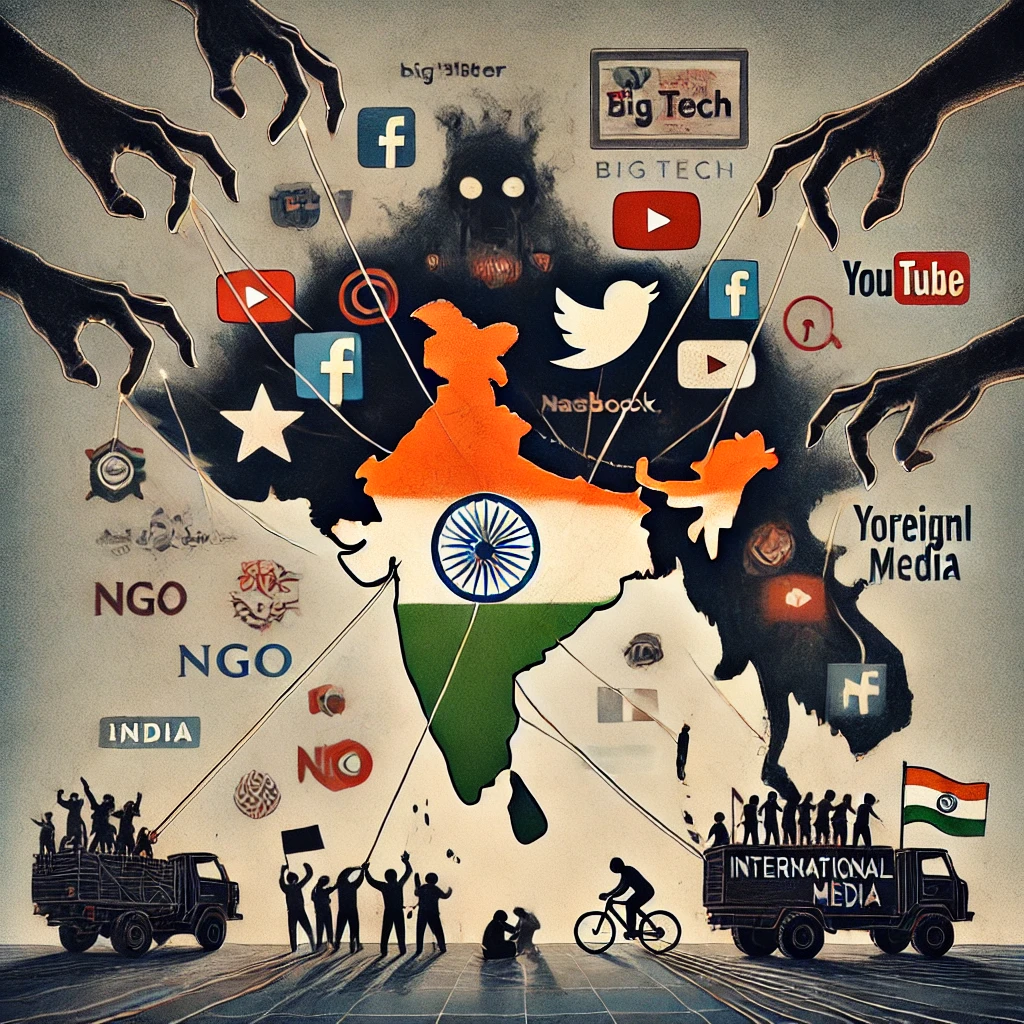
Narrative of Unrest: When Neighbors Become Examples
Part II: Unrest in India’s Neighbors
Building the Narrative Through the Money
The Narrative of Neighbors
Unrest in South Asia is never just local. When streets burn in Bangladesh, when citizens storm the President’s House in Sri Lanka, or when social-media ban riots in Nepal and shortages, the tremors don’t stop at their borders. They echo across Bharat — not as distant news, but as ready-made arguments for those who seek to question, weaken, or reshape India’s own political order. Each neighboring upheaval quickly transforms from crisis on foreign soil into a rhetorical weapon in domestic debate, blurring the line between genuine caution and deliberate narrative-building.
Opposition Echoes: Turning Neighbors into Examples
Mani Shankar Aiyar, senior Congress leader, openly compared India’s situation to Bangladesh’s upheaval. He argued that despite electoral victories, Bharat could not be complacent, warning that inequality and unemployment might one day erupt into unrest similar to Dhaka’s streets (Times of India).
Salman Khurshid echoed the thought, saying, “what happened in Bangladesh can happen here too.” To some, this may sound like a sober caution; to critics, it looked like the planting of unrest into domestic discourse (Organiser).
Others in the opposition ecosystem have gone further, hinting that Sri Lanka’s 2022 economic collapse and storming of the President’s House could serve as a model if India does not “correct course.” These allusions have not gone unnoticed, especially when protests in Bangladesh also saw mobs storming the Prime Minister’s residence, drawing immediate parallels in media coverage (Hindustan Times).
These invocations raise uncomfortable questions. Is it coincidence that when the U.S. President speaks of punishing Bharat and its Prime Minister, opposition leaders at home attack the credibility of democracy itself? Is it coincidence that one of the fastest-growing economies in the world is dismissed as “sinking” by politicians who echo language used abroad? And finally, is the figure who seeks to inherit opposition leadership positioning himself as a kind of “Mohammad Yunus of India” — waiting for unrest to deliver him the seat of power, just as it did in Dhaka?
By themselves, such remarks may seem rhetorical. But placed against the regional backdrop, they look like part of a narrative weapon — a steady effort to normalize the idea that Bharat could, or even should, face the same fate as its neighbors.
The Digital Empire: Tech Giants and the Power of Narrative
If political voices spread the narrative of unrest through speeches, the machinery of Big Tech amplifies and enforces it globally. The digital realm has become the new empire, where unelected corporations dictate what stories are told, who gets silenced, and which governments are pressured into compliance.
Australia was the first to taste this high-handedness. In 2021, when Canberra passed a law requiring Facebook and Google to pay news publishers for content, the tech giants retaliated by threatening — and briefly enforcing — a news blackout. Entire news feeds disappeared overnight, exposing how far these companies would go to preserve control.
India soon faced similar arm-twisting. When New Delhi introduced IT rules demanding greater accountability, takedown compliance, and local grievance redressal, the same global platforms pushed back. Some delayed compliance, others framed it as an attack on “free speech,” but the pattern was clear: use size and dominance to pressure a sovereign state.
Yet Bharat held its ground. Bharat kept pushing till the Tech Giants ensured compliance unlike the knee jerk reaction as happened in Nepal. Unlike smaller nations, it refused to bend, forcing the platforms to eventually fall in line. The episode revealed a deeper reality — that the narrative of rights and openness, so often invoked by tech companies, is selectively applied. When profits or influence are at stake, the same platforms have no qualms about shutting down voices, blocking news, or amplifying unrest narratives that suit their interests.
For Bharat, this was more than a regulatory battle. It was proof that in the digital age, narrative has become a weapon wielded not only by politicians, but also by corporations that operate above borders and beyond accountability.
NGOs as Narratives in Disguise
If Big Tech represents the corporate empire of the digital age, the agencies in the guise of NGOs represent the moral empire of narrative. Their stated missions are noble: rights, relief, justice, equality. Yet their selective outrage and financial opacity often expose how narratives can be manufactured in the name of humanitarianism. Are they wolves in sheeps’ skin?
Consider Amnesty International in India. It once positioned itself as the guardian of rights, issuing reports that quickly made international headlines. But when its financial dealings came under scrutiny, and the government demanded compliance with foreign funding regulations, Amnesty claimed it was being “silenced.” The organisation chose to suspend its India operations rather than open its books fully.
This was presented abroad as proof of authoritarianism, but the real question was never answered: why should a sovereign democracy not ask NGOs to follow the same laws as others? The narrative of victimhood became the shield against accountability.
Hami Nepal, more recently, showed how humanitarian branding can blend into political mobilization. Publicly, it is a disaster-relief NGO; quietly, it was reported to have uploaded protest toolkits and declared funding from global brands — details later scrubbed from its own website. Again, the narrative of neutrality masked involvement in unrest.
This pattern repeats: when NGOs comply, they are applauded as civil society champions; when questioned, they weaponize the narrative of repression. In both cases, the story travels abroad, framing Bharat not as a sovereign state defending its laws, but as a regime stifling dissent.
Media Houses with Agendas
If NGOs supply the moral cover, media houses provide the megaphone of narrative. Their role is not just reporting events but defining them — deciding whether unrest is “youthful resistance” or “violent anarchy,” whether regulation is “reform” or “repression.”
The BBC stands as the clearest case. Long accused of bias in its South Asia coverage, it has faced financial investigations in Bharat, exposing questionable tax practices and opaque funding flows. The money angle was so strong that they seemingly toned down their operations in Bharat. Yet each time scrutiny tightens, the narrative of press freedom under attack is broadcast louder than the financial irregularities themselves.
This is not new. Western media houses often align with geopolitical currents, portraying sovereign assertion by nations like India as stubborn nationalism, while glossing over their own governments’ pressures and hypocrisies. In Bharat’s case, farmer protests became an international headline amplified disproportionately, while narratives of terror networks or targeted violence against Hindus rarely received the same megaphone.
By choosing what to highlight and what to omit, media outlets act not as neutral observers but as narrative architects. Their global reach ensures that once a story is framed, it echoes back into Bharat’s domestic politics, reinforcing opposition talking points and amplifying external criticisms.
The result is a feedback loop of narrative: NGOs generate the reports, media amplifies them, and tech platforms ensure they dominate the digital space. Sovereignty, in this ecosystem, is reduced to a counter-narrative fighting for oxygen.
The Pattern Exposed: A Narrative Siege
Step back, and the strands converge. Neighbors’ unrest repurposed as examples. Tech giants enforcing digital obedience. NGOs cloaked in morality. Media amplifying select stories. Together they form a pattern that is too consistent to dismiss as coincidence.
This is what can be called a Narrative Siege. As Sanjeev Sanyal, a member of the Prime Minister’s Economic Advisory Council, warned: regional protests in Nepal, Bangladesh, Sri Lanka, and Indonesia appear to follow a ‘suspicious toolkit’—a strikingly similar pattern across different countries—suggesting a coordinated playbook rather than organic uprising The Economic Times. Armies no longer march at the border; instead, narratives march across screens, newspapers, hashtags, and international conferences. They shape public mood, delegitimize sovereign decisions, and prepare the ground for political shifts that elections alone could not produce.
The catapult strategy is clear:
- Unrest in the periphery (Bangladesh, Sri Lanka, Nepal) becomes a rehearsal stage.
- Opposition leaders inside Bharat recycle those crises as warnings.
- Global NGOs and media frame Bharat’s sovereignty as authoritarianism.
- Tech platforms enforce which version of events trends and which voices disappear.
- Economic tariffs now serve as tools of coercion, extending the narrative siege into trade itself.
Every actor plays its part, and every part strengthens the central weapon: the narrative.
Defending Sovereignty in the Age of Narrative
For Bharat, this is no abstract contest. Its refusal to accept GMO clauses in trade, its push for a post-dollar world, and its insistence on national regulation of digital giants have already marked it as inconvenient to entrenched powers. What conventional war could not achieve, the war of narrative now attempts.
This is not to claim that all protests are engineered, or that domestic grievances are unreal. But when every genuine grievance is instantly magnified into a global campaign, when every regulatory act is painted as repression, and when even opposition leaders echo the language of foreign critics, the pattern becomes undeniable.
Bharat’s challenge is therefore double: to address its internal issues honestly, while refusing to let them be hijacked by external actors wielding narrative as a weapon. In this new battlefield, resilience is not measured in tanks or missiles, but in the ability to hold the line against a siege of stories.
India has withstood empires before. It can withstand this too — but only if it recognizes that the frontline is no longer at the border. It is in the narrative itself.
Feature Image: Click here to view the image.
[…] Narrative of Unrest: When Neighbors Become Examples […]
[…] Narrative of Unrest: When Neighbors Become Examples […]
[…] Narrative of Unrest: When Neighbors Become Examples […]
[…] Narrative of Unrest: When Neighbors Become Examples […]
[…] Narrative of Unrest: When Neighbors Become Examples […]
[…] Narrative of Unrest: When Neighbors Become Examples […]