

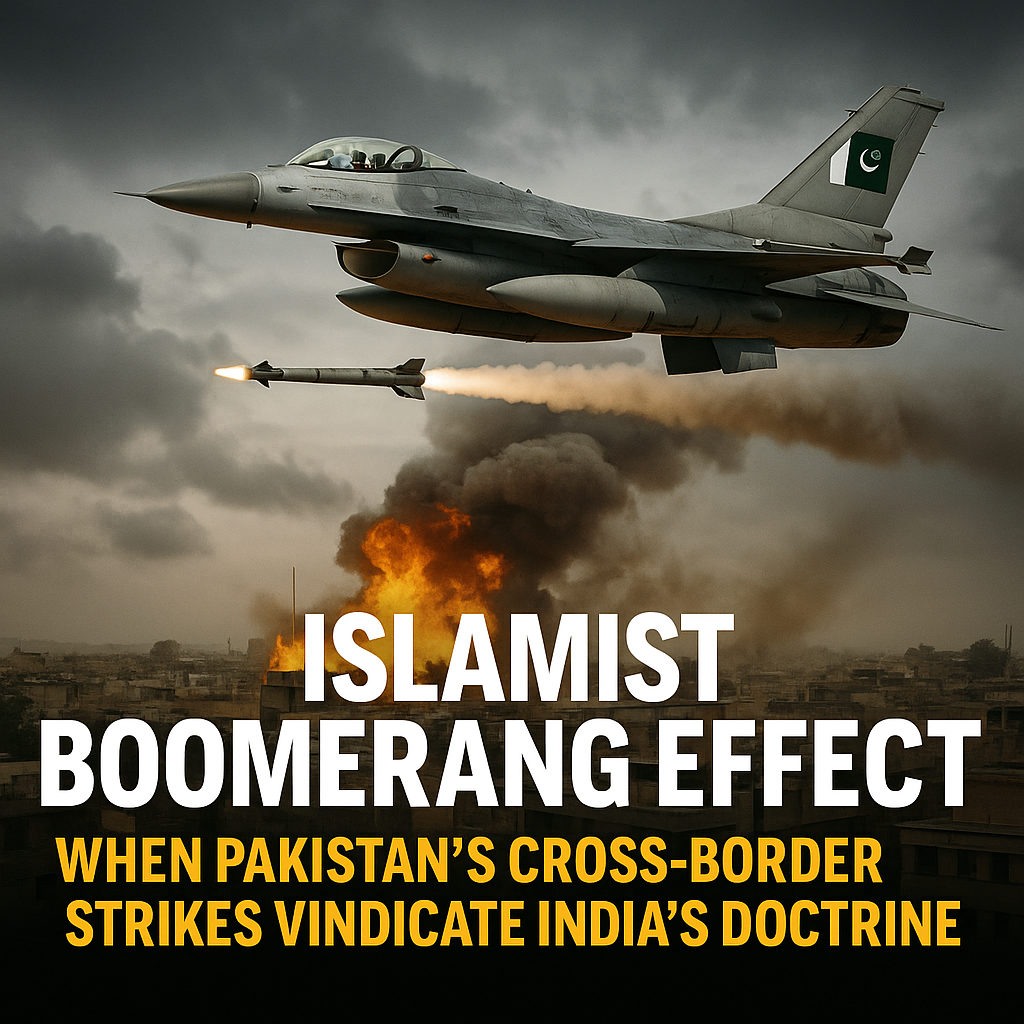
Islamist Boomerang Effect – When Pakistan’s Cross-Border Strikes Vindicate India’s Doctrine
The Islamist Boomerang Effect in Action
Part 1: “Pakistan’s Self-Destructive Trajectory – When State-Sponsored Extremism Turns Inward”
The Islamist Boomerang Effect — When Pakistan Became What It Condemned
On Pakistani aircraft — by most accounts either jets or armed drones — crossed the Durand Line and struck targets in and around Kabul, in what aligns with Islamabad’s stated campaign against the Tehrik-e-Taliban Pakistan (TTP). The declared aim was to eliminate Tehreek-e-Taliban Pakistan (TTP) militants, with reports suggesting their chief Noor Wali Mehsud was among those targeted. The Taliban government quickly condemned the attack, accusing Pakistan of bombing civilian areas and violating Afghan sovereignty. Former U.S. envoy Zalmay Khalilzad called it “a huge escalation” that “poses dangerous risks” to regional stability. Read from another perspective this incident is more than just another border clash — it is the textbook Islamist Boomerang Effect. Pakistan has now done exactly what it spent a decade condemning India for. The very strategy it denounced — pre-emptive cross-border strikes against terrorist sanctuaries — has become its own desperate tool for survival.
Intriguing Questions
Was the October 9 strike timed deliberately, coming just days after the Afghan Foreign Minister’s visit to Bharat—a visit that reportedly unsettled Islamabad? The sequence raises a strategic question: was Pakistan reacting out of insecurity over Kabul’s growing diplomatic warmth with New Delhi, or was it nudged into revealing its own contradictions? Some regional observers even suggest that the turbulence within Pakistan’s militant networks bears traces of covert counter-measures—perhaps another calibrated taste of its own medicine from Bharat. Whether or not that is the case, the effect is unmistakable: Pakistan now faces the consequences of the Islamist machinery it once directed outward.
From Denial to Imitation: Three Indian Precedents
Over the past decade, Bharat has delivered three clear messages through decisive action. In 2016, after Pakistan-backed militants attacked an Army camp in Uri, India carried out surgical strikes across the Line of Control, destroying terror launchpads. In 2019, following the Pulwama bombing, India struck a Jaish-e-Mohammed facility in Balakot, deep inside Pakistan, again forcing Islamabad to protest “sovereignty violations.” The pattern re-emerged in May 2025, when Pakistan escalated along the Rajasthan–Gujarat frontier and India launched precision air and missile strikes under Operation Sindoor — reportedly hitting militant targets inside Pakistan and Pakistan-administered Kashmir — ending the confrontation within two days after Islamabad sought a ceasefire, forcing Islamabad to seek a ceasefire, after Pakistan itself requested a ceasefire.
Together, These three operations effectively rewired South Asia’s counter-terror thinking — exposing Pakistan’s double standard and forcing it to operate within the same logic it once condemned, illustrating the Islamist Boomerang Effect in real time.
These three operations redefined India’s counter-terror doctrine and exposed Pakistan’s double standard: it condemned what it now imitates.

The Role Reversal Complete and Islamist Boomerang
Today, the same Pakistan that once preached against “Indian aggression” justifies its own air raids in identical terms — claiming “terror bases across the border” and “the right to self-defence.” The Islamist Boomerang Effect has come full circle: A state that once exported jihad as policy now finds itself using India’s playbook to fight the very militants it midwifed.
This is not evolution. It is desperation disguised as doctrine — and it marks the moment Pakistan finally became what it once condemned.
The Surgical Strike Playbook – Now With Pakistani Fingerprints
When India conducted surgical strikes across the Line of Control in September 2016, and later the Balakot air strikes in February 2019, Pakistan’s response was predictable and theatrical. They called it “naked aggression,” a “violation of sovereignty,” and “warmongering.” The Pakistani establishment demanded international intervention, portrayed itself as the victim, and warned of nuclear escalation.
The justification India provided was straightforward: cross-border terrorism emanating from Pakistani soil necessitated direct action against terrorist infrastructure when the host state was either unable or unwilling to act.
Fast forward to 2025. Pakistan has now conducted multiple rounds of airstrikes on Afghan territory, targeting what it claims are militant hideouts in provinces like Paktika, Khost, Nangarhar, and Kunar. The justification? Cross-border terrorism emanating from Afghan soil, with the host state (Taliban-ruled Afghanistan) either unable or unwilling to act against the TTP.
It’s the exact same playbook. Word for word. Strike for strike.
The Islamist Boomerang Effect in Action
To understand this Islamist Boomerang Effect, we must first acknowledge an uncomfortable truth Pakistan’s establishment has tried desperately to bury: the TTP is not some foreign implant or Indian creation. It is the direct offspring of Pakistan’s decades-long policy of nurturing jihadist groups as strategic assets.
Read the Exodus 1.0 contexts →
From Strategic Assets to Domestic Threats
The statistics are devastating. According to the Center for Research and Security Studies (CRSS), Pakistan’s security forces suffered at least 685 fatalities in 2024, and the combined civilian-and-security death toll reached about 1,600 — the deadliest year in a decade. The perpetrators? TTP, Baloch insurgents, ISIS-Khorasan, and other extremist factions. This isn’t sporadic violence—it’s a sustained insurgency consuming entire regions..
The TTP now operates from Afghan soil, which makes the story even more ironic. During the Taliban’s first rule (1996-2001), Pakistan was viewed internationally as their patron and protector. When the Taliban returned to power in 2021, Islamabad celebrated it as a strategic victory. The expectation was clear: the Afghan Taliban would be grateful allies who would help neutralize the TTP threat.
That calculation has catastrophically failed.
Pakistani officials and regional analysts argue that the Afghan Taliban have tolerated, and in certain zones may have sheltered, TTP fighters — a claim Kabul publicly denies — underscoring the growing trust deficit between the two neighbours. Ideologically, they are cut from the same cloth—products of the same Deobandi madrassas, sharing the same jihadist doctrine, and viewing Pakistan’s partnership with America during the War on Terror as apostasy.
Pakistan nurtured the snake, fed it, housed it—and now acts shocked when it strikes.
The Vindication India Didn’t Need to Claim
India never needed to trumpet the vindication of its surgical-strike doctrine — Pakistan has done it for us through its own actions. As analysts told the Hindustan Times and The Print, Islamabad has “operationalised the very cross-border logic it long decried,” echoing India’s justification for the Uri and Balakot operations. Consider the parallels:
India’s Position (2016-2019):
- Terrorist groups operating from Pakistani soil
- Pakistan unable/unwilling to act against them
- Cross-border strikes necessary to eliminate threat
- Targeted military action, not civilian areas
- Sovereign right to self-defense
Pakistan’s Position (2024-2025):
- Terrorist groups operating from Afghan soil
- Afghanistan unable/unwilling to act against them
- Cross-border strikes necessary to eliminate threat
- Targeted military action (they claim)
- Sovereign right to self-defense
The international community’s response has been telling.
When India struck Balakot in 2019, the world responded with a chorus of official statements; by contrast, Pakistan’s 2025 raids into Afghanistan have elicited only muted public reactions — a contrast that speaks volumes. Why? Because even Western powers privately acknowledge that Pakistan is now reaping what it sowed, and the principle India articulated – that states have the right to defend against cross-border terrorism when the host state won’t act – has been validated through Pakistan’s own adoption of it.

The Kabul Strikes: Desperation, Not Strategy
Pakistan’s October 2025 strikes on Kabul were less a show of strength than a sign of strategic exhaustion — a desperate bid to contain the forces it once set loose. The Guardian described the attack as “a mirror image of India’s Balakot moment,” and Reuters called it a “dangerous escalation exposing Islamabad’s eroding deterrence narrative. When a nuclear-armed state with the world’s sixth-largest military has to bomb the capital city of its neighbor (and former client state) to deal with an insurgency, it reveals catastrophic policy failure.
The strikes also exposed another uncomfortable reality: Pakistan is rapidly losing control of its own narrative — no longer seen solely as a victim of terrorism but increasingly as its reflection. AP News noted that “for the first time, global reactions cast Pakistan not as a counter-terror partner but as a destabilising actor,” while Foreign Policy argued that “Islamabad’s policy Frankenstein has come home to claim its maker.” For decades, Islamabad successfully portrayed itself internationally as a victim of terrorism rather than its sponsor. The Afghan Taliban’s refusal to cooperate, forcing Pakistan into overt military action, has stripped away that façade.
Former US envoy Khalilzad’s warning about “dangerous escalation” should terrify Pakistani policymakers. It signals that even traditional Western supporters recognize Pakistan is now a destabilizing force in the region, not a partner for stability. The Taliban’s angry response and threats of retaliation mean Pakistan now faces the prospect of hostile relations with the very regime it helped create and reinstall. BBC News reported Taliban warnings that “Pakistan will face consequences if attacks continue,” while Dawn highlighted an unprecedented rupture between the former allies.
The Questions Mainstream Media Won’t Ask
If Pakistan’s current cross-border strikes are justified (as Islamabad claims), then weren’t India’s strikes also justified? Outlets like The Print and Times of India underlined the irony: Pakistan has “internalised the very doctrine of pre-emptive self-defence it once condemned India for. If targeting terrorist hideouts across international borders is legitimate when Pakistan does it, why was it “aggression” when India did it?
The answer, of course, has nothing to do with international law or moral consistency. It has everything to do with strategic interests and the West’s decades-long willingness to give Pakistan a free pass on terrorism as long as it served broader geopolitical objectives.
But that calculation is changing. The same extremist ideology Pakistan exported to Afghanistan, Kashmir, and beyond has now metastasised within Pakistan itself. The Diplomat observed that “groups like TLP and TTP now dictate Pakistan’s domestic agenda as thoroughly as they once shaped its regional one,” echoing the Carnegie Endowment’s warning that the country’s security policy “has entered a self-consuming loop.” The TTP wants to impose Sharia rule in Pakistan. Baloch insurgents are conducting deadly attacks on security forces and Chinese nationals. Banned sectarian groups like Tehreek-e-Labbaik Pakistan (TLP) can paralyze the capital at will, demanding the government implement their version of Islamic governance.

Pakistan is now fighting the very ideology it promoted, using military tactics it once condemned when others used them.
The Broader Pattern: A State at War With Itself
The Kabul strikes are just one symptom of a much deeper pathology. Pakistan’s establishment made a Faustian bargain decades ago: nurture jihadist groups as “strategic assets” for Kashmir and Afghanistan, while somehow maintaining control over them domestically. This was always an impossible contradiction, and the contradictions are now tearing the state apart.
In 2024, Pakistan saw its deadliest year for terrorism since 2014. Military convoys were attacked in daylight, police posts overrun, and Chinese engineers working on CPEC projects repeatedly targeted — prompting South China Morning Post to note Beijing’s growing anxiety over its corridor investments. Entire districts in Khyber Pakhtunkhwa are effectively ungoverned, with the TTP collecting taxes and running parallel administrations.
And now Pakistan is bombing Kabul – the city it once controlled through its Taliban proxies – because those same proxies have turned into adversaries.

What This Means Going Forward
What India can do is continue articulating clearly and consistently the warning it has voiced for decades: that state-sponsored extremism inevitably devours its sponsor. Pakistan’s aircraft over Kabul make that lesson unmistakable. We said that jihadist groups cannot be controlled like puppets.
But vindication alone isn’t a strategy. India must recognize several critical realities:
First, Pakistan’s descent into chaos poses risks for the entire region. A nuclear-armed state fighting multiple internal insurgencies is nobody’s victory scenario.
Second, the extremist groups Pakistan nurtured won’t simply disappear if Pakistan collapses. They’ll metastasize across borders, creating new threats.
Third, the international community’s belated recognition of Pakistan’s double game on terrorism doesn’t mean they’ll suddenly support India’s Kashmir policy or other strategic objectives.
What India can do is continue articulating clearly and consistently: we told you so. We said that nurturing terrorism as state policy would eventually destroy the state itself. We said that jihadist groups cannot be controlled like puppets. We said that cross-border terrorism requires cross-border responses.
Pakistan’s fighter jets over Kabul prove all of that beyond any doubt.
In Part 2, we’ll examine how this same boomerang effect is playing out internally, as banned extremist groups like Tehreek-e-Labbaik Pakistan turn on their former patrons and paralyze Pakistan’s own capital with demands for Sharia governance – the very ideology Pakistan exported for decades.
Series Navigation:
- Part 1: The Boomerang Effect (You are here)
- Part 2: When Extremists Turn on Their Masters (Coming next)
- Part 3: A State’s Suicide Note – The ‘Dump Truck’ Doctrine
- Part 4: Occupied Territories in Revolt
- Part 5: The Western Complicity
- Part 6: The Ideological Foundation
- Part 7: The Kashmir Obsession
- Part 8: Trajectory and Consequences
#PakistansSelf-DestructiveTrajectory
Feature Image: Click here to view the image.
Glossary of Terms
- Islamist Boomerang Effect: A phenomenon where Pakistan’s long-standing policy of nurturing jihadist proxies backfires, forcing it to use the same counter-terror doctrines once condemned when used by India.
- Tehrik-e-Taliban Pakistan (TTP): A banned militant network based along the Pakistan-Afghanistan border, responsible for numerous attacks on Pakistani military and civilians.
- Durand Line: The 2,640-kilometre border between Pakistan and Afghanistan, often disputed and a flashpoint for cross-border tensions.
- Operation Sindoor (2025): Reported Indian military operation involving precision strikes inside Pakistan and Pakistan-administered Kashmir following cross-border escalations.
- Balakot Air Strikes (2019): Indian Air Force operation targeting a Jaish-e-Mohammed camp in Balakot, Pakistan, after the Pulwama terror attack.
- Surgical Strikes (2016): Indian Army operations across the Line of Control in response to the Uri terrorist attack, aimed at destroying terror launchpads.
- Deobandi Madrassas: Religious seminaries in South Asia aligned with the Deobandi movement, known for producing many Islamist ideologues in Pakistan and Afghanistan.
- Cross-Border Doctrine: India’s strategic framework allowing limited, precise strikes beyond borders to neutralize terrorist threats when the host state is unwilling to act.
- Zalmay Khalilzad: Former U.S. envoy to Afghanistan and Pakistan, who warned that Pakistan’s 2025 airstrikes marked a “dangerous escalation.”
- CPEC (China–Pakistan Economic Corridor): A multi-billion-dollar infrastructure initiative under China’s Belt and Road project, frequently targeted by insurgents in Pakistan.
- Tehreek-e-Labbaik Pakistan (TLP): A radical Islamist political group in Pakistan known for violent protests demanding stricter blasphemy laws and Sharia enforcement.
- Faustian Bargain: A metaphor used in the blog describing Pakistan’s decision to use jihadist groups as strategic assets—trading long-term stability for short-term geopolitical leverage.
- Strategic Assets: A term used by Pakistan’s security establishment to describe non-state militant groups historically used for influence in Afghanistan and Kashmir.
- Self-Defence Doctrine: The principle invoked by both India and Pakistan to justify cross-border counter-terror strikes under international law.
- Baloch Insurgency: Armed rebellion in Pakistan’s Balochistan province, driven by demands for autonomy and opposition to state exploitation of natural resources.
#Pakistan #India #TTP #Kabul #HinduinfoPedia #Boomerang #PakistansSelfDestructiveTrajectory
Our Related Blogs
- https://hinduinfopedia.org/india-pakistan-relations-under-i-k-gujral-impact-of-his-policies-on-dharma-and-national-security
- https://hinduinfopedia.org/civilization-under-siege-why-hindu-communities-face-an-existential-crisis/
- https://hinduinfopedia.org/bangladesh-hindu-killings-politics-of-massacre-part-iii/
- https://hinduinfopedia.org/bangladesh-hindu-killings-marichjhapi-the-untold-story-part-i/
- https://hinduinfopedia.org/afghanistan-soviet-war-the-world-peace-disrupter/
- https://hinduinfopedia.org/mumbai-attacks-reflections-on-november-26ths-impact-on-indias-path/
- https://hinduinfopedia.org/taliban-takeover-of-afghanistan-1996/
- https://hinduinfopedia.org/riots-in-kohat-and-forgotten-exodus-kashmir-exodus-1-0-2/
- https://hinduinfopedia.org/indo-pak-war-and-operation-grand-slam/
- https://hinduinfopedia.org/madrasa-education-in-india/
- https://hinduinfopedia.org/article-370-path-to-insertion-and-revocation/
- https://hinduinfopedia.org/radcliffe-line-elusive-boundary-that-crafted-chaos/
- https://hinduinfopedia.org/afghanistan-and-taliban/
- https://hinduinfopedia.org/direct-action-day-1946-and-partition-of-india/
- https://hinduinfopedia.org/terrorist-attack-and-chamba-massacre-a-tragic-event/
- https://hinduinfopedia.org/terrorism-in-india-bangalore-serial-blasts-2008/
- https://hinduinfopedia.org/amarnath-yatra-ethical-reflections-on-the-2017-attack/
- https://hinduinfopedia.org/extremism-the-7-7-london-bombings-and-global-terror-infrastructure/
- https://hinduinfopedia.org/jammu-and-kashmir-massacre-at-chapnari/
- https://hinduinfopedia.org/pokhran-ii-stragetic-assertion-of-india/
- https://hinduinfopedia.in/lahore-resolution-review-pakistans-islamic-path/
- https://hinduinfopedia.in/pulwama-terror-attack-pakistan-sponsored-act/
- https://hinduinfopedia.in/indo-pak-war-1965-revelation-of-sinister-design-of-pakistan-22-sep/
https://hinduinfopedia.in/war-on-terror-the-legacy-of-osama-bin-laden/ - https://hinduinfopedia.in/osama-bin-laden-life-journey-through-terror/
- https://hinduinfopedia.in/kargil-conflict-history-of-indo-pak-religious-tensions/
- https://hinduinfopedia.in/kargil-war-a-turning-point-in-indo-pak-relations/
- https://hinduinfopedia.in/doda-massacre-2006-context-execution-and-aftermath/
- https://hinduinfopedia.in/gujral-doctrine-consequences-of-bharats-diplomatic-experiment/
- https://hinduinfopedia.in/prankote-massacre-1998-a-dark-day-in-jk-history/
- https://hinduinfopedia.in/raghunath-temple-attack-display-of-extremism/
- https://hinduinfopedia.in/global-jihad-impact-and-terrorism-in-kashmir/
- https://hinduinfopedia.in/nadimarg-massacre-tragedy-in-the-heart-of-kashmir/
- https://hinduinfopedia.in/lingering-shadows-of-violence-from-partition-to-terrorism/
- https://hinduinfopedia.in/mumbai-terror-attacks-1993-impact-and-legacy/
- https://hinduinfopedia.in/navigating-extremism-and-resilience-and-testing-tolerance/
- https://hinduinfopedia.in/1993-world-trade-center-bombing-day-of-remembrance/
- https://hinduinfopedia.in/the-balakot-airstrike-a-decisive-blow-in-modern-warfare/
- https://hinduinfopedia.in/islamic-extremism-linked-murder-of-delhi-police-officer-ratan-lal/
- https://hinduinfopedia.in/bridging-divides-the-lahore-declarations-impact/
- https://hinduinfopedia.in/shifting-borders-of-gilgit-baltistan/
- https://hinduinfopedia.in/ahmedabad-railway-station-bombing/
- https://hinduinfopedia.in/wandhama-massacre-1998/
- https://hinduinfopedia.in/global-terrorism-insight-the-indian-parliament-attack-anniversary/
- https://hinduinfopedia.in/akshardham-temple-terrorist-attack-2002/
- https://hinduinfopedia.in/mumbai-terrorist-attack-year-2000-to-2020/
Follow us:
- English YouTube: Hinduostation – YouTube
- Hindi YouTube: Hinduinfopedia – YouTube
- X: https://x.com/HinduInfopedia
- Instagram: https://www.instagram.com/hinduinfopedia/
- Facebook: https://www.facebook.com/Hinduinfopediaofficial
- Threads: https://www.threads.com/@hinduinfopedia
[…] insurgency with weapons, training, and diaspora funding. Pakistan provided Kashmir separatists with documented cross-border support. Western media amplifies grievances while downplaying aggression. sometimes military backing while […]
[…] पाकिस्तान ने कश्मीर अलगाववादियों को दस्तावेज़ीकृत सीमा-पार सहायता प्रदान की। पश्चिमी मीडिया शिकायतों […]
[…] Islamist Boomerang Effect: When Pakistan’s Cross-Border Strikes Vindicate India’s Doctri… […]
[…] […]
[…] Islamist Boomerang Effect — When Pakistan’s Cross-Border Strikes Vindicate India’s Doc… — dump truck principle applied to Pakistan, parallel to Iran […]
[…] Islamist Boomerang Effect: When Pakistan’s Cross-Border Strikes Vindicate India’s Doctri… […]
[…] Islamist Boomerang Effect — When Pakistan’s Cross-Border Strikes Vindicate India’s Doc… — dump truck principle applied to Pakistan, parallel to Iran […]
[…] Islamist Boomerang Effect — When Pakistan’s Cross-Border Strikes Vindicate India’s Doc… — dump truck principle applied to Pakistan, parallel to Iran […]
[…] Islamist Boomerang Effect — When Pakistan’s Cross-Border Strikes Vindicate India’s Doc… — dump truck principle applied to Pakistan, parallel to Iran […]
[…] Islamist Boomerang Effect — When Pakistan’s Cross-Border Strikes Vindicate India’s Doc… — dump truck principle applied to Pakistan, parallel to Iran […]
[…] Islamist Boomerang Effect: When Pakistan’s Cross-Border Strikes Vindicate India’s Doctri… […]
[…] Part 1 documented extremists turning on their masters. This analysis reveals why: Pakistan’s theological violence strategy comes from Islam’s foundational texts and orthodox jurisprudence itself. […]