Examining the Theological Roots of Pakistan’s Perpetual Violence
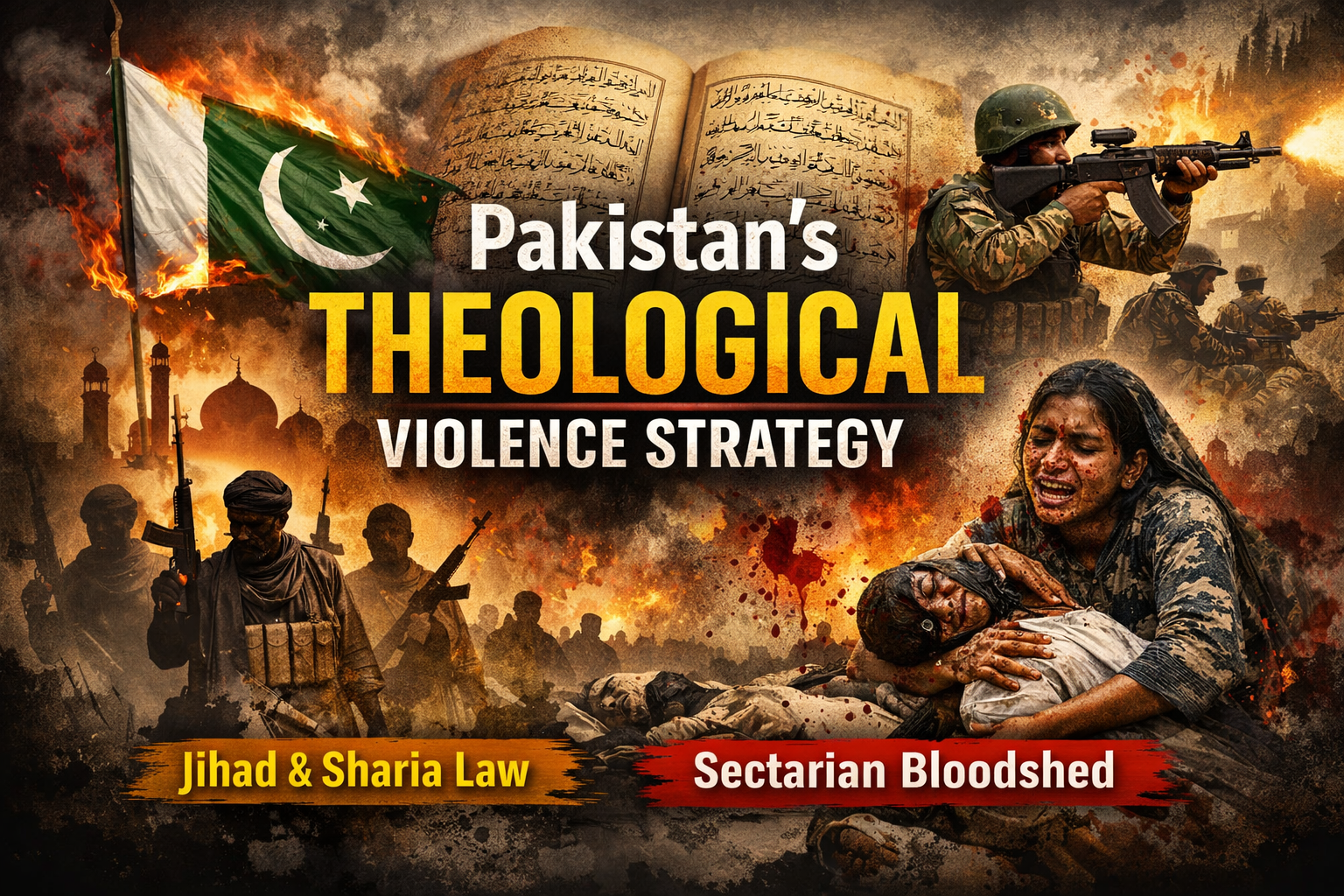
Pakistan’s theological violence strategy has proven to be the nation’s defining—and ultimately self-destructive—characteristic. In Part 1 of this series, we documented how extremist groups nurtured by the Pakistani state turned on their masters, with TLP paralyzing Islamabad and TTP attacking from Afghan soil. But to understand why this boomerang effect is inevitable rather than accidental, we must examine the theological foundation upon which Pakistan built its entire state apparatus.
The evidence is stark and undeniable: seventy-eight years after its creation as an explicitly Islamic homeland where Muslims could live in peace, Pakistan has never achieved internal peace. Not in 1947, not in 1971 when it fragmented through genocidal civil war, and certainly not in 2025 as it fights simultaneous wars against multiple Muslim insurgencies. Pakistan’s theological violence strategy, embedded in its founding ideology and reinforced through decades of state policy, has created a society where conflict is theologically mandated, not circumstantially triggered.
The Pakistan Experiment: 96% Muslim, Zero Peace
When the Muslim League successfully argued for Partition in 1947, the premise was clear: Muslims needed their own homeland to escape Hindu “oppression” and live according to Islamic principles in peace and prosperity. Muhammad Ali Jinnah’s Two-Nation Theory claimed that Hindus and Muslims were fundamentally incompatible and could never coexist peacefully.
Seventy-eight years later, the results of this experiment are conclusive.
If the Two-Nation Theory were correct—if Hindu-Muslim incompatibility was the problem—then removing Hindus should have created peace. Instead, Pakistan’s theological violence strategy generated new enemies from within its own Islamic population. Even fellow Muslims praying in mosques are not safe from sectarian attacks.
Why peaceful coexistence prevailed with trade Islam but disappeared with conquest Islam.
Contextual Support
The pattern extends far beyond Pakistan’s borders. Every Muslim-majority nation organized on strict Islamic principles faces similar internal violence:
Afghanistan (99.7% Muslim): Four decades of continuous warfare, currently under Taliban rule facing ISIS-K attacks and internal resistance
Iraq (95-98% Muslim): Sunni-Shia civil war, ISIS insurgency, ongoing instability
Syria (87% Muslim): Devastating civil war despite shared religion among most combatants
Yemen (99.1% Muslim): Saudi-backed government vs. Iranian-backed Houthis—both Muslim
Libya (96.6% Muslim): Fragmented into warring factions since 2011
The common denominator isn’t external enemies or non-Muslim minorities. The common denominator is Pakistan’s theological violence strategy replicated across Islamic governance models—a theological framework that mandates perpetual struggle, creates purity competitions, and generates enemies even in homogeneous populations.
The 1971 Bangladesh Genocide: When Muslims Massacred Muslims
The most devastating proof of Islam’s failure to create unity came in 1971, when Pakistan’s Muslim West fought Pakistan’s Muslim East in a genocidal civil war.
Pakistan Army’s own Hamoodur Rahman Commission documented Pakistani atrocities
This was not a simple Hindu-Muslim conflict, nor merely an external invasion. The 1971 catastrophe had immediate political and economic triggers—language imposition (Urdu over Bengali), resource imbalances between East and West Pakistan, and the denial of Sheikh Mujibur Rahman’s democratic electoral mandate in 1970. However, the theological framework of the state intensified the rupture. When political dissent was framed as ideological deviation and ethnic identity was filtered through religious orthodoxy, repression gained moral justification. Theology did not create the grievances—but it provided the legitimizing vocabulary for their violent suppression.
The Punjabi Muslim military machine that slaughtered Bengali Muslims used Islamic justifications. Bengali Muslims were labeled “Hindu-influenced” and insufficiently Islamic. The Pakistani state’s theological violence strategy couldn’t tolerate linguistic, cultural, or political differences even among fellow Muslims.
How madrasa credentials enable theological supremacism to infiltrate and capture democratic institutions.
The Textual Foundation: What Islamic Jurisprudence Actually Teaches
To understand why Pakistan’s theological violence strategy is structurally embedded rather than accidentally adopted, we must examine what mainstream Islamic theology actually teaches. This isn’t about fringe extremist interpretations—this is about orthodox Islamic jurisprudence across all major schools.
The Quranic Warfare Emphasis
The Quran contains 6,236 verses. Academic analysis using multiple scholarly translations reveals a striking pattern:
Verses explicitly commanding fighting/warfare against non-believers:
Approximately 164 verses directly command fighting, warfare, or killing
Additional verses establishing rules of warfare, treatment of captives, distribution of spoils
Surah At-Tawbah (Chapter 9), one of the last revealed chapters, contains the “Verse of the Sword” (9:5) and commands to “fight those who believe not in Allah” (9:29)
Verses about unconditional peace, tolerance, or coexistence:
Significantly fewer, often contextually limited to specific circumstances
Pakistan’s theological violence strategy relies heavily on the Islamic jurisprudential principle of naskh (abrogation), which holds that later Quranic revelations supersede earlier ones when they conflict.
The progression:
Meccan period (early Islam, weak position): More tolerant verses about coexistence
Medinan period (later Islam, strong position): More militant verses commanding warfare
Video Evidence: Islamic Scholar Explains Orthodox Position
Watch this ground report from law maker of Pakistan confirming what mainstream Islamic jurisprudence teaches in action.
Key abrogating verse:“Fight those who believe not in Allah nor the Last Day, nor hold that forbidden which hath been forbidden by Allah and His Messenger, nor acknowledge the religion of Truth, (even if they are) of the People of the Book, until they pay the Jizya with willing submission, and feel themselves subdued.” (Quran 9:29)
This verse, from one of the last chapters revealed, establishes the framework for Pakistan’s theological violence strategy: permanent inferior status for non-Muslims under Islamic rule, backed by the threat of warfare.
Uncovering Hindu philosophy’s values of openness and collective well-being in addressing contemporary challenges.
What Mainstream Islamic Law Actually Mandates
Pakistan’s theological violence strategy isn’t derived from misinterpretation or extremist distortion. It comes directly from orthodox Islamic jurisprudence taught across all four major Sunni schools of law (Hanafi, Maliki, Shafi’i, Hanbali) and the major Shia schools:
On Apostasy (Leaving Islam):
All major schools teach: Death penalty for apostates
Male apostates must be executed
Female apostates imprisoned until recanting (some schools) or executed (others)
This isn’t incidental to Pakistan’s theological violence strategy—it’s central. From childhood, Pakistani Muslims are conditioned to view causing suffering and death as acts of religious piety. The psychological barrier to violence is systematically lowered through theological normalization.
Abrahamic Alliance Targets India
How global religious networks coordinate narrative inversion, demographic strategies, and institutional capture to undermine India’s secular democracy and Hindu interests.
If Islam were primarily a religion of peace and brotherhood, removing non-Muslim “enemies” should produce internal peace. Pakistan’s 78-year history, Bangladesh’s post-1971 experience, and every Muslim-majority nation organized on Islamic principles proves otherwise.
The Sectarian Violence Pattern
Even within Islam’s homogeneity, Pakistan’s theological violence strategy generates perpetual enemies:
Cannot call themselves Muslim, call mosques “mosques,” or pray publicly
Systematically killed, churches attacked
The Ethnic Conflicts
Islam didn’t eliminate ethnic identity—it intensified conflicts over who is the “better” Muslim:
1971 Bangladesh:
Bengali vs. Punjabi
Both Muslim, religion created no unity
Ethnic identity stronger than Islamic brotherhood
Current fragmentation:
Baloch vs. Punjabi (both Muslim)
Sindhi vs. Punjabi (both Muslim)
Pashtun vs. Punjabi (both Muslim)
Pakistan’s theological violence strategy promised Islamic unity would overcome ethnic divisions. Instead, it added religious justification to ethnic conflicts: “They’re not truly Islamic enough.”
A simple question exposes the pattern: The Deobandi school—ideological fountainhead of Pakistan’s extremism—originated in Deoband, Uttar Pradesh. Yet Deobandis hardly became the ruling class in Pakistan post-1947. Who did? Punjabi Muslims. Who committed the 1971 genocide? Punjabi-dominated military. Who do Baloch, Sindhi, and Pashtun insurgents fight against? Punjabi state control.
If Islam created brotherhood, why does every non-Punjabi Muslim region view Pakistan as Punjabi occupation?
The Ideological Dead End: Why Reform is Impossible
Western analysts and moderate Muslims often argue that “Islam needs reform” or “moderate interpretation.” This misunderstands the fundamental theological trap Pakistan’s theological violence strategy creates.
Option 1: Take the Quran literally → Result: Warfare against non-Muslims, death for apostates, dhimmi status, permanent jihad → This is Pakistan’s theological violence strategy implemented faithfully
Option 2: Reinterpret or ignore violent passages → Problem: Violates Islam’s foundational claim that Quran is perfect and literal → Creates vulnerability to “more orthodox” Muslims who weaponize literalism → TTP, TLP, and other groups are theologically correct in their literalism
Option 3: Abandon Islamic governance entirely
→ Contradicts Pakistan’s founding premise → Viewed as apostasy by significant population → Triggers the exact extremist violence we’re seeing
Pakistan is trapped: The theology that justified its creation now prevents its survival. Pakistan’s theological violence strategy, taken to its logical conclusion, produces groups like TTP demanding even stricter implementation. The state can’t moderate without losing legitimacy, but can’t implement fully without self-destruction.
Is self-destruction the path Pakistan is following? Is destruction the only destination?
Pakistan as Orthodox Islam’s Logical Conclusion
This does not mean every Muslim-majority society inevitably follows Pakistan’s trajectory. It means that when classical jurisprudence is embedded directly into state power without structural constitutional constraints, the centrifugal pressures inherent in orthodoxy become politically destabilizing.
This does not imply that every Muslim-majority state inevitably follows Pakistan’s trajectory. Countries such as Turkey, Indonesia, Malaysia, and Morocco operate under secular or hybrid constitutional systems that constrain classical jurisprudence from becoming state doctrine. Pakistan’s instability arises not from Muslim demography alone, but from embedding orthodox interpretations directly into state legitimacy, law, and security policy. The state:
✓ Made Islam the state religion (Islamic Republic of Pakistan) ✓ Implemented Sharia law (especially under Zia-ul-Haq) ✓ Built education on Islamic curriculum (textbooks teaching jihad as duty) ✓ Promoted madrassas teaching orthodox interpretation ✓ Used Islamic identity as national cohesion tool ✓ Weaponized jihad for Kashmir and Afghanistan
The results validate our thesis:
TTP demands stricter Sharia:
They’re theologically correct per orthodox fiqh
Pakistan’s partial implementation created contradictions
They’re simply demanding consistency
Blasphemy laws with death penalty:
Standard Islamic jurisprudence on apostasy
Pakistan implementing orthodox teaching
“Moderate” Muslims want to ignore this—but can’t justify doing so theologically
Jihad against India:
Offensive jihad as religious obligation per classical texts
Pakistan faithful to theological mandate
Moderating this means admitting Islamic law was wrong
Sectarian violence:
Inevitable when competing claims to orthodoxy exist
Each group views the other as insufficiently Islamic
No theological framework for tolerating difference
Pakistan’s theological violence strategy produced exactly what the theology mandates: perpetual warfare, internal purification campaigns, sectarian violence, and the eventual fragmentation we’re witnessing in 2025-2026.
Does Army Chief Asim Munir’s statement—calling Pakistan a “dump truck loaded with gravel” that will destroy India’s “Mercedes” even if the truck itself is destroyed—summarize Pakistan’s entire philosophy? Self-destruction isn’t a risk Pakistan fears. It’s the strategy itself.
When Theology Mandates Violence, Geography Cannot Contain It
The ultimate lesson of Pakistan’s theological violence strategy is this: you cannot weaponize religious extremism without becoming its victim.
Ethnic insurgencies (using Islam to justify separation)
The theology that created Pakistan is now destroying it.
Part 1 documented extremists turning on their masters. This analysis reveals why: Pakistan’s theological violence strategy comes from Islam’s foundational texts and orthodox jurisprudence itself.
Three proofs:
1971 Bangladesh genocide: Religious homogeneity ≠ unity
2025 insurgencies: Islamic governance ≠ peace
February 2026 China withdrawal: Theological obsession = economic collapse
Pakistan’s theological violence strategy wasn’t a deviation from Islamic principles—it was their deliberate implementation.
Part 3 examines why Hindu civilization’s high violence threshold (ahimsa, dharmic restraint) enabled Islamic expansion despite military capability—and why ancient Astra Shastra texts prove Hindus chose restraint over total warfare.
Series Navigation:
Part 1: When Extremists Turn on Their Masters
Part 2: Pakistan’s Theological Violence Strategy (You are here)
Part 3: Civilizational Violence Thresholds (Coming next)
Two-Nation Theory: The ideological foundation of Pakistan’s creation asserting that Hindus and Muslims constitute separate nations requiring separate homelands.
Tehreek-e-Taliban Pakistan (TTP): A Pakistani militant organization seeking strict enforcement of Sharia law within Pakistan.
Tehreek-e-Labbaik Pakistan (TLP): A Barelvi Islamist political movement known for blasphemy-related protests and street mobilization.
Bangladesh Genocide (1971): The mass killings, rapes, and displacement during Pakistan’s military crackdown in East Pakistan following electoral and political conflict.
Hamoodur Rahman Commission: A Pakistani inquiry commission that investigated the military and political failures of the 1971 war.
Naskh (Abrogation): An Islamic jurisprudential principle stating that later Quranic revelations supersede earlier ones when conflicts arise.
Surah At-Tawbah (Chapter 9): A Quranic chapter often cited in classical jurisprudence discussions on warfare and non-Muslim governance.
Verse of the Sword (Quran 9:5): A verse frequently referenced in debates on jihad and abrogation in Islamic theology.
Jizya: A tax historically levied on non-Muslims under Islamic governance in exchange for protection and limited autonomy.
Dhimmi: A non-Muslim living under Islamic rule granted conditional protection but subject to legal and social restrictions.
Fard Kifaya: A collective religious obligation in Islamic jurisprudence, fulfilled if undertaken by a sufficient number of believers.
Offensive Jihad (Jihad al-Talab): Classical jurisprudential doctrine concerning expansion of Islamic rule beyond existing Muslim territories.
Fiqh: Islamic jurisprudence derived from Quran, Hadith, consensus, and scholarly reasoning.
Ahimsa: A Hindu philosophical principle emphasizing non-violence toward all living beings.
Dar al-Islam: Territory governed under Islamic law.
Dar al-Harb: Territory not governed under Islamic law, historically considered subject to expansion.
Madrassa: An Islamic religious school teaching Quranic and jurisprudential doctrine.
Blasphemy Laws (Pakistan): Legal provisions imposing severe penalties, including death, for insulting Islamic figures or texts.
Sectarian Violence: Conflict between different Islamic sects, notably Sunni and Shia communities.
Deobandi Movement: A Sunni revivalist movement originating in Deoband, India, influencing many Pakistani religious institutions.
Annex: Demographic Clarification on Hindu Population at Partition
The figure of 23% refers to the combined population of undivided Pakistan (West Pakistan + East Pakistan) at the time of Partition in 1947.
The last reliable pre-Partition census widely used by historians is the 1931 Census of British India. The 1941 census was conducted during World War II and is considered less reliable due to enumeration disruptions and undercounting as well as data manipulation owing to ensuing partition and misinformation provided to census as revealed in academic studies.
Based on 1931 district-level data:
Areas that became West Pakistan: Hindus constituted approximately 14–15% of the population.
Areas that became East Pakistan (East Bengal): Hindus constituted approximately 42–44% of the population.
Combined (United Pakistan, 1947–1971): Hindus comprised roughly 22–24% of the total population — commonly rounded to 23% in demographic studies.
Hindu and Sikh populations in West Pakistan declined sharply due to migration and violence.
By the 1951 Pakistan census, Hindus in West Pakistan had fallen to approximately 1–2%.
In present-day Pakistan, Hindus constitute under 2% of the population.
Thus, the reduction from approximately 23% (undivided Pakistan, 1947) to under 2% (present-day Pakistan) reflects demographic change between the state’s founding configuration and its current territorial form.



[…] भारत/GB […]
[…] Related: Pakistan’s Theological Violence Strategy → […]
[…] […]