

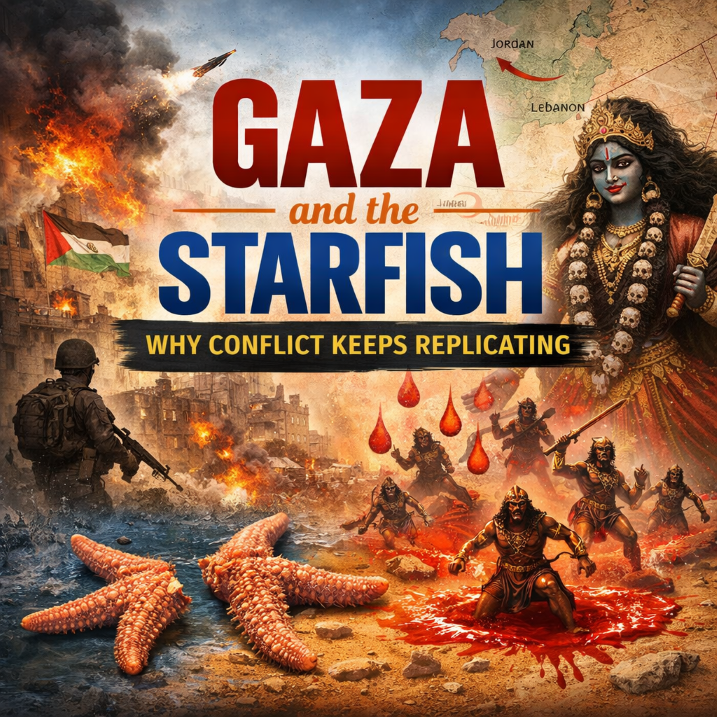
Gaza and the Starfish: Why Every Cut Creates More
The Civilizational Diagnostic Series — Islam | Part III
भारत/GB
Gaza and the Starfish: Why Every Cut Creates More
Cut a starfish in half and you don’t get a dead organism; you get two starfish. Similarly, Palestine has been sliced into minuscule strips, yet the population and extremism grow at an increasing pace. We must investigate if Gaza and the Starfish share a biological similarity.
Each starfish fragment carries a complete instruction set; it experiences amputation not as defeat, but as reproduction. Marine biologists find no mystery here—there is no central command to destroy because every cell carries the full program. This design, which converts destruction into multiplication, is mirrored in the behavior seen in Gaza and the broader Palestinian context.
What biology mapped in tide pools, seventy-eight years of documented conflict has failed to map on land. In Hindu tradition, the demon Raktbeej mirrors this: every drop of blood hitting the ground births a new version of the original. While previous parts of this series established the 1,400-year diagnostic of this mechanism, the world remains trapped in a cycle it cannot name. To understand seven decades of failure, we must look past political theory and into the cold mechanics of an organism that thrives on being cut—and the Dagdhabeejprinciple required to neutralize the seed.
Gaza and the Starfish: Conflict That Behaves Like a Starfish
Every military operation in Gaza has produced more fighters than it eliminated. Every targeted assassination has produced an identical replacement. Every economic blockade has produced tunnels. Every destroyed building has produced a recruitment narrative. Every civilian casualty has produced the next generation’s founding story.
This is not propaganda. It is a pattern observable across the entire timeline — across multiple operations, multiple political configurations, multiple Israeli governments, multiple Palestinian leaderships.
The pattern is biological, not political.
A conventional opponent has a central command structure. Destroy it and the organism stops. A conventional opponent has a loss condition — the point where cost exceeds benefit. A conventional opponent experiences defeat as defeat.
Gaza has none of these properties. And this is not recent. It is a seventy-eight year consistent pattern that every analyst has observed and none has explained within their own frameworks.
IS THE STARFISH A DISTRACTION?
While the Raktbeej mechanism operates on the ground, a secondary layer of warfare is being deployed in our courtrooms, media cycles, and international institutions. If the Starfish is the biology, The Great Deception is the camouflage that allows it to regenerate in broad daylight.
Why the Starfish Metaphor Is Incomplete
The starfish regenerates identically. One becomes two.
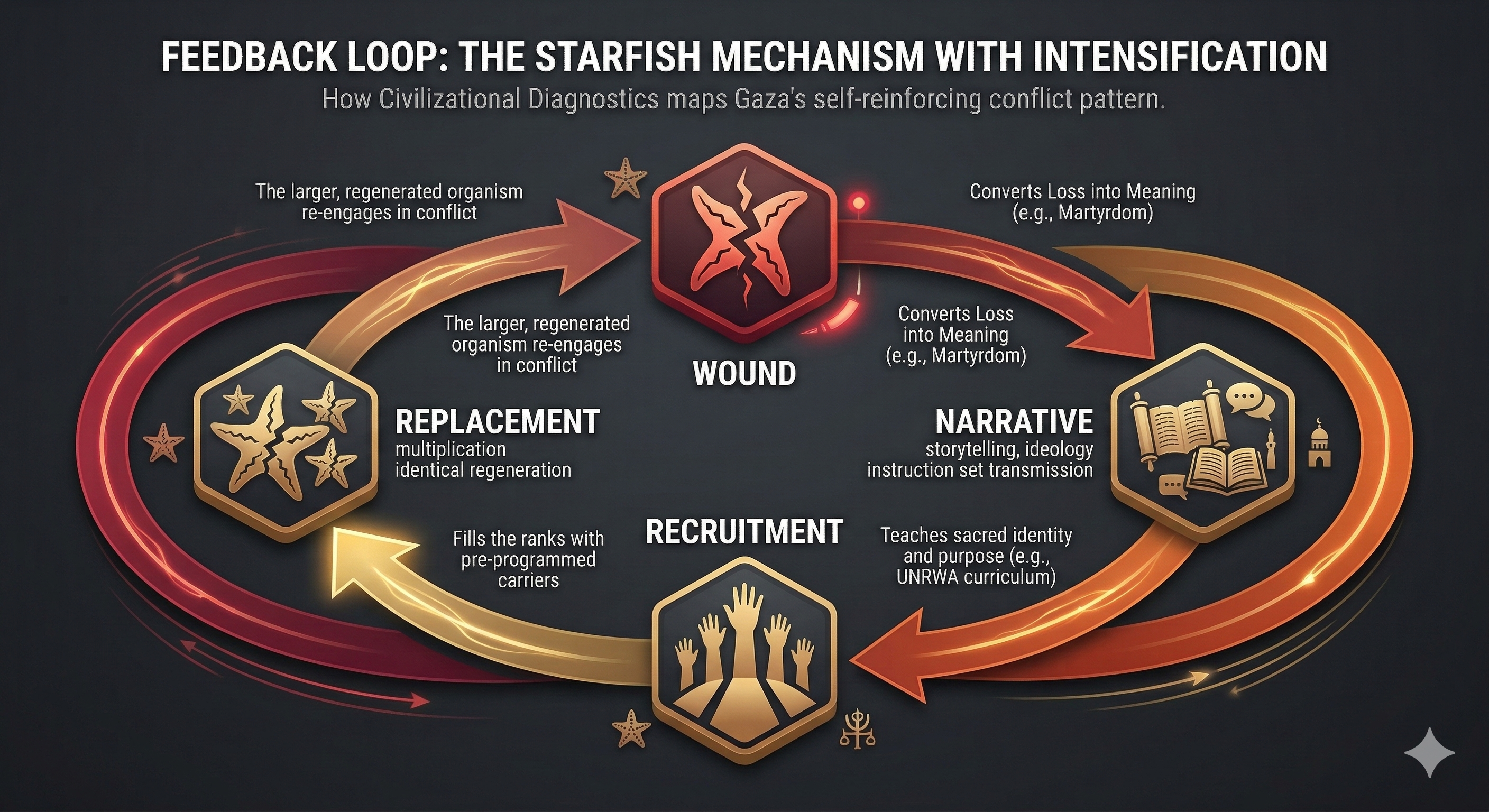
The mechanism operating in Gaza does something the starfish does not. It replicates with intensification. Each generation carries the previous generation’s martyrdom as sacred identity — not as grief, but as inheritance, as purpose, as theological obligation that is hardened and strengthened in every following generation.
IS THE STARFISH A DISTRACTION?
While the Raktbeej mechanism replicates and strengthens on the ground, a secondary layer of warfare is being deployed in our courtrooms and media cycles. If the Starfish is the biology, The Great Deception is the camouflage that allows it to regenerate in broad daylight.
The starfish grows back with the same biology. The next generation grows back with the previous generation’s death as its founding narrative. Each cycle adds the previous cycle’s losses as permanent fuel.
The wound becomes the seed. The martyr becomes the recruiting poster. The destroyed building becomes the classroom lesson.
BEFORE THE STARFISH: THE RAKTBEEJ THESIS
The Starfish is the biological symptom; Raktbeej is the civilisational diagnostic. To understand how a system disables its own defeat mechanism and converts blood into recruitment, you must start with the foundational logic of the 1,400-year organism.
The Instruction Set That Cannot Be Removed
The starfish regenerates because its instruction set is distributed across every cell. You cannot remove the regeneration capability without destroying every cell — which produces a different kind of multiplication: global outrage, recruitment across the entire Muslim world, the conflict metastasising far beyond its geography.
Gaza carries an instruction set that functions identically. It is not in a central command. It is not in a leadership structure. It is not in a geography.
It is in a theological construct written 1,400 years ago — transmitted through education, family structure, and reward systems to every member of the population across every generation. At the heart of this theological transmission is Quran Verse 9.5, the “Verse of the Sword,” which provides the absolute mandate for the elimination of the polytheist (Mushrikeen) unless they submit, effectively serving as the primary biological instruction set that drives the starfish’s replication. Numerous other verses provide further ambience for the interpretation of the verse to flourish, creating a self-sustaining ecosystem of conflict where the promise of divine reward ensures that for every carrier eliminated, multiple replacements are already programmed to emerge.
The instruction set has one defining property: it disables the loss condition.
Win means win. Die means martyrdom — which within the theological architecture is not loss but promotion. The family receives pension. The name is celebrated. The next generation is named after the martyr. There is no outcome that registers as defeat.
This is the starfish biology operating at civilisational scale. The cells do not know they are supposed to stop regenerating. The defeat mechanism has been architecturally removed.
STATE-LEVEL REPLICATION
Gaza demonstrates the biological replication of the Raktbeej mechanism; Pakistan demonstrates its state-sponsored application. To understand how theological source code is converted into a permanent national security doctrine, you must analyze the framework that drives the subcontinent’s most enduring conflict.
Gaza and the Starfish: The Four-Country Laboratory
If this behaviour were produced by occupation or blockade, removing the Israeli variable should change the outcome. The experiment has been run. Four times. Independently.
Jordan gave Palestinians citizenship and parliamentary representation. The PLO attempted to overthrow the monarchy. Jordan expelled them after a civil war — Black September, 1970.
Lebanon accepted Palestinian refugees, gave them operational autonomy in the south. Watched its state dissolve into a fifteen-year civil war that transformed what was once called the Paris of the Middle East into a failed state.
Kuwait hosted 400,000 Palestinians, employed them throughout the economy. When Palestinians supported Saddam Hussein’s invasion, Kuwait expelled all 400,000.
Syriamaintained camps under iron control. The camps became conflict zones again the moment Syrian state control weakened.
Four countries. Four independent experiments. Zero Israeli variable in any of them. Identical starfish mechanics in all four.
The marine biologist who ran four independent trials with identical results would publish the conclusion without hesitation: the regeneration mechanism is intrinsic to the organism. It is not produced by the environment.
[Related: Black September Jordan: The Forgotten War That Changed the Arab World]
[Related: Gulf States Refugee Policy: Why the Wealthy Arabs Said No]
Gaza and the Starfish: What Egypt’s Wall Actually Says
Egypt built a steel wall along its Gaza border. Not concrete — steel. Not two metres — nine storeys deep, extending below the water table, specifically engineered to prevent tunnelling.
Egypt is a Muslim-majority nation. Egypt shares a civilisational and religious heritage with Palestinians. Egypt has no territorial dispute with Palestine. Egypt is not Israel.
And Egypt built a biological containment structure.
Intelligence communities do not build nine-storey steel walls based on political sentiment. The engineering specification is the verdict. Egypt looked at the starfish directly — and built accordingly.
The fifty-seven Muslim-majority nations that maintain maximum verbal solidarity with Palestinians while simultaneously maintaining walls, legal exclusions, citizenship refusals, and mass expulsions have reached the same operational conclusion. They understand the starfish. They simply cannot say so publicly.
RELATED ANALYSIS
The international push for a Palestinian state collapsed when
99 out of 100 Israeli Knesset members rejected it.
This rare political consensus exposed the deep structural problems behind the
Two-State formula and why many analysts now consider it strategically obsolete.
The Potter Who Makes Only One Vessel
A potter who makes a chilam — a clay smoking pipe — produces an object designed to face fire and deliver poison. The form determines the function. The vessel has no choice in what it becomes.
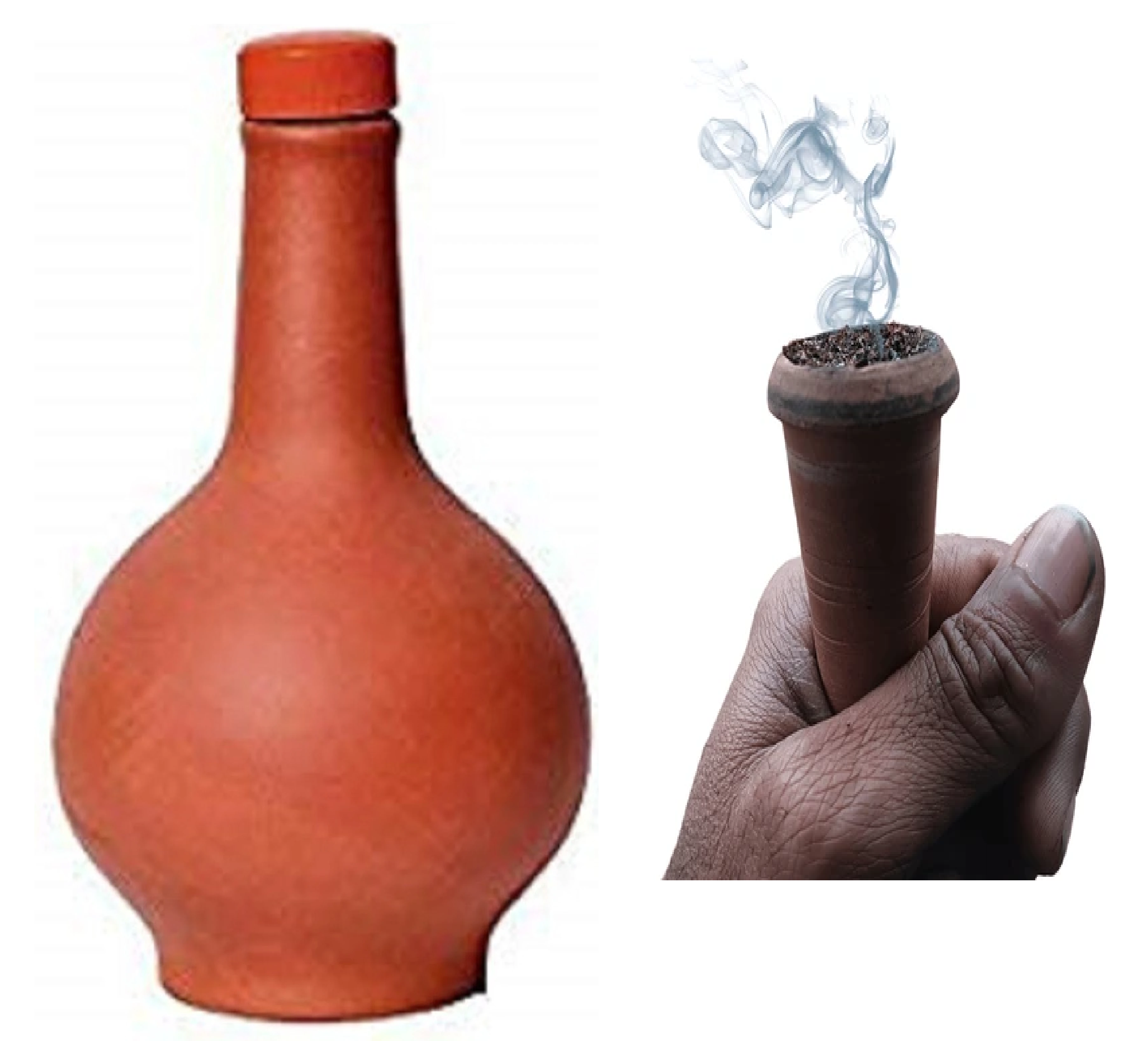
The Palestinian child enters an ecosystem that makes only one vessel.
UNRWA schools are the kiln. The curriculum — martyrdom as highest aspiration, right of return as non-negotiable across infinite generations — is the clay. The PA Martyr Fund, paying pensions indexed to attack severity, is the fuel. The theological source code is the mould.
The child does not choose this formation. It is applied before the capacity for choice exists. By the time choice becomes available, the vessel is already fired.
This is why the carrier-militant distinction is timing only — not category. Every individual is a carrier. Different activation timelines. Same instruction set.
Demographic expansion is increasingly shaping global politics, migration debates, and civilisational stability.
Explore how rapid population growth patterns intersect with ideological narratives and why Bharat’s historical experience offers warnings for a fragile West.
Related: Population Growth or Jihad — Bharat’s Warning to a Fragile West →
The Demographic Anomaly
A century ago, population growth followed a predictable economic pattern. As societies became wealthier and healthier, their populations grew rapidly. But as development continued, birth rates began to fall.
This pattern — known as the Demographic Transition Model — now describes most of the world. Developed economies such as Japan, Germany, and South Korea have some of the lowest fertility rates on earth. Even emerging economies like India and Bangladesh are moving toward replacement-level fertility.
Economic progress eventually slows population growth.
The Palestinian case defies standard demographic patterns, with population growth continuing at a high rate despite weak economic conditions.
Despite GDP per capita remaining around $3,500 — roughly one quarter of the global average — population growth continues at about 2.4% annually, more than double the global rate.
In demographic terms, this represents an unusual configuration: rapid population expansion occurring alongside a stagnant, aid-dependent economic base sustained largely through external support.
Cuscuta (Amarbel / Dodder) Concept
Another biological comparison raises an interesting question. Could the demographic pattern in Gaza resemble certain parasitic growth patterns found in nature?
In parts of South Asia there exists a parasitic vine known as Amarbel (Cuscuta). It attaches itself to host plants and draws nutrients from them, often spreading rapidly across the host while relying on it for sustenance. Because it produces very little of its own nourishment, its growth depends almost entirely on the energy drawn from the host system.
Does the Gaza ecosystem display a similar structural pattern — a demographic system capable of rapid population growth even when the underlying economic base remains weak and heavily supported by external inputs?
The India 1947 Proof
Same partition. Same displacement. Same trauma. Zero UNRWA. Zero hereditary status. Zero Martyr Fund. Forced finality with no international life support system.
Unlike any other refugee community in modern history, Palestinians retain a legally protected “right of return” across generations, while their population continues to grow at a rate significantly higher than the global average—even as the international system sustains the economy through continuous external support.
The result: within two generations, a space-faring economy.
The seed did not germinate because the ground was denied. Not because the trauma was lesser. Not because the people were different. Because the ecosystem that converts trauma into perpetual replication was never constructed.
Every civilisation that has successfully resolved conflicts of this type has applied this principle in different forms at different scales. The international community’s role for seventy-eight years has been to ensure the ground remains permanently fertile — to guarantee that every drop reaches the soil and germinates on schedule, generation after generation.
That is not humanitarianism. That is gardening the mechanism.
Demographic shifts are increasingly shaping political stability across Europe.
Explore how the same population dynamics discussed in this series are unfolding inside France,
where demographic continuity and strategic narratives intersect with questions of identity, governance, and social cohesion.
The Ancient Diagnostic, Named Precisely
Every phenomenon consistently observed across centuries eventually gets named. The naming is not the explanation — the phenomenon precedes the name. But the name allows transmission of the explanation across time.
Indian civilisational tradition, operating from systematic observation across millennia, named this specific mechanism 3,000 years before the Palestinian conflict existed.
Raktbeej — blood-seed.
The diagnostic: a system in which spilled blood produces new warriors rather than reducing fighting capacity. The defeat mechanism disabled. The attack mechanism converted into a regeneration mechanism.
The starfish is the Western reader’s entry point. Raktbeej is the precise ancient name for what the starfish illustrates imperfectly — because the starfish merely replicates, while Raktbeej replicates with each copy carrying the full memory and intensity of the original, plus the accumulated martyrdom of every previous cycle. Like most living systems under repeated pressure, each generation does not weaken but often develops a stronger survival impulse, hardening the will to persist and reproduce — a pattern that increasingly appears visible in the Palestinian demographic trajectory.
The Rishis who encoded this were doing what the marine biologist does — observing a recurring pattern, identifying its mechanics, encoding it in a form with maximum transmission durability. Narrative encoding outlasts academic text by millennia.
The idea that ancient Indian texts encoded scientific observations in narrative form is not limited to civilisational diagnostics like Raktbeej.
Indian astronomers used the same narrative method to explain complex celestial mechanics.
The Surya Siddhanta, one of the foundational texts of Indian astronomy, reveals how the famous story of Rahu swallowing the Sun during an eclipse reflects a remarkably accurate understanding of orbital mechanics.
Related: Surya Siddhanta — The Astronomical Truth of Rahu’s Bite →
Closing
The marine biologist is not cruel to the starfish. He simply understands what it is.
Understanding what Gaza is — what mechanism operates there, what instruction set drives the regeneration, what ecosystem enables the germination — is not hatred of Palestinians. It is the precondition for any honest analysis of what has failed for seventy-eight years and what the only functional alternatives actually are.
Cut the starfish. Count what grows back.
Then ask the question that seven decades of strategic thinking has avoided: what would it take to change the conditions rather than the count?
The answer was encoded 3,000 years ago. It was available the entire time.
The diagnostic is complete. We have seen the Starfish, the Raktbeej, and the necessity of the Dagdhabeej principle. The question is no longer ‘what is happening,’ but whether the West has the civilizational courage to apply the ancient cure to the modern wound.
Disclaimer
This article presents an analytical discussion of historical events, demographic patterns, and ideological frameworks. It is not intended to criticize or target any community, faith, or religion. References to texts, institutions, or historical developments are used only for analytical and educational purposes to examine long-term conflict dynamics and social patterns. The discussion focuses on systems and ideas, not on judging individuals or communities.
Part 4 — The Four-Country Laboratory Jordan, Lebanon, Kuwait, Syria — four independent host nation experiments. Zero Israeli variable in all four. Identical replication pattern in all four. This is your most academically devastating argument. It destroys the “pressure cooker” counter-argument permanently. You have individual blogs on each — this is the synthesis article reading all four as a single controlled experiment.
Feature Image: Click here to view the image.
Videos
Glossary
- रक्तबीज):Blood-seed — the asura in Devi Mahatmya whose spilled blood produces duplicate warriors; used here as a civilisational diagnostic for systems where defeat produces replication rather than surrender
- Dagdhabeej (दग्धबीज):Burnt seed — a seed rendered incapable of germination; the karmic chain broken at source before manifestation; applied here as ecosystem denial rather than population destruction
- Chilam (चिलम):A clay smoking pipe — the potter analogy: a vessel shaped to face fire and deliver poison, the only product the Palestinian ecosystem manufactures
- UNRWA:The only UN body that confers hereditary refugee status across unlimited generations, unique to Palestinians across all of human history
- Black September (1970):The Jordanian civil war in which King Hussein expelled the PLO after it attempted to overthrow his government — the first of four independent national experiments proving the Raktbeej mechanism operates independent of the Israeli variable
- Starfish Regeneration: A biological phenomenon in which starfish can regenerate from severed parts, used as a metaphor for self-replicating conflict systems that multiply when attacked.
- Demographic Transition Model: A demographic theory explaining how population growth initially rises and then declines as economies develop and societies become wealthier.
- Martyr Fund: A payment system administered by the Palestinian Authority that provides financial compensation to families of individuals involved in attacks against Israel.
- Cuscuta (Amarbel / Dodder): A parasitic vine that survives by attaching to host plants and extracting nutrients, used as an ecological analogy for systems sustained by external support.
- Surya Siddhanta: An ancient Indian astronomical treatise describing planetary motions and eclipse mechanics through mathematical and narrative explanations.
- Verse of the Sword (Quran 9:5): A Quranic verse historically interpreted in various theological traditions regarding warfare and religious conflict.
- Right of Return: The political doctrine asserting that Palestinian refugees and their descendants have the right to return to territories lost during the Arab–Israeli conflicts.
- The Four-Country Laboratory: The analytical framework examining Jordan, Lebanon, Kuwait, and Syria as independent geopolitical environments that experienced similar destabilization patterns linked to Palestinian militant groups.
- The Great Deception Framework: A conceptual argument that legal, media, and diplomatic narratives can mask underlying structural conflict dynamics.
- Civilizational Diagnostic: A method of interpreting historical and political phenomena through long-term civilizational patterns rather than short-term political explanations.
- Wet Sand Principle: A metaphor describing how altering environmental conditions can prevent replication in biological or conflict systems, similar to removing a starfish from the ocean.
[…] […]
[…] […]
[…] […]
[…] Gaza and the Starfish: Why Every Cut Creates […]
[…] […]
[…] Gaza and the Starfish: Why Every Cut Creates […]
[…] लाता है, जिसकी आईएसआई चार दशकों तक वहाबी बीज की रक्तबीज जैसी वृद्धि का मुख्य संचालन माध्यम बनी […]
[…] The self-undermining logic of this architecture is the one the analysis has established precisely. Saudi Arabia is replacing the American security guarantee — which was commercially extractive but ideologically neutral toward the Saud monarchy’s domestic legitimacy — with a Pakistan-Turkey security architecture that is less commercially extractive but ideologically connected to the Brotherhood challenge that Qatar is building. Blog 62 (Dar Al Harb Ambivalence) documented Qatar funding the Brotherhood whose democratisation of political Islam is existentially threatening to hereditary monarchy. Blog 63 (Dar Al Harb Ambivalence Pakistan) documented Pakistan’s bifurcated state architecture maintaining operational relationships with Brotherhood-adjacent organisations. The SMDA that Saudi Arabia signed with Pakistan in September 2025 brings in as replacement security guarantor the state whose ISI became the principal operational channel through which the Wahhabi seed’s Raktbeej-like multiplication was administered across four decades. […]
[…] Real people moved. The apparatus constructed around that movement — hereditary refugee status, Martyr Fund, the statehood vocabulary — was the manufactured layer built on top of a real but ordinary […]
[…] उसी पर वंशानुगत शरणार्थी व्यवस्था, मार्टर फंड और राज्य निर्माण की राजनीतिक […]
[…] […]
[…] Gaza and the Starfish: Why Every Cut Creates […]