

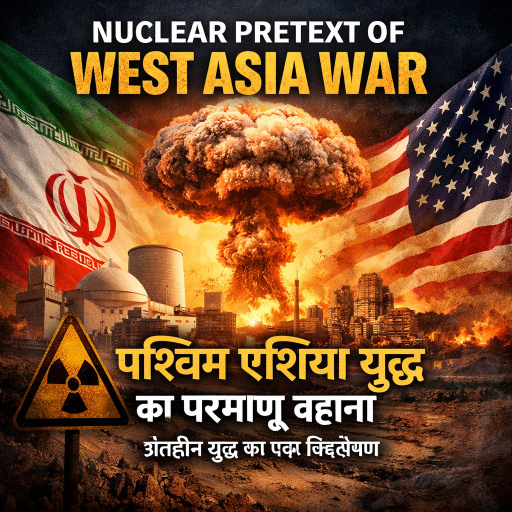
Nuclear Pretext of West Asia War: A Reckoning of West Asia’s Endless War (5)
Part 5: West Asia’s Endless War
भारत / GB
What the IAEA Actually Said, What the Strikes Actually Destroyed, and What Survived
Nuclear Pretext of West Asia War: The Justification That Built Itself
Nuclear Pretext of West Asia War: Iran enriched uranium toward weapons-grade while Washington dismantled the one agreement that had stopped it.
Blog 4 established the economic core of the Iran war — oil is the only motive that survives every ethical and legal test. But the nuclear pretext of West Asia War was not invented. Iran was enriching uranium. The IAEA was alarmed. Breakout was real. A nuclear pretext of West Asia War built on real facts is more dangerous than a fabricated one — it carries enough truth to serve as cover for the motive beneath it. This blog examines the nuclear pretext in sequence: what Iran actually built, what Washington’s own policy produced, what the June 2025 strikes destroyed, and what survived.
Nuclear Pretext of West Asia War: What Iran Actually Built
The facts of Iran’s nuclear programme are not disputed. The IAEA’s May 2025 report confirmed Iran held 408.6 kilograms of uranium enriched to sixty percent purity — a near fifty percent increase from February — making Iran the only non-nuclear-weapon state in the world producing material at that level. The IAEA called it a matter of serious concern. For our discussion, we are ignoring the credibility of IAEA and Iran’s claim of bias against it.
Sixty percent enrichment has no civilian justification. Power reactors require three to five percent. Research reactors use twenty percent. By November 2024, Iran’s breakout time had been compressed from over a year under the JCPOA to one week or less. The IAEA also confirmed it had lost continuity of knowledge over Iran’s centrifuge inventory after Tehran restricted experienced inspectors’ access to key installations in 2023. The declared programme was what inspectors could see — what existed beyond their sight was a question this West Asia endless war has not yet answered.
Nuclear Pretext of West Asia War: Washington Built It
The JCPOA — the 2015 nuclear agreement between Iran and the P5+1 — capped Iranian enrichment at 3.67 percent, capped the stockpile at 202 kilograms, and placed intrusive IAEA inspections across the entire programme. It explicitly prohibited uranium enrichment at Fordow before 2030 and barred production of highly enriched uranium through 2030. Breakout time under the deal was over a year.
Trump withdrew from the JCPOA unilaterally in May 2018. Not bound by any commitment after Trump’s withdrawal from JCPOA, Iran began breaching enrichment limits in 2019 — exactly one year after the US exit — and accelerated steadily from that point. Every step of Iran’s nuclear escalation — sixty percent enrichment, stockpile accumulation, inspector expulsion, breakout compression — followed directly from the American decision to destroy the agreement that had frozen those same capabilities. The nuclear pretext of West Asia War justifying the 2026 strikes was built on the foundation of the 2018 policy that dismantled the diplomatic alternative.
This is the destabilization doctrine’s core mechanism — create the conditions that generate the justification, then deploy the justification to justify the force. In Iraq it was WMD. In Iran it is the nuclear pretext of West Asia War. The product differs. The mechanism is identical.
Nuclear Pretext of West Asia War: What the June 2025 Strikes Destroyed
Israel’s Operation Rising Lion began June 13 2025. The United States joined June 21 with Operation Midnight Hammer. One hundred and twenty-five aircraft including B-2 bombers carrying thirty-thousand-pound Massive Ordnance Penetrators struck Natanz, Fordow, and Isfahan. At Natanz, above-ground infrastructure and the pilot fuel enrichment plant were destroyed, with two bunker-busters hitting the underground centrifuge halls. At Isfahan, the uranium conversion facility was obliterated. At Fordow, twelve Massive Ordnance Penetrators left six craters and the site was declared inoperable. The Institute for Science and International Security assessed that Iran’s centrifuge enrichment programme had been effectively destroyed. Trump called it obliteration. That description was accurate for the centrifuges. It was not accurate for the material. Contemporary reporting described it as one of the largest concentrated airstrike operations against a single country in recent decades.
Nuclear Pretext of West Asia War: What Survived
The centrifuge programme was destroyed. The enriched uranium stockpile was not. The IAEA Director General confirmed in March 2026 that over two hundred kilograms of sixty percent enriched uranium remained underground at Esfahan alone — enough for approximately five nuclear warheads if enriched further. US officials acknowledged Iran retained its full stockpile. Whereabouts of the complete 408 kilograms remained unconfirmed.
Sixty percent enriched uranium is weapon-usable without further enrichment. Iran’s stockpile represented enough material for six to seven bombs of an unsophisticated design — and Iran had expelled IAEA inspectors, making the stockpile’s precise location unknown to any international body. The enrichment infrastructure was gone. The material was not. This strategic failure was punctuated on March 3, 2026, when a 4.4 magnitude seismic event was detected in Fars Province. While Tehran claimed a natural tectonic shift, the intelligence community remains divided: was it a structural collapse of a deep-storage facility, or a sub-critical test of what survived? Before June 2025, Iran had a monitored programme approaching weapons capability. After June 2025, it has an unmonitored Iran nuclear stockpile and a series of seismic anomalies that no inspector can verify. The regime change playbook has once again produced an outcome more dangerous than the situation it claimed to resolve.
Nuclear Pretext of West Asia War: If the Red Line Was Real, Why Three Years?
The nuclear pretext cannot answer one question. By September 2022, the IAEA had formally confirmed Iran held enough sixty percent enriched uranium to fuel one bomb. By November 2023, enough for three. By May 2025, enough for nine. The threshold Washington called intolerable was crossed in autumn 2022. The strikes came in June 2025. Three years and a growing stockpile separated the red line from the response.
A genuine nuclear red line produces a consistent response at the moment of crossing — the way Israel’s Begin Doctrine operated against Iraq’s Osirak in 1981 and Syria’s reactor in 2007. What this timeline produced was tolerance, then sudden urgency. The variable was not the programme. Obama faced the same enrichment trajectory and negotiated the JCPOA. Trump exited it. Biden failed to restore it. Trump returned and struck — not because the nuclear facts had changed materially from 2022, but because the decision-maker had. Identical facts. Three responses. The variable was the person in office, not the programme.
Then there is the question of sequencing. The June 2025 strikes destroyed enrichment infrastructure. The logical next step — if the goal was nuclear resolution — was to secure the surviving stockpile diplomatically. Instead Washington launched the February 28 2026 campaign while negotiations were still active in Muscat. You do not strike mid-negotiation to resolve a nuclear threat. You strike mid-negotiation when the negotiation is the obstacle — because what you want is not a nuclear agreement.
Nuclear Pretext of West Asia War: The Intelligence Assessment Washington Ignored
The final element of the nuclear pretext of West Asia War is the most consequential. The US Intelligence Community assessed, even after the June 2025 strikes, that Iran was not building a nuclear weapon. IAEA Director General Grossi confirmed in March 2026 that inspectors had found no evidence of a coordinated Iranian programme to manufacture nuclear weapons. The enrichment was real. The stockpile was real. The nuclear weaponisation step — converting enriched material into a bomb — was not confirmed by any authoritative body.
Iran was at the threshold. It had not crossed it. The nuclear pretext of West Asia War justified strikes on a programme approaching weapons capability — not one building weapons. That distinction matters under international law. It mattered less to Washington in February 2026 than the oil economics Blog 4 laid bare. The next blog examines what made this selective enforcement possible — the nuclear hypocrisy that surrounds Israel, Pakistan, and North Korea in silence while Iran faces war for a threshold it never crossed.
Next: Nuclear Hypocrisy — A Reckoning of West Asia’s Endless War (6). Who appointed America the nuclear policeman of the world? Israel’s ninety warheads, Pakistan’s proliferation network, North Korea’s six detonations — and the silence that surrounds all three while Iran faces obliteration for approaching a threshold it never crossed.
Feature Image: Click here to view the image.
Glossary of Terms
- JCPOA (Joint Comprehensive Plan of Action): The 2015 multilateral nuclear agreement between Iran and the P5+1 powers — the United States, United Kingdom, France, Russia, China, and Germany. Iran agreed to limit uranium enrichment and accept IAEA inspections in exchange for sanctions relief. The US withdrew unilaterally in May 2018.
- IAEA (International Atomic Energy Agency): The United Nations body responsible for verifying compliance with the Nuclear Non-Proliferation Treaty. Its inspectors monitored Iran’s nuclear programme under the JCPOA and documented Iran’s progressive breaches of enrichment limits following the 2018 US withdrawal.
- Nuclear Breakout: Point at which a nation has sufficient enriched uranium and capability to assemble a nuclear weapon rapidly.
- Maximum Pressure: The US policy of comprehensive economic sanctions applied to Iran following the 2018 JCPOA withdrawal. Designed to crush Iranian oil exports and force renegotiation of nuclear terms. Oil exports fell from over two and a half million barrels per day to under four hundred thousand barrels per day at peak pressure.
- Mandate Progression: The arc across successive US-led military interventions showing progressive erosion of legal constraint — Afghanistan (UN mandate), Iraq (no UN mandate, fabricated WMD pretext), Libya (UN mandate exceeded for regime change), Kosovo (no mandate, precedent set), Venezuela (economic warfare without mandate), Iran 2026 (struck without mandate, mid-negotiation). Each step less legally constrained than the last.
- P5+1: The six-power group that negotiated the JCPOA with Iran — the five permanent UN Security Council members (United States, United Kingdom, France, Russia, China) plus Germany. Also referred to as the E3+3 in European diplomatic usage.
- Uranium Enrichment: The industrial process of increasing the concentration of the fissile isotope U-235 in uranium. Natural uranium contains 0.7 percent U-235. Reactor fuel requires 3–5 percent. Weapons-grade requires 90 percent or above. Sixty percent — Iran’s level — has no civilian application and is classified as highly enriched uranium.
- Operation Rising Lion: The Israeli military air campaign against Iranian nuclear facilities that began June 13 2025. Struck Natanz, Fordow, Isfahan, and additional sites. Preceded the US entry into the strikes by eight days.
- Operation Midnight Hammer: The US military air campaign against Iranian nuclear facilities that began June 21 2025. Deployed B-2 Spirit stealth bombers carrying Massive Ordnance Penetrators against hardened underground sites at Fordow and Natanz.
- Massive Ordnance Penetrator (MOP): A thirty-thousand-pound GPS-guided bunker-buster bomb developed by the US Air Force to destroy deeply buried and hardened underground facilities. The largest conventional bomb in the US arsenal. Used at Fordow and Natanz in Operation Midnight Hammer.
- Fordow: Iran’s uranium enrichment facility built deep inside a mountain near Qom, approximately 80 metres underground. Constructed to withstand conventional air strikes. Declared to the IAEA in 2009 after US intelligence revealed its existence. Under the JCPOA, enrichment at Fordow was prohibited until 2030.
- Nuclear Weaponisation: The technical and engineering process of converting enriched uranium or plutonium into a functional nuclear weapon — including bomb design, triggering mechanisms, and miniaturisation for delivery. Distinct from enrichment. Iran’s enrichment was documented; weaponisation was not confirmed by any authoritative body prior to the 2026 strikes.
#NuclearPretextWestAsia #HormuzReckoning #WestAsiaEndlessWar #IranNuclear #IranWar2026 #JCPOAWithdrawal #USIsraelStrikesIran #OperationRisingLion #OperationMidnightHammer #IranNuclearStockpile #NuclearWeaponisation #RegimeChangePlaybook #WestAsiaWar #MaximumPressure #Fordow #Natanz #HinduinfopediaGeopolitics #IranWar #NuclearPretext
Relevant Links
Previous Blog
- https://hinduinfopedia.com/war-zone-in-hormuz-a-reckoning/
https://hinduinfopedia.in/?p=25537 - https://hinduinfopedia.com/hormuz-world-war-ladder-a-reckoning-of-west-asias-endless-war-2/
https://hinduinfopedia.in/?p=25545 - https://hinduinfopedia.com/west-asia-war-ethics-a-reckoning-of-west-asias-endless-war-3/
https://hinduinfopedia.in/?p=25550 - https://hinduinfopedia.com/west-asia-war-economics-a-reckoning-of-west-asias-endless-war-4/
https://hinduinfopedia.in/?p=25557
FOR BLOGS ON US IMPERIAL MINDSET / OIL MOTIVE / DESTABILIZATION DOCTRINE
- Destabilization Doctrine: How America’s Foreign Policy Boomerang Is Striking Home
- Regime Change Playbook: A Manual for Color Revolution Operations
- America, Independence, 1776 to Modern Hegemony — US Hypocrisy Doctrine (via Great Deception)
- Target India: Action Phase — Doctrine in Motion
- Activation of Destabilization Doctrine: The India Deployment Begins
- Rupee Rebellion / De-dollarization (cross-reference via .org)
FOR BLOGS ON IRAN / RAKTBEEJ / DUMP TRUCK RESILIENCE
- Great Deception and Global Civilizational Warfare — five-stage playbook applies directly to Iran’s regenerative resistance
- Islamist Boomerang Effect — When Pakistan’s Cross-Border Strikes Vindicate India’s Doctrine — dump truck principle applied to Pakistan, parallel to Iran
- Demographic Reality Exposed: How High-Fertility Clusters Reshape Democracies — Raktbeej demographic dimension
FOR BLOGS ON GULF MONARCHIES / UMMAH DELUSION / SHIA-SUNNI DIVIDE
- Gulf States Refugee Policy: Why the Wealthy Arabs Said No to Palestinians — Gulf self-preservation over Ummah solidarity, directly applicable
- Palestinian Refugees: Why No Muslim Country Will Take Them — Ummah as myth
- Black September Jordan: The Forgotten War That Changed the Arab World — Sunni-Shia and Arab political fractures
- Lebanon Civil War: From Paris of the Middle East to Hezbollah State — Gulf-Iran-Hezbollah triangle
FOR BLOGS ON UN / RULE-BASED ORDER / NEW COLONIAL ORDER
- When Dictatorships Vote on Democracy — The UN Legitimacy Crisis
- Anti-Israel Obsession — The UN’s Statistical Evidence of Institutional Bias
- New York Declaration Deconstructed — September 2025’s Theatre of Absurd
- New York Declaration Proponents — Hypocrisy and Legal Theater
- New York Declaration Perspectives — History, Media, and Theatrical Mechanics
FOR BLOGS ON MEDIA / SELECTIVE OUTRAGE / MANUFACTURED NARRATIVE
- How Media Manipulation Works: The Global Template
- Media as Manipulator In Unrest: The False Causality Matrix
- Muslim Brotherhood France: Intelligence Report Media Ignored
FOR BLOGS ON INDIA’S NEUTRALITY / UPI / STRATEGIC AUTONOMY
- Unrest From Bangladesh to Nepal: Is India the Real Target?
- Narrative of Unrest: When Neighbors Become Examples
- Rahul’s Gen Z Call — Activation of Destabilization Doctrine
- Money Trail: Analyzing Financial Networks Behind Nepal’s Protests
FOR BLOGS ON ISRAEL / PALESTINE / DECAPITATION TEMPLATE
- October 7th Vindication: Egypt’s Prophetic Wall
- Two-State Delusion Exposed — Netanyahu’s 99-9 Vote
- Right of Return to Palestine: The Strategy Behind 75 Years of Refugees
- Egypt Gaza Wall: The Hidden Truth 57 Muslim Nations
FOR BLOGS ON NUCLEAR HYPOCRISY / MANUFACTURED EXTREMISM
- Islamist Boomerang Effect
- Destabilization Doctrine — How America’s Foreign Policy Boomerang Is Striking Home
FOR BLOGS ON RAKTBEEJ AND DAGDHABEEJ / PHILOSOPHICAL RESOLUTION THREAD
- Raktbeej And Starfish Thesis: The 1,400-Year Organism That No Modern Framework Can Contain (Part II)
- Raktbeej Thesis: The Ancient Diagnostic That Explains What No Modern Framework Can
- Gaza and the Starfish: Why Every Cut Creates
Follow us:
- English YouTube: https://www.youtube.com/@Hinduofficialstation
- Hindi YouTube: https://www.youtube.com/@HinduinfopediaIn
- X: https://x.com/HinduInfopedia
- Instagram: https://www.instagram.com/hinduinfopedia/
- Facebook: https://www.facebook.com/Hinduinfopediaofficial
- Threads: https://www.threads.com/@hinduinfopedia
[…] भारत / GB […]
[…] Nuclear Pretext of West Asia War: A Reckoning of West Asia’s Endless War (5) […]
[…] https://hinduinfopedia.com/nuclear-pretext-of-west-asia-war-a-reckoning-of-west-asias-endless-war-5/ https://hinduinfopedia.in/?p=25588 […]
[…] […]
[…] https://hinduinfopedia.com/nuclear-pretext-of-west-asia-war-a-reckoning-of-west-asias-endless-war-5/ https://hinduinfopedia.in/?p=25588 […]
[…] उसकी नैतिक और आर्थिक संरचना, उसके परमाणु आयामों, इस्लामी एकजुटता के विभाजन, […]
[…] […]
[…] https://hinduinfopedia.com/nuclear-pretext-of-west-asia-war-a-reckoning-of-west-asias-endless-war-5/ https://hinduinfopedia.in/?p=25588 […]
[…] https://hinduinfopedia.com/nuclear-pretext-of-west-asia-war-a-reckoning-of-west-asias-endless-war-5/ https://hinduinfopedia.in/?p=25588 […]
[…] https://hinduinfopedia.com/nuclear-pretext-of-west-asia-war-a-reckoning-of-west-asias-endless-war-5/ and https://hinduinfopedia.in/?p=25588 […]
[…] https://hinduinfopedia.com/nuclear-pretext-of-west-asia-war-a-reckoning-of-west-asias-endless-war-5/ and https://hinduinfopedia.in/?p=25588 […]
[…] https://hinduinfopedia.com/nuclear-pretext-of-west-asia-war-a-reckoning-of-west-asias-endless-war-5/ and https://hinduinfopedia.in/?p=25588 […]
[…] https://hinduinfopedia.com/nuclear-pretext-of-west-asia-war-a-reckoning-of-west-asias-endless-war-5/ and https://hinduinfopedia.in/?p=25588 […]
[…] https://hinduinfopedia.com/nuclear-pretext-of-west-asia-war-a-reckoning-of-west-asias-endless-war-5/ and https://hinduinfopedia.in/?p=25588 […]
[…] https://hinduinfopedia.com/nuclear-pretext-of-west-asia-war-a-reckoning-of-west-asias-endless-war-5/ and https://hinduinfopedia.in/?p=25588 […]
[…] https://hinduinfopedia.com/nuclear-pretext-of-west-asia-war-a-reckoning-of-west-asias-endless-war-5/ and https://hinduinfopedia.in/?p=25588 […]
[…] https://hinduinfopedia.com/nuclear-pretext-of-west-asia-war-a-reckoning-of-west-asias-endless-war-5/ and https://hinduinfopedia.in/?p=25588 […]
[…] https://hinduinfopedia.com/nuclear-pretext-of-west-asia-war-a-reckoning-of-west-asias-endless-war-5/ and https://hinduinfopedia.in/?p=25588 […]
[…] https://hinduinfopedia.com/nuclear-pretext-of-west-asia-war-a-reckoning-of-west-asias-endless-war-5/ and https://hinduinfopedia.in/?p=25588 […]
[…] https://hinduinfopedia.com/nuclear-pretext-of-west-asia-war-a-reckoning-of-west-asias-endless-war-5/ and https://hinduinfopedia.in/?p=25588 […]
[…] Read: Nuclear Pretext → […]
[…] Read: Nuclear Pretext → […]
[…] Nuclear Pretext: A Reckoning of West Asia’s Endless War (5) https://hinduinfopedia.com/nuclear-pretext-of-west-asia-war-a-reckoning-of-west-asias-endless-war-5/ […]
[…] run it against Washington. The results are not comfortable for the designation’s architects. Iran was mid-negotiation with IAEA inspectors when the strikes began — it had not withdrawn from the Nuclear Non-Proliferation Treaty, had not conducted nuclear […]
[…] […]
[…] as a state objective is an existential threat that pre-emption doctrine permits addressing. Blog 5 (Nuclear Pretext) documented the nuclear argument’s weaknesses — Iran was mid-negotiation with IAEA […]
[…] उस चुनौती का सामना किया जा सकता है। ब्लॉग 5 (परमाणु बहाना) ने परमाणु तर्क की सीमाएँ दर्ज की थीं। […]
[…] Read […]
[…] https://hinduinfopedia.com/nuclear-pretext-of-west-asia-war-a-reckoning-of-west-asias-endless-war-5/ and https://hinduinfopedia.in/?p=25588 […]
[…] https://hinduinfopedia.com/nuclear-pretext-of-west-asia-war-a-reckoning-of-west-asias-endless-war-5/ and https://hinduinfopedia.in/?p=25588 […]
[…] https://hinduinfopedia.com/nuclear-pretext-of-west-asia-war-a-reckoning-of-west-asias-endless-war-5/ and https://hinduinfopedia.in/?p=25588 […]
[…] https://hinduinfopedia.com/nuclear-pretext-of-west-asia-war-a-reckoning-of-west-asias-endless-war-5/ https://hinduinfopedia.in/?p=25588 […]