

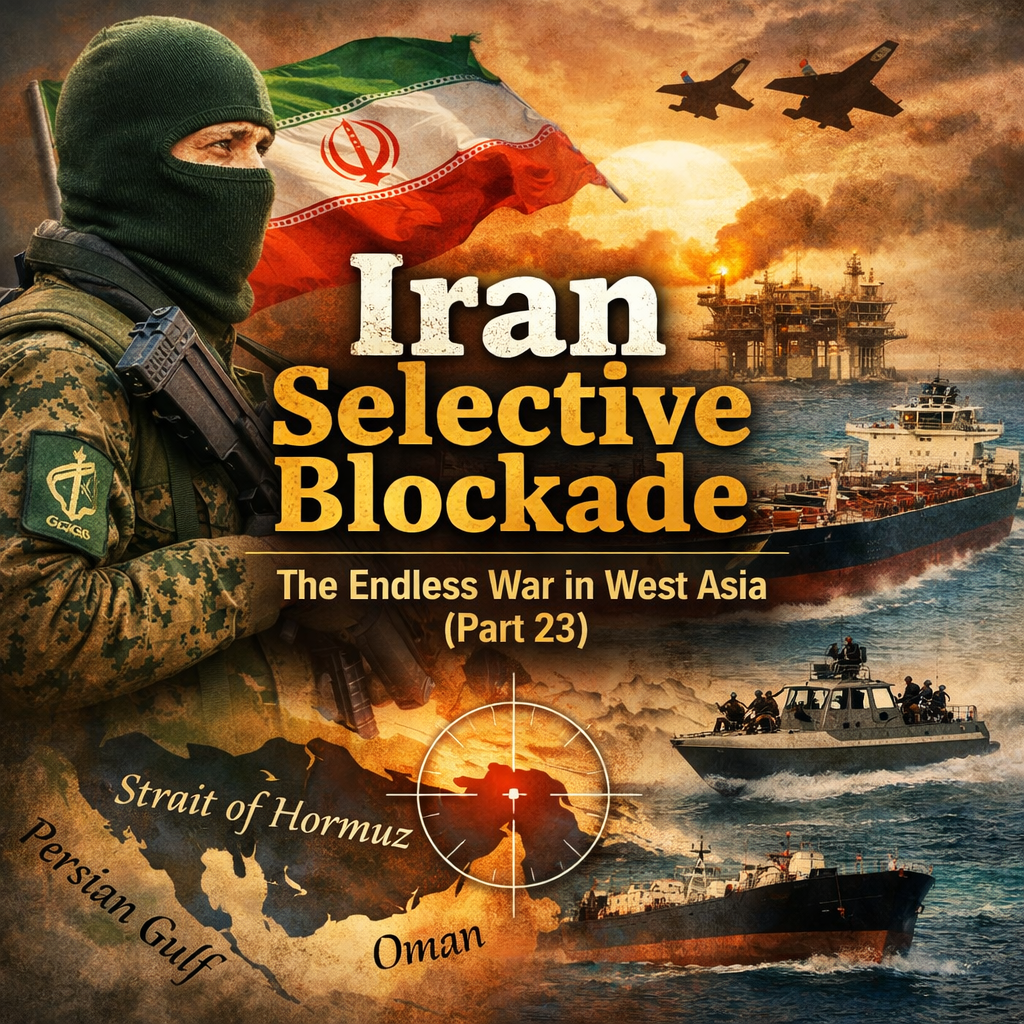
Iran Selective Blockade: A Reckoning of West Asia’s Endless War (23)
Part 23 of the West Asia’s Endless War Series
भारत / GB
The Tehran Toll Booth — How Iran Turned a Blockade Into a Geopolitical Sorting Machine
Iran Selective Blockade: Blowback of US’ Economic Blocked?
We walked through the local dynamics of the war now at display involving threat to very survival of Israel, the clash of cultures between Saudi Arabia, the Shia-Sunni divide within Islam, the poorly designed exit plan, if any, and the very rationale to war at this very moment when Iran holds the battery power to the pacemaker of Gulf allies of the United States. Blog 22 established Trump’s Hormuz Abandonment Doctrine — Washington’s formal declaration that Hormuz is the responsibility of user nations, not America’s. Now we will examine what Iran has built inside that abandoned space: not a simple closure, but. what we call as Iran Selective Blockade that functions as a geopolitical sorting machine — deciding which nations get access to the global oil highway and which do not, ship by ship, payment by payment, allegiance by allegiance.
The transition was not declared—it was absorbed. As enforcement receded, coordination became control, and what began as procedural compliance hardened into conditional access.
Iran Selective Blockade: The Fiction of the Friendly Nation
Iran Selective Blockade: Not a closure — a toll booth. Iran decides ship by ship, nation by nation, dollar by dollar. When Iran announced it would allow passage for “friendly nations” — China, Russia, India, Iraq, Pakistan — the framing suggested a coherent exemption policy. The operational reality has been something different. From March 1 to March 15, just 21 tankers transited the route since the war began on February 28, compared with more than 100 ships daily before the conflict. The Iran Selective Blockade is not a humanitarian exemption. It is an extortion architecture operating under the language of diplomatic accommodation.
The mechanism is documented with precision. Ships hoping to use the pre-approved route are expected to have communicated extensive details regarding both the ownership of the vessel and destination of the cargo to the IRGC in advance of transit. Once screened, the IRGC provides a route code and an armed escort — through Iranian territorial waters, not the standard international shipping lane. The transit is not through the public maritime corridor. It is through Iran’s territorial waters, under Iranian military escort, on Iranian terms. Iranian lawmaker Alaeddin Boroujerdi told Iran International that the country has been charging some vessels $2 million to pass through the strait. Some vessels have paid fees in Chinese yuan or cryptocurrency before being escorted through the strait.
Iran Selective Blockade: Role Inversion
The architecture Iran has constructed at Hormuz has a precise historical mirror. For four decades, Washington decided which nations could trade with Iran — sanctioning governments that bought Iranian oil, blacklisting companies that sold Iran equipment, threatening secondary sanctions against banks that processed Iranian transactions. The United States, from Washington, determined the terms on which the world could engage with a sovereign state it had not declared war on. It called this economic statecraft. Iran is now doing the same thing from the other end of the strait — determining which nations may access the global oil highway, on what terms, at what price, under whose escort. Washington sanctioned Iranian trade for defying American strategic preferences. Iran is now sanctioning Western-aligned shipping for the same reason. The instrument is identical. The direction has reversed. The state that spent forty years telling the world what commerce was permissible has discovered that the logic it built can be operated by someone else.
The Iran Selective Blockade: It Is a Power Architecture
The “friendly nation” designation is not a fixed list based on diplomatic status. It is a dynamic instrument that Iran adjusts in real time based on what each nation is willing to do, say, or pay. On March 5, the IRGC announced Iran would keep Hormuz closed only to ships from the US, Israel, and their Western allies. By March 13, Turkish transport minister Abdulkadir Uraloğlu said Iran approved passage of a Turkish ship. By March 25, Thailand secured passage after diplomatic coordination with Tehran — a Thai oil tanker crossed the strait without paying a fee. The Philippines subsequently secured a pledge of safe transit for its oil shipments after Tehran determined Manila was not aligned with Washington’s war posture.
The pattern that emerges is not a policy of exceptions. It is a pricing mechanism for geopolitical alignment. Every nation that wants access to Hormuz must negotiate individually with the IRGC. Some pay in yuan. Some pay in crypto. Some pay in diplomatic statements distancing themselves from Washington. Some pay in flag changes — one stranded tanker was offered safe passage if it raised the flag of Pakistan, according to a company executive. The Iran Selective Blockade has converted maritime transit rights — which international law treats as universal and non-negotiable — into a bilateral commodity that Tehran trades for political and financial concessions.
The Randomness Is the Strategy
The Iran Selective Blockade would be manageable if it were predictable. It is not. The attacks have followed no discernible pattern, said Bridget Diakun, senior risk and compliance analyst at Lloyd’s List Intelligence, which “makes things difficult for people trying to plan any transiting, because they can’t work out what the rationale is for one ship getting hit over another.” A vessel broadcasting “China Owner” on its AIS is not guaranteed safety — one China-owned vessel broadcasting its Chinese affiliation was struck by shrapnel while sailing from the Middle East Gulf toward Jebel Ali on March 12. A Pakistani-flagged vessel transited successfully in mid-March; another Pakistani vessel was subsequently turned back for not complying with Iranian protocols.
The randomness is the strategy. An Iran Selective Blockade that operated on clear, consistent rules would allow shipping companies to plan. They could qualify their vessels, pay the required fees, file the required manifests, and route accordingly. A blockade that attacks vessels regardless of their declared status — including vessels from nominally friendly nations — cannot be planned around. It can only be avoided entirely or accepted as a pure risk gamble. Over 2,000 ships are stranded in the region, with about 400 vessels in the Gulf of Oman, suggesting that many operators have chosen to hold position rather than commit to either transiting or long-haul rerouting. The uncertainty itself is the weapon. It does not need to sink every ship to stop the shipping.
Naval force can escort ships, but it cannot eliminate risk. In a system where a single strike can trigger environmental catastrophe and insurance collapse, uncertainty—not prohibition—is sufficient to thin traffic to a trickle.
📌 The Chokehold Economics That Make This Possible
The Iran Selective Blockade operates inside the economic architecture established when Hormuz became a selective access weapon. Read the full oil economics.
Iran Selective Blockade: The Sovereignty Claim and Its Implications
Iran has framed the toll booth not as a wartime measure but as a permanent assertion of sovereignty. Iran’s parliament approved legislation to formally impose transit fees, framed not just as a revenue source but as a formal assertion of Iranian sovereignty over the strait. An Iranian lawmaker stated the reasoning directly: “Just as goods pay transit fees when passing through other corridors, the Strait of Hormuz is also a corridor. We provide its security, and it is natural that ships and oil tankers should pay such fees.”
This framing is legally significant and strategically deliberate. The United Nations Convention on the Law of the Sea — which Iran has ratified — establishes the right of transit passage through international straits as universal and non-suspendable even in wartime. Iran’s toll booth legislation directly challenges this framework, asserting that Hormuz is subject to Iranian sovereign authority rather than international maritime law. Iran has demanded international recognition of its right to exercise authority over the Strait of Hormuz as one of its five conditions for ending the war. If that demand is partially satisfied through de facto recognition — through nations paying tolls, filing manifests with the IRGC, and accepting Iranian escort — the Iran Selective Blockade will have achieved something that outlasts the current conflict: a precedent for Iranian sovereign authority over international waters.
The Global South nations currently negotiating individual passage agreements with Tehran are — whether they intend to or not — participating in the construction of that precedent. Every nation that files a vessel manifest with the IRGC, pays a transit fee in yuan, and accepts an Iranian naval escort is acknowledging Iranian jurisdictional authority over the strait. The UN institutional framework that prohibits this has no enforcement mechanism. The Iran Selective Blockade is not a wartime aberration that will revert to the previous order when the shooting stops. It is a new order being constructed ship by ship.
📌 The Nation Most Exposed to This Toll Booth
India’s experience of the Iran Selective Blockade — 22 ships stranded, ship-by-ship negotiations, navy deployed, neutrality tested in real time.
Next: India Hormuz Trap — Blog 24 in West Asia’s Endless War examines India’s impossible position inside the Iran Selective Blockade — half its crude and LNG imports through the strait, 22 ships stranded, ship-by-ship negotiations with Tehran, navy deployed to escort tankers, and strategic neutrality being tested in real time by both Washington and Tehran simultaneously.
Feature Image: Click here to view the image.
Videos
[…] भारत / GB […]
[…] भारत / GB […]
[…] Read: Iran Selective Blockade → […]
[…] Read: Iran Selective Blockade → […]
[…] https://hinduinfopedia.com/iran-selective-blockade-a-reckoning-of-west-asias-endless-war-23/ and https://hinduinfopedia.in/?p=26098 […]
[…] The United States has signalled it could participate in coordination arrangements. As detailed in Blog 23, Iran’s system of security vetting and coordination for vessels remained in place rather than […]
[…] Iran Selective Blockade: A Reckoning of West Asia’s Endless War (23) https://hinduinfopedia.com/iran-selective-blockade-a-reckoning-of-west-asias-endless-war-23/ […]
[…] https://hinduinfopedia.com/iran-selective-blockade-a-reckoning-of-west-asias-endless-war-23/ and https://hinduinfopedia.in/?p=26098 […]
[…] उस ब्लॉग ने स्पष्ट तर्क रखा: ईरान हॉर्मुज़ को बंद नहीं कर रहा है। वह इसे अपनी शर्तों पर पुनः खोल रहा है। Iran Selective Blockade ने एक नई व्यवस्था को स्थापित होते हुए दर्शाया — जहाज दर जहाज। इसने यह भी संकेत दिया कि जो देश IRGC को विवरण प्रस्तुत कर रहे थे, पारगमन शुल्क दे रहे थे, और ईरानी नौसैनिक सुरक्षा स्वीकार कर रहे थे, वे अनजाने में भी जलडमरूमध्य पर ईरानी अधिकार को स्वीकार कर रहे थे। […]
[…] Blog 23 of this series — Iran Selective Blockade — documented the toll booth architecture in precise operational detail. The IRGC vetting system. The manifest and crew detail requirements. The route code issued after screening. The armed escort through Iranian territorial waters. The $2 million per transit fees. The yuan and cryptocurrency payment channels. The parliamentary legislation framing the fees not as a wartime measure but as a permanent assertion of Iranian sovereignty over the strait. […]
[…] Read: Iran Selective Blockade → […]
[…] Iranian authorisation until reverse blocked by US, while American-allied shipping was blocked. The Iran Selective Blockade established that Iran designed its Hormuz closure to maintain access for friendly states while […]
[…] Read […]
[…] पढ़ें: ईरान चयनात्मक नाकाबंदी → […]
[…] में भाग ले सकता है। जैसा कि ब्लॉग 23 में विस्तार से बताया गया है, जहाजों के […]