

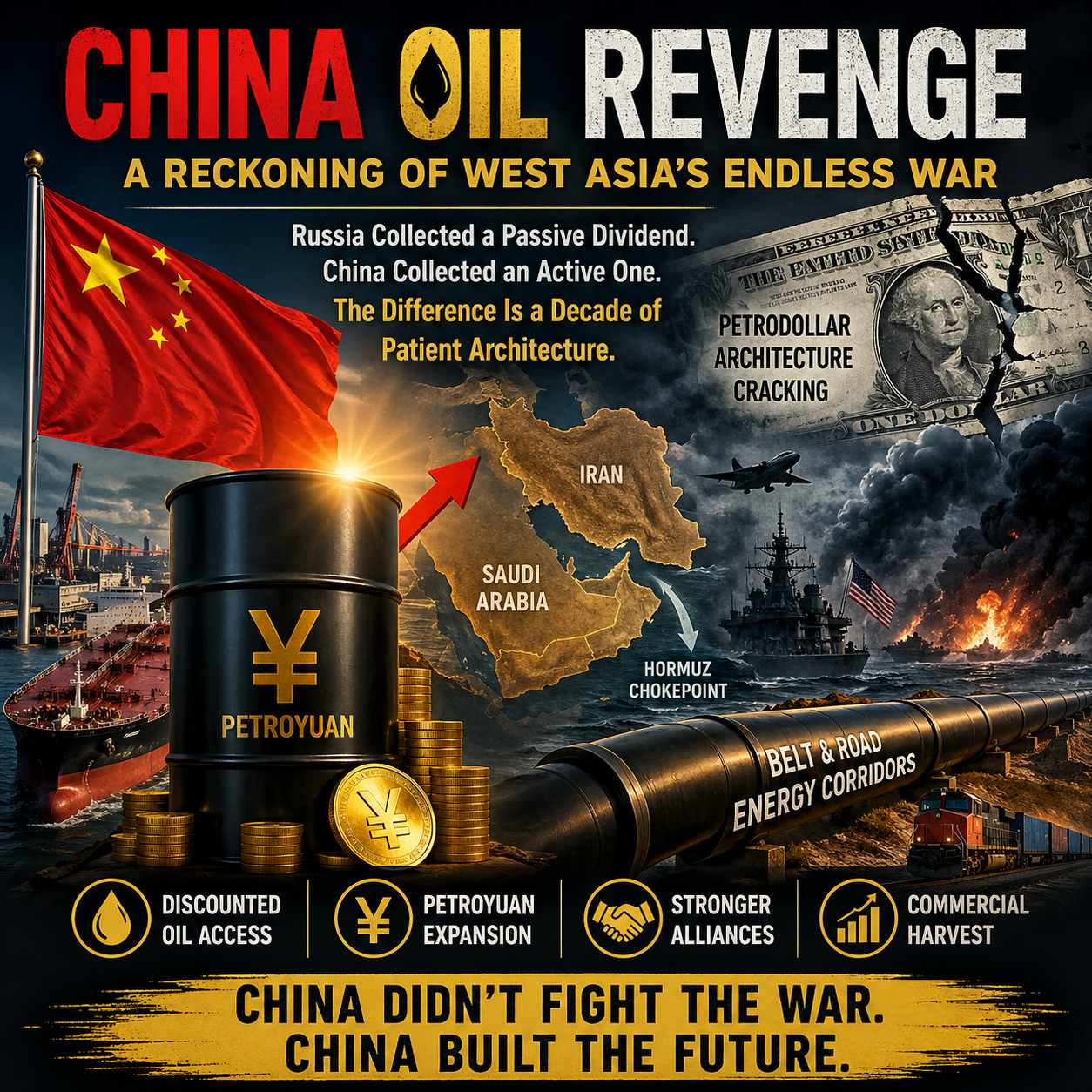
China Oil Revenge: A Reckoning of West Asia’s Endless War (47)
Part 47 of the West Asia’s Endless War Series
भारत / GB
Russia Collected a Passive Dividend. China Collected an Active One. The Difference Is a Decade of Patient Architecture.
Blog 46 established Washington’s Global Control War — the series thesis: Iran is the instrument, the war is against economic independence from Washington wherever it exists. Blog 47 examines the power that spent a decade building the alternative to the architecture Washington was defending, and then watched Washington dismantle that architecture through the war designed to protect it. China Oil Revenge is not China winning the Iran war. China did not fight the Iran war. China Oil Revenge is the name for what happens when a great power’s patient decade-long positioning meets another great power’s strategic overreach — and the harvest arrives without a battle being fought.
China Oil Revenge: Positioned, Not Passive
China Oil Revenge: China did not fight the Iran war. China spent war energy collecting the commercial harvest of the architecture Washington was trying to defend. The distinction between Russia’s position and China’s in the 2026 Iran conflict is the distinction between passive collection and active positioning. Blog 42 established the Russia Passive Dividend — Russia sat out, absorbed no cost, and collected $9 billion monthly in oil revenue from a price spike it did not cause. Russia’s dividend was the windfall from doing nothing in the right place at the right time. China’s dividend is structurally different: it is the harvest of a decade of deliberate infrastructure construction, currency architecture, energy contract positioning, and alternative order building — all of which became commercially indispensable at the precise moment Washington’s war disrupted the system China’s architecture was designed to replace.
China called for a ceasefire without joining one. China’s Foreign Ministry condemned the strikes as a “serious violation of international law and the UN Charter” and called for an immediate halt — a position that cost nothing to state and gained everything from being stated to a Global South that had already reached the same conclusion. China’s oil continued flowing through Hormuz under Iranian authorisation until reverse blocked by US, while American-allied shipping was blocked. The Iran Selective Blockade established that Iran designed its Hormuz closure to maintain access for friendly states while blocking hostile ones — and China, having maintained a strategic partnership with Iran through the decade of sanctions, was among the states whose passage was protected. The China Oil Revenge began before the first bomb fell: it was embedded in the relationship architecture China had built while Washington was applying sanctions.
China Oil Revenge: The Petrodollar Architecture Was the Target
Blog 32 documented Saudi Arabia’s non-renewal of the petrodollar agreement in 2024. Blog 37 established the 1974 deal was signed under duress. China Oil Revenge is the completion of that argument: China has been systematically building the architecture to replace dollar-denominated oil pricing since 2018 — the Shanghai International Energy Exchange, petroyuan contracts with Russia and Iran, bilateral currency swap agreements with nineteen oil-producing states, Belt and Road infrastructure creating non-dollar trade corridors across three continents. The IMF’s own analysis noted the gradual but accelerating fragmentation of the global currency system away from dollar dominance — a trend China’s petroyuan architecture was designed to accelerate. The South China Morning Post documented that yuan-denominated oil trade grew from effectively zero in 2017 to 20% of China’s total oil imports by 2025 — a structural shift that predated the Iran war and that the Iran war has now dramatically accelerated.
The acceleration is documented in the war’s own commercial data. Gulf states watching Washington block their own exports without consultation accelerated their petroyuan contract discussions. Bloomberg confirmed that Saudi Arabia’s yuan-denominated oil sales to China increased by 34% in March and April 2026 — the months of the Iran war — as Riyadh assessed that the petrodollar arrangement’s protective guarantee had been revealed as conditional at best.
Russia, collecting its oil windfall, is selling an increasing share in yuan. Iran has conducted all its oil trade in non-dollar currencies since 2018 and has demonstrated across twelve weeks of American military pressure that non-dollar oil pricing survives. The war that was supposed to defend the dollar-based energy order has produced the fastest acceleration of non-dollar oil pricing in the petrodollar system’s fifty-year history. Washington’s Global Control War was fought to protect the petrodollar architecture. China Oil Revenge is the name for what is happening to that architecture while the war is being fought.
📌 The Architecture Washington Was Defending
The petrodollar system built in 1974 under the shadow of invasion planning — its fifty-year structure, its non-renewal in 2024, and why the Iran war has accelerated its dissolution.
China Oil Revenge: The Commercial Harvest
The China Oil Revenge’s commercial anatomy operates through four simultaneous channels — each of which was pre-positioned before the war and each of which the war made more valuable.
Discounted Russian crude. China’s oil imports from Russia surged during the war — Russian Urals crude available at significant discounts to Brent even as Brent repriced upward due to Hormuz disruption. Reuters confirmed China was purchasing Russian crude at spreads 15-20% below Brent during the peak of the crisis — buying cheap while the world’s benchmark price was elevated by a war China had nothing to do with. The spread between what China paid and what the market priced is the China Oil Revenge’s most direct financial expression.
African energy infrastructure. Blog 33 documented the African LNG emergency contracts that India and Europe signed when the Gulf alternative was disrupted. China had been financing African energy infrastructure for a decade before those emergency contracts were signed — port terminals in Angola, pipeline infrastructure in Nigeria, LNG facility financing in Mozambique and Equatorial Guinea. The African energy surge the Iran war created flows partly through Chinese-built and Chinese-financed logistics. The African Development Bank noted that Chinese-financed energy infrastructure handled a disproportionate share of the surge in African LNG exports during the Hormuz crisis — the Belt and Road’s energy infrastructure dividend arriving through a crisis China did not create.
The South China Sea precedent. Washington’s Hormuz blockade — adopting Iran’s toll booth without Iran’s territorial legal basis — has validated the chokepoint as a legitimate instrument of strategic power. The Diplomat documented that Chinese strategic analysts cited Washington’s Hormuz blockade as establishing a precedent directly applicable to Chinese control architecture in the South China Sea — where China has been building precisely the kind of chokepoint control that Washington just demonstrated, in Hormuz, constitutes acceptable great power behaviour when the power in question is sufficiently dominant. Washington’s war has validated China’s South China Sea strategy through operational example.
The alternative order made credible. The EU Energy Umbrella Reckoning showed Europe paying 50-90% premium for American LNG after the Ukraine war destroyed cheap Russian gas. The Agricultural Feudalism Reckoning showed Ukrainian farmers retaining 30% of agricultural value while American corporations captured 70%. China is offering Belt and Road infrastructure financing at 3% to the same African LNG producers whose energy Europe now desperately needs. Chatham House analysis confirmed that Chinese-financed infrastructure projects in African energy-producing states carried financing costs averaging 2.8-3.2% — compared to Western commercial financing at 6-9% and IMF conditional financing whose market liberalisation requirements Blog 44 documented. China is building agricultural supply chain infrastructure in South America, Africa, and Central Asia as an alternative to the ABCD grain trading network. The choice governments are making — between Washington’s commercial architecture at Washington’s prices and China’s alternative architecture at negotiated terms — is no longer theoretical. The Global South War Narrative the series documented in Blog 9 is now a procurement decision.
📌 The War Washington’s Global Control War Was Fighting
The series thesis — Iran is the instrument, the war is against economic independence from Washington. Every element of the commercial architecture Washington is defending through the endless war is the architecture China is building its alternative to.
The China Oil Revenge: The Closing Argument
The China Oil Revenge’s closing argument is structural and historical simultaneously. The British Empire built the Royal Navy to protect its trade routes. When the trade routes became more valuable than the empire could sustain protecting, the empire dissolved and the United States inherited the architecture. Washington built the petrodollar system, the dollar-denominated energy order, and the military guarantee architecture to protect its commercial position. When the commercial position became more valuable than the war designed to protect it could sustain defending, the architecture began dissolving — and China, which spent a decade building the alternative, is positioned to inherit the trade routes the empire can no longer protect. The New Colonial Enforcement does not outlast the enforcer’s capacity to enforce. Washington fought the war to defend the petrodollar architecture. China spent the war collecting the commercial harvest of the architecture’s dismantling. That is the China Oil Revenge — not a battle won but a position inherited through patience while the incumbent exhausted itself defending what it could no longer hold.
Next: India Energy Exposure — Blog 48 in West Asia’s Endless War examines India’s position in the commercial architecture the Iran war has restructured: 90 lakh workers in Gulf states, Chabahar investment in Iran, defence partnership with Israel, energy dependency across four competing supply chains simultaneously, and a Strategic Defence Partnership with UAE signed nineteen days before the war began. India’s tightrope is the most precise illustration of what strategic autonomy actually costs when the global control war reaches the chokepoint through which 40% of India’s energy flows. Part of the West Asia’s Endless War Series on hinduinfopedia.com.
Feature Image: Click here to view the image.
Videos
Glossary of Terms
- China Oil Revenge: A coined term in this series describing China’s long-term strategic positioning that enabled it to gain commercial advantages from the conflict without direct military involvement.
- Global Control War: A framework describing the use of economic, military, and institutional tools to maintain global dominance, particularly associated with U.S. strategy.
- Petrodollar Architecture: The global system established post-1974 where oil trade is denominated in U.S. dollars, reinforcing dollar dominance.
- Petroyuan: China’s alternative currency framework enabling oil trade in yuan, reducing reliance on the U.S. dollar.
- Passive Dividend: Gains accrued without direct participation, such as Russia benefiting from oil price increases during the conflict.
- Active Positioning: Strategic long-term preparation that allows a state to capitalize on geopolitical shifts, as demonstrated by China.
- Selective Blockade: A controlled restriction strategy allowing access to certain countries while denying others, as seen in the Hormuz context.
- Hormuz Chokepoint: A critical maritime passage through which a significant portion of global oil supply flows.
- Belt and Road Initiative (BRI): China’s global infrastructure and connectivity program aimed at building trade and energy corridors.
- Currency Fragmentation: The shift from a dollar-dominated system toward a multi-currency global financial structure.
- Alternative Order: An emerging global economic and trade system positioned as an alternative to Western-led frameworks, led significantly by China.
- Strategic Overreach: When a power extends beyond its sustainable capacity, weakening its ability to maintain control.
- Commercial Harvest: The economic gains realized from long-term investments and positioning, especially during crises.
- Global South: A collective term for developing nations seeking alternatives to existing global economic dominance structures.
#China #Oil #Iran #Geopolitics #Energy #Dollar #Yuan #GlobalTrade #India #HinduinfoPedia
West Asia’s Endless War: Why This Series Exists
[…] भारत / GB […]
[…] Blog 47 established the China Oil Revenge — how China spent a decade building the alternative to the petrodollar architecture and collected the harvest as Washington’s war dismantled the system it was designed to defend. Blog 48 examines today’s breaking development: the UAE exits OPEC and OPEC+ effective May 1 2026, ending 59 years of membership, timed precisely as Iran’s new Hormuz proposal is being considered and the second round of Islamabad talks is being arranged. The UAE OPEC Split is not a market story. It is a diplomatic communication — delivered without a phone call, readable by every party that needs to read it. […]
[…] https://hinduinfopedia.com/china-oil-revenge-a-reckoning-of-west-asias-endless-war-47/ […]
[…] extraction mechanism persists until a credible alternative exists. Blog 47 (China Oil Revenge) established that China spent a decade building the architecture the Gulf needed before the Gulf […]
[…] Read […]
[…] […]
[…] outcomes. Russia collected $9 billion monthly in oil windfall from a price spike the war created. China collected its oil revenue advantage through a decade of pre-positioning that the war’s disruption made commercially decisive. […]
[…] oil windfall from the Hormuz closure gives it no structural incentive to end the conflict quickly. Blog 47 (China Oil Revenge) documented China’s consistent pattern: accumulate position while Washington fights. China […]
[…] ईरानी तेल का प्रसंस्करण करती हैं — ब्लॉग 47 (चीन तेल प्रतिघात) ने दर्ज किया था कि चीन ईरान द्वारा […]