

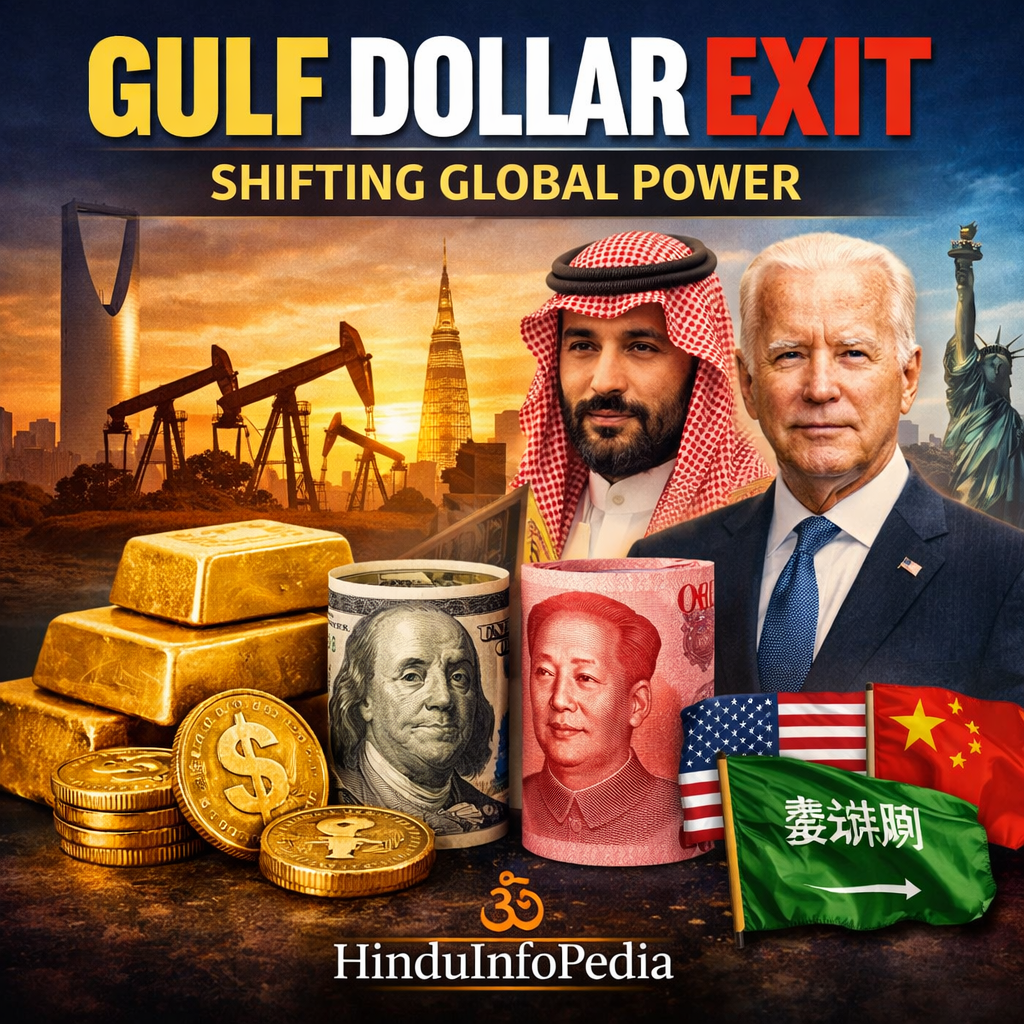
Gulf Dollar Exit Reckoning: A Reckoning of Endless War (32)
Part 32 of the West Asia’s Endless War Series
भारत / GB
The Fashion Has Changed. Central Banks Are Buying Gold. The Gulf Is Repricing the Arrangement That the War Has Broken.
Blog 31 established the Gulf Betrayal Reckoning — the four-pillar security architecture the Gulf built around Washington, broken simultaneously by a war launched from Gulf bases without consultation, with the ceasefire negotiated over Gulf heads by Pakistan. Blog 32 examines the structural consequence: why the Gulf states will not simply continue to price oil in dollars, recycle surpluses into US Treasuries, and depend on Lockheed Martin for defence after a war that demonstrated what the petrodollar arrangement actually costs. The Gulf Dollar Exit Reckoning is the vindication arc’s final argument — and it was already underway before the first missile fell on February 28.
Gulf Dollar Exit Reckoning: The Deal That Was Already Expiring
Gulf Dollar Exit Reckoning: Saudi Arabia did not renew the petrodollar deal in 2024. The war confirmed why. The repricing has begun. The most significant single fact in the Gulf Dollar Exit Reckoning was not produced by the Hormuz war. It predates it. Saudi Arabia chose not to formally renew the petrodollar agreement in June 2024 — the 50-year arrangement under which Gulf producers priced oil exclusively in dollars and recycled surpluses into US Treasuries. The arrangement that Blog 18 of this series documented as the foundation of dollar hegemony — the 1974 Kissinger-Saudi deal that converted American monetary dominance into a structurally enforced global norm — was allowed to expire without renewal by the state whose participation made it work.
This was not announced as a strategic rupture. It was a quiet non-renewal. Saudi Arabia did not declare de-dollarisation. It simply did not sign again. The distinction matters: a state that announces dollar exit makes a political statement. A state that quietly declines to renew makes a strategic calculation. The calculation was already in motion before the war. The war has confirmed it with evidence that was impossible to ignore. The Gulf Dollar Exit Reckoning is the documentation of a process that the Hormuz war accelerated but did not initiate.
The Signals That Were Already There
The Gulf Dollar Exit Reckoning did not begin on February 28, 2026. It began with a series of documented signals that the series has referenced throughout — and which the war has now transformed from trend into trajectory.
Central banks buying gold instead of dollars. Central banks added over 1,000 tonnes of gold to their reserves in 2024 — a record — with nearly 70% of central banks surveyed planning to increase gold’s share of their reserves over the next five years. The dollar’s share of global foreign exchange reserves fell from 71% in 1999 to 56.3% in mid-2025 — the lowest in thirty years. This is not a marginal adjustment. It is fifteen consecutive years of central banks buying gold as policy — treating it as geopolitically neutral, unsanctionable, and not subject to the weaponisation Washington demonstrated against Russia in 2022. The Gulf sovereign wealth funds — which built their balance sheets inside the dollar system — are part of this shift. BRICS+ nations, which now include Saudi Arabia and the UAE since the 2024 expansion, hold 17.4% of global gold reserves — up from 11.2% in 2019.
European states repatriating gold from American vaults. Germany repatriated 300 tonnes from the New York Federal Reserve between 2013 and 2017. Netherlands, Poland, and Austria followed. The direction is consistent across states that hold no brief against Washington — they are reducing exposure to assets held in American custody because the 2022 Russian sanctions demonstrated that dollar-denominated reserves held in American institutions can be frozen. European gold repatriation is not anti-American. It is risk management by states that watched Washington weaponise custodial access and drew the logical conclusion.
Saudi Arabia allowing yuan settlement for Chinese oil. Saudi Aramco has signed agreements permitting yuan settlement for Chinese oil purchases — the first operational breach of the dollar-only pricing architecture since 1974. Deutsche Bank analysts noted in March 2026 that the Hormuz conflict could be remembered as a key catalyst for erosion in petrodollar dominance and the beginnings of what they call the petroyuan. Iran’s selective blockade — offering passage to tankers settling in yuan — is the most direct operational challenge to dollar-denominated energy pricing in the system’s history.
Gulf monarchies embracing Indian payment systems. Several Gulf states have integrated India’s Unified Payments Interface (UPI), allowing instant rupee-linked transactions by Indian expatriates, tourists, and businesses. The UAE led the way in 2022, with widespread merchant acceptance at malls, supermarkets, and transport; Qatar, Saudi Arabia, and Oman followed, enabling QR-code payments and easier cross-border flows. This practical accommodation of the rupee — alongside ongoing experiments with rupee trade settlement via Vostro accounts — reflects the Gulf’s quiet recalibration. It reduces friction in one of the world’s largest bilateral corridors while diminishing exclusive reliance on dollar-based rails.
📌 The 1974 Deal This Reckoning Is Unravelling
The Nixon-Kissinger-Saudi arrangement that made dollar hegemony structural — and why the Gulf’s participation was always the load-bearing pillar.
Gulf Dollar Exit Reckoning: What the War Has Confirmed
The Gulf Dollar Exit Reckoning is not a prediction. It is the documentation of a repricing already underway, confirmed by the war’s evidence. The states whose dollar loyalty was the petrodollar system’s load-bearing pillar have now witnessed what that loyalty actually costs.
From 2022 to 2024, central banks purchased 3,220 tonnes of gold — more than double the pace of the preceding decade, representing the longest institutional accumulation cycle in modern monetary history. The US national debt crossed $34 trillion before the war. Interest payments on the debt now exceed defence spending in the federal budget. The US debt surpassed $37 trillion in 2025, with persistent inflation eroding the dollar’s purchasing power. The war has added significant expenditure on top of a base that was already structurally unsustainable. The dollar’s status as global reserve currency is the mechanism that allows Washington to borrow at this scale without triggering a debt crisis. De-dollarisation is therefore not merely a financial trend — it is a direct threat to the American government’s solvency model. States that understand this are not waiting for the crisis to arrive before adjusting their reserve composition.
The Lockheed Martin dependency is being hedged. Saudi Arabia has been negotiating defence cooperation with China. The UAE signed Huawei 5G infrastructure agreements that Washington tried to block. Qatar hosts Al Udeid but is simultaneously exploring alternative supplier relationships. The defence dependency is not ended — it is being diversified. After a war in which American bases on Gulf soil attracted Iranian missiles to Gulf infrastructure, the strategic calculation behind exclusive dependence on American military hardware has visibly changed.
The Gulf Dollar Exit Reckoning does not require the Gulf to announce a dollar exit to be real. It requires the fashion to change. As the Global South War Narrative established in Blog 9, the six billion people reading this war as resource imperialism are not making ideological arguments. They are making strategic calculations. Gulf states are not anti-American. They are states that have now seen what the American security guarantee costs operationally, what dollar-denominated reserve management costs when the guarantor weaponises the currency system, and what exclusive defence dependence costs when the supplier launches wars from your bases without asking. The repricing is not from ideology. It is from evidence. And it was already underway before the first missile fell.
📌 The New Energy Architecture Replacing the Gulf Fashion
Africa’s LNG, India’s emergency contracts, and why the Hormuz war has broken the Gulf’s fashion monopoly on global energy investment — the next structural shift already in motion.
Next: Global Energy Reckoning — Blog 33 in West Asia’s Endless War examines the Hormuz war as the event that broke the Gulf’s fashion monopoly on global energy investment — and why Africa, South America, and Central Asia, whose energy was always there but chronically undervalued, are now receiving the investment that the petrodollar fashion directed exclusively toward the Gulf for fifty years. The fashion has changed. The capital follows. Part of the West Asia’s Endless War Series on hinduinfopedia.com.
Feature Image: Click here to view the image.
Videos
Glossary of Terms
- Gulf Dollar Exit Reckoning: The gradual shift by Gulf nations away from exclusive reliance on the US dollar in oil trade and reserves, driven by strategic recalibration.
- Petrodollar System: A global financial arrangement established in nineteen seventy four where oil transactions were priced in US dollars, reinforcing dollar dominance.
- Key Phrase – Gulf Dollar Exit: Refers to the evolving process in which Gulf states diversify away from dollar-based oil pricing and financial systems.
- De-dollarisation: The process by which countries reduce dependence on the US dollar in trade, reserves, and financial transactions.
- Central Bank Gold Accumulation: A sustained increase in gold purchases by central banks as a reserve asset instead of holding dollar-based assets.
- Foreign Exchange Reserves: Assets held by central banks in foreign currencies, gold, or securities to manage economic stability and trade.
- BRICS+ Expansion: The inclusion of additional countries like Saudi Arabia and United Arab Emirates into the BRICS grouping, expanding its economic influence.
- Petroyuan: A term used to describe oil transactions settled in Chinese yuan instead of US dollars.
- Gold Repatriation: The process of countries bringing back their gold reserves from foreign storage locations to domestic vaults.
- Reserve Currency: A currency held in significant quantities by governments and institutions for international trade and finance, primarily the US dollar.
- Sovereign Wealth Funds: State-owned investment funds that manage national surplus revenues, often derived from natural resources like oil.
- UPI Integration in Gulf: Adoption of India’s digital payment system by Gulf countries to enable rupee-based transactions for trade and retail.
- Energy Pricing Architecture: The system and conventions that determine how global energy commodities like oil are priced and traded.
- Strategic Hedging: The practice of diversifying economic, financial, or defense dependencies to reduce vulnerability.
#Geopolitics #Economy #Petrodollar #Gold #Oil #Dollar #BRICS #GlobalShift #Energy #HinduinfoPedia
West Asia’s Endless War: Why This Series Exists
[…] भारत / GB […]
[…] Gulf Dollar Exit Reckoning: A Reckoning of Endless War (32) https://hinduinfopedia.com/gulf-dollar-exit-reckoning-a-reckoning-of-endless-war-32/ […]
[…] Washington’s military attention, political bandwidth, and financial resources simultaneously. The Gulf Dollar Exit Reckoning documented the financial architecture fracturing. The Pentagon requested a further $200 billion by […]
[…] Blog 32 documented Saudi Arabia’s non-renewal of the petrodollar agreement in 2024. Blog 37 established the 1974 deal was signed under duress. China Oil Revenge is the completion of that argument: China has been systematically building the architecture to replace dollar-denominated oil pricing since 2018 — the Shanghai International Energy Exchange, petroyuan contracts with Russia and Iran, bilateral currency swap agreements with nineteen oil-producing states, Belt and Road infrastructure creating non-dollar trade corridors across three continents. The IMF’s own analysis noted the gradual but accelerating fragmentation of the global currency system away from dollar dominance — a trend China’s petroyuan architecture was designed to accelerate. The South China Morning Post documented that yuan-denominated oil trade grew from effectively zero in 2017 to 20% of China’s total oil imports by 2025 — a structural shift that predated the Iran war and that the Iran war has now dramatically accelerated. […]
[…] Read: Gulf Dollar Exit Reckoning → […]
[…] The Petrodollar Duress Reckoning rewrites the origin story of the arrangement that Blogs 18, 19, 32, and 34 have built […]
[…] management of the extraction within the constraints that the enforcement architecture imposed. Blog 32 (Gulf Dollar Exit Reckoning) documented the culmination of this quiet management: Saudi Arabia’s 2024 decision not to […]
[…] […]
[…] Read […]
[…] Gulf Dollar Exit Reckoning: A Reckoning of Endless War (32) […]
[…] पढ़ें: गल्फ डॉलर एग्जिट विश्लेषण → […]