

Global South War Narrative: A Reckoning of West Asia’s Endless War (9)
Part 9 of the West Asia’s Endless War Series
भारत / 🌍
Global South War Narrative: Analysis of Different Perspectives
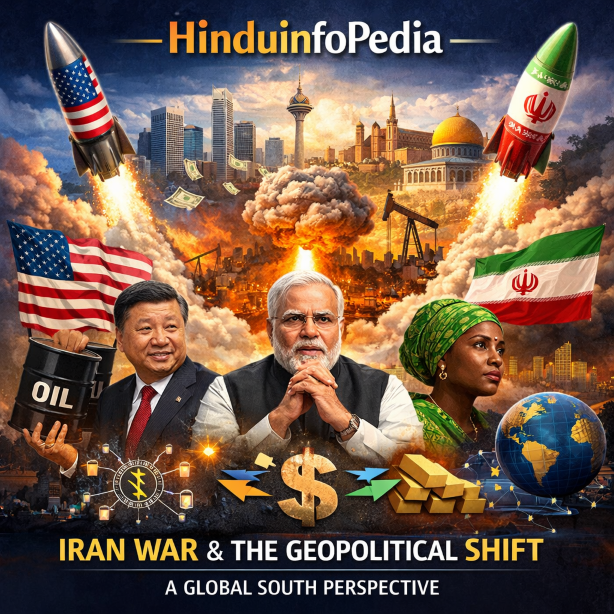
The Global South War Narrative is not a fringe view. It is the working interpretation of approximately six billion people — across China, India, Africa, Southeast Asia, and Latin America — who watched the February 2026 US–Israel strikes on Iran and read them through a single coherent lens: resource imperialism wearing the mask of a rules-based order. This reading does not emerge from coordination, but from repetition — similar outcomes observed across different regions over time. The contention, therefore, is not about any single event, but about a perceived pattern: that strategic autonomy in resource, currency, or security domains invites coercive response, while alignment ensures protection. What appears in the West as enforcement of order is experienced across much of the non-West as selective application of power. Understanding this narrative does not require sympathy for Tehran. It requires arithmetic.
The Numbers That Built the Narrative
China holds 1.4 billion people. India holds 1.4 billion. Sub-Saharan Africa holds 1.4 billion and rising. Southeast Asia holds 700 million. Latin America holds 660 million. These populations do not consume Western media as their primary frame. They consume their own press, their own political memory, and above all their own economic experience of what happens when Washington decides a country must change its government.
The Global South War Narrative did not begin in 2026. It was constructed over two decades of documented US interventions that left Iraq dismembered, Libya destroyed, Venezuela sanctioned into collapse, and Syria partitioned. Each of these countries held either oil, gas, or a refusal to align with Washington’s financial architecture. Iran holds all three. The pattern is not invisible to the six billion. It is the most visible pattern in modern geopolitics.
The Global South War Narrative: What Six Billion People See
When the Global South looks at the Iran war, it does not see a nuclear threat neutralised. It sees the Iraq-Libya-Venezuela template of resource imperialism applied with precision. The sequence is identical every time: manufacture a legal pretext, run it through sympathetic media, strike before inspections conclude, seek to install a compliant successor, extract concessions — or at minimum, remove a non-compliant regime and secure concessions on energy pricing and dollar denomination.
Iran in 2026 was mid-negotiation with the IAEA when the strikes landed. That detail — strikes while talks were live — was not lost on the Global South. It was the same detail that defined the Iraq invasion: inspectors still in the country when the bombs fell. The Global South War Narrative is built on exactly this kind of pattern recognition. It is not conspiratorial. It is historical.
The South Asian neighbourhood adds its own evidence. Bangladesh and Nepal — both on India’s perimeter — experienced engineered political destabilisation in the years immediately preceding the Iran conflict. The mechanics were consistent: the role of social media platforms and IT ecosystems in shaping narrative velocity, pressure on domestic political factions through external signalling, and targeted NGO networks amplifying street unrest. The populations of both countries widely recognised an external hand. Their governments drew their own conclusions about whose interests were being served. This neighbourhood experience feeds directly into the Global South War Narrative — Washington does not limit its pressure to the Middle East. It operates wherever strategic autonomy is contested.
The UN Vote Pattern Iran
The clearest quantitative expression of the Global South War Narrative is the UN General Assembly vote record. On every resolution condemning the Iran strikes, the majority of the world’s states voted against Washington’s position. The abstentions were not neutral — they were calculated Global South non-alignment from states that could not afford to antagonise Washington directly but refused to endorse the operation. The votes in favour of the US position were the predictable coalition: NATO members, a handful of Pacific island states dependent on American aid, and the Gulf monarchies whose own survival depends on American security guarantees.
The Global South War Narrative reads this vote pattern as confirmation. The rules-based order, as currently constructed, is a club of a relatively small Western-aligned bloc imposing rules on a far larger majority of states. The majority are not confused about this. They have simply lacked the economic weight to resist it — until now.
📌 The Ideology Behind the Operation
The Iran war is not an anomaly. It is the doctrine in its clearest form yet. Read the full civilisational warfare framework.
De-Dollarisation as Strategic Logic
The Iran war accelerated one economic shift that Washington did not intend: it confirmed dollar dependency as a strategic liability for every non-Western state. The war’s economic mechanics made this visible. Iran’s assets were frozen. Trade in dollars with Iran became a sanctions risk. Any country holding significant dollar reserves was implicitly holding an instrument that Washington could weaponise against it. The conclusion spread rapidly through central banks from Beijing to Brasília: de-dollarisation is not an ideological preference. It is risk management.
Pakistan’s trajectory reinforces the narrative from a different angle. Imran Khan’s displacement as Prime Minister was widely interpreted across parts of the Global South as a textbook case of Washington managing a non-compliant leader out of power. Khan had pursued an independent foreign policy, visited Moscow, and resisted aligning Pakistan fully with the American position on Ukraine. The mechanism of his removal — a parliamentary vote engineered through external pressure — left a clear message for every Global South leader watching: independence has a price. The Global South War Narrative absorbed this lesson and applied it to the Iran case. Tehran refused independence over its nuclear programme. The price was airstrikes.
India: The Operational Form of the Narrative
India is the clearest living expression of the Global South War Narrative because India has the weight to act on it. New Delhi maintained India strategic neutrality Iran despite sustained American pressure. It continued purchasing discounted Iranian crude through intermediary arrangements. It refused to join the naval coalition at Hormuz. It abstained rather than condemned at the UN.
Washington responded with trade leverage — technology access restrictions, tariff threats, and pressure on Indian IT sector interests operating in the American market. The US technology and platform ecosystem, the same infrastructure that had been seen to apply pressure in South Asia through platform access and content moderation during the Bangladesh and Nepal episodes, became an instrument of coercive diplomacy against New Delhi itself. India’s response was to accelerate its own semiconductor and technology infrastructure programme. The leverage backfired. It strengthened the argument inside India’s strategic establishment that dependence on American technology platforms was itself a vulnerability requiring resolution.
India’s navigation of this pressure is watched by every mid-sized Global South state. If India — with its scale, its nuclear deterrent, its market size — can absorb American trade pressure and maintain strategic autonomy, the Global South War Narrative acquires a proof of concept. If India folds, the narrative darkens: even the largest non-Western democracies cannot escape the system.
Why the Global South War Narrative Endures
The Global South War Narrative will outlast this war regardless of how the Hormuz crisis resolves. It is not dependent on Iran winning or losing. It is dependent on the pattern remaining visible — and the pattern has been visible for twenty years. Islamic solidarity failed to produce a unified response to the strikes. Arab states hedged. But the Global South did not need Islamic unity to form its own reading. The six billion are not a bloc. They are a distributed perception — holding the same conclusion from different directions.
Washington can win this war militarily and still lose the world it was trying to defend. The Hormuz Reckoning is not only a reckoning for Iran. It is a reckoning for the rules-based order itself — conducted in the court of six billion people who were never asked to ratify the rules.
📌 The Theatre That Blessed the Strikes
The September 2025 UN General Assembly gave the Iran operation its final multilateral cover. See how that performance was constructed.
Next: Israel Survival Logic — Blog 10 in West Asia’s Endless War. Part of the West Asia’s Endless War Series on hinduinfopedia.com.
Feature Image: Click here to view the image.
Videos
Glossary of Terms
- Rules-Based Order: The framework of international norms, laws, and institutions — the UN Charter, international humanitarian law, the NPT, the ICC — invoked by Western governments to frame their foreign policy as principled enforcement of universal standards. Examined in this series as a selectively applied instrument: consistently invoked when enforcement serves Western strategic interests, consistently silent when it does not.
- Mandate Progression: The arc across successive US-led military interventions showing progressive erosion of legal constraint — Afghanistan (UN mandate), Iraq (no UN mandate, fabricated WMD pretext), Libya (UN mandate exceeded for regime change), Kosovo (no mandate, precedent set), Venezuela (economic warfare without mandate), Iran 2026 (struck without mandate, mid-negotiation). Each step less legally constrained than the last.
- IAEA (International Atomic Energy Agency): The United Nations body responsible for verifying compliance with the Nuclear Non-Proliferation Treaty. Its inspectors monitored Iran’s nuclear programme under the JCPOA and documented Iran’s progressive breaches of enrichment limits following the 2018 US withdrawal.
- Gulf Monarchies: The oil-rich Arab monarchies of the Persian Gulf — Saudi Arabia, UAE, Qatar, Kuwait, Bahrain, and Oman.
- Imran Khan (born 1952): Pakistani cricketer turned politician. Prime Minister of Pakistan 2018–2022, removed via a no-confidence vote. Faced over 150 criminal cases widely characterised as politically motivated. Sentenced to over thirty years in prison across multiple verdicts. His party — Pakistan Tehreek-e-Insaf — was stripped of its election symbol for the February 2024 general elections, forcing candidates to run as independents. The elections were widely characterised as the most manipulated in Pakistan’s history.
- Western Narrative War: The systematic use of media framing, strategic communications, and sequenced information distribution by Western governments and aligned media organisations to construct public legitimacy for military interventions. Operates through five elements: villain construction, humanitarian crisis amplification, legal ambiguity concealment, liberation promise, and marginalisation of alternative perspectives. Documented across US-led interventions from the Gulf War through Iraq, Afghanistan, Libya, Syria, and Iran 2026.
- Democracy Framing: The narrative instrument through which Western governments and aligned media characterise target states as authoritarian and their populations as suppressed, while applying no equivalent standard to allied states conducting comparable or worse electoral manipulation. Applied to Iran, Venezuela, Belarus, and Russia. Not applied to Saudi Arabia, UAE, Pakistan, Egypt, or Bangladesh under comparable or documented worse conditions.
- Global South: The collective term for nations in Asia, Africa, Latin America, and Oceania that share a broadly post-colonial political identity, a historical experience of Western economic and political dominance, and an emerging desire for multipolar governance structures. Does not denote a formal organisation or unified bloc — rather a distributed geopolitical orientation. Population approximately six billion. Includes China, India, Brazil, Indonesia, Nigeria, South Africa, and most of the world’s states by number.
- Resource Imperialism: The analytical framework in which military interventions, sanctions regimes, and regime change operations are understood primarily as mechanisms for securing access to, or control over, strategic natural resources — oil, gas, minerals — or for eliminating governments that threaten to price or trade those resources outside the dollar-denominated financial system. The lens through which the Global South reads US-led interventions in Iraq, Libya, Venezuela, and Iran.
- De-Dollarisation: The strategic process by which states reduce their dependence on the US dollar as a reserve currency, trade settlement currency, and instrument of financial transactions. Accelerated by the use of dollar-denominated asset freezes and sanctions against Iran, Russia, and Venezuela — which demonstrated to non-Western states that dollar dependency represents a geopolitical vulnerability. Not an ideological preference but risk management, as described in this blog.
- Strategic Autonomy: The capacity of a state to make foreign policy, security, and economic decisions independently of major power blocs — maintaining relations with multiple competing powers without full alignment with any single one. India’s position on the Iran war — continuing Iranian oil purchases, refusing the naval coalition, abstaining at the UN — is the primary contemporary example of strategic autonomy at scale.
- Non-Alignment: The foreign policy doctrine of refusing formal military or political alignment with major power blocs — historically associated with the Non-Aligned Movement founded at the 1955 Bandung Conference. In the contemporary context of the Iran war, non-alignment manifests as calculated abstention from the US-led coalition at Hormuz and from UN resolutions endorsing the strikes — a position adopted by India, and implicitly by most Global South states.
- UN General Assembly Vote Pattern: The documented record of UN General Assembly votes on resolutions related to the Iran strikes showing the majority of the world’s states voting against Washington’s position. Abstentions from states unable to antagonise Washington directly but unwilling to endorse the operation. The vote pattern is the clearest quantitative expression of the Global South War Narrative — a majority of sovereign states declining to validate the rules-based order framing of the Iran operation.
- Naval Coalition at Hormuz: The US-led coalition of naval forces assembled at the Strait of Hormuz following the February 28 2026 strikes on Iran, tasked with ensuring freedom of navigation through the strait. India declined to join despite direct American pressure. India’s refusal — given its status as a major power with naval assets in the region — was the most significant act of strategic autonomy in the immediate aftermath of the strikes.
- Imran Khan Displacement: The April 2022 removal of Imran Khan as Prime Minister of Pakistan through a parliamentary no-confidence vote widely interpreted in the Global South as externally engineered. Khan had pursued an independent foreign policy — visiting Moscow on the day of the Ukraine invasion, resisting alignment with Washington on Ukraine, and seeking to expand Pakistan’s economic relationships outside the US-dominated framework. The mechanism of his removal — a parliamentary vote following intense pressure on defecting coalition members — became a case study in non-military regime change for Global South audiences.
#GlobalSouthWarNarrative #GlobalSouthNonAlignment #DeDollarisation #ResourceImperialism #IndiaStrategicNeutrality #UNVotePatternIran #HormuzReckoning #WestAsiaEndlessWar #IranWar2026 #RulesBasedOrder #RegimeChangePlaybook #MandateProgression #GulfMonarchies #IndiaNavalDeployment #WestAsiaWar #StrategicAutonomy #NonAlignment #HinduinfopediaGeopolitics #GlobalSouth #IranNuclear
Relevant Links
Previous Blog
- https://hinduinfopedia.com/war-zone-in-hormuz-a-reckoning/
https://hinduinfopedia.in/?p=25537 - https://hinduinfopedia.com/hormuz-world-war-ladder-a-reckoning-of-west-asias-endless-war-2/
https://hinduinfopedia.in/?p=25545 - https://hinduinfopedia.com/west-asia-war-ethics-a-reckoning-of-west-asias-endless-war-3/
https://hinduinfopedia.in/?p=25550 - https://hinduinfopedia.com/west-asia-war-economics-a-reckoning-of-west-asias-endless-war-4/
https://hinduinfopedia.in/?p=25557 - https://hinduinfopedia.com/nuclear-pretext-of-west-asia-war-a-reckoning-of-west-asias-endless-war-5/
https://hinduinfopedia.in/?p=25588 - https://hinduinfopedia.com/nuclear-hypocrisy-of-usa-a-reckoning-of-west-asias-endless-war-6/
https://hinduinfopedia.in/?p=25593 - https://hinduinfopedia.com/ummah-delusion-during-war-a-reckoning-of-west-asias-endless-war-7/ https://hinduinfopedia.in/?p=25614
- https://hinduinfopedia.com/western-narrative-war-a-reckoning-of-west-asias-endless-war-8/
https://hinduinfopedia.in/?p=25650
FOR BLOGS ON US IMPERIAL MINDSET / OIL MOTIVE / DESTABILIZATION DOCTRINE
- Destabilization Doctrine: How America’s Foreign Policy Boomerang Is Striking Home
- Regime Change Playbook: A Manual for Color Revolution Operations
- America, Independence, 1776 to Modern Hegemony — US Hypocrisy Doctrine (via Great Deception)
- Target India: Action Phase — Doctrine in Motion
- Activation of Destabilization Doctrine: The India Deployment Begins
- Rupee Rebellion / De-dollarization (cross-reference via .org)
FOR BLOGS ON IRAN / RAKTBEEJ / DUMP TRUCK RESILIENCE
- Great Deception and Global Civilizational Warfare — five-stage playbook applies directly to Iran’s regenerative resistance
- Islamist Boomerang Effect — When Pakistan’s Cross-Border Strikes Vindicate India’s Doctrine — dump truck principle applied to Pakistan, parallel to Iran
- Demographic Reality Exposed: How High-Fertility Clusters Reshape Democracies — Raktbeej demographic dimension
FOR BLOGS ON GULF MONARCHIES / UMMAH DELUSION / SHIA-SUNNI DIVIDE
- Gulf States Refugee Policy: Why the Wealthy Arabs Said No to Palestinians — Gulf self-preservation over Ummah solidarity, directly applicable
- Palestinian Refugees: Why No Muslim Country Will Take Them — Ummah as myth
- Black September Jordan: The Forgotten War That Changed the Arab World — Sunni-Shia and Arab political fractures
- Lebanon Civil War: From Paris of the Middle East to Hezbollah State — Gulf-Iran-Hezbollah triangle
FOR BLOGS ON UN / RULE-BASED ORDER / NEW COLONIAL ORDER
- When Dictatorships Vote on Democracy — The UN Legitimacy Crisis
- Anti-Israel Obsession — The UN’s Statistical Evidence of Institutional Bias
- New York Declaration Deconstructed — September 2025’s Theatre of Absurd
- New York Declaration Proponents — Hypocrisy and Legal Theater
- New York Declaration Perspectives — History, Media, and Theatrical Mechanics
FOR BLOGS ON MEDIA / SELECTIVE OUTRAGE / MANUFACTURED NARRATIVE
- How Media Manipulation Works: The Global Template
- Media as Manipulator In Unrest: The False Causality Matrix
- Muslim Brotherhood France: Intelligence Report Media Ignored
FOR BLOGS ON INDIA’S NEUTRALITY / UPI / STRATEGIC AUTONOMY
- Unrest From Bangladesh to Nepal: Is India the Real Target?
- Narrative of Unrest: When Neighbors Become Examples
- Rahul’s Gen Z Call — Activation of Destabilization Doctrine
- Money Trail: Analyzing Financial Networks Behind Nepal’s Protests
FOR BLOGS ON ISRAEL / PALESTINE / DECAPITATION TEMPLATE
- October 7th Vindication: Egypt’s Prophetic Wall
- Two-State Delusion Exposed — Netanyahu’s 99-9 Vote
- Right of Return to Palestine: The Strategy Behind 75 Years of Refugees
- Egypt Gaza Wall: The Hidden Truth 57 Muslim Nations
FOR BLOGS ON NUCLEAR HYPOCRISY / MANUFACTURED EXTREMISM
- Islamist Boomerang Effect
- Destabilization Doctrine — How America’s Foreign Policy Boomerang Is Striking Home
FOR BLOGS ON RAKTBEEJ AND DAGDHABEEJ / PHILOSOPHICAL RESOLUTION THREAD
- Raktbeej And Starfish Thesis: The 1,400-Year Organism That No Modern Framework Can Contain (Part II)
- Raktbeej Thesis: The Ancient Diagnostic That Explains What No Modern Framework Can
- Gaza and the Starfish: Why Every Cut Creates
Follow us:
- English YouTube: https://www.youtube.com/@Hinduofficialstation
- Hindi YouTube: https://www.youtube.com/@HinduinfopediaIn
- X: https://x.com/HinduInfopedia
- Instagram: https://www.instagram.com/hinduinfopedia/
- Facebook: https://www.facebook.com/Hinduinfopediaofficial
- Threads: https://www.threads.com/@hinduinfopedia
[…] भारत / 🌍 […]
[…] Global South War Narrative: A Reckoning of West Asia’s Endless War (9) […]
[…] Global South War Narrative: A Reckoning of West Asia’s Endless War (9) […]
[…] है। भंडारण क्षमता नहीं है। ये वही वैश्विक दक्षिण की जनसंख्याएँ हैं जिन्होंने पहले प्रक्षेपास्त्र […]
[…] Global South War Narrative: A Reckoning of West Asia’s Endless War (9) […]
[…] […]
[…] […]
[…] […]
[…] […]
[…] […]
[…] and most operationally complete example of what non-dollar oil settlement looked like at scale. The Global South was watching to see whether it worked. The February 2026 strikes signalled how such challenges would be […]
[…] https://hinduinfopedia.com/global-south-war-narrative-a-reckoning-of-west-asias-endless-war-9/ and https://hinduinfopedia.in/?p=25680 […]
[…] https://hinduinfopedia.com/global-south-war-narrative-a-reckoning-of-west-asias-endless-war-9/ and https://hinduinfopedia.in/?p=25680 […]
[…] https://hinduinfopedia.com/global-south-war-narrative-a-reckoning-of-west-asias-endless-war-9/ and https://hinduinfopedia.in/?p=25680 […]
[…] https://hinduinfopedia.com/global-south-war-narrative-a-reckoning-of-west-asias-endless-war-9/ and https://hinduinfopedia.in/?p=25680 […]
[…] वैश्विक दक्षिण के वे देश जो तेहरान के साथ व्यक्तिगत पारगमन समझौते कर रहे हैं, अनजाने में इस मिसाल के निर्माण में भाग ले रहे हैं। प्रत्येक देश जो IRGC को जहाज का विवरण देता है, युआन में शुल्क का भुगतान करता है, और ईरानी नौसैनिक एस्कॉर्ट स्वीकार करता है, वह हॉर्मुज़ पर ईरानी अधिकार को स्वीकार कर रहा है। […]
[…] position is the Global South War Narrative made operational. The six billion people who read this war as the imposition of a Western order on […]
[…] https://hinduinfopedia.com/global-south-war-narrative-a-reckoning-of-west-asias-endless-war-9/ and https://hinduinfopedia.in/?p=25680 […]
[…] https://hinduinfopedia.com/global-south-war-narrative-a-reckoning-of-west-asias-endless-war-9/ and https://hinduinfopedia.in/?p=25680 […]
[…] https://hinduinfopedia.com/global-south-war-narrative-a-reckoning-of-west-asias-endless-war-9/ and https://hinduinfopedia.in/?p=25680 […]
[…] https://hinduinfopedia.com/global-south-war-narrative-a-reckoning-of-west-asias-endless-war-9/ and https://hinduinfopedia.in/?p=25680 […]
[…] Global South Narrative: A Reckoning of West Asia’s Endless War (9) https://hinduinfopedia.com/global-south-war-narrative-a-reckoning-of-west-asias-endless-war-9/ […]
[…] does not require the Gulf to announce a dollar exit to be real. It requires the fashion to change. As the Global South War Narrative established in Blog 9, the six billion people reading this war as resource imperialism are not making ideological […]
[…] […]
[…] significant breach in a fifty-year architecture of manufactured African energy unfashionability. The Global South is not discovering African energy in 2026. It is finally being allowed to act on what it has always […]
[…] अफ्रीकी ऊर्जा को अपसंदीदा बनाया था। ग्लोबल साउथ अब अफ्रीकी ऊर्जा पर काम कर… वह हमेशा से इसे जानता था। अब उसे काम […]
[…] The Global South War Narrative of neutrality and prior authorisation was written for centralised adversaries. Against distributed systems, your name on the list means nothing if the node holding the gun was not updated, did not agree, or decided its local logic came first. […]
[…] significant is not who is making this argument. It is where the argument is coming from. Blog 9 documented the Global South War Narrative — six billion people reading the war as resource imperialism, the latest expression of a colonial […]
[…] […]
[…] का तर्क यहाँ लागू होता है। यह तर्क ब्लॉग 16 में स्थापित हुआ था। यूरोप की नीति […]
[…] The Global South War Narrative documented six billion people reading the conflict as resource imperialism. Those six billion people are also the buyers of sanctioned Russian oil, Venezuelan crude, and Iranian back-channel exports. They are buying it because the Gulf alternative is blocked, the American alternative is priced at a premium, and the moral authority Washington used to enforce sanctions compliance has been spent in a war that the Global South did not consent to — as documented by multiple G20 foreign ministers who voted against the US position at the UN in March 2026. The Manufactured Instability Reckoning established that African energy unfashionability was deliberately constructed across fifty years. The same Gulf blockade that commercially benefits American LNG terminals has simultaneously broken that fifty-year architecture — Nigeria, Algeria, Angola, Mozambique, and Equatorial Guinea are selling energy like hot cake to buyers who cannot access the Gulf alternative. Britain refused to join Washington’s naval blockade, citing that it would interdict allies more than adversaries — the most precise official confirmation of the Washington’s Global Control War argument from within the Western alliance itself. The architecture is consuming its own foundations. […]
[…] prices and China’s alternative architecture at negotiated terms — is no longer theoretical. The Global South War Narrative the series documented in Blog 9 is now a procurement […]
[…] दूसरी ओर चीन की वैकल्पिक संरचना है। Global South War Narrative अब केवल विचार नहीं है। यह अब खरीद […]
[…] Blog 9 documented the Global South War Narrative — the six billion people whose economic interests the petrodollar system was designed to manage. The Sensex is the Global South’s most instructive mirror. The BSE Sensex launched at 100 in 1979 and stands near 75,000 in 2024 — a 750-fold nominal return in rupees, a 15.8% annual compounding rate that outperforms every instrument in the table in INR terms. BSE data confirms the Sensex’s extraordinary nominal performance — one of the world’s best-performing major indices across the post-liberalisation period. But the rupee fell from 8 to 83 per dollar across the same period — a 10.4-fold depreciation. Reserve Bank of India historical exchange rate data documents the rupee’s systematic depreciation against the dollar across five decades of dollar denomination in India’s trade and reserve management. A Gulf investor converting that spectacular INR return back to dollars receives $7,200 billion nominally and $1,344 billion in real USD terms. Better than Treasuries. Far below NASDAQ. The Indian market lesson is the currency lesson: nominal returns in a depreciating currency are partially illusory. The rupee’s depreciation against the dollar is itself partly the consequence of the same dollar denomination architecture the Gulf Petrodollar Drain documents — India’s exports must be priced in dollars, India’s imports must be paid in dollars, India’s reserve management must hold dollars, and the dollar’s periodic strengthening through Fed tightening cycles compresses the rupee regardless of India’s domestic economic performance. […]
[…] […]
[…] The Global South War Narrative that the series documented — six billion people reading the Iran war as resource imperialism — is the political context in which the China Sanctions War is being received. The narrative prepared the ground. China’s blocking order plants the flag. The states that follow will be those where the Chinese market dependency exceeds the dollar system dependency, where the alternative settlement architecture is sufficiently developed to absorb the crossing, and where the domestic political will exists to absorb Washington’s retaliation. […]
[…] वैश्विक दक्षिण युद्ध आख्यान, जिसे इस शृंखला ने दर्ज किया था — अर्थात छह अरब लोगों द्वारा ईरान युद्ध को संसाधन साम्राज्यवाद के रूप में देखना — वही राजनीतिक पृष्ठभूमि है, जिसके भीतर चीन प्रतिबंध संघर्ष को ग्रहण किया जा रहा है। इस आख्यान ने भूमि तैयार की। चीन के ब्लॉकिंग आदेश ने उस भूमि पर ध्वज स्थापित किया। अब वे राष्ट्र आगे बढ़ेंगे, जहाँ चीनी बाज़ार पर निर्भरता, डॉलर व्यवस्था पर निर्भरता से अधिक है। वे राष्ट्र आगे बढ़ेंगे जहाँ वैकल्पिक निपटान संरचना पर्याप्त रूप से विकसित हो चुकी है। वहीँ यह परिवर्तन संभालना संभव होगा। वे राष्ट्र आगे बढ़ेंगे, जहाँ वॉशिंगटन की प्रतिकारात्मक कार्रवाई को सहने की आंतरिक राजनीतिक इच्छा भी उपस्थित हो। […]
[…] runs through the Global South. India leads the non-alignment narrative at multilateral forums. Blog 9 established that the Global South reads the Hormuz war as resource imperialism — the same […]
[…] Read […]
[…] Blog 9 (Global South War Narrative) documented six billion people reading the Hormuz war as resource imperialism. The Mustad’afin Doctrine is the theological infrastructure through which Iran can claim alignment with that narrative without requiring the six billion to convert to Shia Islam or accept Velayat-e Faqih governance. The Mustad’afin framework says: we are all Mustad’afin. The adversary is the same. The struggle has different expressions in different territories. Iran’s expression is the Hormuz war. Yours is IMF conditionality. Venezuela’s is oil sanctions. Palestine’s is occupation. The doctrine provides the unifying framework across all expressions simultaneously. […]
[…] ब्लॉग 9 (वैश्विक दक्षिण युद्ध कथन) ने दर्ज किया था कि छह अरब लोग होरमुज युद्ध को संसाधन साम्राज्यवाद के रूप में देखते हैं। मुस्तदअफ़ीन सिद्धांत वह धार्मिक आधार प्रदान करता है जिसके माध्यम से ईरान स्वयं को इस कथन के साथ जोड़ सकता है। इसके लिए उन छह अरब लोगों को शिया इस्लाम अपनाने या विलायत-ए-फ़क़ीह शासन मॉडल स्वीकार करने की आवश्यकता नहीं है। मुस्तदअफ़ीन ढाँचा कहता है कि हम सभी मुस्तदअफ़ीन हैं। प्रतिद्वंद्वी एक ही है। विभिन्न क्षेत्रों में संघर्ष की अभिव्यक्तियाँ अलग हो सकती हैं। ईरान की अभिव्यक्ति होरमुज युद्ध है। किसी अन्य समाज की अभिव्यक्ति आईएमएफ की शर्तें हो सकती हैं। वेनेज़ुएला के लिए यह तेल प्रतिबंध हैं। फ़िलिस्तीन के लिए यह कब्ज़ा है। यह सिद्धांत इन सभी संघर्षों को एक ही ढाँचे में जोड़ता है। […]
[…] Global South nations currently negotiating individual passage agreements with Tehran are — whether they intend to or […]