

India Strategic Neutrality: A Reckoning of West Asia’s Endless War (58)
Part 58 of the West Asia’s Endless War Series
भारत / GB
The Country That Holds Nine Contradictions Simultaneously — and Calls It Doctrine
This series has mapped the Hormuz war from the first missile strike to the ceasefire’s unresolved aftermath — tracking oil imperialism, the petrodollar’s slow fracture, Iran’s civilisational patience, the Gulf monarchies’ strategic betrayal, and the manufactured instabilities that shaped the energy world before any shot was fired. Every major power has been examined for what it gains, what it loses, and what it pretends not to know. Blog 57 placed India inside the operational trap — the numbers, the stranded ships, the medicines aircraft, the individual negotiations for every tanker. Blog 58 carries what Blog 57 deliberately held back: the civilisational complexity beneath the crisis.
India Strategic Neutrality: Associated Complexities of Neutrality
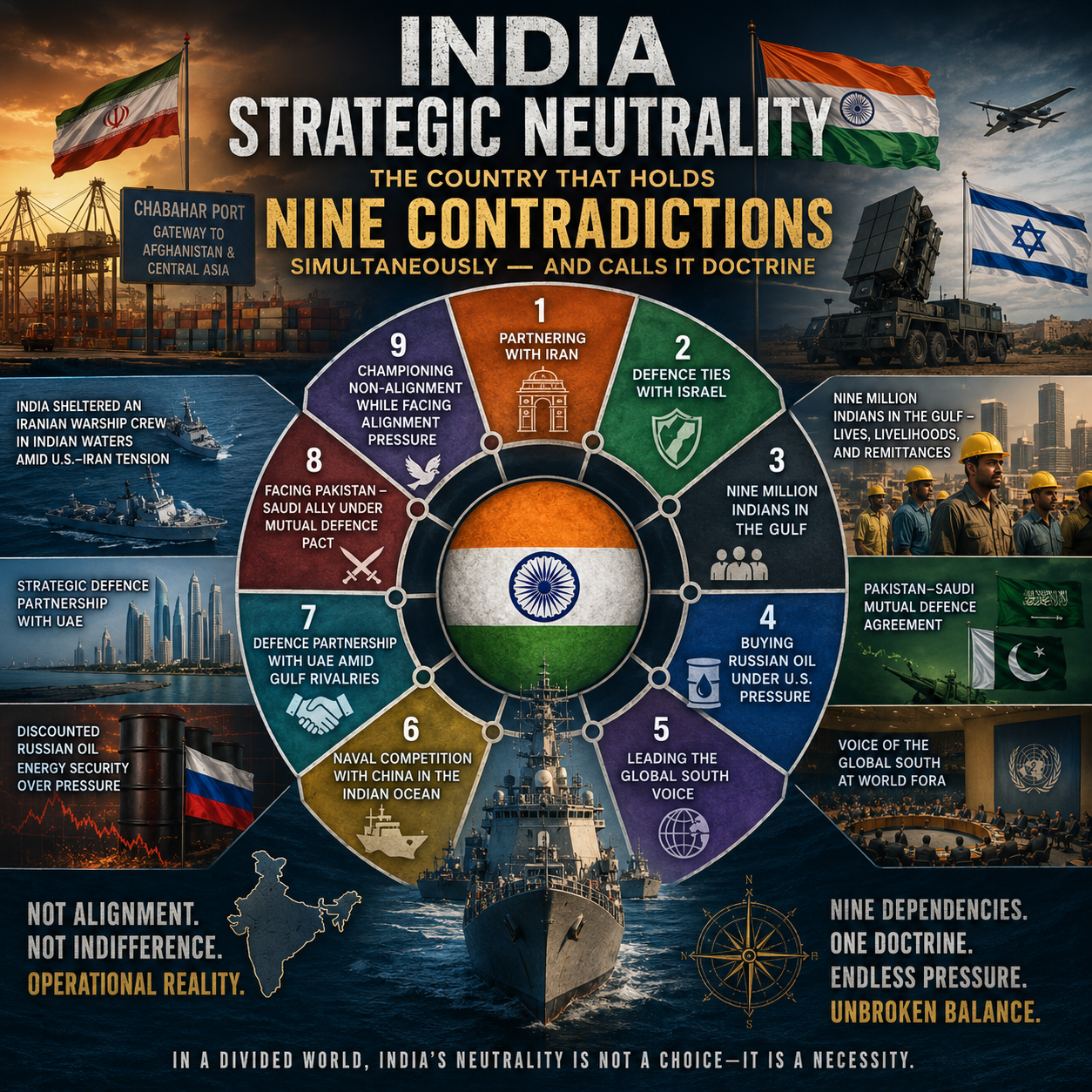
India Strategic Neutrality: nine simultaneous contradictions India holds while the world burns. No other country on earth is simultaneously invested in Iran’s port infrastructure, maintains active defence ties with Israel through two regional wars, hosts nine million workers in Gulf monarchies struck by Iranian missiles, buys discounted Russian oil under Washington’s sanctions pressure, leads the Global South’s non-alignment voice, shares a naval competition with China across the same Indian Ocean energy corridors, holds a new strategic defence partnership with the UAE while the UAE is in a cold war with Saudi Arabia, and faces Pakistan as an adversary — a Pakistan that is now militarily committed to Saudi Arabia under a formal mutual defence architecture. Every one of these nine relationships was activated simultaneously by the same conflict. India Strategic Neutrality is not a diplomatic posture. It is an operational reality shaped by dependencies running in nine directions at once.
India Strategic Neutrality and the Nine-Relationship Intersection
Begin with Iran. India’s Chabahar port investment represents India’s only overland access corridor to Afghanistan and Central Asia that bypasses Pakistan. The investment survived the JCPOA collapse, Trump’s first-term sanctions, the Gaza war, and Khamenei’s direct criticism of India’s Kashmir policy. India absorbed the criticism and maintained engagement — because the corridor is strategically irreplaceable.
The relationship did not remain merely commercial.
India and Iran have conducted joint naval exercises in the Gulf of Oman — coordinated naval operations in the same waters where the Hormuz war’s operational pressure was highest. When US forces moved to detain the crew of an Iranian warship operating in the region, India intervened: India permitted docking and facilitated the safety and movement of an Iranian crew within its maritime jurisdiction during a period of heightened U.S.–Iran tension, maintaining engagement despite external pressure. This was not a passive refusal of coalition membership. It was an active operational decision that placed Indian naval assets between an Iranian crew and an American demand. When the Hormuz war began, individual ship negotiations with Iranian maritime authorities continued while Tehran fired missiles at Gulf infrastructure hosting ninety lakh Indian workers — each negotiation a reminder that India held the Iran relationship open with both hands while every other pressure pulled it shut.
Now hold that relationship and add Israel.
India has maintained and deepened its defence and technology partnership with Israel through the Gaza war, through the Hezbollah conflict, and through the Hormuz war. India imports Israeli air defence systems, surveillance drones, and precision munitions. The relationship is not ceremonial — it is procurement-level operational. Both Iran and Israel are simultaneously active partners. The contradiction is not theoretical.
The ninety lakh Indian workers in Gulf monarchies represent India’s largest single diaspora concentration. Remittances from the Gulf represent a structural pillar of India’s balance of payments. When Iranian missiles struck Gulf infrastructure during the Hormuz war, Indian workers were inside the target radius. India’s government was simultaneously maintaining Iran engagement, absorbing Washington’s coalition demand pressure, and ensuring consular operations for citizens living inside an active war zone — in states whose security guarantee had just been proved conditional by the same Washington applying coalition pressure on New Delhi.
The UAE Architecture: India Strategic Neutrality Inside Conflict Zone
The UAE dimension carries a structural contradiction that no other relationship produces.
On January 19, 2026, India and the UAE signed a Strategic Defence Partnership Letter of Intent. MbZ made a three-hour unscheduled visit to New Delhi. The letter covers defence industrial collaboration, special operations interoperability, nuclear reactor cooperation, and a $200 billion trade target. This is not a diplomatic communiqué. It is a defence architecture commitment.
What the January 19 letter formalised was not a bilateral — it was the visible edge of a trilateral. India, the UAE, and Israel have been quietly building converging military and intelligence coordination across the same theatre the Hormuz war detonated. Israel supplies India with air defence systems and drone technology. The UAE provides India with Gulf basing proximity, financial corridor access, and strategic depth into the Arab world that no other partner offers. India provides both with the political legitimacy of the world’s largest democracy maintaining ties with the Islamic world simultaneously. The triangle is not a formal alliance — it has no treaty name, no joint command structure, no public announcement. It operates through interoperability agreements, joint exercises, shared intelligence architecture, and the January 19 letter’s specific language around special operations coordination. Iran — which is simultaneously India’s Chabahar partner — is the implicit common threat calculus running beneath all three relationships. The doctrine, in this triangle, is neutrality in name only. The military geometry points in one direction even when the diplomatic language points in all directions at once.
The UAE is simultaneously in a cold war with Saudi Arabia over Yemen.
The UAE exited OPEC and OPEC+ effective May 1, 2026 — without consulting Riyadh. Saudi Arabia holds a formal Strategic Military Defence Agreement with Pakistan that includes mutual Article 5-equivalent commitments and, according to Pakistan’s Defence Minister, access to Pakistan’s nuclear capabilities. India is Pakistan’s adversary. Saudi Arabia’s formal military partner is India’s adversary. India has a defence letter of intent with the UAE, which is in a cold war with Saudi Arabia, which is in a formal military pact with Pakistan.
India is not adjacent to two conflicting Gulf security architectures. India is inside both of them simultaneously. This is not neutrality between two blocs — it is participation in two incompatible blocs without belonging to either. The civilisational patience this requires is not a foreign policy achievement. It is a structural condition India did not choose and cannot exit.
Russia, China, and Strategic Neutrality Dependency India
India’s purchase of discounted Russian crude after the Ukraine invasion demonstrated the operational independence India claims. India bought Russian oil at $20-30 per barrel below Brent while Washington applied sanctions pressure, while the G7 debated price caps, and while India’s IT industry and technology access relationships with Washington were simultaneously being used as leverage. The doctrine held on the Russian oil question because the dependency calculus — cheap energy for an economy of 1.4 billion people — outweighed Washington’s pressure.
China is India’s regional competitor across the Indian Ocean. Both countries are simultaneously navigating the Hormuz crisis as energy-dependent economies whose refinery infrastructure is locked to Gulf crude grades. India’s emergency LNG contracts with six African nations, documented in Global Energy Reckoning (Blog 33), represent India’s independent energy diversification response — a response that mirrors China’s Central Asian energy architecture without coordination, overlap, or conflict. Two large non-Western economies acting independently to reduce the same dependency produced structurally parallel responses. India Strategic Neutrality in this context is not the absence of strategy. It is strategy operating without Western institutional scaffolding.
The bridge from dependency geometry to the civilisational question runs through the Global South. India leads the non-alignment narrative at multilateral forums. Blog 9 established that the Global South reads the Hormuz war as resource imperialism — the same architecture that extracted colonial-era value now extracting through energy pricing and financial architecture. India is the largest economy making this argument publicly, and it can only make it credibly while holding its nine-way contradiction intact.
India Strategic Neutrality: Inescapable Question of Large Economy
The nine simultaneous relationships — Iran, Israel, Gulf monarchies, United States, Russia, China, Global South, Pakistan, UAE — are not a list of India’s foreign policy achievements. They are a map of India’s dependencies. Each relationship carries a cost of exit. The Chabahar corridor cannot be replaced without Pakistan’s consent, which will not come. The Israel defence technology cannot be replaced without accepting Western bloc alignment conditions. The Gulf remittances represent the livelihood of ninety lakh families. The Russian oil represents the energy security of an economy that cannot yet absorb Brent-priced crude without domestic inflation consequences. The UAE defence partnership represents India’s most significant Gulf military architecture since the Rajiv Gandhi era.
India Strategic Neutrality is the doctrine that holds all nine dependencies simultaneously without forcing a choice that exits any of them. Washington’s destabilisation doctrine, documented across this series, is designed precisely to force that choice — to make fence-sitting economically and militarily expensive enough that large non-Western economies are compelled to declare alignment. The technology leverage, the tariff pressure, the H1B and skilled-visa squeeze — three million Indians on US visas whose status Washington can tighten or loosen by administrative decision with no legislation required — the IT lobby conditionality, the coalition demand during the Hormuz war: each instrument was designed to raise the cost of India’s ninth position above the cost of choosing a side.
India did not choose a side.
The medicines aircraft incident — an Indian civilian aircraft carrying medical supplies to Iran struck by American forces — contained the entire architecture of the pressure in a single event. India maintained Iran engagement while absorbing the strike. India maintained Washington technology access while refusing coalition participation. India Strategic Neutrality survived the medicines aircraft. It survived because the cost of exiting any one of the nine relationships exceeds the cost of absorbing the pressure.
The civilisational question the Hormuz war forces on India is not whether strategic autonomy is desirable. It is whether strategic autonomy is achievable when dependency runs in nine directions simultaneously. The civilisational warfare framework this series has built across fifty-seven blogs answers that question indirectly: no large non-Western economy has achieved genuine independence from the dollar architecture while remaining inside it. India is the largest economy attempting to navigate that architecture without capitulating to it. India Strategic Neutrality is either the most sophisticated geopolitical doctrine of the post-Western era — or it is the most elaborate rationalisation of dependency ever constructed by a civilisational state. The Hormuz war did not resolve which it is. It merely made the question unavoidable.
Next: Israel Cause or Cover — Blog 59 in West Asia’s Endless War examines the question that the series has circled without naming directly: is Israel a genuine cause of the West Asia conflict or the cover under which Washington prosecutes its Global Control War? The answer is not binary — and the series’ argument requires examining both simultaneously. Part of the West Asia’s Endless War Series on hinduinfopedia.com.
Feature Image: Click here to view the image.
Videos
Glossary of Terms
- India Strategic Neutrality: A doctrine described in this series where India simultaneously sustains multiple conflicting geopolitical relationships without formally aligning with any single bloc.
- Nine-Relationship Intersection: The framework identifying India’s simultaneous engagement with Iran, Israel, Gulf monarchies, United States, Russia, China, UAE, Pakistan, and the Global South.
- Hormuz War: The conflict scenario in this series centered around disruptions in the Strait of Hormuz affecting global energy flows and regional stability.
- Chabahar Corridor: India’s strategic infrastructure investment in Iran providing overland access to Afghanistan and Central Asia while bypassing Pakistan.
- Operational Neutrality: A coined term indicating neutrality not just as diplomacy, but as active, real-time management of conflicting strategic engagements.
- Dependency Architecture: The structural network of economic, military, and geopolitical dependencies that constrain a nation’s strategic choices.
- Civilisational Patience: A long-term strategic approach where a state absorbs short-term pressure to preserve enduring geopolitical interests.
- Strategic Defence Partnership Letter of Intent: A formal but non-binding agreement outlining future defence cooperation, such as the India-UAE framework referenced in this blog.
- Interoperability (Military): The ability of different nations’ armed forces to operate together through shared systems, training, or protocols.
- Global South Narrative: The collective geopolitical perspective of developing nations emphasizing historical exploitation and present-day economic imbalances.
- Resource Imperialism: The extraction or control of resources (especially energy) by powerful states or systems to maintain global influence.
- Petrodollar System: The global financial structure where oil trade is primarily conducted in U.S. dollars, reinforcing dollar dominance.
- Destabilisation Doctrine: A term used in this series to describe strategies that increase pressure on nations to force geopolitical alignment.
- Energy Dependency Trap: A condition where economies are structurally reliant on specific energy sources or routes, limiting strategic flexibility.
- Civilisational Warfare Framework: A conceptual lens used in this series to interpret global conflicts as long-term systemic struggles beyond immediate military events.
#India #Geopolitics #WestAsia #Iran #Israel #Russia #China #UAE #Oil #Strategy #GlobalSouth #Neutrality #Energy #Diplomacy #HinduinfoPedia
West Asia’s Endless War: Why This Series Exists
[…] https://hinduinfopedia.com/india-strategic-neutrality-a-reckoning-of-west-asias-endless-war-58/ […]
[…] भारत / GB […]
[…] Read […]
[…] Axis of Convenience here is exposed by its own internal contradiction. Blog 58 (India Strategic Neutrality) documented that India simultaneously maintains Chabahar investment in Iran — the triangle’s […]
[…] The most consequential non-aligned actor. Blog 58 (India Strategic Neutrality) established India’s nine simultaneous contradictions — the swing actor in a four-power […]