

Who Decides War Endgame: A Reckoning of West Asia’s Endless War (83)
Part 83 of the West Asia’s Endless War Series
भारत / GB
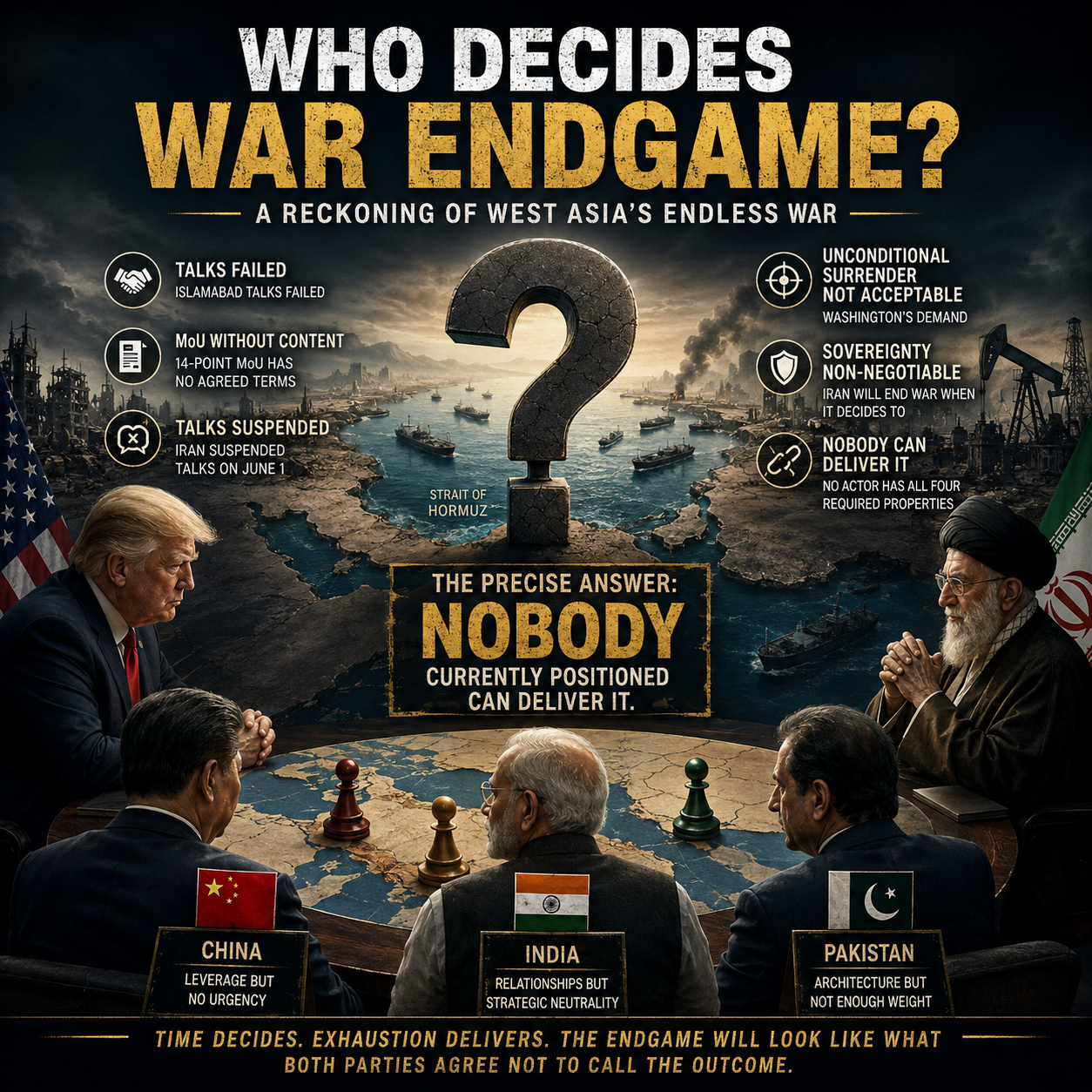
Iran Said It Will End the War When It Decides To. Washington Said Only Unconditional Surrender Was Acceptable. The 14-Point MoU Has No Agreed Content. The Islamabad Talks Failed. Iran Suspended Talks on June 1. The Endgame Question Has a Precise Answer: Nobody Currently Positioned Can Deliver It.
Blog 82 (Every War Solution Fails) established the 73-year documented sequence — each solution Washington applied deepened the condition it was designed to resolve. Blog 83 examines the question that sequence leaves open: if every available instrument has been applied and the condition persists, who has the authority, the capability, and the strategic interest to produce an endgame? The answer the current configuration produces is precise and uncomfortable: no single actor can deliver the endgame, and every actor with a stake in the outcome has structural reasons to prevent the endgame another actor might deliver.
Who Decides War Endgame: What Each Actor Wants and Cannot Have
Who Decides War Endgame: Iran says it will end the war when it decides to. Washington demanded unconditional surrender. The 14-point MoU has no agreed content. The Islamabad talks failed. Iran suspended talks June 1. The endgame question has a precise answer: nobody currently positioned can deliver it. The answer requires examining what each actor wants and why what it wants cannot be delivered by the current configuration.
Washington’s endgame — and why it is undeliverable:
Washington’s stated endgame shifted across the war’s 90 days. On March 6 Trump demanded Iran’s “unconditional surrender” and threatened to attack energy infrastructure and bridges if a deal was not reached — setting deadlines of March 21, then March 23, then April 7. Each deadline passed without the surrender. The endgame shifted to a nuclear moratorium — Washington demanded 20 years, Iran offered 5. Axios documented the 14-point MoU being negotiated between Witkoff, Kushner, and Iranian officials: a 30-day negotiating period on Hormuz’s opening, Iran’s nuclear programme, and sanctions — with the MoU’s terms contingent on a final agreement that has not been reached. Washington’s endgame — nuclear moratorium, Hormuz opened, sanctions removed — requires Iran to accept the outcome of a war that Iran’s own leadership says it has not lost. The endgame Washington wants requires Iranian compliance. The organism Washington faces has demonstrated structural immunity to the compliance mechanism.
Iran’s endgame — and why it is equally undeliverable alone:
At the Islamabad talks of April 11-12 2026, Iran’s counter-proposal contained five points: end to US-Israeli attacks on Iran and pro-Iranian forces in Lebanon and Iraq, security guarantees preventing future aggression, war reparations, and international recognition of Iranian sovereignty over the Strait of Hormuz. An anonymous Iranian official told Press TV: “Iran will end the war when it decides to and when its own conditions are met.” Iran’s endgame — sovereignty over Hormuz formally recognised, reparations paid, security guarantees given — requires Washington to accept the outcome of a war that Washington’s domestic political architecture cannot permit to be named a defeat. Iran suspended talks on June 1 2026 in protest at Israel’s actions in Lebanon — demonstrating that the negotiating track is hostage to a third party’s actions even when the two primary parties are close to a framework. Iran’s endgame requires Washington to accept what Washington cannot name. The structural gap is not negotiating distance. It is constitutional.
Israel’s endgame — the third party problem:
Israel’s endgame is Iran’s permanent nuclear disarmament and the elimination of its proxy architecture. Neither is achievable through the current configuration. The decapitation template (Blog 75) produced a more capable proxy architecture, not a dismantled one. The nuclear infrastructure strikes produced a dispersed and concealed programme, not an eliminated one. Israel’s endgame requires outcomes that 90 days of the most intensive air campaign in the region’s history did not produce — and Israel’s actions in Lebanon are simultaneously disrupting the negotiating track that might produce a partial settlement. The third party that cannot deliver its own endgame is also preventing the partial settlement the other two parties might reach.
📌 The Trap That Makes Every Endgame Unavailable
Five walls, no exit — established in Blog 56. The Who Decides War Endgame question is the Hormuz Logical Trap stated from the endgame rather than from the current moment.
Who Decides War Endgame: The Actors Who Might and Why They Have Not
The endgame’s delivery requires an actor with four properties simultaneously: sufficient leverage over Washington to make the status quo more costly than settlement, sufficient leverage over Iran to make the status quo more costly than settlement, no structural interest in the conflict’s continuation, and the diplomatic architecture to construct a framework both parties can accept without naming what neither can admit. No current actor possesses all four — but three actors possess partial combinations.
China: Sufficient economic leverage over both parties — the largest buyer of Iranian oil and a major trading partner with the United States whose $9 billion monthly Russian oil windfall from the Hormuz closure gives it no structural incentive to end the conflict quickly. Blog 47 (China Oil Revenge) documented China’s consistent pattern: accumulate position while Washington fights. China nudged the April 7-8 ceasefire — demonstrating the leverage exists. China has not applied that leverage to a final settlement — demonstrating it has not chosen to. China’s endgame is the petroyuan’s institutionalisation and American strategic exhaustion, both of which the conflict’s continuation delivers without China’s active participation. China can decide the endgame. China has chosen not to yet.
India: The most consequential non-aligned actor. Blog 58 (India Strategic Neutrality) established India’s nine simultaneous contradictions — the swing actor in a four-power world whose position every pole needs to court. India’s Chabahar port access, its 40% Hormuz-dependent energy import, and Modi’s documented relationship with both Trump and Iranian leadership give India both the motivation and the partial leverage to facilitate a settlement. India has not deployed this leverage toward an endgame — maintaining the strategic neutrality that preserves all relationships rather than expending relational capital on a settlement whose terms India cannot control.
Pakistan: The most operationally demonstrated mediator — the Islamabad talks and the April 7-8 ceasefire both Pakistani-brokered, with Chinese facilitation. Blog 36 (Islamabad Reckoning) documented Pakistan’s bifurcated position — SMDA member, Washington’s historical security partner, Iran’s neighbour, China’s CPEC endpoint. Pakistan has the diplomatic architecture. It demonstrated the capability in April. It lacks the economic weight to make the status quo more costly than settlement for either party.
The Who Decides War Endgame answer is therefore not “nobody” — it is “not yet, and not without a configuration that does not currently exist.” China has the leverage and has not chosen to apply it. India has the relationships and has not expended the capital. Pakistan has the architecture and lacks the weight. The combination of all three — a coordinated China-India-Pakistan framework with Gulf state financial incentives — could construct the endgame. That combination has not been attempted because each actor’s individual calculus makes the conflict’s continuation preferable to the diplomatic cost of producing the settlement. CFR President Michael Froman documented that a month into the war, the United States had achieved military objectives but faced a deepening gap between tactical success and strategic resolution.
The Brokerage Deficit: Why Neutrals Aren’t Stepping In
For an outside power to step in and force an endgame, it needs leverage, structural interest, and diplomatic architecture. Right now, those traits are split across three different nations, preventing a unified front:
| Actor | What They Have | What They Lack / Why They Wait |
| China | Massive economic leverage over both the US and Iran. | No structural interest in a quick fix. China benefits from a $9 billion monthly Russian oil windfall due to the Hormuz closure and watches the US undergo strategic exhaustion. |
| India | Great relationships with both Trump and Tehran; key economic ties (Chabahar Port). | Unwilling to burn relational capital. India maintains a position of “strategic neutrality” rather than risking its diplomatic standing on an unpredictable settlement. |
| Pakistan | Proven operational architecture (brokered the April ceasefire talks). | Lacks economic and military weight. Pakistan cannot single-handedly make the status quo too costly for either major combatant to continue. |
Who Decides War Endgame: The Structural Answer
The Who Decides War Endgame question’s structural answer is the series’ most honest single conclusion. The endgame will be decided not by negotiation but by exhaustion — the point at which the gap between what each party must publicly claim and what each party will privately accept narrows sufficiently that a face-saving framework becomes constructible. That point has not yet been reached because Washington cannot privately accept Iranian Hormuz sovereignty while publicly claiming the war’s objectives have been achieved, and Iran cannot privately accept a nuclear moratorium while publicly claiming it has not surrendered. The via media (Blog 80) is Washington’s attempt to manage toward that point — declaring the war status quo while repositioning assets, hoping Iran’s toll authority becomes normalised background reality rather than the explicit concession it would be if named.
Blog 65 (Iran’s War Logic) established that Iran’s constitutional architecture was designed to sustain maximum external pressure indefinitely — the organism can wait longer than the state. Blog 46 (Washington’s Global Control War) established the commercial architecture requiring the confrontation’s continuation. The structural answer to Who Decides War Endgame is: time decides, exhaustion delivers, and the endgame will look like what both parties agree not to call the outcome. The Raktbeej and Starfish Thesis on hinduinfopedia.com established that the organism was designed to outlast the pressure. The Who Decides War Endgame answer confirms the thesis: the organism outlasts, the state exhausts, and the endgame arrives not as a decision but as the accumulated weight of what neither party can continue to sustain.
📌 The Every Solution Fails Sequence That Produced This Question
73 years of solutions each deepening the condition — why the Who Decides War Endgame question has no clean answer when the instrument that produced the condition is the only instrument available.
Next: Order Without Enforcer — Blog 84, the series’ closing argument, examines what the world after the Hormuz war’s status quo looks like when the enforcer of the rules-based international order has demonstrated the limits of its enforcement capability — and whether a four-power world with no agreed rules and no capable enforcer can sustain the global commercial architecture that every actor in the system depends on. Part of the West Asia’s Endless War Series on hinduinfopedia.com.
Feature Image: Click here to view the image.
Videos
Glossary of Terms
- Who Decides War Endgame: The central key phrase of the blog, examining which actor possesses the authority, leverage, capability, and strategic interest to bring the West Asia conflict to a durable conclusion.
- 14-Point MoU: A proposed fourteen-point memorandum of understanding reportedly negotiated between American and Iranian representatives, intended as a framework for broader negotiations but lacking mutually agreed final terms.
- Hormuz Logical Trap: A recurring concept in the series describing a strategic situation where all available options impose unacceptable costs, leaving major actors trapped within mutually reinforcing constraints.
- Unconditional Surrender: A demand that one side accept defeat without negotiating terms, guarantees, or concessions, becoming a major obstacle in conflict resolution efforts.
- Nuclear Moratorium: A temporary suspension or restriction of nuclear activities proposed as part of a negotiated settlement between competing parties.
- Strategic Neutrality: A foreign policy approach in which a state maintains working relations with multiple competing powers while avoiding formal alignment with any single bloc.
- Chabahar Port: An Iranian port on the Gulf of Oman that provides India with strategic trade and connectivity access to Central Asia and Afghanistan.
- Proxy Architecture: The network of allied organizations, militias, or partner groups through which a state extends influence without direct military deployment.
- Decapitation Template: A series term describing a strategy focused on eliminating senior leadership figures in the expectation that organizations will collapse after leadership removal.
- Petroyuan: The use of the Chinese yuan in international oil transactions, viewed as a potential alternative to the traditional dollar-based energy trade system.
- Brokerage Deficit: A condition in which no single actor possesses sufficient leverage, incentives, and diplomatic reach to successfully mediate and enforce a settlement.
- Via Media: A middle-path approach seeking practical compromise between competing positions without fully endorsing either side’s stated objectives.
- Raktbeej and Starfish Thesis: A series concept comparing resilient political or military structures to entities that regenerate after being attacked, suggesting that pressure can produce adaptation rather than collapse.
- Commercial Architecture: The interconnected system of trade routes, financial networks, energy flows, and economic arrangements that sustain international commerce.
- Rules-Based International Order: The post-World War II framework of institutions, norms, and agreements intended to regulate international relations and global trade.
#Iran #Israel #USA #Hormuz #Geopolitics #War #Diplomacy #China #India #Pakistan #MiddleEast #Strategy #Conflict #GlobalOrder #HinduinfoPedia
West Asia’s Endless War: Why This Series Exists
Refer to Various Arks Referred to in the Blog
https://hinduinfopedia.com/proof-of-endless-war-master-reference-table/
[…] https://hinduinfopedia.com/who-decides-war-endgame-a-reckoning-of-west-asias-endless-war-83/ […]
[…] enforcer has demonstrated its limits is not yet documentable because it has not yet been decided. Blog 83 (Who Decides Endgame) established that nobody currently positioned can deliver the endgame. The same is true of the […]