

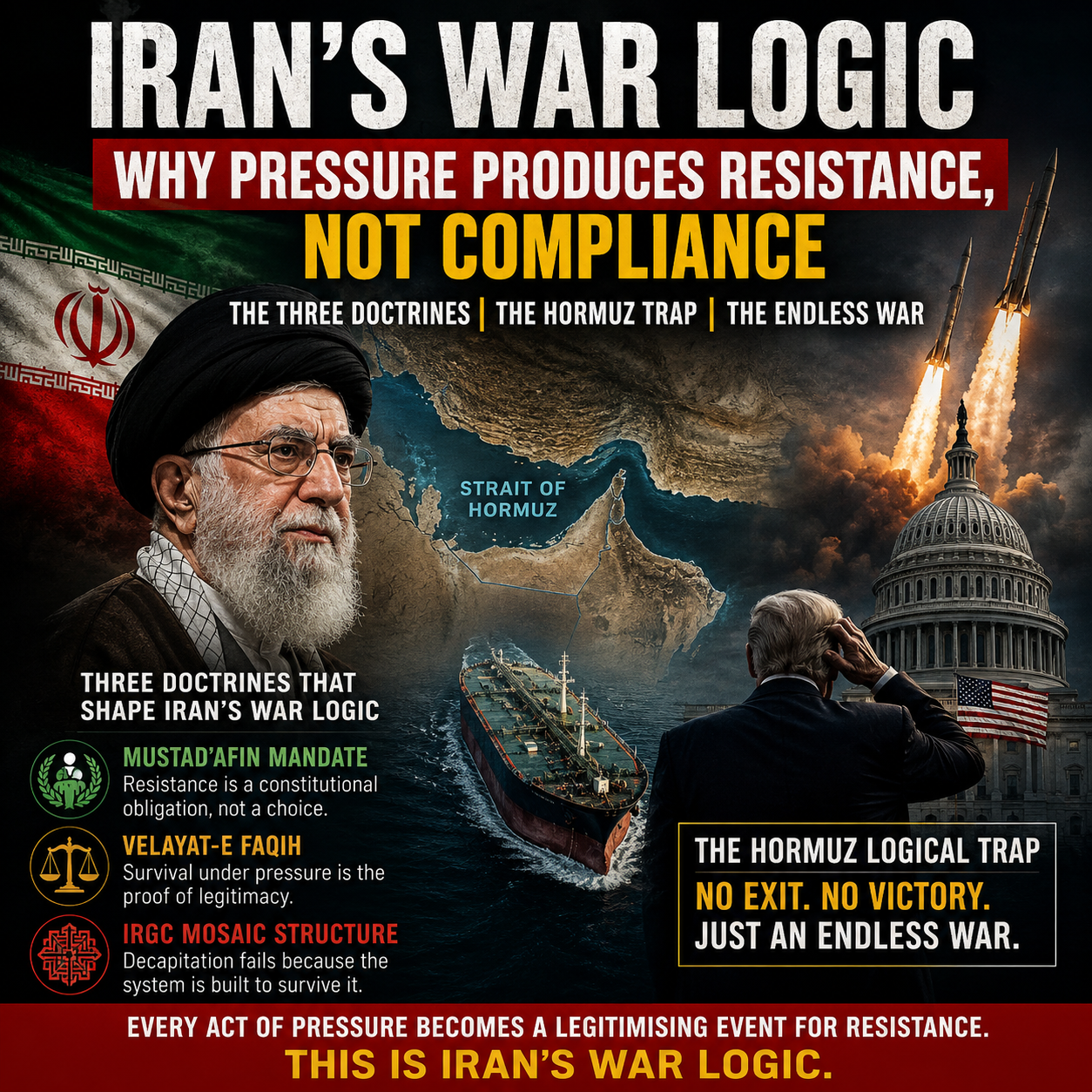
Iran’s War Logic: A Reckoning of West Asia’s Endless War (65)
Part 65 of the West Asia’s Endless War Series
भारत / GB
The Ideology Arc Has Named the Doctrine. Blog 65 Reconnects It to the Operational War. Why Iran Fires. Why Iran Does Not Break. Why Every Instrument Washington Has Applied Has Produced a More Capable Adversary Rather Than a More Compliant One.
Blogs 60 through 64 constituted the ideology arc — the Dar Al Harb Doctrine stated precisely, hardened by Washington’s Cold War manufacture, maintained through Gulf state ambivalence, carried by Pakistan’s bifurcated architecture, and superseded by Iran’s own Mustad’afin constitutional mandate. Blog 65 is the reconnection blog. The theology arc’s findings — that Iran operates a constitutional revolutionary doctrine more expansive than Dar al-Harb, that its silence on the doctrine is strategic constraint not doctrinal abandonment, and that its proxy architecture is the operational expression Iranian constitution Article 154’s global mandate — are not academic conclusions. They are the explanation for the Hormuz war’s operational present: why Iran fired 12 ballistic missiles at UAE on May 4 2026, why the Hormuz Logical Trap has five walls and no exit, and why the series has arrived at Blog 65 without a resolution in sight.
Iran’s War Logic: The Three Doctrines That Produce the Behaviour
Iran’s War Logic: Three doctrines — Mustad’afin mandate, Velayat-e Faqih governance, IRGC Mosaic architecture — explain why forty-seven years of maximum pressure have produced a more capable Iranian adversary rather than a more compliant one. Washington’s Iran policy across seven administrations has operated on a single implicit assumption: that sufficient pressure — economic sanctions, diplomatic isolation, targeted assassination, military strikes — will produce a rational cost-benefit calculation in Tehran that makes compliance cheaper than resistance. The assumption has failed seven times. Blog 65 examines why the failure is structural rather than tactical — why the three doctrines that govern Iran’s behaviour make the compliance calculation systematically impossible regardless of the pressure applied.
Doctrine One — The Mustad’afin mandate makes resistance constitutionally obligatory.
Blog 64 (Iran’s Revolutionary Doctrine) established that Article 154 of Iran’s 1979 constitution commits the Islamic Republic to support the oppressed against the oppressors in every corner of the globe. This is not a foreign policy preference that can be adjusted by a new administration or abandoned under pressure. It is a constitutional obligation — the founding document of the state. When Washington applies sanctions to coerce Iranian compliance, the Mustad’afin framework does not register the pressure as a cost-benefit calculation. It registers it as confirmation that Washington is the Mustakbirin — the oppressor — whose pressure is precisely what the constitutional mandate was designed to resist. The Mustad’afin doctrine converts every act of external pressure into a legitimising event for the resistance. The more Washington squeezes, the more constitutionally correct Iran’s resistance becomes in the framework that governs Iranian decision-making. This is Iran’s War Logic’s first structural explanation for why pressure produces resistance rather than compliance: the pressure is not a deterrent within the Mustad’afin framework. It is a proof of concept.
Doctrine Two — Velayat-e Faqih makes survival under pressure the proof of legitimacy.
The Velayat-e Faqih governance model — governance by qualified Islamic jurists — is not merely a political system. It is a claim about the superiority of Islamic governance over Western liberal democracy and over Sunni monarchy simultaneously. Blog 21 (Persian Civilisation War) established Iran as a civilisational state. The Velayat-e Faqih system’s legitimacy claim rests on a specific proof: that a state governed by Islamic jurists can maintain sovereignty, resist the world’s most powerful military and economic pressure, and continue to operate its constitutional mandate across decades of maximum external coercion. Every year Iran survives under sanctions is a year the Velayat-e Faqih legitimacy claim is renewed. Every military strike that fails to produce regime change is a demonstration that the governance model is resilient enough to survive what Western liberal democracies and Gulf monarchies could not. The IMF documented Iran’s per capita income declining 40% between 2012 and 2022 — a compression that has destroyed civilian living standards while the Velayat-e Faqih system remains intact. The civilian cost is real and severe. Within the Velayat-e Faqih framework, that cost is the price of the legitimacy proof — and the Supreme National Security Council’s calculus accepts it because the alternative is not relief but the dissolution of the governance model itself.
Doctrine Three — The IRGC Mosaic makes military decapitation self-defeating.
Blog 39 (IRGC Mosaic Reckoning) established that Iran’s 31 independent IRGC commands were specifically designed to survive decapitation — distributed architecture in which each command can operate autonomously without central direction. The removal of Khamenei in Operation Epic Fury did not remove the capability. The Fujairah strikes of May 4 2026 — 12 ballistic missiles, 3 cruise missiles, 4 drones engaged by UAE air defences — were the Mosaic architecture’s operational proof after decapitation. Blog 56 (Hormuz Logical Trap) established that this produces the trap’s second wall: Iran is hungry but cannot surrender, because surrender requires a central authority capable of delivering it — and the distributed Mosaic architecture means there is no single actor whose compliance produces system-wide compliance. Washington removed the head. The Mosaic continued. Negotiations require a counterparty capable of enforcing agreements. The Mosaic’s distributed autonomy makes Iran a difficult negotiating partner not from diplomatic bad faith but from structural architecture: local IRGC commanders can continue operations regardless of what any central authority agrees.
📌 Why Iran Will Not Blink — The Foundational Argument
The civilisational depth, the distributed military architecture, and the strategic doctrine that makes Iran’s continued resistance rational — established before the war began and confirmed by every development since.
Iran’s War Logic: The Reconnection to Hormuz
The three doctrines reconnect to the Hormuz war’s operational present through a single question that the series has been building toward since Blog 1: why does Iran fight the way it fights? The answer is not that Iran is irrational, suicidal, or ideologically captured in a way that prevents cost-benefit calculation. The answer is that Iran’s cost-benefit calculation operates within a framework in which the costs Washington imposes are constitutionally legitimising, the survival under pressure is itself the governance model’s proof of concept, and the military architecture is specifically designed to continue operating after the central authority that Western strategy targets has been removed.
Iran’s War Logic explains four operational behaviours that Washington has consistently misread as irrationality:
Why Iran escalates after strikes rather than capitulating.
The Mustad’afin framework converts military strikes into legitimising events. Every strike that does not produce regime change confirms that the Islamic Republic can withstand the Mustakbirin’s maximum pressure. Escalation after a strike is not defiance for its own sake — it is the operational expression of a doctrine that requires demonstrating resilience to sustain legitimacy. Blog 5 (Nuclear Pretext) documented that Iran was mid-negotiation with IAEA inspectors when strikes began. The strikes converted a negotiating Iran into a striking Iran — not because Iran wanted war but because the Mustad’afin doctrine required that unprovoked military action be met with operational response.
Why Iran fires on Muslim-majority states.
Blog 64 established that the Mustad’afin doctrine divides the world by political category — oppressed versus oppressors — not by religious category. UAE, Saudi Arabia, and Kuwait are designated Mustakbirin not because they are non-Muslim but because they host the American military architecture that Iran’s constitutional mandate designates as the oppressor’s instrument. The Ummah Delusion (Blog 7) documented that Muslim solidarity fractures at every operational test. Iran’s War Logic explains the mechanism: the fracture is not a failure of Islamic solidarity but the Mustad’afin framework’s logical consequence — Gulf monarchies that host Washington’s military are not fellow Muslims to be protected. They are Mustakbirin to be pressured.
Why Iran’s proxy architecture continued after Khamenei’s death.
The IRGC Mosaic was designed for precisely this scenario. Hezbollah, Hamas, the Houthis, and the Iraqi PMF are not remote-controlled from Tehran. They are ideologically autonomous movements that share Iran’s Mustad’afin framework and operate their own cost-benefit calculations within it. Blog 64’s Lebanon embassy example — Iran’s ambassador remaining in Beirut despite Lebanon’s expulsion order, with Hezbollah overriding the sovereign Lebanese government’s decision — demonstrates that the proxy architecture operates with a degree of autonomy that makes decapitation of the Iranian centre insufficient to terminate the network’s operational capacity.
Why economic pressure has not produced compliance in forty-seven years.
The Lancet documented Iran’s pharmaceutical supply chain collapse under sanctions — civilian suffering that is real, documented, and severe. The Velayat-e Faqih framework accepts this cost because the alternative — compliance that dissolves the governance model — is existentially worse than the cost of resistance. This is not ideological fanaticism. It is the rational calculation of a governance system whose legitimacy proof requires surviving maximum pressure. Academic analysis in International Organization confirms that sanctions rarely produce compliance when the target state’s regime survival depends on resisting the sanctioning power’s demands. A governance model that capitulates to sanctions does not survive as a governance model. Iran’s War Logic is therefore not a war logic at all in the conventional sense. It is a survival logic — the operational expression of a state whose existence depends on demonstrating that it cannot be coerced.
Iran’s War Logic closing argument connects the ideology arc back to the series’ central thesis. Washington’s Global Control War (Blog 46) established that the war is against economic independence from Washington wherever it exists. The Hormuz Logical Trap (Blog 56) established that Washington cannot win, cannot withdraw, and cannot stop. Iran’s War Logic is the explanation for why the trap has no exit from the Iranian side: a state whose constitutional mandate requires resistance to oppressor pressure, whose governance model’s legitimacy depends on surviving that pressure, and whose military architecture continues operating after the central authority is removed cannot produce the compliance that would allow Washington to declare victory and exit. Jeffrey Sachs told ET Now that a resumption of fighting would produce “not just a dire crisis but a worldwide catastrophe.” The catastrophe is structural: Washington is applying a compliance model to a state whose entire operational architecture is designed to make compliance structurally impossible. The Hormuz Logical Trap is not a diplomatic failure. It is the inevitable outcome of a power that does not understand the war logic of the state it is fighting.
📌 The Trap That Iran’s War Logic Has Produced
Five walls, no exit, gale ki haddi. The Hormuz Logical Trap — Washington cannot swallow the war or spit it back. Iran’s War Logic explains why the trap has no exit from either side.
Next: Mustad’afin Doctrine — Blog 66 in West Asia’s Endless War examines Iran’s constitutional Mustad’afin framework as a standalone doctrine — a complete alternative world order framework that divides humanity by political category rather than religious identity, applies to every oppressed people everywhere regardless of religion, and competes directly with Washington’s freedom-and-democracy universalism as a global legitimising narrative. The doctrine that makes Iran’s war logic rational examined on its own terms. Part of the West Asia’s Endless War Series on hinduinfopedia.com.
Feature Image: Click here to view the image.
Videos
Glossary of Terms
- Mustad’afin Doctrine: Iran’s constitutional revolutionary framework that divides the world into oppressed and oppressor categories and treats resistance against dominant powers as a state obligation under Article 154 of the 1979 Constitution.
- Mustakbirin: A political-religious category in Iranian revolutionary ideology referring to oppressive or domineering powers viewed as exploitative toward weaker societies.
- Velayat-e Faqih: Iran’s governing doctrine in which qualified Islamic jurists hold ultimate political and religious authority over the state.
- IRGC Mosaic Architecture: A decentralized military structure of the Islamic Revolutionary Guard Corps designed so regional commands can continue operating independently even if central leadership is removed.
- Hormuz Logical Trap: A term coined in the series describing the strategic deadlock in which Washington cannot decisively win, withdraw, or compel compliance from Iran without escalating wider instability.
- Operation Epic Fury: A major military operation referenced in the series involving the removal of Iran’s central leadership, used to demonstrate the survivability of Iran’s distributed military structure.
- Fujairah Strikes: The missile and drone attacks launched toward Fujairah in the UAE on May fourth, two thousand twenty six, presented in the series as proof of post-decapitation operational continuity.
- Proxy Architecture: Iran’s network of aligned regional organizations such as Hezbollah, Hamas, the Houthis, and Iraqi PMF groups that operate with ideological coordination and varying operational autonomy.
- Supreme National Security Council: Iran’s highest strategic decision-making body responsible for coordinating national security and major policy responses.
- Compliance Model: The Western strategic assumption that economic sanctions, diplomatic isolation, and military pressure can force adversaries into negotiated submission.
- Civilisational State: A state that derives legitimacy from historical, cultural, and ideological continuity beyond modern national boundaries or electoral politics.
- Maximum Pressure Strategy: The long-term American policy approach using sanctions, isolation, and coercive measures intended to weaken Iran economically and politically.
- Decapitation Strategy: A military doctrine aimed at weakening an adversary by eliminating top leadership and command structures.
- Article 154 of Iran’s Constitution: A constitutional provision declaring support for oppressed peoples worldwide while framing Iran’s revolutionary outlook beyond national borders.
- West Asia’s Endless War: The long-running analytical series examining ideological conflict, geopolitical competition, military escalation, and civilisational struggle across West Asia.
#HinduinfoPedia #Iran #Hormuz #MiddleEast #Geopolitics #IRGC #Sanctions #WestAsia #War #Tehran
West Asia’s Endless War: Why This Series Exists
Refer to Various Arks Referred to in the Blog
[…] भारत / GB […]
[…] https://hinduinfopedia.com/irans-war-logic-a-reckoning-of-west-asias-endless-war-65/ […]
[…] Read: Iran’s War Logic → […]
[…] पढ़ें: ईरान की युद्ध-तर्क व्यवस्था → […]
[…] Via Media does not resolve is the foundational condition the series has documented across 80 blogs. Blog 65 (Iran’s War Logic) established that Iran’s constitutional architecture was designed to sustain maximum external […]
[…] वह इस पूरी श्रृंखला का मूल विषय है। ब्लॉग 65 (ईरान्स वॉर लॉजिक) ने स्थापित किया था कि ईरान की […]
[…] methodologies to analysts whose professional interests are not served by confirming them. Blog 65 (Iran’s War Logic) established that Iran’s constitutional architecture was designed to make compliance […]
[…] ब्लॉग 65 (ईरान्स वॉर लॉजिक) ने स्थापित किया था कि ईरान की संवैधानिक संरचना ऐसी बनाई गई है कि बाहरी दबाव के समक्ष समर्पण संरचनात्मक रूप से असंभव हो जाता है। हिन्दुइंफोपेडिआ पर प्रकाशित रक्तबीज एंड स्टारफिश थीसिस ने यह तर्क प्रस्तुत किया था कि यह व्यवस्था दबाव की स्थिति में स्वयं को पुनर्सृजित करने के लिए निर्मित है। युद्ध श्रृंखला प्रमाणित यह दर्शाती है कि यह संरचना उसी प्रकार कार्य करती रही जैसी उसके निर्माण का उद्देश्य था। इस निष्कर्ष की स्वतंत्र पुष्टि शिकागो विश्वविद्यालय के विश्लेषण और प्रोजेक्ट फॉर द न्यू अमेरिकन सेंचुरी के सह-संस्थापक के मूल्यांकन से भी हुई। दोनों ने पूरी तरह भिन्न पद्धतियों का उपयोग किया, फिर भी निष्कर्ष समान रहे। […]
[…] कारण के बजाय लक्षणों पर केंद्रित रहे। ब्लॉग 65 (ईरान का युद्ध तर्क) ने बताया था कि ये तीन संरचनाएँ […]
[…] ब्लॉग 65 (ईरान का युद्ध तर्क) ने स्थापित किया था कि ईरान की […]
[…] के प्रदर्शन में परिवर्तित करता है। ब्लॉग 65 (ईरान का युद्ध तर्क) ने स्पष्ट किया था कि तीन प्रमुख […]
[…] mandate converts external economic pressure into domestic legitimacy demonstrations. Blog 65 (Iran’s War Logic) established that the three doctrines make compliance structurally impossible regardless of economic […]