

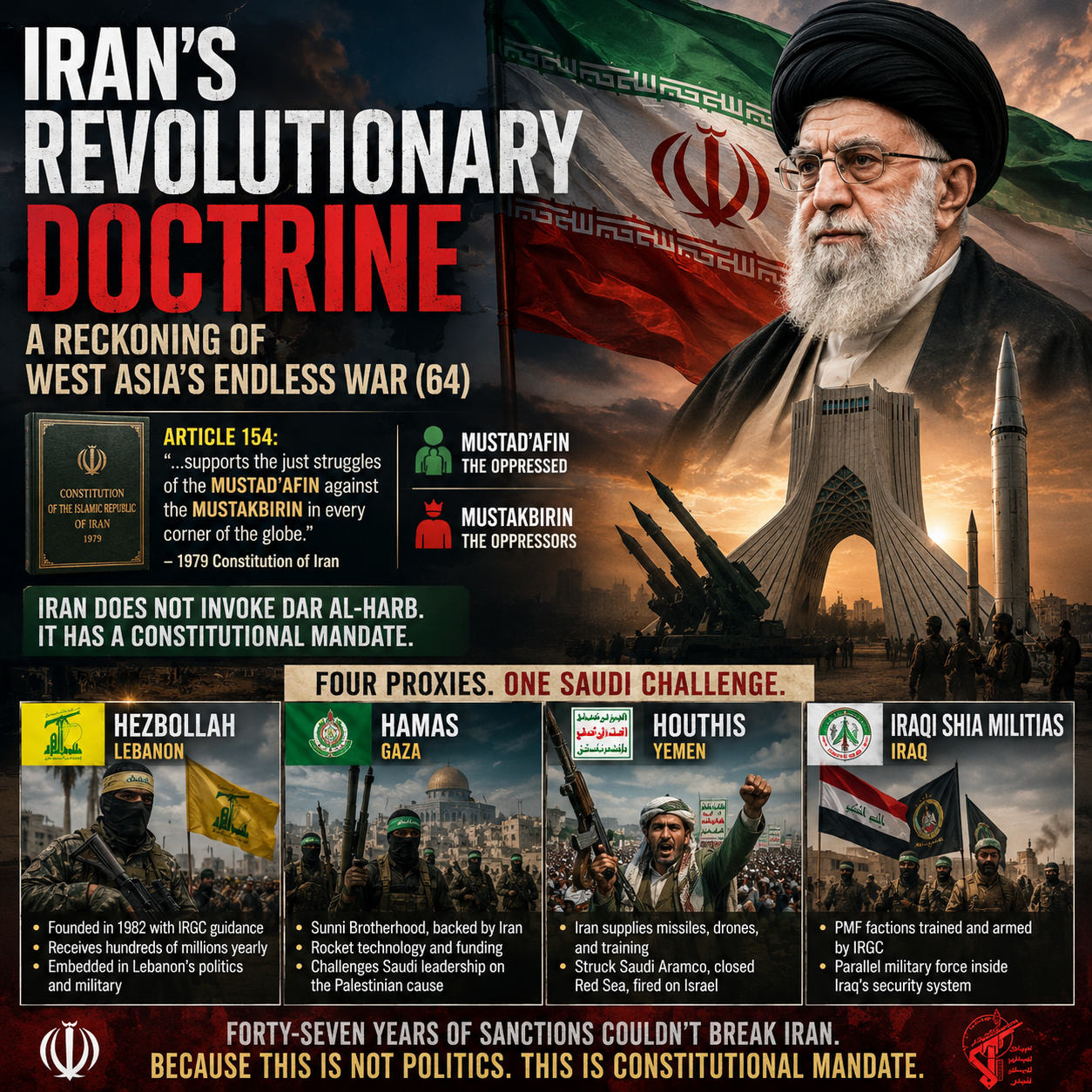
Iran’s Revolutionary Doctrine: A Reckoning of West Asia’s Endless War (64)
Part 64 of the West Asia’s Endless War Series on hinduinfopedia.com
भारत / GB
Iran Does Not Need the Dar al-Harb Vocabulary. It Has a Constitutional Mandate That Is More Expansive, More Universal, and More Dangerous to the Existing World Order — Because It Applies to Every Oppressed People Everywhere, Regardless of Religion.
Blog 62 (Dar Al Harb Ambivalence) examined Saudi Arabia and Qatar — the theological substrate’s primary funders and the condemnation industry’s most precisely documented Gulf cases. Blog 63 (Dar Al Harb Ambivalence Pakistan) examined the third actor — a bifurcated state architecture in which two parallel policies operate simultaneously as official strategy, documented by FATF, rescued by geopolitics, and confirmed by Pahalgam. Blog 64 completes the three-blog examination of the peer review’s third observation: Iran does not publicly invoke Dar al-Harb, does not formally operate the jihadist maximalist framework, and uses a distinct constitutional architecture. The series has consistently treated Iran as a civilisational state — Blog 21 (Persian Civilisation War) established this. Blog 64 examines what that civilisational state’s founding document actually commits it to — and why the Islamic Republic’s operational doctrine is not Dar al-Harb but something the series must name on its own terms before Blog 65 reconnects this ideology arc to the Hormuz war’s operational present.
Iran’s Revolutionary Doctrine: The Mustad’afin Mandate
Iran’s Revolutionary Doctrine: Iran does not publicly invoke Dar al-Harb. It does not need to. The 1979 constitution, the Mustad’afin mandate, and the proxy architecture across four countries produce a state whose silence is calculation, not conversion. Article 154 of Iran’s 1979 constitution states: “The Islamic Republic of Iran has as its ideal human felicity throughout human society, and considers the attainment of independence, freedom, and rule of just law in every part of the world to be the right of all people. Accordingly, while scrupulously refraining from all forms of interference in the internal affairs of other nations, it supports the just struggles of the Mustad’afin against the Mustakbirin in every corner of the globe.”
Iran’s Revolutionary Doctrine’s central category is the Mustad’afin — the oppressed — and the Mustakbirin — the arrogant oppressors — are Quranic categories. Khomeini did not invent them. He constitutionalised them. The distinction from Dar al-Harb is precise and significant: Dar al-Harb divides the world by religious category — Muslim territory versus non-Muslim territory. The Mustad’afin doctrine divides the world by political category — the oppressed versus the oppressors — and that division explicitly crosses religious lines. Iran’s constitutional mandate to support liberation struggles applies to every people it considers oppressed everywhere regardless of religion. This is why Iran has supported Palestinian liberation (Sunni Muslim), Latin American anti-imperialist movements, African anti-colonial struggles, and non-Muslim populations under what Iran designates as oppressor governance. The Mustad’afin mandate is not Dar al-Harb. It is more expansive than Dar al-Harb — and more universally threatening to existing power arrangements — because it requires no religious qualification for its application.
Article 11 states the Islamic unity dimension: “all Muslims form a single nation, and the government of the Islamic Republic of Iran have the duty of formulating its general policies with a view to cultivating the friendship and unity of all Muslim peoples, and it must constantly strive to bring about the political, economic, and cultural unity of the Islamic world.” Read alongside Article 154, the constitutional architecture is complete: universally, Iran supports the oppressed against the oppressors regardless of religion; within the Islamic world specifically, Iran asserts a constitutional duty to lead Muslim unity. The second article is where Iran’s challenge to Saudi Arabia’s Sunni leadership is constitutionally encoded. Iran does not merely compete with Saudi Arabia for regional influence. It asserts a constitutional mandate to lead the entire Islamic world toward unity — a mandate that implicitly delegitimises Saudi Arabia’s self-appointed role as the guardian of Mecca and the leader of Sunni Islam.
Iran’s Revolutionary Doctrine’s Mustad’afin mandate is not Dar al-Islam either. This is the correction the previous version of this blog required. Islamic rule — the establishment of Dar al-Islam — is the territorial ambition of classical Sunni jurisprudence. Iran’s Velayat-e Faqih is not a territorial ambition. It is a governance model — the demonstration that qualified Islamic jurists can govern a modern state justly and effectively. Iran does not want to conquer Dar al-Harb and convert it to Dar al-Islam. Iran wants to demonstrate that the Velayat-e Faqih model of governance is superior and only option according to Iranian to Western liberal democracy and to Sunni monarchy simultaneously — and that the world will eventually recognise this superiority through the evidence of Iran’s survival under maximum pressure. This is why forty-seven years of sanctions, military strikes, assassinations, and economic compression have not produced the regime change Washington sought — because regime change is the terminal diagnosis of an externally imposed political failure, and Iran’s survival under pressure is itself the proof of concept its constitutional doctrine requires.
📌 The Civilisational State This Doctrine Governs
Iran as a civilisational state asserting sovereign strategic interests — the Persian civilisation war argument that makes the revolutionary doctrine’s persistence comprehensible across forty-seven years of maximum external pressure.
Iran’s Revolutionary Doctrine: Four Proxies, One Saudi Challenge
Constitutions establish intent. Proxy architectures establish operational reality. Iran’s Revolutionary Doctrine is not only a textual argument — the proxy architecture across four countries is the most precise evidence of what Article 154’s mandate looks like in practice — and of how Iran uses the Mustad’afin doctrine to challenge Saudi Arabia’s claim to Sunni Islamic leadership simultaneously.
Hezbollah — Lebanon.
Founded in 1982 with IRGC guidance following Israel’s invasion of Lebanon. The Council on Foreign Relations documents Hezbollah as receiving $700 million annually from Iran at its peak. Hezbollah operates social services, holds parliamentary seats, and maintains a military force that has fought in Lebanon, Syria, and Iraq on Iran’s behalf. It is the fullest operational expression of Iran’s Revolutionary Doctrine — a revolutionary Islamic movement built by Shia Iran inside a majority-Muslim Arab state, demonstrating that Iran’s revolutionary model can embed itself within existing state structures without requiring territorial conquest.
The most precise live demonstration of this embedding occurred in March 2026. Lebanon declared Iran’s Ambassador Mohammad Reza Shibani persona non grata on March 24 2026 under Article 41 of the Vienna Convention, citing interference in Lebanon’s internal affairs, and gave him until March 29 to leave. Iran’s Foreign Ministry spokesman Esmail Baghaei responded on March 30: “Our embassy in Lebanon is active” — the ambassador did not leave. The Iranian diplomatic source was precise about why: the ambassador would remain “in accordance with the wishes of the speaker of parliament Nabih Berri and of Hezbollah.” A sovereign Lebanese government declared an Iranian diplomat persona non grata. Hezbollah — an Iranian proxy operating inside Lebanon’s parliament and cabinet — overrode the sovereign government’s decision. Iran’s embassy remained open. The argument that Iran’s revolutionary model embeds itself within existing state structures without requiring territorial conquest is not theoretical. It is the operational reality that Lebanon’s government is unable to reverse despite a formal expulsion order, a ceasefire agreement requiring Hezbollah’s disarmament, and a Lebanese ban on IRGC operations within its territory. Iran simultaneously defied all three.
Hamas — Gaza.
Iran’s relationship with Hamas is the proxy architecture’s most ideologically revealing dimension — because Hamas is a Sunni Brotherhood organisation and Iran is Shia. The shared adversary (Israel) overcomes the Shia-Sunni division. But the relationship carries a second strategic dimension that the previous version of this blog did not state directly: Iran’s support for Hamas is simultaneously a challenge to Saudi Arabia’s claim to lead the Palestinian cause. Saudi Arabia has funded Palestinian organisations through Qatari and other channels for decades. Iran funds Hamas directly and provides rocket technology. When October 7 was launched with Iranian rocket manufacturing knowledge, the narrative credit for Palestinian resistance went to the Iran-backed axis — not to Saudi petrodollar diplomacy. Iran’s Mustad’afin doctrine, applied to the Palestinian cause, makes Iran the constitutional champion of the oppressed Palestinians — displacing Saudi Arabia as the leading Muslim power in Islam’s most politically charged cause. This is the doctrine’s most precise competitive expression: Iran uses the Palestinian struggle not only to resist Israel but to establish Iranian Shia leadership over a Sunni cause against Saudi Sunni money.
Houthis — Yemen.
BBC documented Iran’s weapons and training supply to the Houthis from at least 2014 — missile technology, drone manufacturing, naval mine capability — transforming a Yemeni tribal insurgency into a force capable of striking Saudi Aramco’s Abqaiq facility (2019), closing the Red Sea (2024), and firing on Israel (2024). The Houthis are the Mustad’afin doctrine’s most direct application against Saudi Arabia — a Shia-adjacent movement (Zaydi Shia) that Iran supports against the Saudi-led Sunni coalition in Yemen, simultaneously bleeding Saudi Arabia militarily, demonstrating Iranian reach into Saudi Arabia’s strategic backyard, and framing it constitutionally as support for the oppressed against the oppressors.
Iraqi Shia militias — the eastern front.
International Crisis Group documented that Iran-aligned PMF factions received direct IRGC training, weapons, and strategic coordination — creating a parallel military force within Iraq’s official security apparatus that answers to Tehran as much as to Baghdad. The PMF’s existence inside an Arab state’s official military architecture is the Mustad’afin doctrine’s most institutionally embedded expression — Iran supporting Shia Muslims in Iraq (the oppressed under Saddam, the beneficiaries of American invasion, the current governors) while simultaneously maintaining IRGC influence over a nominally sovereign Arab neighbour. The four-country proxy architecture targets Muslim and non-Muslim nations alike — Saudi Aramco infrastructure, Israeli cities, American military bases in Iraq, commercial shipping in both the Red Sea and the Gulf of Oman. The doctrine does not exempt Muslim nations from pressure. It applies to anyone designated as Mustakbirin — oppressor — regardless of religious identity.
Iran’s Revolutionary Doctrine: Constraint Is Discipline, Not Conversion
The argument that Iran has abandoned its revolutionary doctrine rests on Iran’s public silence on Dar al-Harb. The silence is real. The conclusion is wrong. Iran operates under the most comprehensive sanctions regime ever applied to a mid-sized economy. The IMF documented Iran’s per capita income declining approximately 40% between 2012 and 2022 — pharmaceutical supply chains destroyed, currency collapsed, civilian suffering documented across this series. A state under this level of economic pressure that openly declares permanent war on every Muslim and non-Muslim nation it designates as oppressor would accelerate the destruction of its own civilian population. The silence is the calculation of the strategically constrained. The proxy architecture is the operational expression that the silence conceals. The IRGC commander does not need to invoke Dar al-Harb publicly. Hezbollah’s rockets, the Houthis’ missiles, the PMF’s presence inside Iraq’s military, and Hamas’s rocket factories invoke the doctrine operationally.
The clearest evidence that the constraint is strategic rather than doctrinal is the behaviour pattern across forty-seven years of pressure. Every time Iran has faced an opportunity to advance its revolutionary doctrine operationally — in Lebanon (1982), in Iraq (2003 American invasion creating the vacuum), in Yemen (2014 Houthi expansion), in Gaza (2023 October 7) — it has done so. The constraint operates on the vocabulary, not on the ambition. Blog 39 (IRGC Mosaic Reckoning) established that Iran’s military architecture is distributed, resilient, and designed to survive decapitation. Iran’s Revolutionary Doctrine is the ideological architecture with the same properties — distributed across four proxy organisations, resilient to military pressure, and specifically designed to survive the decapitation that Western analysis attempts when it removes the Dar al-Harb vocabulary and declares the doctrine absent. The silence is not surrender. It is discipline. And Blog 65 will demonstrate precisely what that discipline looks like when reconnected to the Hormuz war’s operational present — where the Mustad’afin doctrine, the Velayat-e Faqih governance model, and the IRGC Mosaic architecture have combined to produce the Hormuz Logical Trap that has no exit for Washington.
📌 Why Iran Will Not Blink
The civilisational depth, the distributed military architecture, and the strategic doctrine that makes Iran’s continued resistance rational — and why the Hormuz Logical Trap has no exit for a state fighting a constitutional mandate it cannot abandon.
Next: Iran’s War Logic — Blog 65 in West Asia’s Endless War reconnects the three-blog theology arc to the Hormuz war’s operational present. The Mustad’afin mandate, the Velayat-e Faqih governance model, and the IRGC Mosaic architecture are not abstract doctrine. They are the operational explanation for why Iran fired 12 ballistic missiles at UAE on May 4 2026, why the Hormuz Logical Trap has five walls and no exit, and why every military pressure Washington has applied across forty-seven years has produced a more capable Iranian adversary rather than a more compliant one. Part of the West Asia’s Endless War Series on hinduinfopedia.com.
Feature Image: Click here to view the image.
Videos
Glossary of Terms
- Mustad’afin: A Quranic term meaning “the oppressed,” used in Iran’s revolutionary doctrine to describe populations that Iran claims to support globally.
- Mustakbirin: A Quranic term meaning “the arrogant oppressors,” used in Iran’s constitutional framework for powers viewed as exploitative or hegemonic.
- Velayat-e Faqih: Iran’s post nineteen seventy nine governance doctrine in which qualified Islamic jurists are given authority over the state.
- Dar al-Harb: A classical Islamic jurisprudential term referring to territories considered outside Islamic rule.
- Dar al-Islam: A classical Islamic concept referring to territories governed under Islamic authority.
- Article One Hundred Fifty Four: A provision in Iran’s Constitution declaring support for oppressed populations and liberation struggles worldwide.
- Article Eleven: A constitutional provision directing Iran to pursue unity among Muslim populations politically, economically, and culturally.
- IRGC (Islamic Revolutionary Guard Corps): Iran’s parallel military and ideological force established after the Islamic Revolution to protect the revolutionary system.
- Proxy Architecture: A strategic network of allied armed and political organisations supported by a state to extend influence without direct territorial expansion.
- Hezbollah: A Lebanon-based Shia political and armed organisation established with Iranian support after the nineteen eighty two Israeli invasion of Lebanon.
- Houthis: A Yemen-based Zaydi Shia movement supported by Iran and involved in regional military confrontations with Saudi Arabia and Israel.
- PMF (Popular Mobilisation Forces): A coalition of Iraqi armed groups, many aligned with Iran, integrated into Iraq’s security framework after the rise of ISIS.
- Hormuz Logical Trap: A term coined in the series describing the strategic dilemma in which military pressure on Iran increases regional instability without guaranteeing strategic victory.
- Civilisational State: A state that derives strategic identity and geopolitical behaviour from long historical and cultural continuity rather than only modern national borders.
- Revolutionary Doctrine: The ideological and constitutional framework through which Iran combines religious governance, regional influence, and support for aligned movements.
#Iran #MiddleEast #WestAsia #Geopolitics #Hezbollah #Hamas #Houthis #IRGC #SaudiArabia #HinduinfoPedia
West Asia’s Endless War: Why This Series Exists
Refer to Various Arks Referred to in the Blog
[…] भारत / GB […]
[…] Blog 64 (Iran’s Revolutionary Doctrine) established that Article 154 of Iran’s 1979 constitution commits the Islamic Republic to support the oppressed against the oppressors in every corner of the globe. This is not a foreign policy preference that can be adjusted by a new administration or abandoned under pressure. It is a constitutional obligation — the founding document of the state. When Washington applies sanctions to coerce Iranian compliance, the Mustad’afin framework does not register the pressure as a cost-benefit calculation. It registers it as confirmation that Washington is the Mustakbirin — the oppressor — whose pressure is precisely what the constitutional mandate was designed to resist. The Mustad’afin doctrine converts every act of external pressure into a legitimising event for the resistance. The more Washington squeezes, the more constitutionally correct Iran’s resistance becomes in the framework that governs Iranian decision-making. This is Iran’s War Logic’s first structural explanation for why pressure produces resistance rather than compliance: the pressure is not a deterrent within the Mustad’afin framework. It is a proof of concept. […]
[…] https://hinduinfopedia.com/irans-revolutionary-doctrine-a-reckoning-of-west-asias-endless-war-64/ […]
[…] Blog 64 (Iran’s Revolutionary Doctrine) established that Article 154 of Iran’s constitution commits the Islamic Republic to support the oppressed against the oppressors everywhere regardless of religion. This constitutional mandate — the Mustad’afin Doctrine that Blog 66 examined as a complete alternative world order framework — was written by a man who organised the revolution from a French village using BBC broadcasts and Western press conferences. The irony is precise: the most comprehensive constitutional challenge to Western liberal order was formulated by a revolutionary whose access to the global information infrastructure that made the revolution possible was provided by the Western liberal order he was challenging. […]
[…] इस शृंखला का सबसे स्पष्ट उदाहरण है। ब्लॉग 64 (ईरान का क्रांतिकारी सिद्धांत) ने दिखाया था कि हमास के प्रति ईरानी […]
[…] years, and rocket manufacturing capability supplied through the same proxy architecture that Blog 64 (Iran’s Revolutionary Doctrine) documented. The attack was designed within the Raktbeej mechanism that Blog 69 (Palestine Cause or Instrument) […]
[…] the organism’s primary instrument for proxy warfare and the four-country architecture that Blog 64 documented. On January 3 2020, a US drone strike at Baghdad International Airport killed Soleimani. […]
[…] Khamenei was falsified within 72 hours by a system that was designed for this precise eventuality. Blog 64 (Iran’s Revolutionary Doctrine) established that the Velayat-e Faqih model’s legitimacy is demonstrated through survival […]
[…] की परिस्थिति के लिए निर्मित की गई थी। ब्लॉग 64 (ईरान का क्रांतिकारी सिद्धांत) ने स्पष्ट किया था कि वेलायत-ए-फ़क़ीह […]
[…] संरचना का विश्लेषण किया था। ब्लॉग 64 (ईरान का क्रांतिकारी सिद्धांत) ने मुस्तज़अफ़ीन दायित्व की व्याख्या […]
[…] established Iran’s civilisational depth and constitutional design for indefinite pressure. Blog 64 (Iran’s Revolutionary Doctrine) established the Mustad’afin mandate that converts pressure into legitimacy. The organism that […]
[…] use of Palestine as an instrument is the most precisely documented case in this series. Blog 64 (Iran’s Revolutionary Doctrine) established that Iran’s support for Hamas simultaneously serves three purposes: the […]