

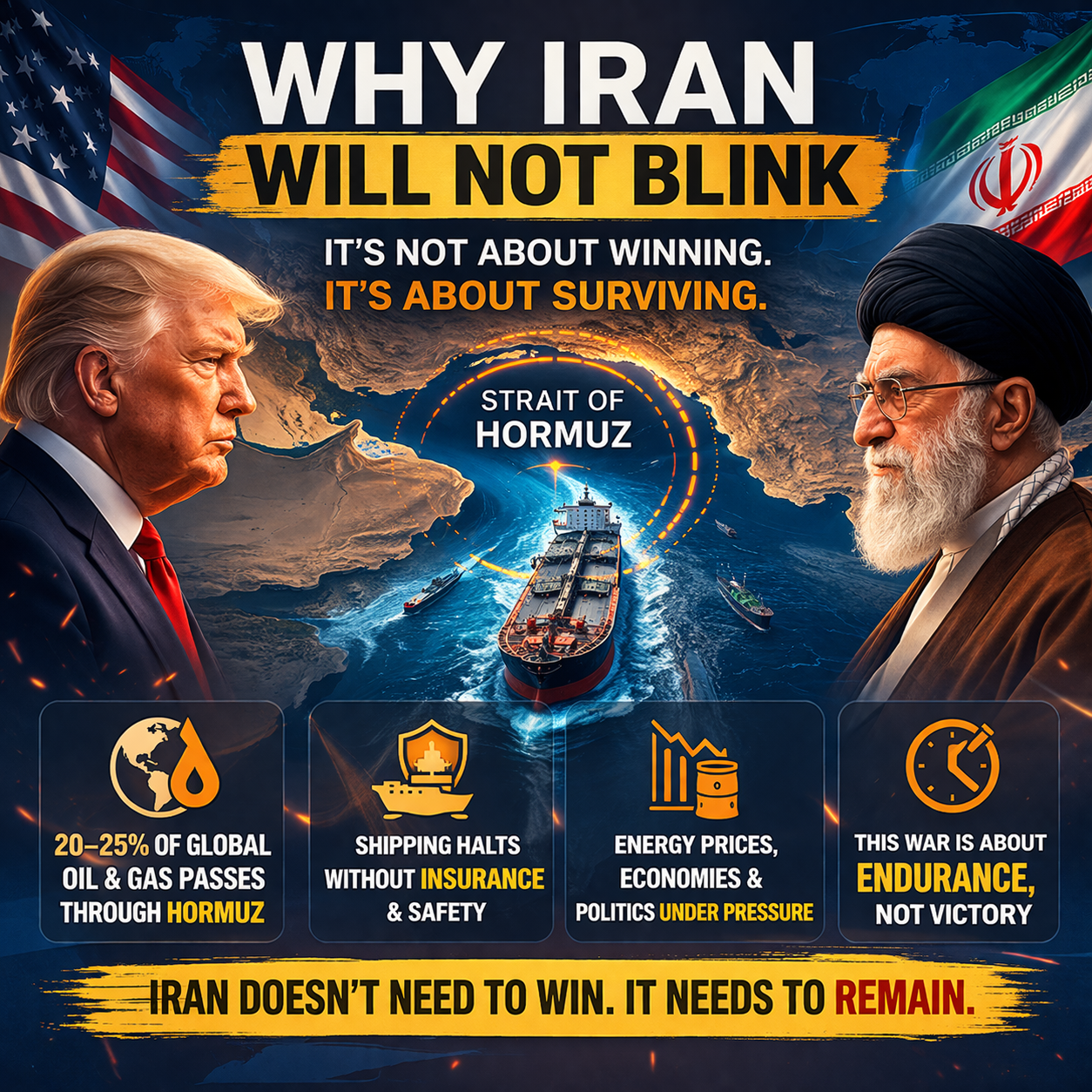
Why Iran Will Not Blink: A Reckoning of West Asia’s Endless War (25)
Part 25 of the West Asia’s Endless War Series
भारत / GB
Three Reasons Tehran Holds — and What They Reveal About Who Is Actually Losing This War
Why Iran Will Not Blink: The Live Learning at Play
Beginning with philosophical discussion, the Israel’s survival compulsion and Iran’s limitation of options to exercise from we discussed, in Blogs 16 through 24 traced the architecture of this war — the colonial order that preceded it, the petrodollar system that provoked it, the civilisational foundations that shape Iran’s strategic posture, the chokehold Iran has deployed in response, and the impossible positions it has created for India, the Gulf monarchies, and the Global South. Blog 25 asks the question that every preceding argument has been building toward: given everything Washington has brought to bear — kinetic decapitation, economic isolation, coalition pressure, escalation declarations — why does Iran still not blink?
Nearly 20–25% of global oil supply and a similar share of LNG flows through the Strait of Hormuz, making disruption not a regional tactic but a global system lever.
Why Iran Will Not Blink: The Calculus of Nothing Left to Lose
Why Iran Will Not Blink: Nothing left to lose, a political clock it can outlast, a chess game removing the adversary’s own pieces. The first reason Iran will not blink is the simplest and the most structurally decisive. Iran in April 2026 is not the Iran that negotiated the JCPOA in 2015 from a position of sanctions fatigue and diplomatic hope. That Iran calculated that compliance offered relief — that the deal would lift sanctions, normalise trade, and stabilise the regime. The United States withdrew from the JCPOA in 2018. The worst that non-compliance could bring has now already been delivered. Supreme Leader Khamenei has been killed. The IRGC command has been decapitated. The navy has been annihilated. The air force has been destroyed. The nuclear infrastructure has been struck. The existential cost that sanctions and military pressure were designed to threaten has already been paid. Why Iran Will Not Blink comes down to this: there is nothing left to threaten it with.
What Else to Lose
What compliance offers Iran now is not relief from the worst. The worst is already done. What compliance would deliver is the legitimisation of the operation that caused it — a formal acknowledgement that Washington’s strategic premises were correct, that decapitation produces compliance, that military pressure on a sovereign state produces the political outcomes the attacking power demands. Iran has nothing left to lose by refusing. It has the precedent of forty-seven years of non-compliance to draw on — a track record that demonstrates sustained resistance is both possible and strategically productive. The civilisational framework established in Blog 21 is not background philosophy at this moment. It is the operational explanation for why a state that has absorbed this level of destruction continues to hold the world’s most important energy chokepoint and reject every ceasefire proposal Washington has tabled.
The Political Clock Iran Can Outlast
The second reason Why Iran Will Not Blink is arithmetic, not ideology. Iran does not need to defeat the United States militarily. It cannot, It needs to impose sufficient cost for long enough that the political will in Washington to sustain the operation collapses before Iran does. The arithmetic of this calculation is not favourable to Washington.
Trump declared the war’s core objectives “nearing completion” on April 1 while simultaneously promising escalation over the next two to three weeks. The war’s stated objectives have shifted continuously since February 28 — from eliminating Iran’s missile capability, to annihilating its navy, to regime change, to seizing oil infrastructure, to reopening Hormuz. Aides and allies have sought to pull Trump in different directions, with those in favour of an exit strategy concerned about global economic instability. The national average for US gas has hit four dollars a gallon. Military and shipping experts have told analysts that reopening the Strait would likely require US ground troops for what could be a years-long, costly, and dangerous operation.
Naval escort does not solve the problem. Tankers in the Strait of Hormuz are floating energy bombs. Insurance either disappears or becomes unviable. One hit—or even a near miss—is enough to stop traffic. The lane does not need to be closed. It becomes unusable. Iran war-induced fertiliser shortages are already threatening farm-state Republicans in the midterms.
Iran’s timeline is civilisational. Washington’s is electoral. Why Iran Will Not Blink is partly a question of which clock is running. Trump’s second term runs to January 2029. The Hormuz closure has already spiked oil to $126 per barrel, stranded 2,000 ships, fractured the allied coalition, and produced no clean military solution after five weeks of the most intense American air campaign since Iraq.
The question Why Iran Will Not Blink is also the question of which side’s political system can sustain this cost longer — and the answer, structured into the architecture of both systems, is not Washington.
📌 The Chokehold Sustaining This Pressure
The Hormuz toll booth — the economic architecture through which Iran is imposing the political cost that makes the clock work in its favour.
Why Iran Will Not Blink: The Chess Game Removing the Adversary’s Own Pieces
The third reason is the argument this series has been building toward since Blog 19, and it is the sharpest. Why Iran Will Not Blink — the deepest answer — is that it does not need to. Washington used missiles to decapitate Iran’s military and political leadership on 28 February. Iran — unable to reach Washington kinetically — has been achieving the equivalent outcome through strategic architecture. The Hormuz closure created conditions in which the gap between Washington’s declared strategy and its operational reality became impossible to ignore.
The officials who assessed that gap accurately — who could see what lies ahead if escalation proceeds, who carried Afghanistan in institutional memory and recognised the same structural absence of an exit strategy forming — those officials are leaving.
Joe Kent, director of the National Counterterrorism Center and a senior Trump appointee, resigned on March 17, stating he “cannot in good conscience support the ongoing war in Iran.” His letter was precise: “Iran posed no imminent threat to our nation, and it is clear that we started this war due to pressure from Israel and its powerful American lobby. This echo chamber was used to deceive you into believing that Iran posed an imminent threat to the United States, and that should you strike now, there was a clear path to victory. This was a lie.” Lieutenant General Jeffrey Kruse, director of the Defense Intelligence Agency, was fired after the DIA’s assessment contradicted Trump’s claims that strikes had totally destroyed Iran’s nuclear sites. Army Chief of Staff General Randy George was asked to retire. Navy chief of staff Jon Harrison was fired. The head of US Special Operations Command and a top Air Force commander departed. Hegseth’s Pentagon purge has removed over thirteen senior military figures since the war began.
One can frame it this way: while the United States and Israel removed Iran’s leadership kinetically, Iran has—silently and structurally—been forcing the removal of decision-making capacity within Washington.
The officials being removed are not being removed because the military failed to execute the strategy. They are being removed because they assessed the strategy accurately and the assessment was inconvenient. Kent was not removed for incompetence. He was removed because he said Iran was not an imminent threat and there was no clear path to victory. Kruse was not removed for poor intelligence work. He was removed because his agency’s findings contradicted the political narrative. The Afghanistan parallel is not rhetorical. Military leaders were blindsided by the recent ousters, generating concern about the implications for the war in Iran. The officials who see what lies ahead if escalation proceeds are the ones who are gone.
What remains is a decision structure under pressure but without internal restraint. The consequence is not recalibration, but escalation—expressed not only in policy, but in tone.
Why Iran Will Not Blink: Pressure That Escapes the System
Iran’s Embassy in South Africa posted a single line on April 3: “The regime change happened successfully. MAGA.” It was not a taunt. It was an accurate strategic assessment. Washington used missiles to remove Iran’s leadership. Iran used strategy to remove Washington’s. The instrument is entirely different. The outcome — a command architecture progressively stripped of those who understand the operation’s limits — is structurally identical. Iran is achieving from Tehran, through sustained strategic pressure, what it could never achieve kinetically: the removal of the institutional layer most capable of identifying the trap and counselling a way out. This is Why Iran Will Not Blink — and why the war is not going the way the April 1 address described.
Under this pressure, the objective itself has not stabilised but hardened. Rather than converging on reopening the Strait of Hormuz, key allies and internal factions have pushed toward “finishing the job” in Iran—expanding aims even as costs compound. The language from Donald Trump reflects this shift, framing the reopening of Hormuz not as a negotiated outcome but as a demand to be imposed on Iran under threat of severe consequences. Public remarks have moved beyond strategic signalling into openly abrasive and undiplomatic characterisations of a sovereign state and its people. This is not incidental. It is a marker of compression. When policy coherence weakens, escalation replaces resolution and rhetoric hardens to sustain it. The war is no longer being narrowed toward an exit; it is being widened under pressure—signalling not control of the situation, but the absence of a viable off-ramp.
The Asymmetric War: A Structural Breakdown
The following table summarizes the three pillars of Iran’s refusal to “blink,” contrasting Washington’s kinetic actions with Tehran’s architectural responses.
| Strategic Pillar | Washington’s Kinetic Action | Tehran’s Structural Reality | The “Unseen” Consequence |
| Existential Stakes | Decapitation of IRGC; destruction of navy and nuclear sites. | “Nothing Left to Lose”: The “worst-case” scenario has already been paid in full. | Compliance now would only legitimize the destruction, offering Iran no actual relief. |
| The Temporal War | High-intensity air campaigns aimed at a “quick” victory before midterms. | The Civilizational Clock: Iran views time in decades; Washington views it in election cycles. | Economic pressure ($126/barrel oil) erodes US political will faster than bombs erode Iranian resolve. |
| Leadership Erosion | Targeted strikes to remove Iranian decision-makers. | The “Mirror” Purge: Strategic pressure forces out the most competent US dissenting voices. | Washington’s command structure loses its “internal restraint,” leading to escalatory traps rather than exit strategies. |
This is not a battlefield imbalance. It is a structural asymmetry—where one side expends force, and the other defines the conditions under which that force becomes ineffective.
Iran does not need to defeat the United States. It needs to outlast the political and economic willingness of the United States to continue the war. Washington is applying force to an opponent. Tehran is applying pressure to the system that sustains Washington.
📌 The Strategic Architecture That Made This Possible
The Persian civilisational framework — the long-game thinking, the political clock mismatch, the chess strategy operating on a timescale no American administration can sustain.
Next: Qatar Mediator Vacuum — Blog 26 in West Asia’s Endless War examines why the Gulf state that served as the region’s indispensable diplomatic broker — hosting the Taliban talks, the Hamas negotiations, the back-channel between Washington and Tehran — has been effectively removed from that role by a war launched from a base on its soil, at the precise moment the world most needs someone capable of constructing an off-ramp.
Feature Image: Click here to view the image.
Videos
Glossary of Terms
[…] भारत / GB […]
[…] Blog 25 established why Iran will not blink — the calculus of nothing left to lose, the political clock mismatch, the chess game removing Washington’s own institutional pieces. This blog examines the diplomatic consequence of that sustained refusal: a war that has now exhausted its primary off-ramp architecture. The Qatar Mediator Vacuum is not a side effect of this conflict. It is one of its most consequential structural outcomes. […]
[…] ब्लॉग 25 ने स्थापित किया कि ईरान पीछे क्यों नहीं हटेगा — कुछ खोने को शेष न रहने का अनुमान , राजनीतिक समय का असंतुलन, और वह शतरंज खेल जिसमें वाशिंगटन अपने ही संस्थागत मोहरों को हटाता है। ब्लॉग 26 इस निरंतर अस्वीकृति के कूटनीतिक परिणाम की जांच करता है: एक ऐसा युद्ध जिसने अब अपने प्रमुख निकास-मार्ग ढांचे को समाप्त कर दिया है। क़तर मध्यस्थ रिक्तता इस संघर्ष का एक साइड इफेक्ट नहीं है। यह इसके सबसे महत्वपूर्ण संरचनात्मक परिणामों में से एक है। […]
[…] Read: Why Iran Will Not Blink → […]
[…] श्रृंखला ने Blog 25 — Why Iran Will Not Blink — में यह तर्क प्रस्तुत किया था कि ईरान […]
[…] Read: Why Iran Will Not Blink → […]
[…] पढ़ें: Why Iran Will Not Blink → […]
[…] Why Iran Will Not Blink: A Reckoning of West Asia’s Endless War (25) https://hinduinfopedia.com/why-iran-will-not-blink-a-reckoning-of-west-asias-endless-war-25/ […]
[…] Read: Why Iran Will Not Blink → […]
[…] has watched the rules-based order consume itself. The USSR that NATO was built to contain is gone. The adversary that will not blink remains. The adversary that NATO should be watching is growing stronger in the silence. The […]
[…] Ukraine, Russian diplomatic cover for Iran at the UNSC, a growing no-limits partnership framework. Iran survived the war with its nuclear programme intact, its distributed military architecture operational, and its […]
[…] के बीच व्यापक साझेदारी विकसित हुई। ईरान युद्ध से बच गया। उसका परमाणु कार्यक्रम सुरक्षित […]
[…] Read: Why Iran Will Not Blink → […]
[…] Read: Why Iran Will Not Blink → […]
[…] Read […]
[…] It is that Iran’s constraints do not arrive on fixed timetables while Washington’s do. Blog 25 (Why Iran Will Not Blink) established Iran’s civilisational depth and constitutional design for indefinite pressure. […]