

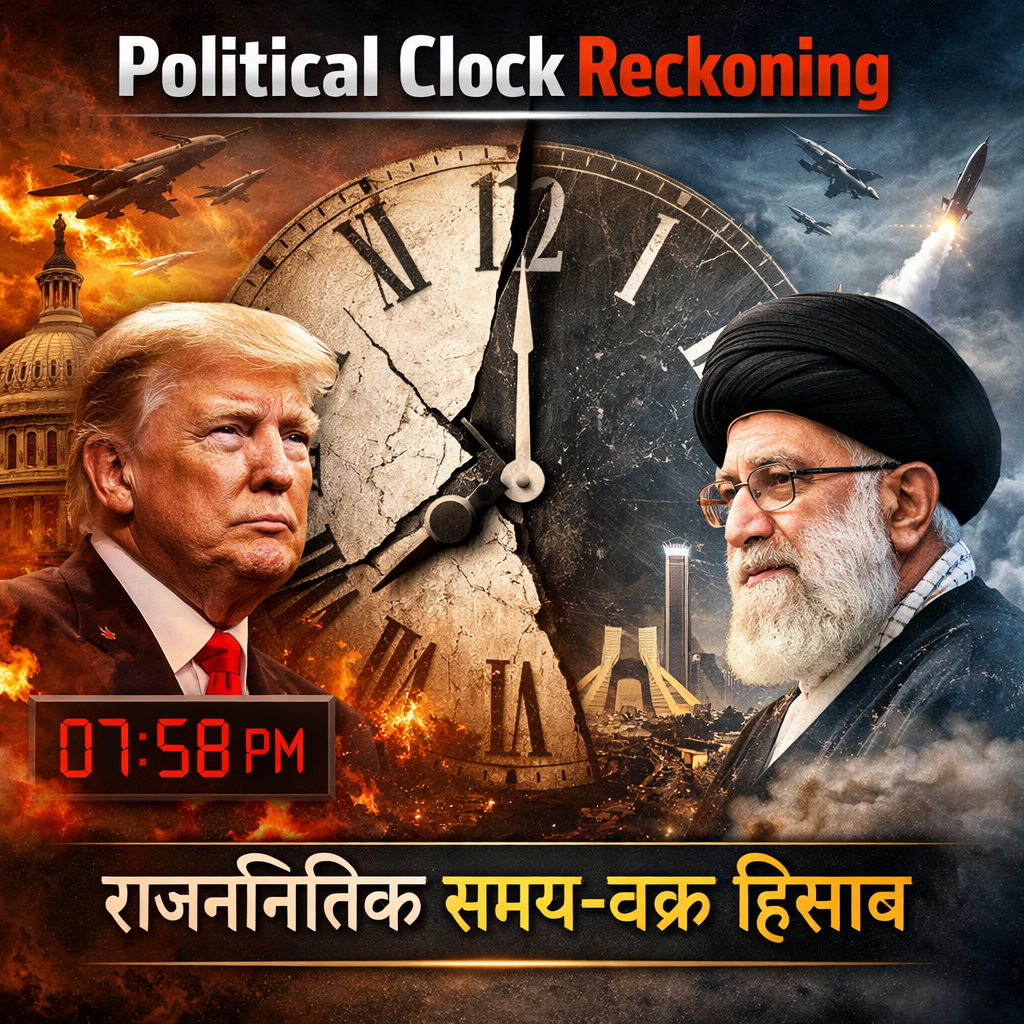
Political Clock Reckoning: A Reckoning of West Asia’s Endless War (30)
Part 30 of the West Asia’s Endless War Series
भारत / GB
Forty Days of Escalation. One Deadline. Ninety Minutes Before It Ran Out, Washington Blinked.
Toll Booth Survives To Political Clock Reckoning
Blog 29 established the Toll Booth Survives Reckoning — the ceasefire institutionalised Iranian coordination of Hormuz passage rather than dismantling it. Blog 30 examines the moment the ceasefire was reached: the single most revealing ninety minutes of the entire war, in which the gap between Washington’s declared timeline and Iran’s civilisational timeline became visible to the world simultaneously. The Political Clock Reckoning is the vindication arc’s most documented argument.
Political Clock Reckoning: The Sequence That Cannot Be Unseen
Political Clock Reckoning: Trump threatened to destroy a civilisation at 8 p.m. At 6:30 p.m. he accepted Iran’s framework. The sequence of April 7, 2026, is now part of the historical record. It begins at the start of the day and ends ninety minutes before the deadline Trump himself had set. It cannot be reframed. It can only be read.
On the morning of April 7, Trump posted on Truth Social: “A whole civilization will die tonight, never to be brought back again. I don’t want that to happen, but it probably will.” He had set an 8 p.m. ET deadline for Iran to agree to reopen the Strait of Hormuz or face destruction of its power plants, bridges, and water treatment facilities — infrastructure whose targeting legal experts described as potential war crimes. This was not rhetorical escalation. Trump had told Fox News’ Bret Baier by phone that morning: “He said 8 p.m. is happening.” The strikes were planned. The orders were ready. The deadline was stated as absolute.
At approximately 6:30 p.m. — ninety minutes before the declared endpoint — Trump posted the ceasefire announcement on Truth Social. The reason given: Pakistan’s Prime Minister Sharif and Field Marshal Munir had requested he hold off. The condition: Iran agreeing to reopen the Strait. The basis for negotiation: Iran’s 10-point proposal, which Trump described as “a workable basis on which to negotiate.” The civilisation did not die. The deadline was not met. Washington accepted the framework of the state it had threatened to annihilate ninety minutes earlier.
The Deadline History That Preceded It
The April 7 collapse was not a single event. It was the terminal point of a pattern of deadline declarations and retreats that had been running for weeks — and which the Political Clock Reckoning documents as the electoral clock’s structural inability to sustain a civilisational conflict.
April 1: Trump claimed Iran had requested a ceasefire — Tehran denied it. He declared the US would only consider a ceasefire when Hormuz was “open, free and clear.” April 4: He warned Iran that “time is running out — 48 hours before all Hell will reign down.” April 5: He pushed the deadline from April 6 to April 7, writing on Easter Sunday that “Tuesday will be Power Plant Day, and Bridge Day.” Each extension was declared as the final extension. Each was followed by another. Iranian civilians formed human chains in front of power plants in response to Trump’s threat to strike them.
The Wall Street Journal reported on March 31 that Trump had told aides he was willing to end the military campaign even if Hormuz remained largely closed — because a mission to pry it open would push the conflict beyond his four-to-six-week timeline.
The Iranian foreign ministry spokesman read this pattern with precision: “US officials have been trying to intimidate Iranians with such literature for 48 years. But Iranians are not going to be subdued by such deadlines.”
The Political Clock Reckoning is not the story of a single retreat. It is the story of a political system that cannot sustain the cost of a civilisational conflict for longer than its electoral cycle will permit. Each deadline was real when declared. Each was retreated from when the political cost of executing it exceeded the political cost of extension. The final retreat came ninety minutes before the terminal deadline — at the precise moment when the alternative to retreat was a war crime so explicit that former Speaker Nancy Pelosi called for the 25th Amendment, Amnesty International warned of potential genocide, and even Senate Minority Leader Schumer said he was glad Trump had “backed off” and was “desperately searching for any sort of exit ramp.”
The Draft That Wasn’t Supposed to Be Seen
While Trump was posting the ceasefire announcement on Truth Social, the Pakistani side was simultaneously trying to get its own diplomatic messaging out — and the haste showed.
On 8 April 2026 at 00:46 Pakistan time, Prime Minister Shehbaz Sharif (@CMShehbaz) published a post on X that was clearly labelled at the very top:
Draft – Pakistan’s PM Message on X
The full text was a carefully worded appeal: it asked Trump to extend the deadline by two weeks, urged Iran to reopen the Strait of Hormuz for the same period “as a goodwill gesture,” and called on all parties to observe a two-week ceasefire. It tagged Trump, JD Vance, key US officials, and senior Iranian figures.

Within minutes the post was edited and the “Draft” line was removed. Edit history captured on X (still visible in screenshots circulating widely) shows the original version with the tell-tale header intact.

The accidental publication of an internal draft label — complete with the asterisk and “on X*” placeholder — is the most visible evidence that the announcement was not the polished outcome of weeks of diplomacy.
It was a last-minute, hurriedly coordinated message, drafted outside Pakistan’s own channels and rushed onto the Prime Minister’s account as Trump’s 8 p.m. deadline approached.
This is the Political Clock Reckoning in real time: even the mediating power that Trump credited for the breakthrough could not hide the improvised, improvised, assembled nature of the final ninety minutes.
Source screenshots captured from @CMShehbaz’s X account, 8 April 2026. The original post was edited within minutes of publication.
📌 Why Iran Knew the Clock Was on Its Side
The three structural reasons Iran was always going to outlast Washington’s political will — the civilisational clock vs the electoral clock.
Political Clock Reckoning: Forty Days vs Forty-Seven Years
Blog 25 of this series argued that the Political Clock Reckoning was always Iran’s strongest strategic instrument. The argument was structural: Iran’s timeline is civilisational, Washington’s is electoral. Trump’s second term runs to January 2029. Iran’s strategic patience has been running since 1979. No American administration has survived politically for more than eight years. Iran has outlasted eleven of them.
The forty-day timeline of Operation Epic Fury is the Political Clock Reckoning made concrete. Washington launched the most intense American air campaign since Iraq. It killed Iran’s Supreme Leader. It destroyed Iran’s navy, substantially degraded its missile capability, and struck its nuclear infrastructure. It imposed oil prices above $126 per barrel on the global economy. Gulf countries sell up to $2 billion worth of goods through the strait of Hormuz daily. It stranded 2,000 ships. It cost the Gulf monarchies billions in LNG revenue. It generated a domestic political crisis in which the President’s own senior intelligence official resigned, his top military officers were removed, and members of Congress called for invocation of the 25th Amendment. The Wall Street Journal reported on March 31 that Trump had told aides he was willing to end the military campaign even if Hormuz remained largely closed — because the mission to force it open would take longer than his political timeline permitted.
Iran’s foreign ministry spokesman said it in one sentence: Iranians are not going to be subdued by deadlines. This is not defiance. It is the Political Clock Reckoning stated from the other side of the equation. The civilisational framework this series established in Blog 21 — 2,500 years of Persian strategic patience, the chess game operating on a timescale no electoral democracy can sustain — is now documented not as philosophical analysis but as operational outcome. The ceasefire was reached on Iran’s framework. The deadline ran out ninety minutes early. The Political Clock Reckoning is confirmed: forty days could not do what forty-seven years could not do. The clock that ran out belonged to Washington.
📌 The War Objectives That Were Declared and Not Delivered
Four objectives on Day 1. None in the ceasefire terms as binding settled outcomes. The full reckoning of what was promised and what was settled.
Civilizational Clock vs. Electoral Clock
The Political Clock Reckoning is rooted in a fundamental disparity of time.
| Feature | Washington (Electoral Clock) | Iran (Civilizational Clock) |
| Duration | 4-year cycles; maximum 8-year limit | 2,500-year history; 47-year post-1979 stance |
| Tolerance | Highly sensitive to gas prices and casualties | High threshold for economic pain and infrastructure loss |
| Strategy | Immediate “Shock and Awe” to force a deal | Strategic patience; outlasting administrations |
| Outcome | Needs “Victory” before the next election | Needs “Survival” to maintain the status quo |
Next: Gulf Betrayal Reckoning — Blog 31 in West Asia’s Endless War examines the four-pillar dependency the Gulf monarchies built inside the American security architecture — security guarantee, dollar recycling, Lockheed Martin defence supplies, US Treasury investment — and how the Hormuz war has broken or is breaking every pillar simultaneously, conducted over their heads, at their expense, without their consultation. Part of the West Asia’s Endless War Series on hinduinfopedia.com.
Feature Image: Click here to view the image.
Videos
Glossary of Terms
- Political Clock Reckoning: The core concept of the blog referring to the moment when a political system’s time constraints—such as electoral cycles—force a decisive shift in strategy or outcome.
- Strait of Hormuz: A critical maritime chokepoint between the Persian Gulf and the Gulf of Oman through which a significant portion of global oil shipments pass.
- Truth Social: A social media platform used by Donald Trump to communicate official statements and policy positions during the crisis.
- Ten-Point Proposal (Iran): A structured set of negotiation terms presented by Iran as the basis for ceasefire discussions with the United States.
- Electoral Clock: The time-bound political cycle in democratic systems, typically driven by elections, public opinion, and short-term accountability.
- Civilisational Clock: A long-term strategic perspective shaped by historical continuity, cultural endurance, and multi-generational planning.
- Operation Epic Fury: The name used in the blog to describe the forty-day military campaign involving extensive U.S. air operations against Iran.
- Deadline Escalation Pattern: A recurring sequence in which deadlines are repeatedly extended or modified due to changing political or strategic pressures.
- Human Chain Protests: Civilian demonstrations in Iran where people physically formed chains around infrastructure sites to deter potential military strikes.
- Ceasefire Framework: The agreed structure or set of conditions under which hostilities were paused between the involved parties.
- The Wall Street Journal Report (March Thirty One): A key media report indicating that the U.S. administration was considering ending the campaign even before achieving its stated objectives.
- Fox News (Bret Baier Call): A referenced communication in which Trump confirmed the strict deadline, reinforcing the seriousness of the threat.
- Shehbaz Sharif Draft Post Incident: An event where Pakistan’s Prime Minister briefly posted a draft diplomatic message on X, revealing the hurried nature of negotiations.
- Hormuz Passage Coordination: The system through which Iran maintained influence or control over maritime movement in the Strait during the conflict.
- Twenty-Fifth Amendment (United States): A constitutional provision that allows for the removal of a U.S. President under specific conditions, referenced during domestic political reactions to the crisis.
#WestAsia #Hormuz #Iran #Trump #Geopolitics #USPolitics #Conflict #Strategy #HinduinfoPedia
West Asia’s Endless War: Why This Series Exists
[…] भारत / GB […]
[…] Political Clock Reckoning: A Reckoning of West Asia’s Endless War (30) https://hinduinfopedia.com/political-clock-reckoning-a-reckoning-of-west-asias-endless-war-30/ […]
[…] Read […]
[…] end a war the executive branch is prosecuting — removes all three exit mechanisms simultaneously. Blog 30 (Political Clock Reckoning) documented Hegseth’s pre-vote declaration that the administration will continue the war […]
[…] and Iran since April 7 2026. The hostilities that began on February 28 2026 have terminated.” Blog 30 (Political Clock Reckoning) established the War Powers Act’s 60-day clock as one of the political constraints closing […]
[…] हुआ सैन्य टकराव समाप्त हो चुका है।” ब्लॉग 30 (पॉलिटिकल क्लॉक रेकनिंग) ने स्थापित किया था कि युद्ध शक्तियाँ […]
[…] निकास मार्ग एक साथ सीमित हो जाते हैं। ब्लॉग 30 (पॉलिटिकल क्लॉक रेकनिंग) में हेगसेथ के उस पूर्व-मतदान वक्तव्य […]