

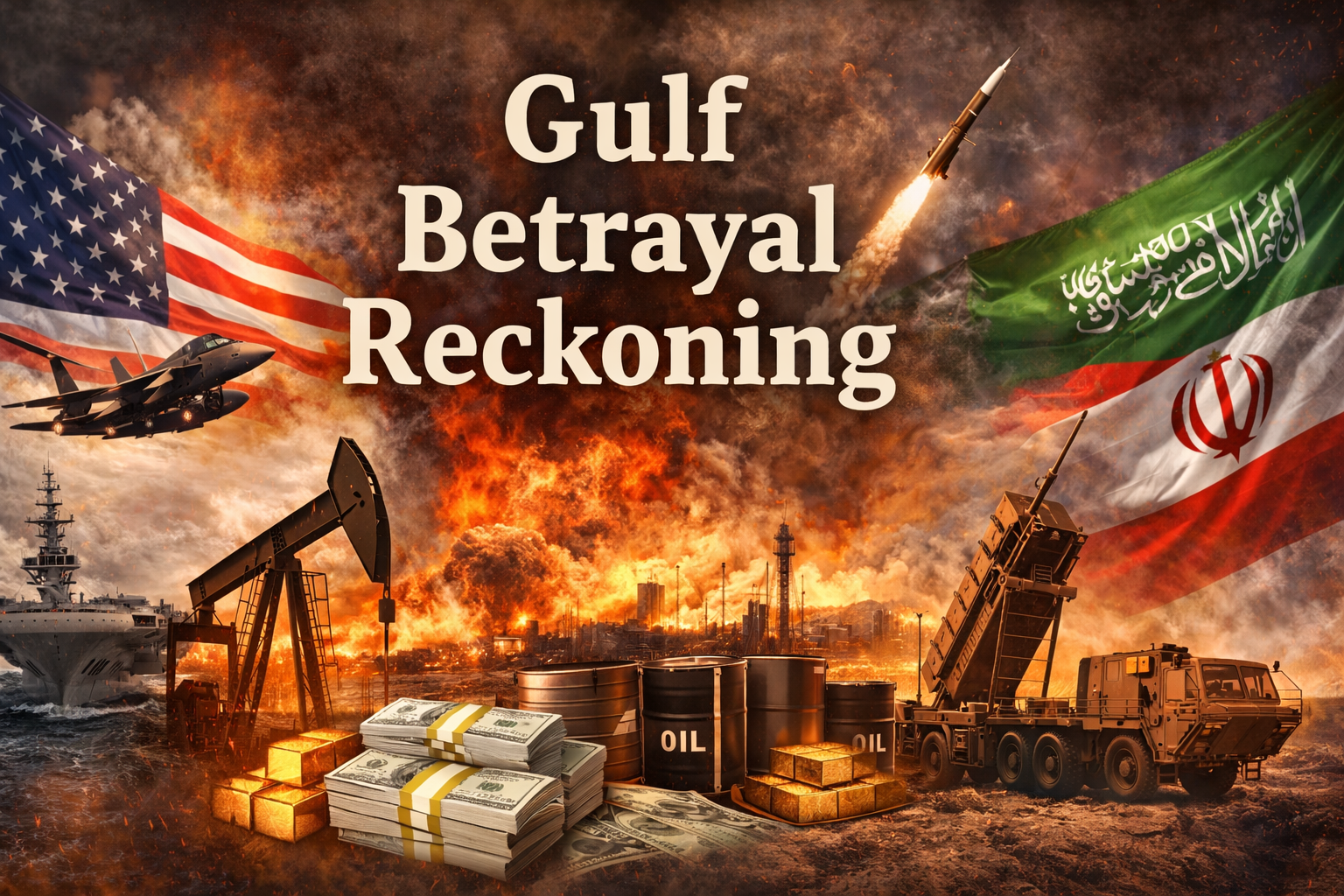
Gulf Betrayal Reckoning: A Reckoning of West Asia’s Endless War (31)
Part 31 of the West Asia’s Endless War Series
भारत / GB
The Four Pillars the Gulf Built Inside the American Security Architecture — and How the War Broke Every One
Blog 30 established the Political Clock Reckoning — Washington folded ninety minutes before its own deadline, accepting Iran’s framework after forty days of the most intense American air campaign since Iraq. Blog 31 examines what those forty days cost the states that hosted the campaign, absorbed its consequences, and were not consulted about either. The Gulf Betrayal Reckoning is the most structurally complete argument in the vindication arc — because the betrayal was not an accident. It was built into the architecture of the arrangement from 1974.
Gulf Betrayal Reckoning: The Four-Pillar Architecture
Gulf Betrayal Reckoning: Launched from their bases, fought over their heads, settled without them — and they paid for all of it. The Gulf monarchies built their entire political economy inside a four-pillar arrangement with Washington that this series established in Blogs 18 and 19. Pillar One: American security guarantee — in exchange for hosting US military bases and pricing oil in dollars, Washington guaranteed Gulf security from external threats. Pillar Two: Dollar recycling — Gulf petrodollar surpluses invested in US Treasury instruments. Pillar Three: Lockheed Martin dependency — Gulf defence built around American weapons systems. Pillar Four: US Treasury investment — Gulf sovereign wealth funds holding significant dollar-denominated positions. The 1974 oil-for-security arrangement was reciprocal: Gulf states priced oil in dollars and recycled surpluses into US financial systems, and in return Washington guaranteed their external security. The Gulf Betrayal Reckoning documents what forty days of war revealed about each pillar simultaneously.
Pillar One — The Security Guarantee That Made the Gulf a Target
Gulf states expressed early in the war that they were not consulted about Operation Epic Fury and that they were carrying the brunt of retaliation for a military action they had not launched. Iran attacked all six Arab Gulf states across forty days. Qatar’s Ras Laffan was destroyed — 17% of LNG export capacity lost for three to five years. Saudi Arabia’s Eastern Province and its East-West Crude Oil Pipeline were struck. UAE facilities were hit. Kuwait absorbed attacks. Bahrain’s capital Manama was targeted. After the ceasefire was announced, Qatar intercepted seven ballistic missiles and the UAE intercepted 17 ballistic missiles and 35 drones — fired after the ceasefire took effect.
The security guarantee promised protection from Iran. The war launched from Gulf bases produced Iranian retaliation against Gulf infrastructure at a scale the GCC had never absorbed. The guarantee was not merely insufficient — it was inverted. American military presence was supposed to deter Iranian attack on Gulf states. It became the specific reason Iranian attacks intensified. Washington used Gulf bases to launch the war. Iran targeted Gulf states as the bases’ hosts. The Gulf Betrayal Reckoning on Pillar One: the security guarantee did not protect the Gulf. It made the Gulf a target.
The ceasefire was brokered by Pakistan. The current ceasefire again appears to have been negotiated without any involvement of the Arab Gulf state partners. The states whose territory hosted the operations, whose infrastructure was destroyed, whose LNG contracts were voided — were not at the table. The GCC body that represents all six Gulf states welcomed the ceasefire in a very short statement — which itself shows that there is not total or identical agreement on how this ceasefire was achieved and the direction after. Saudi Arabia’s silence following Trump’s endorsement of Iran’s 10-point framework is not indecision — it is strategy under pressure. Publicly opposing a US-endorsed proposal risks fracturing a decades-old security relationship. But the Gulf Betrayal Reckoning has registered: this was not their war, yet they bore its costs, and the settlement was made without their participation.
This confirms the structural reality: security dependence without political agency.
📌 How the Arrangement Was Built — and Why It Failed
The 1974 petrodollar deal that created the Gulf’s dependency — and the structural reason the security guarantee was always conditional.
Gulf Betrayal Reckoning: Pillars Two, Three, Four — Breaking Under the Weight
The Gulf Betrayal Reckoning extends beyond the security guarantee to the three economic pillars — all now under active reconsideration.
Pillar Two — Dollar recycling. States that watched Washington weaponise dollar reserves against Russia in 2022, then launched a war that destroyed Gulf LNG infrastructure and disrupted Gulf oil revenues for forty days, are not enthusiastic recyclers of petrodollar surpluses into US Treasury instruments. Saudi Arabia has signed agreements allowing yuan settlement for Chinese oil purchases. Gulf sovereign wealth funds — ADIA, PIF, QIA — are diversifying away from dollar-denominated instruments. The war accelerated a trend that was already underway. The petrodollar arrangement required willing participants. States that have absorbed what the arrangement’s fine print actually costs are repricing their willingness.
Pillar Three — Lockheed Martin dependency. Gulf states are now evaluating where else in Asia and Europe to diversify their defence relationships. Saudi Arabia has been in ongoing discussions with China on defence cooperation. The UAE signed the Huawei 5G deal Washington tried to block. American weapons systems — Patriot batteries, THAAD — successfully intercepted Iranian missiles throughout the conflict. That is the positive case for the dependency. The negative case: hosting American bases made Gulf states primary Iranian targets. The Lockheed Martin dependency is not ending. It is being hedged. Every Gulf state is now asking a question it did not ask before February 28: what does American defence partnership actually cost when Washington decides to go to war?
Pillar Four — US Treasury investment. The structural dependency Blog 19 documented — the existential alignment that made Saudi Arabia Washington’s ideal petrodollar partner in 1974 — is now the architecture of its exposure. The Gulf cannot exit the arrangement abruptly. The dependencies run too deep, the switching costs are too high, and the security vacuum that American withdrawal would create is real. But the direction of travel has changed.
That concern has been confirmed by the ceasefire terms. The Gulf Betrayal Reckoning is documented. The recalculation is underway.
📌 The Saudi Dependency That Made This Betrayal Possible
Why Saudi Arabia became the anchor of the petrodollar system — and why the structural alignment that made it indispensable in 1974 is now the architecture of its exposure in 2026.
Next: Gulf Dollar Exit Reckoning — Blog 32 in West Asia’s Endless War examines the structural exit the Gulf monarchies are now executing from the dollar architecture — central bank gold purchases replacing Treasury instruments, yuan settlement for oil replacing dollar pricing, alternative defence suppliers replacing Lockheed Martin dependency — not from ideology but from forty days of documented evidence that the arrangement’s terms are not what the 1974 deal promised. Part of the West Asia’s Endless War Series on hinduinfopedia.com.
Feature Image: Click here to view the image.
Videos
Glossary of Terms
- Gulf Betrayal Reckoning: The analytical conclusion that the Gulf security–economic arrangement with the United States structurally failed under real war conditions.
- Political Clock Reckoning: A framework describing how Washington accepted Iran’s terms before its own declared deadline under operational pressure.
- Operation Epic Fury: The US-led military campaign launched from Gulf bases that triggered regional retaliation.
- Petrodollar System: A system where oil is priced in US dollars and surplus revenues are reinvested into US financial assets.
- Oil-for-Security Arrangement (1974): A strategic agreement where Gulf states ensured dollar-based oil trade in exchange for US security guarantees.
- Dollar Recycling: The reinvestment of Gulf oil revenues into US Treasury instruments and financial markets.
- Sovereign Wealth Funds (ADIA, PIF, QIA): State-owned investment funds managing national reserves and global assets.
- Lockheed Martin Dependency: The reliance of Gulf defence systems on US-manufactured military platforms and technologies.
- Patriot and THAAD Systems: Advanced US missile defence systems used to intercept incoming ballistic threats.
- GCC (Gulf Cooperation Council): A regional organization of six Gulf states coordinating economic and security policies.
- Ras Laffan: Qatar’s major LNG export hub, partially destroyed during the conflict, impacting global energy supply.
- Yuan Settlement: The use of China’s currency for oil transactions instead of the US dollar.
- Strategic Hedging: The diversification of alliances and investments to reduce dependence on a single partner.
- Security Dependence without Political Agency: A condition where states rely on external protection but lack influence in decision-making.
#Gulf #Iran #USA #Geopolitics #Oil #Energy #War #Strategy #HinduinfoPedia
West Asia’s Endless War: Why This Series Exists
[…] भारत / GB […]
[…] Gulf Betrayal Reckoning: A Reckoning of West Asia’s Endless War (31) https://hinduinfopedia.com/gulf-betrayal-reckoning-a-reckoning-of-west-asias-endless-war-31/ […]
[…] Washington forced it to perform the “dirty cleaning” of the war as enumerated in out blog 31. The US leveraged the specific Muslim-to-Muslim relationship between Islamabad and Tehran, forcing […]
[…] सफाई” करने के लिए मजबूर किया जैसा कि ब्लॉग 31 में वर्णित है। अमेरिका ने इस्लामाबाद […]
[…] यूरोपीय संघ मध्यस्थता में विफल रहा, खाड़ी के साथ विश्वासघात हुआ, पेट्रोडॉलर व्यवस्था समाप्त हुई, […]
[…] पढ़ें: खाड़ी परिवर्तन विश्लेषण → […]
[…] Gulf Betrayal Reckoning: A Reckoning of West Asia’s Endless War (31) […]
[…] खाड़ी विश्वासघात का हिसाब : पश्चिम एशि… […]
[…] Read […]
[…] पढ़ें: गल्फ विश्वासघात समीक्षा → […]
[…] Read: Gulf Betrayal Reckoning → […]
[…] पढ़ें: गल्फ बिट्रेयल रेकनिंग → […]
[…] assets simultaneously strengthens deterrence while elevating their exposure to Iranian strikes. Blog 31 (Gulf Betrayal Reckoning) established the Praetorian Guard’s conditionality. The June 3 strikes demonstrated the cost […]