

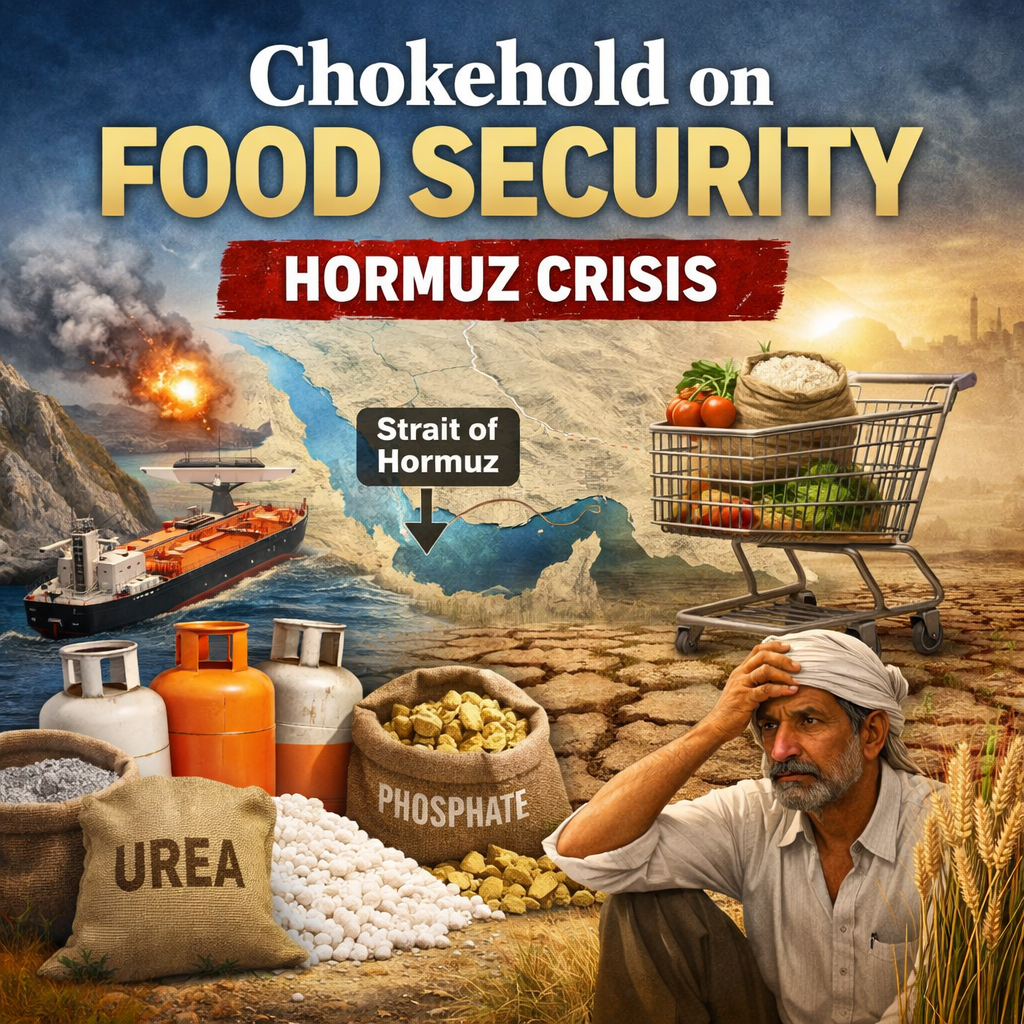
Chokehold Food Security: A Reckoning of West Asia’s Endless War (12)
भारत / GB
Part 12 of the West Asia’s Endless War Series on hinduinfopedia.com
From the Strait to the Soil — How the Hormuz Closure Becomes a Food Crisis
This series has established the war’s trigger, its escalation architecture, the ethical and nuclear pretexts used to sell it, the fracture of Islamic solidarity, the competing narrative wars, Israel’s survival calculus, the Global South’s reading of the strikes as resource imperialism, and the oil economics of a chokehold that serves as a selective access weapon. Blog 12 follows the same chokehold down into the soil — where the Hormuz closure stops being an energy story and becomes a food crisis for billions of people who were already paying attention.
Chokehold Food Security: The Crisis Already Planted
Chokehold Food Security: Three fertiliser chains, one cooking gas crisis, and a harvest already lost before it was planted. The food shock from the Hormuz closure does not announce itself at the supermarket immediately. It announces itself in the decisions farmers are making right now about what to plant, how much fertiliser to apply, and whether the numbers still work. Those decisions are being made under a fertiliser price spike that is the direct downstream consequence of a war that began on 28 February 2026. The harvest that absorbs this shock fully will arrive in three to six months. The Chokehold Food Security crisis is not coming. It has already been planted.
Ammonia: Rose by approximately 24%, climbing from $495 per tonne to $600 per tonne by mid-March.
The Nitrogen Chain: Gas Is Food
The first chain runs through nitrogen. Urea — the world’s most widely used chemical fertiliser — is synthesised from natural gas and ammonia via the Haber-Bosch process. Natural gas is not a fuel input in this process. It is the chemical feedstock. Natural gas accounts for approximately 70% of the production cost of nitrogen fertilisers. When Qatari LNG stops flowing and gas prices triple, urea production costs follow within weeks, not months.
Urea: Surged by 30% to 40% within the initial weeks, jumping from approximately $480–$500 per tonne to over $720 per tonne.
The Gulf’s position in this chain is not marginal. Qatar, Saudi Arabia, Bahrain, and Oman produce a combined 15 million metric tonnes per year of urea, diammonium phosphate, and anhydrous ammonia — together accounting for approximately one third of globally traded nitrogen fertiliser supply.
The price of urea has already jumped from $450 to over $600 per tonne since the closure began. That is a 33% cost increase landing on farmers in India, Brazil, Australia, and the United States at the precise moment when spring planting decisions are being finalised. This shock is not landing on a healthy system.
The global fertiliser supply chain was already fractured before February 2026. Russia and Belarus together account for approximately 40% of global potash exports and significant shares of urea and ammonia supply. Western sanctions following the 2022 Ukraine invasion disrupted those flows, drove fertiliser prices to record highs in 2022–2023, and forced farmers across Africa, South Asia, and Latin America to reduce application rates.
Many agricultural systems never fully recovered to pre-disruption input levels. The Hormuz closure is the second major fertiliser supply shock in four years hitting the same import-dependent farming economies — with smaller buffers, less fiscal space, and no time between shocks to rebuild.
The Phosphate Chain: Sulphur Is Also Food
The second chain runs through phosphate — and it is less discussed but equally consequential. Phosphate fertiliser requires sulphuric acid in its production. Sulphuric acid requires sulphur. Sulphur is a byproduct of refining sour crude oil — the medium-sour Arab Light grades that dominate Gulf production and transit Hormuz.
Iran, Kuwait, Qatar, Saudi Arabia, and the UAE combined produce nearly a quarter of the world’s sulphur supply, and the Middle East region accounts for approximately half of global seaborne sulphuric acid supply.
A Hormuz closure does not only cut the gas that makes nitrogen fertiliser. It simultaneously cuts the sulphur that makes phosphate fertiliser. Both of the two primary chemical fertiliser chains — nitrogen and phosphate — are disrupted by the same 21-nautical-mile passage closing. Every major crop type depends on both. The Chokehold Food Security mechanism is not a single broken link. It is two broken links in two separate chains, breaking at the same moment.
The sulphur supply disruption carries a further consequence that runs beyond agriculture entirely. Sulphuric acid is essential for leaching critical minerals in mining operations across Africa and Asia. The cobalt, lithium, and rare earth extraction that feeds battery and semiconductor supply chains depends on sulphuric acid availability. The food crisis and the technology supply chain crisis share the same upstream input. Both are downstream of Hormuz.
📌 How the Oil Chokehold Works
The fertiliser crisis is downstream of the energy crisis. Read how the Hormuz closure functions as a selective access weapon before the food shock hits.
The LPG Chain: Cooking Gas Is a Welfare Crisis
The third chain does not run through farmland. It runs through kitchens. Approximately 55% of global seaborne LPG trade transits the Strait of Hormuz. For India — with 332 million active domestic LPG connections, including 104 million connections under the Pradhan Mantri Ujjwala Yojana welfare scheme — approximately 90% of LPG imports move through the strait. This means roughly 54% of India’s total normal LPG availability is directly exposed to Hormuz disruption.
This is not an industrial input problem. LPG is the primary cooking fuel for hundreds of millions of households across South Asia — the welfare-sensitive, subsidy-dependent fuel that governments have spent decades trying to get into rural kitchens as a replacement for biomass. India’s structural position is the most exposed of any large economy.
LPG accounts for approximately 16% of India’s total petroleum product consumption — making it not a niche fuel but a mainstream energy category. Against that demand, India’s domestic LPG production capacity covers only approximately 40% of consumption. The remaining 60% is import-dependent, and 90% of those imports move through Hormuz. The arithmetic is unambiguous: India cannot produce its way out of a Hormuz closure on LPG. There is no domestic production ramp that bridges a gap of this size in any timeframe relevant to the current crisis. A prolonged Hormuz closure does not raise the price of a manufacturing input for India. It empties the cylinder on 332 million cooking stoves — the majority of them in households that have no alternative fuel and no buffer stock.
In Bangladesh and Pakistan, natural gas accounts for 50% and 25% of electricity generation respectively — meaning the LNG disruption simultaneously hits power supply, industrial output, and household cooking fuel in the same countries at the same time. The Chokehold Food Security mechanism in South Asia is not metaphorical. It is a cylinder running empty on a cooking stove, with no refill route that does not pass through 21 nautical miles of active war.
Chokehold Food Security: The Double-Hit Countries
The countries absorbing the worst of the Chokehold Food Security shock are the double-hit countries — those that import both energy and food, struck on input costs and supply simultaneously. Egypt imports approximately 70% of its wheat and is heavily gas-dependent for electricity and industry. Pakistan imports LPG and wheat. Bangladesh imports LNG for half its electricity and is a net food importer. Sub-Saharan Africa imports fertiliser — much of it from the Gulf — and has limited domestic production capacity to absorb a price shock of this magnitude.
These are not peripheral economies. They are populous, politically volatile states with governments that have limited fiscal space to absorb subsidy costs and limited storage infrastructure to buffer supply disruptions. They are also the same Global South populations who identified the Iran war as resource imperialism before the first missile landed. The Chokehold Food Security crisis is the point at which that identification stops being a political reading and becomes a lived material experience. The narrative and the grocery bill have converged.
Trump’s Agricultural Leverage — Turbocharged
Before the war, Trump had already demonstrated comfort using food and agricultural trade as bilateral pressure instruments. Soy tariffs against China, wheat export policy adjustments, sanctions affecting food supply chains for non-compliant states — the toolkit existed and had been used. The war has added an energy-cost multiplier on top of a global agricultural system already under tariff stress.
The combination is structurally precise in its targeting. The countries most exposed to the Chokehold Food Security shock — India, Pakistan, Bangladesh, Egypt — are exactly the countries Washington is simultaneously pressuring for alignment on the Iran war, naval coalition participation, and trade concessions. A state facing a cooking gas shortage, a fertiliser price spike, and a food import disruption simultaneously is a state whose government is far more susceptible to Washington’s bilateral demands than one operating from a position of food security. The ethics of this pressure are not discussed in the rules-based order framing. The mechanics of it are visible to every government in the Global South that is currently calculating its options.
📌 Six Billion People Already Read This Correctly
The Global South War Narrative identified the pattern before the food prices moved. Now the grocery bill confirms the reading.
Next: Chokehold Industrial Chain — Blog 13 in West Asia’s Endless War maps how the helium shortage threatens semiconductor fabrication and AI chip production, how aluminium and petrochemical disruptions cascade through manufacturing, and why the Trump tariff war and the Hormuz energy shock hitting simultaneously creates a compound disruption that no just-in-time supply chain was built to absorb.
Feature Image: Click here to view the image.
Glossary of Terms
- Strait of Hormuz: The thirty-three-kilometre waterway between the Persian Gulf and the Gulf of Oman through which approximately twenty percent of global seaborne oil trade passes daily.
- LNG (Liquefied Natural Gas): Natural gas cooled to liquid form for tanker transport. Twenty-five to thirty percent of global LNG trade transits the Strait of Hormuz.
- LPG (Liquefied Petroleum Gas): Propane and butane compressed into liquid form for transport and domestic use. Approximately 55% of global seaborne LPG trade transits the Strait of Hormuz. For India’s 332 million domestic connections, Hormuz closure is a household fuel crisis, not an industrial input problem.
- Gulf Monarchies: The oil-rich Arab monarchies of the Persian Gulf — Saudi Arabia, UAE, Qatar, Kuwait, Bahrain, and Oman.
- Sulphur Supply Chain: The industrial chain linking Gulf crude refining — which produces sulphur as a byproduct — to sulphuric acid production, phosphate fertiliser synthesis, and critical mineral leaching. The Gulf accounts for nearly a quarter of global sulphur supply. Hormuz closure disrupts this chain, compounding the food security and mining sector shocks downstream.
- Arab Light: The medium-sour crude grade produced primarily by Saudi Arabia and across the Gulf — the dominant grade transiting Hormuz. Asian refinery infrastructure was built specifically to process it, making rapid grade substitution a capital challenge measured in months.
- Chokehold Food Security: The mechanism by which the Hormuz closure converts into a food crisis — disrupting three separate supply chains simultaneously: the nitrogen fertiliser chain (via LNG), the phosphate fertiliser chain (via sulphur), and the household cooking fuel chain (via LPG).
- Haber-Bosch Process: The industrial chemical reaction that synthesises ammonia from nitrogen and hydrogen — the foundation of all nitrogen fertiliser production. Natural gas is the primary hydrogen feedstock. Gas price spikes translate directly into urea and ammonia production cost increases within weeks.
- Urea: The world’s most widely used nitrogen fertiliser — synthesised from ammonia and carbon dioxide via the Haber-Bosch process. Natural gas accounts for approximately 70% of its production cost. Gulf states produce approximately one-third of globally traded urea supply.
- Diammonium Phosphate (DAP): A primary phosphate fertiliser — one of the most widely applied globally. Requires phosphate rock, sulphuric acid, and ammonia in production. Gulf states produce significant shares of global DAP supply alongside urea and anhydrous ammonia.
- Anhydrous Ammonia: A concentrated nitrogen fertiliser applied directly to soil — also an intermediate in urea and DAP production. Highly sensitive to natural gas price movements. Gulf states produce significant global supply volumes alongside urea and DAP.
- Potash: The third primary fertiliser nutrient (potassium) after nitrogen and phosphorus. Russia and Belarus control approximately 40% of global potash exports — already disrupted by Ukraine war sanctions. The pre-existing potash supply shock created the fractured baseline that the Hormuz fertiliser disruption compounds.
- Double-Hit Countries: Nations simultaneously exposed to both energy import disruption and food import disruption from the Hormuz closure — hit on fertiliser input costs and food supply chains at the same time. Primary examples: Egypt, Pakistan, Bangladesh, and sub-Saharan African food importers.
- Pradhan Mantri Ujjwala Yojana: India’s government scheme providing subsidised LPG connections to below-poverty-line households — 104 million connections distributed by 2026. The scheme’s beneficiaries are the most exposed population to a Hormuz LPG disruption, having no alternative cooking fuel and no buffer stock capacity.
- Resource Imperialism: The analytical framework in which military interventions, sanctions regimes, and regime change operations are understood primarily as mechanisms for securing access to strategic natural resources or eliminating governments that threaten to trade those resources outside the dollar-denominated financial system.
#ChokeholdFoodSecurity #NitrogenFertiliserCrisis #PhosphateFertiliserCrisis #HaberBoschProcess #UreaPriceSpike #DoubleHitCountries #LPGIndiaCrisis #SulphurSupplyChain #GlobalFoodSecurity #HormuzReckoning #WestAsiaEndlessWar #OilChokepoint #EnergyCrisis2026 #IranWar2026 #ResourceImperialism #ChokeholdOilEconomics #HinduinfopediaGeopolitics #FoodSecurity #FertiliserCrisis #Hormuz
Relevant Links
Previous Blog
- https://hinduinfopedia.com/war-zone-in-hormuz-a-reckoning/
https://hinduinfopedia.in/?p=25537 - https://hinduinfopedia.com/hormuz-world-war-ladder-a-reckoning-of-west-asias-endless-war-2/
https://hinduinfopedia.in/?p=25545 - https://hinduinfopedia.com/west-asia-war-ethics-a-reckoning-of-west-asias-endless-war-3/
https://hinduinfopedia.in/?p=25550 - https://hinduinfopedia.com/west-asia-war-economics-a-reckoning-of-west-asias-endless-war-4/
https://hinduinfopedia.in/?p=25557 - https://hinduinfopedia.com/nuclear-pretext-of-west-asia-war-a-reckoning-of-west-asias-endless-war-5/
https://hinduinfopedia.in/?p=25588 - https://hinduinfopedia.com/nuclear-hypocrisy-of-usa-a-reckoning-of-west-asias-endless-war-6/
https://hinduinfopedia.in/?p=25593 - https://hinduinfopedia.com/ummah-delusion-during-war-a-reckoning-of-west-asias-endless-war-7/
https://hinduinfopedia.in/?p=25614 - https://hinduinfopedia.com/western-narrative-war-a-reckoning-of-west-asias-endless-war-8/
https://hinduinfopedia.in/?p=25650 - https://hinduinfopedia.com/global-south-war-narrative-a-reckoning-of-west-asias-endless-war-9/
https://hinduinfopedia.in/?p=25680 - https://hinduinfopedia.com/israel-survival-logic-a-reckoning-of-west-asias-endless-war-10/
https://hinduinfopedia.in/?p=25755 - https://hinduinfopedia.com/chokehold-oil-economics-a-reckoning-of-west-asias-endless-war-11/
https://hinduinfopedia.in/?p=25763
FOR BLOGS ON US IMPERIAL MINDSET / OIL MOTIVE / DESTABILIZATION DOCTRINE
- Destabilization Doctrine: How America’s Foreign Policy Boomerang Is Striking Home
- Regime Change Playbook: A Manual for Color Revolution Operations
- America, Independence, 1776 to Modern Hegemony — US Hypocrisy Doctrine (via Great Deception)
- Target India: Action Phase — Doctrine in Motion
- Activation of Destabilization Doctrine: The India Deployment Begins
- Rupee Rebellion / De-dollarization (cross-reference via .org)
FOR BLOGS ON IRAN / RAKTBEEJ / DUMP TRUCK RESILIENCE
- Great Deception and Global Civilizational Warfare — five-stage playbook applies directly to Iran’s regenerative resistance
- Islamist Boomerang Effect — When Pakistan’s Cross-Border Strikes Vindicate India’s Doctrine — dump truck principle applied to Pakistan, parallel to Iran
- Demographic Reality Exposed: How High-Fertility Clusters Reshape Democracies — Raktbeej demographic dimension
FOR BLOGS ON GULF MONARCHIES / UMMAH DELUSION / SHIA-SUNNI DIVIDE
- Gulf States Refugee Policy: Why the Wealthy Arabs Said No to Palestinians — Gulf self-preservation over Ummah solidarity, directly applicable
- Palestinian Refugees: Why No Muslim Country Will Take Them — Ummah as myth
- Black September Jordan: The Forgotten War That Changed the Arab World — Sunni-Shia and Arab political fractures
- Lebanon Civil War: From Paris of the Middle East to Hezbollah State — Gulf-Iran-Hezbollah triangle
FOR BLOGS ON UN / RULE-BASED ORDER / NEW COLONIAL ORDER
- When Dictatorships Vote on Democracy — The UN Legitimacy Crisis
- Anti-Israel Obsession — The UN’s Statistical Evidence of Institutional Bias
- New York Declaration Deconstructed — September 2025’s Theatre of Absurd
- New York Declaration Proponents — Hypocrisy and Legal Theater
- New York Declaration Perspectives — History, Media, and Theatrical Mechanics
FOR BLOGS ON MEDIA / SELECTIVE OUTRAGE / MANUFACTURED NARRATIVE
- How Media Manipulation Works: The Global Template
- Media as Manipulator In Unrest: The False Causality Matrix
- Muslim Brotherhood France: Intelligence Report Media Ignored
FOR BLOGS ON INDIA’S NEUTRALITY / UPI / STRATEGIC AUTONOMY
- Unrest From Bangladesh to Nepal: Is India the Real Target?
- Narrative of Unrest: When Neighbors Become Examples
- Rahul’s Gen Z Call — Activation of Destabilization Doctrine
- Money Trail: Analyzing Financial Networks Behind Nepal’s Protests
FOR BLOGS ON ISRAEL / PALESTINE / DECAPITATION TEMPLATE
- October 7th Vindication: Egypt’s Prophetic Wall
- Two-State Delusion Exposed — Netanyahu’s 99-9 Vote
- Right of Return to Palestine: The Strategy Behind 75 Years of Refugees
- Egypt Gaza Wall: The Hidden Truth 57 Muslim Nations
FOR BLOGS ON NUCLEAR HYPOCRISY / MANUFACTURED EXTREMISM
- Islamist Boomerang Effect
- Destabilization Doctrine — How America’s Foreign Policy Boomerang Is Striking Home
FOR BLOGS ON RAKTBEEJ AND DAGDHABEEJ / PHILOSOPHICAL RESOLUTION THREAD
- Raktbeej And Starfish Thesis: The 1,400-Year Organism That No Modern Framework Can Contain (Part II)
- Raktbeej Thesis: The Ancient Diagnostic That Explains What No Modern Framework Can
- Gaza and the Starfish: Why Every Cut Creates
Follow us:
- English YouTube: https://www.youtube.com/@Hinduofficialstation
- Hindi YouTube: https://www.youtube.com/@HinduinfopediaIn
- X: https://x.com/HinduInfopedia
- Instagram: https://www.instagram.com/hinduinfopedia/
- Facebook: https://www.facebook.com/Hinduinfopediaofficial
- Threads: https://www.threads.com/@hinduinfopedia
[…] भारत / GB […]
[…] […]
[…] […]
[…] https://hinduinfopedia.com/chokehold-food-security-a-reckoning-of-west-asias-endless-war-12/ and https://hinduinfopedia.in/?p=25786 […]
[…] […]
[…] https://hinduinfopedia.com/chokehold-food-security-a-reckoning-of-west-asias-endless-war-12/ and https://hinduinfopedia.in/?p=25786 […]
[…] […]
[…] https://hinduinfopedia.com/chokehold-food-security-a-reckoning-of-west-asias-endless-war-12/ and https://hinduinfopedia.in/?p=25786 […]
[…] https://hinduinfopedia.com/chokehold-food-security-a-reckoning-of-west-asias-endless-war-12/ and https://hinduinfopedia.in/?p=25786 […]
[…] https://hinduinfopedia.com/chokehold-food-security-a-reckoning-of-west-asias-endless-war-12/ and https://hinduinfopedia.in/?p=25786 […]
[…] https://hinduinfopedia.com/chokehold-food-security-a-reckoning-of-west-asias-endless-war-12/ and https://hinduinfopedia.in/?p=25786 […]
[…] https://hinduinfopedia.com/chokehold-food-security-a-reckoning-of-west-asias-endless-war-12/ and https://hinduinfopedia.in/?p=25786 […]
[…] https://hinduinfopedia.com/chokehold-food-security-a-reckoning-of-west-asias-endless-war-12/ and https://hinduinfopedia.in/?p=25786 […]
[…] https://hinduinfopedia.com/chokehold-food-security-a-reckoning-of-west-asias-endless-war-12/ and https://hinduinfopedia.in/?p=25786 […]
[…] https://hinduinfopedia.com/chokehold-food-security-a-reckoning-of-west-asias-endless-war-12/ and https://hinduinfopedia.in/?p=25786 […]
[…] https://hinduinfopedia.com/chokehold-food-security-a-reckoning-of-west-asias-endless-war-12/ and https://hinduinfopedia.in/?p=25786 […]
[…] US personnel and the forward headquarters of US Central Command. It simultaneously maintained functional commercial and diplomatic relations with Iran, sharing the world’s largest gas field across their common maritime boundary. It hosted […]
[…] […]
[…] https://hinduinfopedia.com/chokehold-food-security-a-reckoning-of-west-asias-endless-war-12/ and https://hinduinfopedia.in/?p=25786 […]
[…] https://hinduinfopedia.com/chokehold-food-security-a-reckoning-of-west-asias-endless-war-12/ and https://hinduinfopedia.in/?p=25786 […]
[…] Chokehold Food Security: A Reckoning of West Asia’s Endless War (12) https://hinduinfopedia.com/chokehold-food-security-a-reckoning-of-west-asias-endless-war-12/ […]
[…] Chokehold Food Security: A Reckoning of West Asia’s Endless War (12) https://hinduinfopedia.com/chokehold-food-security-a-reckoning-of-west-asias-endless-war-12/ […]
[…] most current illustration. Europe imports 12-14% of its LNG from Qatar through Hormuz. European gas prices surged 63% in a week after Ras Laffan was struck and Qatar Energy declared force majeure. Europe was not a party to the […]
[…] मार्ग के माध्यम से आयात करता है। रास लाफान पर हमले और कतर एनर्जी द्वारा…। यूरोप इस युद्ध का पक्ष नहीं था। उसने […]
[…] years of strategic silence that made resistance impossible until China built the alternative and Washington revealed its own security guarantee as conditional. Blog 54 is a snap blog documenting a development that occurred on May 1-2 2026: the President of […]
[…] $40 billion in annual remittances that constitute India’s primary current account stabiliser. Blog 12 documented how the Hormuz disruption threatens food security across the region. Every Indian worker […]
[…] Read […]