

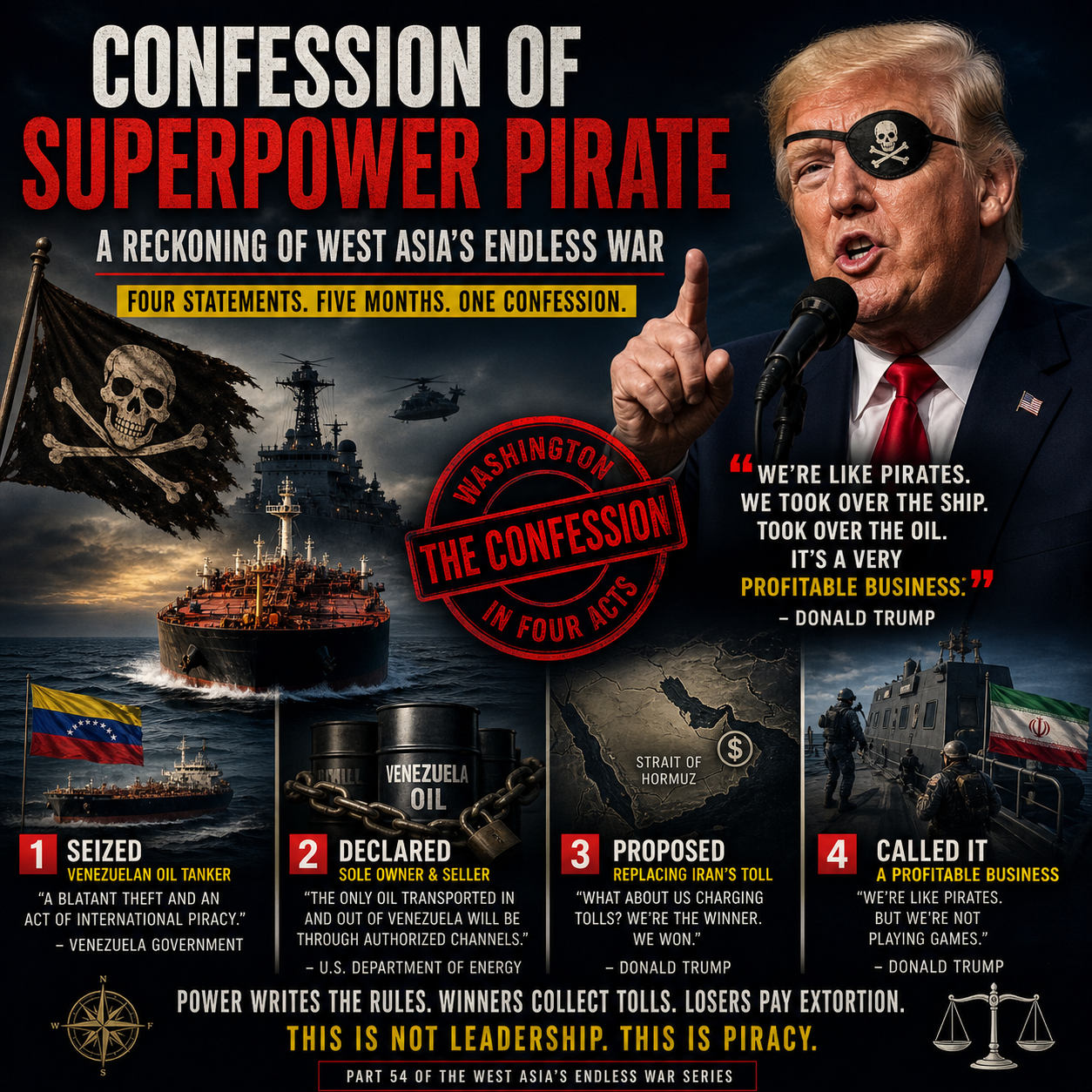
Part 54 of the West Asia’s Endless War Series
भारत / GB
The Confession Was Made in Four Statements Across Five Months. Each One Was Documented. Each One Was Boastful. Together They Name What Washington Is.
Blog 53 (Gulf Dollar Captivity) completed the quintet — the five-blog examination of the petrodollar extraction architecture, the transaction-level toll, and the fifty years of strategic silence that made resistance impossible until China built the alternative and Washington revealed its own security guarantee as conditional. Blog 54 is a snap blog documenting a development that occurred on May 1-2 2026: the President of the United States publicly described his Navy as pirates collecting oil as a profitable business. Confession of Superpower Pirate: Washington called Iran’s Hormuz toll extortion. Then seized Venezuelan oil and declared itself sole authorised seller. Then seized Iranian ships and called it a profitable business. Then called itself pirates. This is the confession.
Confession of Superpower Pirate: The Four Statements
Confession of Superpower Pirate: Washington called Iran’s Hormuz toll extortion. Then seized Venezuelan oil. Then seized Iranian ships. Then called itself pirates. This is not an accusation. It is a documented confession. The series has documented Washington’s resource control doctrine across fifty-four blogs. Blog 54 documents the moment Washington documented it themselves — in four statements, across five months, boastfully, to cheering crowds.
Statement One — The first act of Confession of Superpower Pirate. Venezuela .
Trump confirmed to reporters: “We’ve just seized a tanker on the coast of Venezuela — large tanker, very large, largest one ever seized, actually.” He added it had been seized for “a very good reason” without specifying the legal basis in international waters. Venezuela’s government called it immediately and precisely: “a blatant theft and an act of international piracy.” Venezuela’s Interior Minister called Washington “murderers, thieves, pirates… high seas criminals, buccaneers.” Washington called it law enforcement. The legal basis offered — sanctions enforcement in international waters — has been contested by international maritime law scholars as insufficient to authorise seizure under the UN Convention on the Law of the Sea.
Statement Two — Confession of Superpower Pirate declares sole ownership of another nation’s oil.
Hours after US forces captured Venezuelan President Nicolás Maduro, Trump held a press conference at Mar-a-Lago. “We’re going to get the oil flowing the way it should be. We’ll be selling large amounts of oil to other countries, many of whom are using it now, but I would say many more will come,” Trump said. The US Department of Energy published a formal fact sheet stating: “The only oil transported in and out of Venezuela will be through legitimate and authorized channels consistent with U.S. law and national security.” Washington redefined legitimacy as its own authorisation. Venezuela has the world’s largest proven oil reserves — 303 billion barrels, 17% of global reserves. The state that nationalized its oil industry in 1976 to recover it from American companies had its oil industry re-nationalised by Washington in January 2026 — without a treaty, without a UN resolution, and without any legal instrument beyond the declaration itself. Venezuela’s Interior Minister named it correctly in December. The January fact sheet confirmed the name.
Statement Three — Confession of Superpower Pirate proposes replacing Iran’s extortion with Washington’s toll.
Iran had been charging, presumably, $1 per barrel per vessel for Hormuz passage since the ceasefire. Trump had called this “THIS IS WORLD EXTORTION” in a Truth Social post and said Iran “will not be allowed to profit off this Illegal Act.” When asked whether he would accept a deal allowing Iran to charge Hormuz tolls, Trump said: “What about us charging tolls? I’d rather do that than let them have them. Why shouldn’t we? We’re the winner. We won.” The statement removes any ambiguity about the legal or moral basis for Washington’s objection to Iran’s toll. The objection was not that tolls are wrong. The objection was that Washington should collect the toll instead. The legal principle Washington invoked to call Iran’s toll extortion — freedom of navigation in international waters — applies identically to an American toll. But Washington is the winner. Winners collect tolls. Losers pay extortion. This is not a legal distinction. It is a power distinction stated without diplomatic packaging.
📌 The War That Produced the Pirate
Washington’s Global Control War — Iran is the instrument, the war is against economic independence from Washington wherever it exists. Blog 46 named the design. Blog 54 documents the designer naming it himself.
Statement Four — Confession of Superpower Pirate names itself. Iran.
At a rally in Florida, Trump described a recent US Navy operation boarding an Iranian cargo vessel. “We … land on top of it and we took over the ship. We took over the cargo, took over the oil. It’s a very profitable business,” Trump said. “We’re like pirates. We’re sort of like pirates. But we’re not playing games.” The crowd cheered. CENTCOM confirmed 45 tankers redirected since the naval blockade began April 13, with 41 tankers holding 69 million barrels of Iranian oil worth over $6 billion that Iran cannot sell. Iran’s Foreign Ministry spokesperson stated that Trump’s admission effectively endorsed piracy under international law. The Venezuelan government had said the same in December 2025. Five months apart, two different countries, the same legal verdict — and now the same verdict delivered by the President himself, to cheers, as a boast about profitability.
Confession of Superpower Pirate: The Legal Mirror
The Rome Statute and the UN Convention on the Law of the Sea define piracy with precision: illegal acts of violence, detention, or depredation committed for private ends against ships in international waters. The critical legal element is the absence of authorisation from a flag state or a UN Security Council resolution.
Blog 41 (Rogue Superpower Doctrine) documented how Washington meets its own rogue state checklist more completely than the states it designates with that label. The Confession of Superpower Pirate argument applies the same framework to the specific legal category of piracy. International law experts at Nottingham Trent University and the University of Stirling confirmed publicly that the US seizures in international waters without UNSC authorisation are legally very risky under international maritime law — the polite academic formulation for what Venezuela’s Interior Minister and Iran’s Foreign Ministry stated directly: piracy.
The irony that the series has documented throughout reaches its sharpest point here. Washington built the rules-based international order. Washington wrote the UN Convention on the Law of the Sea — though it never ratified it, a detail that becomes significant when its provisions are invoked against Washington’s actions. Washington called Iran’s Hormuz toll “world extortion” under freedom of navigation principles. Washington called Venezuela’s sovereign oil industry a narco-terrorist enterprise requiring military intervention. Washington then seized ships in international waters, declared itself the sole authorised oil seller of two sovereign nations’ primary resources, proposed replacing Iran’s Hormuz toll with an American Hormuz toll, and described the entire operation as profitable piracy to a cheering crowd. The Responsibility Blockade — the mechanism by which Washington assigns consequences to others for behaviours it practices itself — has been confirmed by Washington’s own President in the language of its own legal critics.
The German Chancellor’s observation adds the final dimension. Friedrich Merz said publicly that the US was being “humiliated” by Iran — that “an entire nation is being humiliated by the Iranian leadership, especially by these so-called Revolutionary Guards.” Trump’s response: withdraw 5,000 troops from Germany and threaten more. Italy and Spain were also threatened with troop withdrawals for their refusal to participate in a war they were not consulted on.
The NATO Weakening War (Blog 40) argument is now confirmed from two directions simultaneously: the German Chancellor says Washington is being humiliated by an adversary, and Washington responds by punishing its allies for noticing.
Confession of Superpower Pirate is not a description of a single act. It is the designation for a state that has simultaneously confirmed the piracy charge against itself, claimed the winner’s right to replace Iran’s extortion with its own toll, declared itself sole authorised seller of Venezuela’s oil reserves, and responded to its most important European ally’s honest assessment by withdrawing its troops as punishment.
📌 The Rogue State Checklist Applied to the Rogue Superpower
Washington developed the rogue state label to justify coercing non-compliant states. The Rogue Superpower Doctrine applied the checklist simultaneously to Iran and Washington — and found Washington meets its own definition more completely. Confession of Superpower Pirate is that argument confirmed by self-disclosure.
Next: China Sanctions War — Blog 55 in West Asia’s Endless War documents the moment China’s challenge to Washington’s sanctions architecture moved from commercial positioning to sovereign law. China’s Ministry of Commerce has ordered Chinese companies not to comply with US sanctions on five Chinese refineries — invoking its 2021 Blocking Rules and threatening Chinese courts, asset freezes, and the Malicious Entity List against any firm that complies with Washington instead. Every multinational now operating in both economies must choose: break Chinese law or break American law. Washington’s Dollar Machine has met the first sovereign blocking statute from the world’s second largest economy. The chain reaction this produces — who will follow, who will stand, and what tactical non-alignment actually means when the choice can no longer be deferred — is the argument. Part of the West Asia’s Endless War Series on hinduinfopedia.com.
Feature Image: Click here to view the image.
Videos
Glossary of Terms
- Confession of Superpower Pirate: A key phrase coined in this blog referring to the moment a global power publicly acknowledges actions interpreted as piracy through its own statements and conduct.
- Superpower Pirate: A term used in the series to describe a dominant state exercising control over global resources through coercive or extra-legal maritime and economic actions.
- Petrodollar Extraction Architecture: The system through which global oil trade is structured around the U.S. dollar, enabling financial and geopolitical leverage.
- Gulf Dollar Captivity: A series concept describing the dependency of Gulf economies on dollar-based oil trade and security arrangements.
- Hormuz Toll: Charges imposed (or proposed) on oil shipments passing through the Strait of Hormuz, central to the blog’s argument on control vs extortion.
- Freedom of Navigation: An international law principle ensuring ships can transit freely through international waters without interference.
- UNCLOS (UN Convention on the Law of the Sea): An international treaty defining maritime rights, territorial waters, and legal standards including piracy.
- Piracy (International Law): Illegal acts of violence, detention, or depredation committed for private ends on the high seas without lawful authorization.
- Sanctions Enforcement in International Waters: Actions taken by states to enforce economic sanctions beyond their territorial jurisdiction, often legally contested.
- Resource Control Doctrine: A recurring concept in the series describing strategies used by powerful states to dominate global resource flows.
- Responsibility Blockade: A term coined in the series describing the practice of assigning consequences to other states for actions that the enforcing state itself undertakes.
- Rogue Superpower Doctrine: A framework from the series applying the “rogue state” criteria to a dominant global power instead of smaller states.
- CENTCOM (United States Central Command): The U.S. military command responsible for operations in West Asia, including naval enforcement actions referenced in the blog.
- Naval Blockade: The use of naval forces to restrict maritime movement, often impacting trade and resource flows.
- Rules-Based International Order: A global governance concept referring to systems of laws and norms claimed to regulate international conduct.
#US #Iran #Venezuela #Oil #Geopolitics #War #Sanctions #NATO #Energy #Piracy #GlobalPolitics #MiddleEast #Trade #Military #HinduinfoPedia
West Asia’s Endless War: Why This Series Exists
[…] भारत / GB […]
[…] https://hinduinfopedia.com/confession-of-superpower-pirate-a-reckoning-of-west-asias-endless-war-54/ […]
[…] Blog 54 (Confession of Superpower Pirate) documented the moment Washington named itself — Trump called his Navy pirates collecting oil as a profitable business, declared himself sole authorised seller of Venezuela’s primary resource, and proposed replacing Iran’s Hormuz toll with Washington’s own. Blog 55 documents China’s response: the China Sanctions War is Beijing’s answer to Washington’s Dollar Machine, delivered not through diplomatic protest but through domestic law that makes compliance with Washington’s extraterritorial sanctions illegal within Chinese jurisdiction. Two legal systems now simultaneously make compliance with the other a criminal act. Every multinational operating in both economies must choose which superpower to obey. […]
[…] Read […]
[…] CFR’s James Lindsay documented that Iran has imposed tolls on some shipping in Chinese renminbi, allowed passage for select countries, and achieved unprecedented control over escalation — giving Tehran new, significant leverage in any negotiation. The order Washington enforced included freedom of navigation as a foundational principle. That principle has been replaced, in the Strait of Hormuz, by Iran’s Persian Gulf Strait Authority — a toll collection institution operating in the world’s most critical chokepoint with Washington’s tacit acceptance. The order without enforcer’s first visible expression: the freedom of navigation principle, enforced for 80 years, replaced by a toll authority that Washington calls extortion and cannot remove — and at the same time, expresses desire to share the revenue from the toll. […]
[…] Confession of Superpower Pirate (Blog 54) documented the legal boundary between sanctions enforcement and piracy under international […]
[…] समुद्री लुटेरे की स्वीकारोक्ति (ब्लॉग 54) ने अंतरराष्ट्रीय समुद्री विधि के […]
[…] […]