

The Dollar’s Gulf Mint: A Reckoning of West Asia’s Endless War (50)
Part 50 of the West Asia’s Endless War Series
भारत / GB
The Gulf Petrodollar Drain (Blog 49) Proved the Drain Happened. Blog 50 Names the Machine That Ran It — Five Components, Each With a Petrodollar Equivalent, One of Which Extracts From Every Gulf Transaction With Every Country in the World.
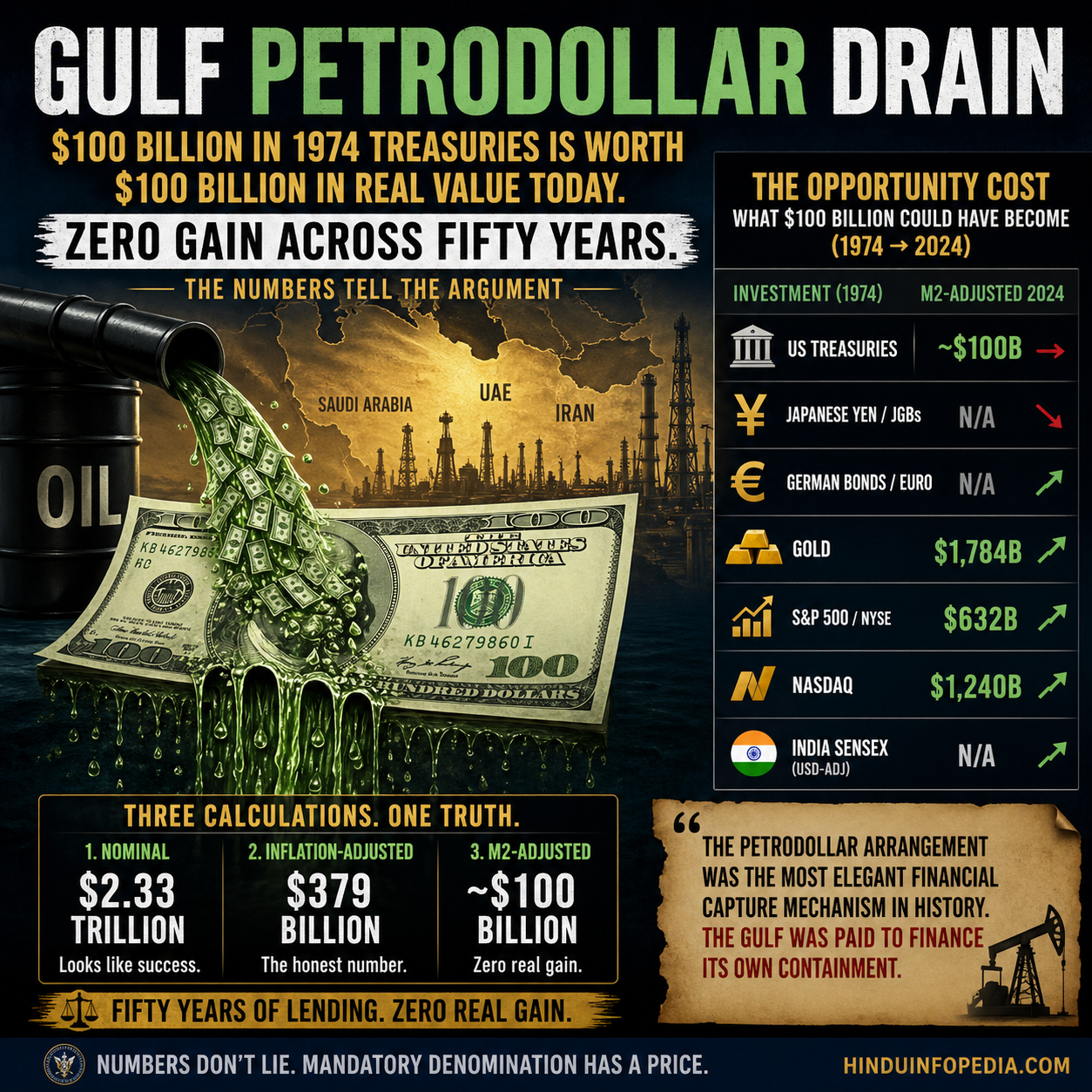
Blog 49 (Gulf Petrodollar Drain) established the arithmetic: $100 billion invested in US Treasuries in 1974 is worth $100 billion in real purchasing power today — zero real gain across fifty years, after three dollar debasement cycles consumed what the nominal yield appeared to produce. Blog 50 examines the architecture that made the drain structurally invisible and structurally mandatory. The Gulf has run Washington’s currency machinery for fifty years. Washington owns the dollar. The Gulf is the mint that gives it global power. The return: zero real gain. The The Dollar’s Gulf Mint identifies five components — each with a documented petrodollar equivalent, one of which extends the extraction beyond Gulf-US transactions to every trade the Gulf conducts with every country in the world.
The Dollar’s Gulf Mint: The Five Components
The British colonial extraction system and the modern dollar-based financial system are the same in function, but their instruments have been redesigned for a different age and geopolitical structure.
Washington owns the dollar. The Gulf is the mint that gives it global power. The return: zero real gain. The Gandhi series on hinduinfopedia.in documented the British extraction machine in full — the apparatus through which Britain extracted an estimated, up to, £9.2 trillion from India across two centuries. The machine had five comparable components. The Gulf Mint maps each one to its petrodollar equivalent — not as historical analogy but as structural identification. The mechanism that extracted Indian wealth through sterling denomination and the mechanism that extracts Gulf wealth through dollar denomination are not similar. They are the same architecture operating through an updated instrument.
Component One — The Tax-and-Buy System.
Britain taxed Indian producers, then used that tax revenue to buy Indian goods. The Indian producer was paid with their own money. Britain received the goods for free. The net transfer was invisible in every individual transaction — the producer received the market price, the tax appeared to be a separate government function, and the purchase appeared to be ordinary commerce. The extraction was structural: the tax and the purchase were two arms of the same apparatus.
The The Dollar’s Gulf Mint’s equivalent: Washington prints dollars, diluting Gulf holdings through money supply expansion — the mechanism Blog 49 established in the M2 calculation. The Gulf sells oil, receives dollars, lends those dollars back to Washington through Treasury bonds at below-market real yields. Washington uses the borrowed capital — financed by the Gulf’s own oil revenue — to fund the military that enforces the petrodollar arrangement that requires the Gulf to lend. Blog 34 (Manufactured Stability Reckoning) established the cost of that military guarantee. The Gulf finances its own Praetorian Guard. Britain taxed India to pay for the army that collected the tax. The architecture is the same.
Component Two — The Council Bills: The Most Invisible Component.
This is the component most analyses miss — and the one that can be, precisely, identified. When India exported cotton to Egypt, grain to Malaya, or jute to China — not to Britain, not involving Britain in any way — Indian merchants earned payment in those countries’ currencies. To remit that payment back to India, they were required to purchase Council Bills from the India Office in London. The India Office sold these bills for sterling. The Indian merchant received rupees. Britain received sterling. Every time India traded with any country in the world, Britain sat in the middle of the transaction and collected a currency conversion toll — without producing anything, without being party to the trade, without providing any service that the trade required. Economic historians document the Council Bills as the most structurally elegant component of the British drain — it made Britain a mandatory intermediary in Indian commerce with the entire world.
The The Dollar’s Gulf Mint’s equivalent is exact — and it is the component that makes the petrodollar extraction broader in geographic scope than the British extraction was. Every barrel of Gulf oil sold to China must be settled in dollars. The Chinese buyer does not pay the Gulf directly in yuan. The Chinese buyer acquires dollars — from Federal Reserve clearing systems, from dollar-denominated financial markets, from correspondent banks that operate within the dollar clearing architecture. The transaction passes through Washington’s monetary system even though Washington is not the buyer, not the seller, not the shipper, and not the insurer. SWIFT, the global financial messaging system through which dollar transactions are cleared, operates under US jurisdiction — giving Washington visibility and veto power over every dollar-denominated transaction globally, including Gulf-China oil trades that have nothing to do with America.
The Gulf selling oil to China, India, Japan, or South Korea: buyer’s currency → dollar conversion → Federal Reserve clearing → dollars to Gulf. Washington takes its toll at the conversion point of every transaction the Gulf conducts with every country on earth.
On the $100 billion in UAE-India trade alone in 2024, transaction-level costs — TT spread, SWIFT clearing, correspondent banking fees — extracted an estimated $750 million to $3 billion from the two trading parties combined, before any Treasury yield suppression, M2 dilution, or reserve currency tax is counted.
Britain needed India to trade with Britain to extract through the Council Bills mechanism — but the Council Bills extended that extraction to India’s trade with everyone else. The petrodollar’s dollar clearing requirement does the same: Washington extracts from Gulf-China trades, Gulf-India trades, Gulf-Japan trades — every trade, with every country, through the mandatory dollar conversion that oil pricing in dollars requires of every buyer everywhere.
📌 The Arithmetic of What This Machine Extracted
$100 billion in 1974 Treasuries is worth $100 billion in real value today. Zero gain across fifty years. Three debasement cycles, seven investment alternatives compared, the opportunity cost quantified.
The Dollar’s Gulf Mint: Components Three, Four, and Five
Component Three — The Home Charges.
India paid the salaries of British colonial administrators, the pensions of retired colonial servants, and the interest on loans taken to build railways that served British commerce rather than Indian development. India paid for its own administration. The colonial state’s running costs were charged to the colonised economy as a mandatory expense — Home Charges that never appeared in any single transaction as exploitation but accumulated across centuries into a structural transfer from Indian productive capacity to British institutional maintenance.
The The Dollar’s Gulf Mint’s equivalent: the Gulf pays for the American military that enforces the petrodollar arrangement. Blog 17 (New Colonial Enforcement) documented how the post-war American security architecture converted military presence from protection into dependency management. The Gulf pays through arms purchases at captive-buyer premium prices — SIPRI arms transfer data confirms the Gulf states collectively represent the world’s largest per-capita arms import market, with Saudi Arabia and UAE ranking among the top five global arms importers in every year from 1990-2024. Blog 49 estimated $140-160 billion extracted through the arms sales premium alone.
The Gulf pays through hosting American bases that Washington uses for its own strategic objectives — as Operation Epic Fury demonstrated when strikes were launched from Gulf soil without Gulf consultation. The Gulf pays through the political cost of being unable to pursue independent foreign policy without triggering security withdrawal. Britain’s Home Charges were formally invoiced. Washington’s Home Charges are embedded in the arms contract, the base agreement, and the implicit threat. The accounting is different. The extraction is structurally identical.
Component Four — Commercial Captivity.
The Dollar’s Gulf Mint’s commercial captivity operates without tariffs. The British colonial tariff was visible — a published schedule of duties that Indian manufacturers could calculate and plan around. The petrodollar equivalent is invisible until triggered, and it is triggered only when the Gulf attempts to develop industrial capacity that competes with American suppliers.
Component Two established that Washington collects a toll on every transaction passing through dollar clearing — automatically, on friendly and hostile trade alike. Component Four is the wall behind the toll booth. Cross it and the toll booth closes entirely. The Gulf can trade in dollars through Washington’s system freely — paying the Component Two toll on every transaction. The moment the Gulf tries to build an alternative to that system, or develops industrial capacity that threatens American commercial interests, the Component Two mechanism converts from a toll into a blockade.
Britain destroyed India’s textile manufacturing through tariffs that made British cloth artificially cheaper than Indian cloth in India’s own domestic market. Washington does not need tariffs. The dollar clearing system accomplishes the same result through the threat of exclusion. A Gulf state developing competitive petrochemical manufacturing, financial technology, or semiconductor capacity faces the implicit threat: if your industrial development challenges American suppliers sufficiently, your access to the dollar clearing system — through which every Gulf international transaction must pass — becomes conditional on compliance.
Blog 14 (Responsibility Blockade) documented how Washington uses sanctions architecture to prevent non-compliant economies from accessing global markets. Iran’s pharmaceutical supply chain collapse is the documented extreme — The Lancet documented that US sanctions prevented Iranian hospitals from accessing essential medicines, causing measurable civilian health deterioration that international humanitarian law nominally prohibits. The Gulf’s industrial development has been systematically channelled toward sectors that do not threaten American suppliers — tourism, real estate, logistics — while manufacturing and technology remain dependent on American input supply chains. The British tariff wall was made of published duties. The Dollar’s Gulf Mint’s equivalent is made of an unwritten threat. Both produce the same industrial captivity. One was visible. The other is not.
Component Five — The Surveillance Architecture.
Britain maintained the intelligence and administrative infrastructure to identify and suppress any challenge to the extraction mechanism before it could organise. The Indian National Congress was monitored, its correspondence opened, its leaders tracked — not because they were military threats but because organised political resistance to the extraction architecture was the one thing the machine could not survive. The surveillance was not about security. It was about maintaining the conditions in which the extraction could continue invisibly.
The The Dollar’s Gulf Mint’s equivalent: the dollar clearing system gives Washington surveillance over every Gulf financial transaction globally — through SWIFT messaging, through correspondent banking relationships, through the Treasury Department’s OFAC sanctions designation authority. Every petrodollar transaction is visible to Washington. Any Gulf attempt to build a non-dollar alternative — as China’s petroyuan architecture represents, as the Gulf’s bilateral currency swap agreements with India and China represent — is identifiable before it reaches scale, sanctionable before it threatens the arrangement, and manageable through the financial exclusion threat that makes even friendly states reluctant to participate in dollar-bypass systems. Bloomberg documented Saudi Aramco’s first yuan-denominated LNG deal with CNOOC in 2023 — a transaction that bypassed the dollar clearing mechanism entirely, and that Washington’s financial surveillance architecture immediately identified and monitored. The Western Narrative War (Blog 8) documented how information architecture supports the extraction. The surveillance architecture ensures the extraction’s challengers are identified before they can threaten it.
The The Dollar’s Gulf Mint’s closing observation is structural and historical simultaneously. The British extraction machine took an estimated £9.2 trillion from India across two centuries. The IMF’s analysis of dollar dominance confirms that the United States extracts an estimated $70-100 billion annually through pure seigniorage — the privilege of issuing the world’s reserve currency — a figure that does not include yield suppression, arms premiums, or the dollar clearing toll.
Britain needed administrators, tax collectors, and occasionally troops to run it. Washington needs none of these. The Dollar Machine runs on five components embedded in the global financial infrastructure — dollar clearing, Treasury bond markets, arms sales contracts, sanctions architecture, and SWIFT surveillance — none of which require a single soldier to operate and none of which are visible as extraction in any individual transaction. The Bank for International Settlements documented in 2022 that approximately 88% of all foreign exchange transactions globally involve the US dollar on one side — giving Washington a structural toll collection position in the vast majority of international commerce regardless of whether America is a party to the transaction. The drain is invisible by design. The machine that runs it is hiding in plain sight. And until the UAE OPEC Split of May 1 2026 began weakening the collective enforcement floor, no Gulf state had the institutional mechanism to challenge even one component without triggering the security consequences that Blog 37 (Petrodollar Duress Reckoning) documented as the deal’s founding enforcement architecture.
📌 The Split That Began Dismantling the Machine
UAE exits OPEC May 1 2026 — weakening the collective enforcement floor of the dollar denomination architecture, signalling Iran through commercial action, and beginning the institutional fragmentation of the machine’s primary Gulf enforcement mechanism.
Next: India Energy Exposure — Blog 51 in West Asia’s Endless War examines India’s position in the commercial architecture the Iran war has restructured: 90 lakh workers in Gulf states, Chabahar investment in Iran, defence partnership with Israel, energy dependency across four competing supply chains simultaneously, and a Strategic Defence Partnership with UAE signed nineteen days before the war began. India sits inside the Dollar Machine’s Council Bills equivalent on every oil import it pays — and is simultaneously building the rupee-dirham bilateral settlement architecture that begins to bypass it. Part of the West Asia’s Endless War Series on hinduinfopedia.com.
Feature Image: Click here to view the image.
Videos
[…] भारत / GB […]
[…] चक्रों में शून्य वास्तविक लाभ। ब्लॉग 50 (डॉलर की खाड़ी टकसाल) ने पाँच-घटक निकासी तंत्र को स्पष्ट […]
[…] https://hinduinfopedia.com/the-dollars-gulf-mint-a-reckoning-of-west-asias-endless-war-50/ […]
[…] petrodollar extraction mechanism was simultaneously the Gulf’s primary development financing mechanism. Saudi Arabia’s […]
[…] […]
[…] Read […]