

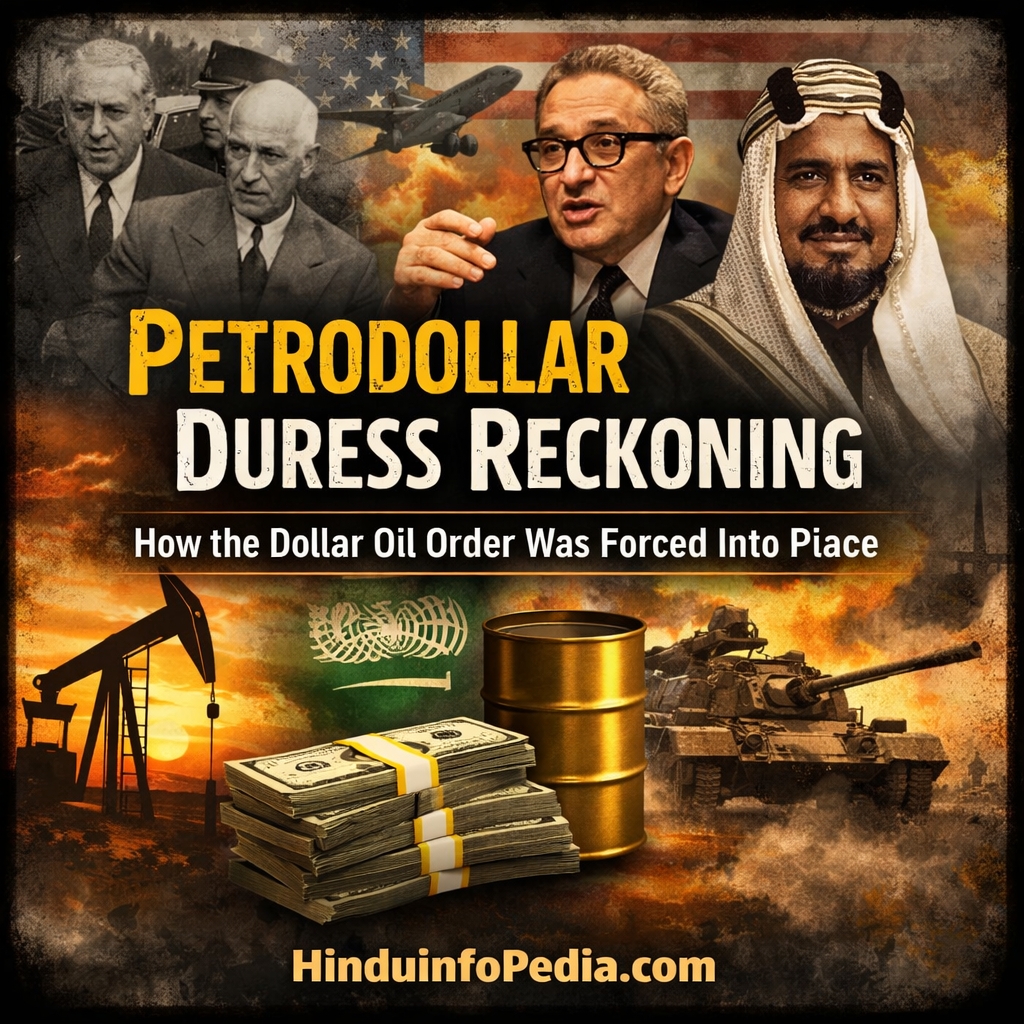
Petrodollar Duress Reckoning: A Reckoning of West Asia’s Endless War (37)
Part 37 of the West Asia’s Endless War Series
भारत / GB
The 1974 Petrodollar Architecture Was Not Kissinger’s Diplomatic Triumph. It Was Washington’s Fallback After Its Military Option Collapsed.
Blogs 34, 35, and 36 established a trilogy: the Gulf’s stability was manufactured by American military force, African instability was manufactured by the same actors to keep the Gulf fashionable, and the Islamabad talks confirmed that Washington has no answer to Iran’s strategy except to adopt it. Blog 37 goes deeper into the foundations — to 1973, when the 1974 petrodollar deal was being shaped not by diplomacy but by invasion planning, unsigned CIA telegrams, and a Saudi king who held firm by threatening to destroy the asset Washington had come to seize. The Petrodollar Duress Reckoning rewrites the origin story of the arrangement that Blogs 18, 19, 32, and 34 have built upon.
Petrodollar Duress Reckoning: The Sword That Was Already Drawn
Petrodollar Duress Reckoning: Washington planned to invade. Saudi Arabia threatened to burn the oil fields. The 1974 deal was what happened next. Before a single word of the petrodollar negotiation was spoken, every Gulf ruler understood what happened to leaders who used oil sovereignty as a political weapon against Washington. Mohammed Mossadegh nationalised Iranian oil in 1951. Two years later, in August 1953, the CIA and MI6 ran Operation Ajax — overthrew Mossadegh, restored the Shah, and restored Western oil company access to Iranian fields. The precedent required no citation in any subsequent negotiation. It was the room in which every negotiation happened. Every Gulf ruler sitting across from an American diplomat in 1973 knew what had been done in Tehran twenty years earlier — and knew it could be done again. It was later displayed in Iraq and Libya.
This is the Petrodollar Duress Reckoning’s first layer: the 1953 precedent was the unstated threat that gave Washington leverage before any explicit threat was made. It did not need to be said. It had already been demonstrated. The Saudi monarchy’s calculation in 1973 was not whether Washington would use force to protect its oil access — it had already answered that question in Iran. The calculation was whether Saudi Arabia had sufficient deterrent to make the cost of force higher than the cost of a deal.
Petrodollar Duress Reckoning: The Invasion Plan and the Counter-Threat
When King Faisal led the Arab oil embargo in October 1973 — cutting supply to the United States and other states supporting Israel in the Yom Kippur War — Washington’s private response was not diplomatic. On August 10, 1973 — two months before the embargo — Kissinger told the Director of the Office of Energy Policy that “the Saudis are just not sophisticated enough to understand it, and they are therefore more dangerous.” This was not strategic respect for an adversary. It was the private register of contempt for a client who had begun to act independently — and who was being assessed as a threat precisely because he could not be managed through normal channels.
When the embargo hit, the contempt became operational planning. Secretary of Defense Schlesinger and Kissinger developed plans in November 1973 to seize Abu Dhabi, Kuwait, and Saudi Arabia’s oil fields. At a State Department meeting, Kissinger asked: “Can’t we overthrow one of the sheikhs just to show that we can do it?” These deliberations were confirmed by declassified British Foreign Office documents and American State Department records released decades later. The 1953 playbook was not historical memory in that room. It was active planning. The question being considered was not whether to seize the oil fields but whether the asset could survive the seizure. The Petrodollar Duress Reckoning turns on precisely that question — because the answer determined what happened in 1974.
Saudi Oil Minister Ahmed Zaki Yamani provided the answer publicly. He announced that Saudi Arabia would cut 80% of its oil production and blow up its own oil facilities if the United States took military action. Prince Turki Al-Faisal — Faisal’s son and then-adviser at the Royal Court — confirmed that Faisal received an unsigned CIA-transmitted telegram from Kissinger warning that if the embargo continued, Washington would take “all measures to protect its interests.” Faisal read the message. He said “Kheir insha Allah” — Good, God willing — and held firm. The CIA confirmed Yamani’s demolition threats were credible. Kissinger abandoned the military option — not from legal or moral restraint but from the cold calculation that the asset Washington wanted to seize would not survive the seizure. Burning oil fields produce nothing. The 1953 option requires a functioning resource. Saudi Arabia’s willingness to self-destruct was the deterrent that made it work.
📌 The Architecture This Duress Produced
The 1974 Kissinger-Saudi petrodollar arrangement — its terms, its self-reinforcing mechanism, and why it converted dollar hegemony from a postwar settlement into a structurally enforced global norm.
Petrodollar Duress Reckoning: The Deal, the Death, and the Pattern
The oil embargo ended March 18, 1974 — after some of Saudi Arabia’s demands were addressed, none of them the full Israeli withdrawal from 1967 territories that Faisal sought. Six months later, in September 1974, the JECOR framework was signed: Saudi oil priced in dollars, surpluses recycled into US Treasuries. This arrangement — documented in full in Blog 18 — is remembered as Kissinger’s diplomatic architecture, the moment Washington converted Arab oil wealth into permanent dollar demand. The Petrodollar Duress Reckoning reads the same events from the other end: Washington planned invasion, transmitted military threats through CIA channels, was deterred only by Saudi Arabia’s credible willingness to destroy the asset Washington came to seize, and accepted a deal it could not obtain by force.
The Gulf did not enter the petrodollar order out of free-market advantage; it entered under a structure where survival depended on compliance as demonstrated in 1953. It joined because the 1953 option remained on the table — and the deal offered a framework within which Saudi Arabia could function without triggering the option again. The Petrodollar Duress Reckoning does not argue that Faisal was compelled to sign at gunpoint. It argues that the negotiation happened in the shadow of a demonstrated willingness to use exactly that force — and that understanding this changes what the 1974 deal actually was.
March 25, 1975: King Faisal was assassinated by his nephew Prince Faisal bin Musaid, who had studied in the United States and had a documented history of instability. No credible evidence of CIA involvement in the assassination exists in the public record. No adequate investigation was ever conducted. The new king, Khalid, was significantly more compliant with Washington’s regional preferences than Faisal had been. The structural alignment between the House of Saud and Washington deepened steadily under Khalid and his successors. The Petrodollar Duress Reckoning does not assert what cannot be proven. It asserts what is documented: a leader who demonstrated strategic independence against Washington, extracted a deal under demonstrated duress, died thirteen months after signing, and was succeeded by a more compliant ruler. That is the 1953 pattern. Whether it repeated is a question the historical record cannot answer. That the pattern existed, and that the precedent for its use had been established twenty years earlier in Tehran, is not a question at all.
The Petrodollar Duress Reckoning connects directly to the Gulf Dollar Exit Reckoning established in Blog 32: Saudi Arabia’s 2024 non-renewal of the petrodollar agreement reads differently once you know the original agreement was signed under the shadow of invasion planning. A deal extracted under duress does not carry the same moral weight as a deal freely negotiated. When the party that signed under duress declines to renew fifty years later — after the Praetorian Guard that maintained the arrangement has demonstrated it will launch wars from Gulf bases without consultation — the non-renewal is not a diplomatic rupture. It is the logical conclusion of a relationship that was never between equals, being repriced now that the power asymmetry has partially shifted. The Petrodollar Duress Reckoning is not a historical argument. It is the explanation for why the present moment exists.
📌 The Non-Renewal That the Duress Explains
Saudi Arabia did not renew the petrodollar agreement in 2024. The Gulf Dollar Exit Reckoning — why the arrangement is being repriced and what replaces it.
🚨 This post has been fully updated on May 1, 2026
Islamabad Reckoning: What Happened in 21 Hours
Islamabad Reckoning: 21 hours. No deal. Then Washington adopted Iran’s own strategy — without Iran’s legal standing or civilisational patience. The talks at Islamabad’s Serena Hotel on April 11-12 were the highest-level direct engagement between the United States and Iran since the Islamic Revolution of 1979. The 300-member US delegation was led by Vice President JD Vance alongside special envoys Steve Witkoff and Jared Kushner. The 70-member Iranian delegation was led by parliamentary speaker Mohammad Bagher Ghalibaf and Foreign Minister Abbas Araghchi. Pakistan moderated. Three rounds of talks — the first indirect, the second and third direct — ran through the night.
Agreement was reached on a range of issues — sanctions architecture, reparations framework, regional security principles, and the ceasefire’s general terms. Two points remained unresolved: Iran’s refusal to terminate uranium enrichment and relinquish its highly enriched uranium stockpile, and Iran’s insistence on continued coordination of Hormuz transit — including the toll mechanism. On those two points, 21 hours of the most intensive US-Iran engagement since 1979 produced no movement. Vance emerged to declare: “The bad news is that we have not reached an agreement. And I think that’s bad news for Iran much more than it’s bad news for the US.” He boarded Air Force Two. Iran’s Foreign Minister Araghchi said the two sides had come within inches of a memorandum of understanding — and that Washington’s maximalism had pulled the deal back at the last moment. “Zero lessons earned,” Araghchi posted. “Good will begets good will. Enmity begets enmity.”
Next: EU Mediator Vacuum — Blog 38 in West Asia’s Endless War examines why Europe — JCPOA co-signatory, Hormuz LNG importer, self-declared defender of the rules-based order — could not insert itself into the ceasefire negotiations that Pakistan brokered or the Islamabad talks that Pakistan hosted. The EU convened 41 countries. Washington and Tehran met face to face for the first time since 1979 in a city Europe did not propose, moderated by a state Europe did not coordinate with. The mediator vacuum reveals what the rules-based order looks like when its self-appointed guardian has no enforcement mechanism that operates independently of Washington. Part of the West Asia’s Endless War Series on hinduinfopedia.com.
Feature Image: Click here to view the image.
Videos
[…] भारत / GB […]
[…] ब्लॉग 37 ने पेट्रोडॉलर दबाव की गणना स्थापित की — 1974 का सौदा वाशिंगटन की बैकअप योजना था। आक्रमण की योजना विफल होने के बाद यह सौदा किया गया। इसे बल प्रयोग की स्पष्ट इच्छा की छाया में हस्ताक्षरित किया गया। ब्लॉग 38 अब वर्तमान यूरोप रहित मध्यस्थता की ओर बढ़ता है। यूरोप ने वाशिंगटन के छोड़ने के बाद सात वर्ष तक जेसीपीओए को बनाए रखा। अप्रैल 2026 की शुरुआत में ब्रिटेन ने 41 देशों को एकत्र किया। इसका उद्देश्य ईरान पर हार्मुज जलडमरूमध्य दोबारा खोलने का दबाव बनाना था। पाकिस्तान ने युद्धविराम कराया और इस्लामाबाद वार्ता की मेजबानी की। इसमें यूरोप की कोई भूमिका नहीं थी। यूरोपीय संघ की मध्यस्थता शून्यता कोई संस्थागत विफलता नहीं है। यह एक संरचनात्मक खुलासा है। नियम-आधारित व्यवस्था में कोई स्वतंत्र प्रवर्तन तंत्र नहीं है जो वाशिंगटन से अलग काम कर सके। […]
[…] Petrodollar Duress Reckoning: A Reckoning of West Asia’s Endless War (37) https://hinduinfopedia.com/petrodollar-duress-reckoning-a-reckoning-of-west-asias-endless-war-37/ […]
[…] capture the commercial market — but applied at continental scale rather than to a single state. Blog 37 established the Petrodollar Duress Reckoning — the 1953 template applied to the 1974 petrodollar deal. The Ukraine Agricultural Reckoning […]
[…] consequences: Hormuz closed, NATO fractured, the EU mediated nothing, the Gulf was betrayed, the petrodollar ended, African energy emerged, Russia collected its dividend, European energy was captured, Ukrainian […]
[…] […]
[…] 32 documented Saudi Arabia’s non-renewal of the petrodollar agreement in 2024. Blog 37 established the 1974 deal was signed under duress. China Oil Revenge is the completion of that argument: China has been systematically building the […]
[…] in 1974 — the year the JECOR framework was signed and the petrodollar arrangement formalised. Blog 37 established that this arrangement was signed under duress — not as a free market choice but under the constraint of the 1953 Iran precedent. Fortune […]
[…] […]
[…] petrodollar deal was not only financial. It came with the American military guarantee — the Praetorian Guard that […]