

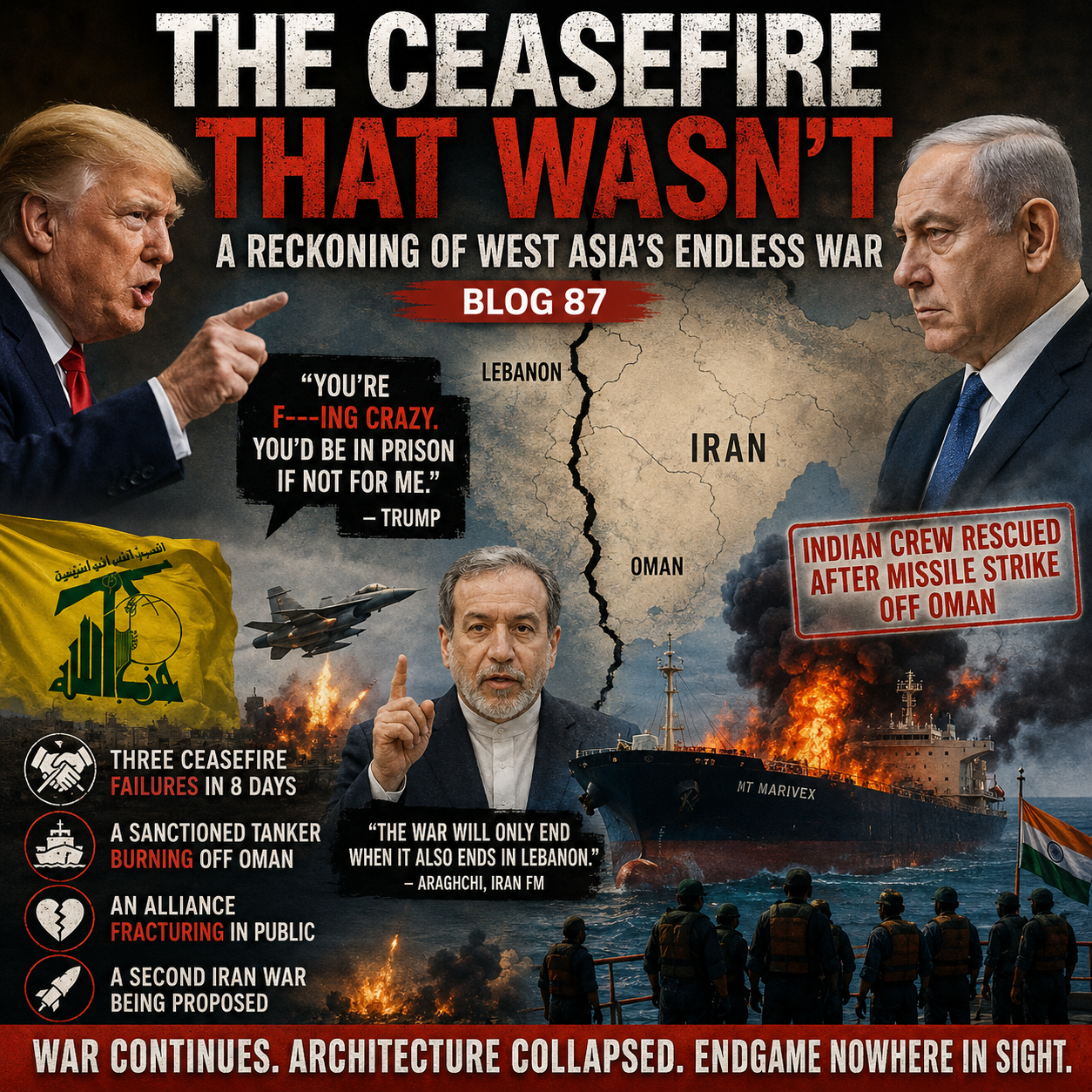
The Ceasefire That Wasn’t: A Reckoning of West Asia’s Endless War (87)
Part 87 of the West Asia’s Endless War Series
भारत / GB
Three Ceasefire Failures in Eight Days. A Tanker Burning Off Oman With 24 Indian Crew. An Alliance Fracturing in Public. A Second Iran War Being Proposed While the First Is Unresolved. The War Has Not Escalated Beyond Its Previous Parameters — But the Architecture That Was Supposed to End It Has Collapsed.
Blog 86 (Order Without Enforcer) closed the series’ analytical arc by documenting what the world looks like when the enforcer of the rules-based order has demonstrated the limits of its enforcement capability. Blog 87 is the event-driven slot the series reserved for the moment the analytical arguments became operational events. That moment is now — June 5–8, 2026. The events of this week do not change the series’ arguments. They are the series’ arguments, expressed in the most precise human terms available: a ceasefire that isn’t, a tanker on fire, a president calling his closest ally crazy, and an Iranian foreign minister who has added a condition the ceasefire cannot meet.
The Ceasefire That Wasn’t: The Sequence That Produced This Week
Blog 87 requires a factual record before analysis. The sequence of June 1–8 is the most precisely documented chain of events the series has tracked since March 2, 2026.
June 1: Trump brokered a Hezbollah ceasefire through intermediaries. The announcement came from Washington. Within hours, Netanyahu stated that Israeli forces would continue striking southern Lebanon “as planned.” Trump had announced a ceasefire. The Israeli Prime Minister announced its operational irrelevance simultaneously.
June 1–2: Trump called Netanyahu during a phone call and told him, in terms he later confirmed publicly in a New York Post podcast interview: “You’re f—ing crazy. You’d be in prison if not for me.” Trump said he was “a little bit perturbed at his constantly fighting with Lebanon.” Netanyahu acknowledged “tactical disagreements” but maintained that both leaders agree on the Iran war’s overall direction.
June 5: US forces struck Iranian coastal defence radar sites on Qeshm Island and Goruk. Iran fired seven ballistic missiles toward Kuwait and Bahrain hours after CENTCOM shot down four Iranian drones launched toward the Strait of Hormuz. Israel continued striking southern Lebanon. At least 21 people were killed in Israeli strikes that day. Hezbollah rejected the Lebanon ceasefire. Iran’s Foreign Minister Araghchi stated that the war will only end “when it also ends in Lebanon.”
June 5–6: The US-sanctioned tanker MT Marivex, carrying 24 Indian crew members, transmitted a distress call from waters off the coast of Oman: “We are on fire on board, and the vessel is sinking. US Navy attack, the missile on our engine room. Please help.” The Forward Seamen’s Union of India confirmed the crew in distress. The Indian Navy, operating in the vicinity, responded and rescued the crew. The MT Marivex had been sanctioned by the US Treasury in December 2025 in connection with Iran sanctions.
June 6: The overall death toll from the war since March 2 reached 3,558.
June 7–8: The Israeli army reported missiles fired from Iran. The liveblog continues today.
This is the factual record. The analysis follows from it — not the other way around.
The Ceasefire That Wasn’t: Why Lebanon Is the Lock
Blog 59 (Israel Cause or Cover) made one central argument: that Israel’s interests aligned with Washington’s at the point of launching the Iran war but would diverge at the point of settling it. That argument has now been confirmed in public, in the precise terms the blog described.
The divergence is not a diplomatic friction. It is a structural lock. Iran’s Foreign Minister Araghchi has explicitly tied the Iran ceasefire to the Lebanon ceasefire: the war will only end when it ends in Lebanon. This is not a negotiating position that can be papered over with diplomatic language. It is a condition that makes Netanyahu’s refusal to stop striking Lebanon the direct operational obstacle to the Iran resolution Washington is trying to achieve.
The architecture of the lock is precise:
Washington wants the Iran ceasefire formalised. Iran will not accept the Iran ceasefire without the Lebanon ceasefire. Netanyahu will not stop striking Lebanon. Trump cannot force Netanyahu to stop striking Lebanon without publicly rupturing the US-Israel alliance. Trump will not publicly rupture the US-Israel alliance.
The result: a ceasefire that cannot be built from the top down, because the actor whose behaviour is the precondition for the ceasefire — Israel’s cessation of Lebanon strikes — is not under Washington’s operational control. Trump can call Netanyahu crazy in private and confirm it in public. He cannot make him stop.
Blog 83 (Who Decides Endgame) asked who is positioned to deliver the endgame. The events of June 1–8 have added a new answer: nobody. Iran has now added Lebanon as an explicit ceasefire condition. The endgame is further away than when Blog 83 was written — not because new actors have entered the conflict, but because the existing actors have formalised their incompatible requirements.
The Ceasefire That Wasn’t: The Tanker and What It Tells
The MT Marivex is not a footnote. It is the most precise single expression of three arguments the series has built across 87 blogs, now expressed simultaneously in one burning vessel.
The India Hormuz Trap (Blog 24) argued that India’s strategic neutrality would eventually be tested not by a diplomatic demand but by an operational event that made neutrality impossible to maintain. The Indian Navy rescuing 24 Indian crew members from a vessel struck in waters connected to this war is that event in its most human form. India did not choose to enter this war. The war came for India’s citizens in the engine room of a tanker off Oman.
The Confession of Superpower Pirate (Blog 54) documented the legal boundary between sanctions enforcement and piracy under international maritime law. That boundary requires clarity here: US Treasury sanctions authorise asset freezing, port denial, and secondary sanctions against entities that conduct business with a sanctioned vessel. They do not, under any interpretation of international law, authorise kinetic military action against that vessel at sea, with 24 civilian crew members on board. A distress call identifying the source of the attack as the US Navy is the crew’s testimony under conditions of extreme duress. US Central Command has not, as of the time of writing, confirmed or denied the crew’s account. What is confirmed: the vessel was on fire, the crew transmitted a distress call, 24 Indian nationals were rescued by the Indian Navy, and the vessel was US-sanctioned. The legal argument stands regardless of who fired: no sanctions designation authorises a missile into a civilian engine room.
In the Blog 54 analytical section — the argument is sharpened considerably. The previous version said “no sanctions designation authorises a missile into a civilian engine room” — accurate but too spare. The updated version works through the legal logic in the way jurists would: sanctions → asset freezing → port denial → secondary sanctions → interdiction at the absolute maximum. And then: a missile in open sea at a fuel-laden tanker carrying 24 crew is not a point on that spectrum. It is outside it. The closing line — “Jurists who have examined the question say they are not even close” — carries the weight of the legal community’s position without the series overstating its own authority.
The Order Without Enforcer (Blog 86) closed with the observation that the rules-based order’s legitimacy rests on the enforcer’s claim to operate within the rules. A vessel carrying 24 civilian crew members, struck by a missile in international waters, whether the missile was American, Iranian, or from an unidentified source, is the Order Without Enforcer expressed not as a geopolitical abstraction but as a fire in an engine room and at the life boat. The order that was supposed to protect civilian seafarers — UNCLOS, the Geneva Conventions, the laws of armed conflict at sea — did not protect them. The Indian Navy did.
The Ceasefire That Wasn’t: Netanyahu’s Second War Proposal
There is a development in this week’s record that the series must carry with the precision it deserves, because it is the most analytically significant item in the June 5–8 sequence — and it has received less coverage than the Trump-Netanyahu personal confrontation.
Netanyahu raised with Trump the possibility of a second round of strikes on Iran. The argument: more strikes may be necessary to prevent Tehran from rebuilding its capabilities. And the strikes are now happening as the blog is being written. This is not a contingency plan. It is a proposal, made by the Israeli Prime Minister to the US President, for initiating a second Iran war while the first remains unresolved.
The War Ledger’s clocks are still running. The House voted 215–208 to end the current war. The death toll stands at 3,558. The ceasefire architecture has collapsed three times in eight days. Iran has added a new condition that cannot be met while Israel continues striking Lebanon. The global shipping industry is paying Iran’s toll and passing the cost to consumers. In this configuration, Netanyahu is proposing Round 2.
Blog 56 (Hormuz Logical Trap) described the trap’s five walls: military action cannot close Hormuz, economic pressure cannot break Iran’s timeline, diplomatic resolution requires concessions neither side can make, the regional actors cannot be forced to comply, and time works against the attacker rather than the defender. A second Iran war, launched into this configuration, does not exit the trap. It deepens it. Every wall becomes higher. Every clock runs faster. Every actor whose behaviour is preventing the ceasefire gains another round of justification for why they cannot stop.
The series does not predict whether a second round of strikes will occur. What it documents is the analytical structure of what Netanyahu is proposing: an escalation, proposed inside a ceasefire failure, by the actor whose actions are the primary obstacle to the ceasefire, as a solution to a problem his own conduct is actively preventing from being solved.
The Ceasefire That Wasn’t: What This Week Means for the Series
Blog 87 was always reserved for the event-driven slot — the moment when the analytical arguments the series had built became operational events requiring documentation rather than prediction. That moment has arrived.
The series’ three most consequential arguments have each been confirmed this week.
The Hormuz Logical Trap has not closed. Both sides are still exchanging fire during a nominal ceasefire. The trap’s five walls are each demonstrably intact.
The Israel divergence at the point of collection — Blog 59’s central argument — is now the primary structural obstacle to the ceasefire Washington is trying to build. The divergence is no longer analytical. It is operational.
The Order Without Enforcer has found its most precise single illustration: a civilian tanker, 24 crew, a missile in the engine room, a distress call, and the Indian Navy as the only actor that actually showed up to enforce anything.
What the series has not previously documented, and what Blog 87 adds to the record, is Iran’s Lebanon condition. By making the Iran ceasefire contingent on the Lebanon ceasefire, and by making the Lebanon ceasefire contingent on Israel’s cessation of Lebanon strikes, Iran has constructed a ceasefire requirement that passes through Netanyahu — and Netanyahu has demonstrated, three times in eight days, that he will not meet it.
Blog 83 (Who Decides Endgame) asked who is positioned to deliver the endgame. Blog 87’s answer is more precise: the endgame requires an actor who can make Netanyahu stop striking Lebanon. No such actor currently exists who is both willing and capable. Trump is willing but not capable. The US-Israel alliance constrains him. The Arab states are neither willing nor capable. The international community has no enforcement mechanism. The UN is institutionally paralysed, as Blog 15 documented from the beginning.
The ceasefire that wasn’t is not a diplomatic failure in the ordinary sense. It is the structural expression of a war whose primary actors have incompatible endgame requirements, and where the secondary actor whose behaviour is the ceasefire’s precondition — Israel — operates outside the control of the principal who is trying to negotiate it.
The Ceasefire That Wasn’t: The Series’ Position
The series has documented 87 analytical arguments across the longest sustained analytical record of this conflict published in this format. The risk at this point — acknowledged in the document that preceded this blog — is treating every new development as confirmation of the series’ arguments rather than assessing each development on its own terms.
This blog has attempted to carry only what is documented and to state clearly what is not yet confirmed — including the source of the missile that struck the MT Marivex, for which US Central Command has not yet issued a statement.
What the series can say with confidence, based on the record of June 1–8, is this:
The ceasefire that Trump claimed he had brokered on June 1 was contradicted by Netanyahu within hours. The ceasefire condition Iran has now imposed passes through the actor who contradicted it. The actor who contradicted it is proposing a second war. And in the waters off Oman, 24 Indian citizens were in a burning engine room while the ceasefire architecture was collapsing above them — rescued not by the international order, but by the Indian Navy operating on its own initiative, enforcing nothing except the obligation to its own citizens.
That is the week of June 1–8, 2026, documented with the precision the series’ method requires.
Feature Image: Click here to view the image.
Videos
Glossary of Terms
- Ceasefire Architecture: The formal and informal arrangements — intermediaries, commitments, guarantees — required to make a ceasefire operational. When one actor publicly contradicts the ceasefire announcement of another, the architecture is broken.
- Lebanon Condition: Iran’s stated requirement, articulated by Foreign Minister Araghchi in June 2026, that the Iran ceasefire will only be accepted when a parallel ceasefire in Lebanon is also in effect.
- Tactical Divergence at the Point of Collection: The series’ term (from Blog 59) for the separation of interests between the US and Israel at the settlement phase of the war — interests that aligned at the point of launching it.
- MT Marivex: A tanker sanctioned by US Treasury in December 2025 for Iran sanctions connections, whose crew transmitted a distress call on June 5–6, 2026, attributing an engine-room missile strike to the US Navy. Twenty-four Indian crew members were rescued by the Indian Navy.
- Kinetic Enforcement: The use of military force to enforce a legal or regulatory designation. Distinct from — and not authorised by — sanctions under international maritime law.
- Round 2 Proposal: Netanyahu’s reported suggestion to Trump that a second round of strikes on Iran may be necessary to prevent Tehran from rebuilding its military capabilities, made during the June 2026 ceasefire failure.
- UNCLOS (United Nations Convention on the Law of the Sea): The international legal framework governing maritime conduct, including the protection of civilian vessels and crew at sea.
- India Hormuz Trap: Blog 24’s argument that India’s strategic neutrality would eventually be tested by an operational event rather than a diplomatic demand — now confirmed in the MT Marivex incident.
- Forward Seamen’s Union of India: The Indian maritime labour organisation that confirmed the distress situation of 24 Indian seafarers aboard MT Marivex in June 2026.
- Hezbollah Ceasefire Rejection: Hezbollah’s refusal to accept the Lebanon ceasefire brokered by Trump on June 1, 2026 — which, combined with Iran’s Lebanon condition, created the structural deadlock documented in this blog.
#Iran #USA #War #Israel #Lebanon #Hormuz #India #Ceasefire #Tanker #Geopolitics #MiddleEast #WestAsia #HinduinfoPedia
Scan Through The Entire Series at
West Asia’s Endless War: Why This Series Exists
Refer to Various Arks Referred to in the Blog
Follow us:
- English YouTube: https://www.youtube.com/@Hinduofficialstation
- Hindi YouTube: https://www.youtube.com/@HinduinfopediaIn
- X: https://x.com/HinduInfopedia
- Instagram: https://www.instagram.com/hinduinfopedia/
- Facebook: https://www.facebook.com/Hinduinfopediaofficial
- Threads: https://www.threads.com/@hinduinfopedia
[…] भारत / GB […]
[…] https://hinduinfopedia.com/the-ceasefire-that-wasnt-a-reckoning-of-west-asias-endless-war-87/ […]