

EU Energy Umbrella Reckoning: A Reckoning of West Asia’s Endless War (43)
Part 43 of the West Asia’s Endless War Series
भारत / GB
Washington Holds the Energy Umbrella Over Europe. Europe Pays for the Privilege of Standing Under It. The Cheap Alternative Was Destroyed So That the Umbrella Would Be Necessary.
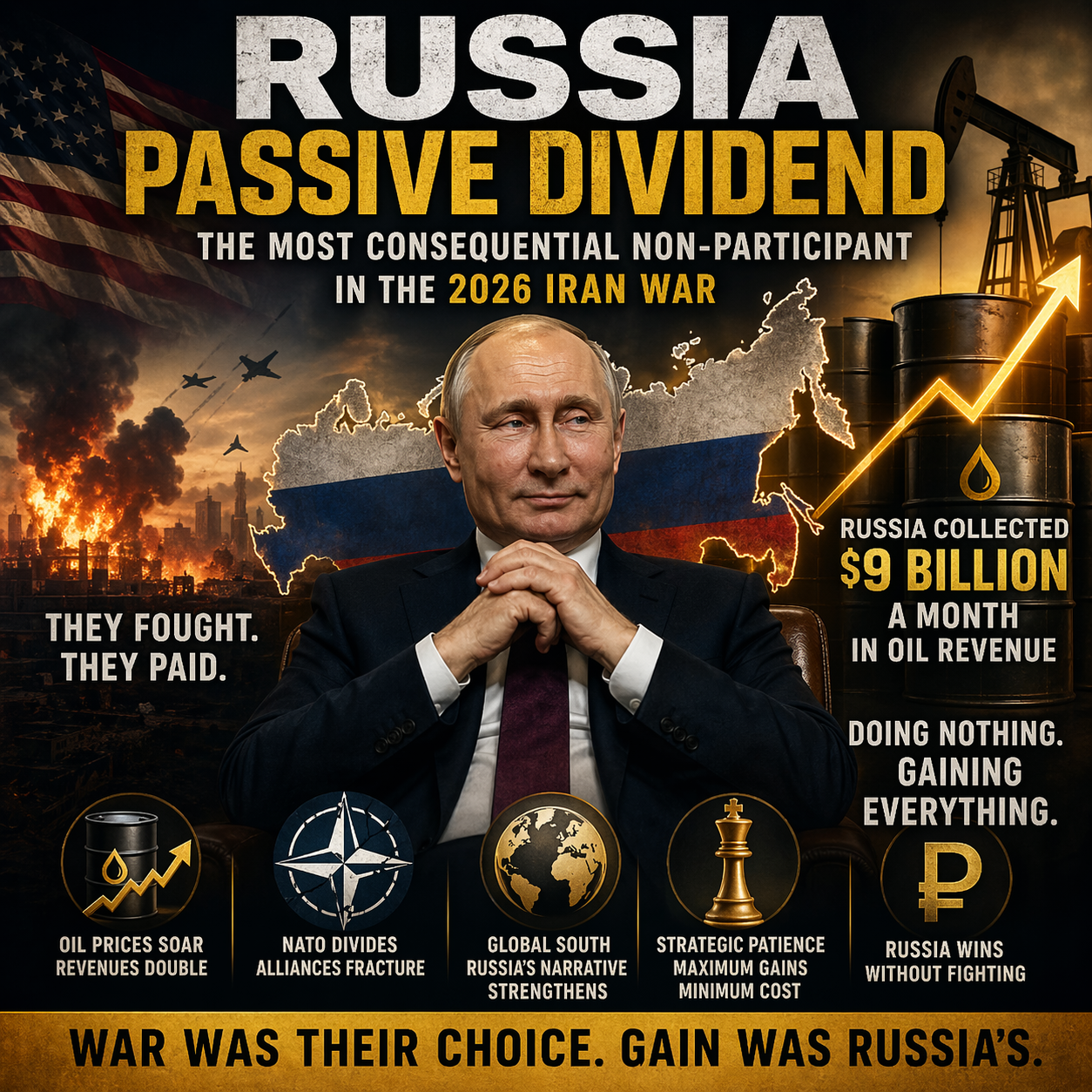
Blog 42 established the Russia Passive Dividend — how Russia collected $9 billion a month in oil revenue without deploying a single soldier, watched NATO fracture without involvement, and emerged from a war it did not fight in a strategically stronger position across every theatre. Blog 43 examines the mirror image: what Europe lost across the same period, and why Europe has never publicly admitted the structural cause of those losses. The EU Energy Umbrella Reckoning is the argument Europe makes in private but never in the press conference.
EU Energy Umbrella Reckoning: The US Built Umbrella Built and Europe Pays
EU Energy Umbrella Reckoning: Washington destroyed cheap Russian energy, then offered American LNG as the replacement. Europe pays the premium and calls it the market. The EU Energy Umbrella Reckoning begins with a precise observation about sequencing: Europe did not find itself dependent on American LNG solely because of a market evolution or a sovereign energy policy choice, despite supporting sanctions. It found itself dependent because the infrastructure connecting Europe to cheap Russian gas was destroyed — and the destruction was followed, within months, by American LNG contracts filling the gap at structurally higher prices.
Germany was buying Russian natural gas at approximately $8 per MMBtu through Nord Stream 1 and Nord Stream 2. American LNG delivered to European terminals trades at $12-15 per MMBtu — a 50-90% structural premium on every unit of energy. This is not a marginal price difference. Reuters analysis confirmed that Europe faces a permanent energy cost disadvantage as LNG replaces pipeline gas — a structural shift that industrial economists warned would accelerate deindustrialisation of energy-intensive European manufacturing sectors. Across European industrial consumption — steel, chemicals, fertilisers, ceramics, glass, automotive manufacturing — the energy cost differential between Russian pipeline gas and American LNG represents hundreds of billions of euros annually in lost industrial competitiveness. The Chokehold Industrial Chain argument applies to Europe as precisely as it applies to Asia: when energy costs rise structurally, industrial production migrates to where energy is cheaper. American manufacturers, paying domestic natural gas prices of $2-3 per MMBtu, are competing against European manufacturers paying $12-15. The EU Energy Umbrella Reckoning names this not as an unfortunate market outcome but as the direct financial consequence of a deliberate infrastructure destruction.
EU Energy Umbrella Reckoning: The Ukraine War Washington Fought Through Europe
The sequencing of statements is documented and precise. On January 26, 2022 — three weeks before the Russian invasion of Ukraine — US Undersecretary of State Victoria Nuland told a Washington press conference: “If Russia invades Ukraine, one way or another, Nord Stream 2 will not move forward.” On February 7, 2022 — seven days before the invasion — President Biden stood beside German Chancellor Scholz at a White House press conference and stated: “We will bring an end to it.” When a reporter asked how the US could end a pipeline that was entirely in German and Russian control, Biden said: “I promise you, we will be able to do it.” These statements preceded the invasion. The operational planning for pipeline destruction was therefore underway before the war that was used to justify it had begun.
The Ukraine proxy war argument — documented in this publication’s Ukraine series — establishes the 2014 Maidan as the strategic starting point: US-backed government change in Kyiv, NATO expansion eastward against explicit verbal assurances given to Moscow, the systematic construction of conditions that made Russian military action in Ukraine a predictable response to a provocation architecture Washington had been building for a decade. The EU Energy Umbrella Reckoning does not require accepting the full Ukraine proxy war argument to make its central observation: the sequencing of Nord Stream statements, followed by Nord Stream destruction, followed by American LNG contracts filling the gap, is documented regardless of who physically planted the explosives.
EU Energy Umbrella Reckoning: The Pipeline That No Longer Exists
On September 26, 2022 — seven months after the invasion began — three of the four Nord Stream pipelines were destroyed in underwater explosions in the Baltic Sea.
The Biden administration called the account “complete fiction.” The CIA called it “completely and utterly false.” A European Parliament member filed a formal parliamentary question citing the Hersh investigation and asking the European Commission to explain its position on the allegations.
Russia called for an independent international investigation at the UN Security Council. The United States used its veto position to block the establishment of an independent investigation. Germany, Sweden, and Denmark conducted their own national investigations — and Sweden closed its investigation in February 2024 without naming a perpetrator, citing that the crime scene was outside Swedish jurisdiction; Germany’s investigation continued but produced no public findings. DW noted that the sabotage destroyed infrastructure worth an estimated €10-15 billion — a figure that represents only the pipeline hardware, not the downstream economic cost of the energy price differential that followed. The investigation that would settle the question of who destroyed Europe’s primary low-cost energy infrastructure has never been conducted. The infrastructure does not exist. The investigation was blocked. The American LNG contracts are signed. The Manufactured Instability Reckoning established that African instability was documented in Washington’s own Senate records. The Nord Stream pattern — destruction, denial, blocked investigation, commercial beneficiary identified — follows the same architecture.
📌 The Proxy War Architecture That Preceded the Pipeline Destruction
The 2014 Maidan, the NATO expansion eastward, the decade-long construction of conditions that made Russian military action predictable — the Ukraine proxy war argument documented.
EU Energy Umbrella Reckoning: The Iran War Compounding the Loss
The Ukraine war destroyed Europe’s cheap Russian gas. The Iran war destroyed Europe’s cheap Qatari LNG access. Both losses were produced by Washington’s strategic decisions. Neither was consented to by Europe.
Blog 38 established the EU Mediator Vacuum — Europe’s structural inability to function as an independent mediator because its security architecture is dependent on Washington. The energy dimension of that dependency is the EU Energy Umbrella Reckoning’s most current illustration. Europe imports 12-14% of its LNG from Qatar through Hormuz. European gas prices surged 63% in a week after Ras Laffan was struck and Qatar Energy declared force majeure. Europe was not a party to the Iran war and explicitly declined offensive participation, even while supporting broader sanctions architecture. And it absorbed a 63% energy price spike in seven days as the direct consequence of a war it had no voice in launching.
Europe is simultaneously paying the Ukraine war energy premium — the structural 50-90% price difference between the cheap Russian gas it no longer has and the American LNG it now buys — and absorbing the Iran war energy crisis that the Hormuz closure produced. Both crises were produced by Washington’s strategic decisions. Both crises commercially benefit the same actor: the United States, which is the primary LNG exporter filling both gaps. The Global Energy Reckoning documented the emergency LNG contracts that India signed with African producers — the search for alternatives to a Gulf supply that Washington’s war disrupted. Europe’s search for alternatives led it to the same destination: American LNG terminals, at American prices, on American contract terms.
The EU Energy Umbrella Reckoning’s structural conclusion is the one Europe states in private budget documents and industrial competitiveness reports but does not state in press conferences or diplomatic communications: Washington has systematically eliminated Europe’s energy alternatives and installed American LNG as the structural replacement — through a Ukraine war fought on European territory and an Iran war that disrupted the secondary supply route. The umbrella Washington holds over European energy security is real. The premium Europe pays to stand under it is documented. The process by which the cheap alternatives were eliminated is, in both cases, traceable to Washington’s decisions. The New Colonial Enforcement architecture does not require military occupation. It requires that the subject economy have no viable alternative to the enforcer’s commercial terms. Europe, in 2026, has none. Even as the Merz administration in Berlin attempts to pivot toward industrial renewal, it remains tethered to the price floors set in Washington. The “Energy Umbrella” has become a structural ceiling that no European leadership can currently break.
📌 The Colonial Order That Built This Dependency
The century of colonial architecture that made European security and energy permanently dependent on American power — and why that dependency was a feature, not a failure, of the post-war order Washington designed.
Next: China Oil Revenge — Blog 44 in West Asia’s Endless War examines China’s position: not passive like Russia but active in a calculated direction. China’s oil continued flowing through Hormuz under Iranian authorisation while American-allied shipping was blocked. China called for a ceasefire without joining one. But the deeper argument is structural — the Iran war has accelerated the architecture of Chinese energy independence from the dollar system that Washington spent fifty years building. Every week the Gulf war continued made that alternative more credible to more governments, and the EU Energy Umbrella Reckoning is the reason those governments are looking. Part of the West Asia’s Endless War Series on hinduinfopedia.com.
Feature Image: Click here to view the image.
Videos
[…] भारत / GB […]
[…] Blog 43 established the EU Energy Umbrella Reckoning—the destruction of cheap regional energy to facilitate a premium American replacement. This Blog examines the second and more devastating commercial capture operating through this same architecture: Ukraine’s Agricultural Reckoning. While the geography has shifted to Eastern Europe, the victim remains the same: the Global South. Just as the closure of the Hormuz Strait threatened the energy of six billion people, the restructuring of Ukraine’s wheat, corn, and sunflower oil markets is a strategic strike against the food security of West Asia and Africa. The Ukraine Agricultural Reckoning argues that this is not a European local conflict, but a global commercial capture where the instrument is war and the outcome is the corporate consolidation of the world’s breadbasket. […]
[…] ब्लॉग 43 ने ईयू ऊर्जा संरचना का विश्लेषण स्थापित किया। वॉशिंगटन ने सस्ती रूसी पाइपलाइन गैस समाप्त की। फिर अमेरिका ने उच्च मूल्य पर एलएनजी उपलब्ध कराया। यूरोप इसे बाजार कहता है। यह ब्लॉग उसी संरचना के दूसरे और बड़े व्यावसायिक नियंत्रण का अध्ययन करता है। यह नियंत्रण यूक्रेन के कृषि बाजार में कार्य कर रहा है। यूक्रेन कृषि पुनर्गठन का तर्क यह है कि यूरोप की खाद्य आपूर्ति बदल रही है। इसमें गेहूं, मक्का और सूरजमुखी तेल की निर्भरता शामिल है। यह परिवर्तन युद्ध के माध्यम से हो रहा है। इसका परिणाम अमेरिकी कॉर्पोरेट नियंत्रण वाली उत्पादन श्रृंखला है। साधन संघर्ष है। परिणाम व्यावसायिक नियंत्रण है। यूरोप एक ही संरचना से दो बार प्रभावित हुआ है। यह प्रभाव एक ही दशक में हुआ है। […]
[…] पढ़ें: EU Energy Umbrella Reckoning → […]
[…] Read: EU Energy Umbrella Reckoning → […]
[…] Gulf was betrayed, the petrodollar ended, African energy emerged, Russia collected its dividend, European energy was captured, Ukrainian agriculture was feudalised. Blog 46 asks the question the series has been building […]
[…] https://hinduinfopedia.com/eu-energy-umbrella-reckoning-a-reckoning-of-west-asias-endless-war-43/ […]
[…] उभरी, रूस ने अपना लाभ प्राप्त किया, यूरोपीय ऊर्जा नियंत्रण में आई, यूक्रेनी कृषि सामंती ढाँचे में बदली। […]