

India Energy Exposure: A Reckoning of West Asia’s Endless War (57)
Part 57 of the West Asia’s Endless War Series
भारत / GB
India Did Not Choose the Hormuz Logical Trap. The Hormuz Logical Trap Chose India — Through Six Relationships That Simultaneously Pull in Opposite Directions.
Blog 56 (Hormuz Logical Trap) documented Washington’s stalemate — five walls, no exit, a war that cannot be won, cannot be lost, and cannot be stopped. Blog 57 examines India’s position inside the same trap, which India entered not through its own strategic choices but through the structural architecture of its energy dependency, its diaspora, and its relationship network. India Energy Exposure is the argument that India’s nine simultaneous relationships with West Asia’s principal actors have placed India at the intersection of every competing interest in the conflict — friend to all, committed to none, exposed to each.
India Energy Exposure: The Numbers That Make Neutrality Impossible
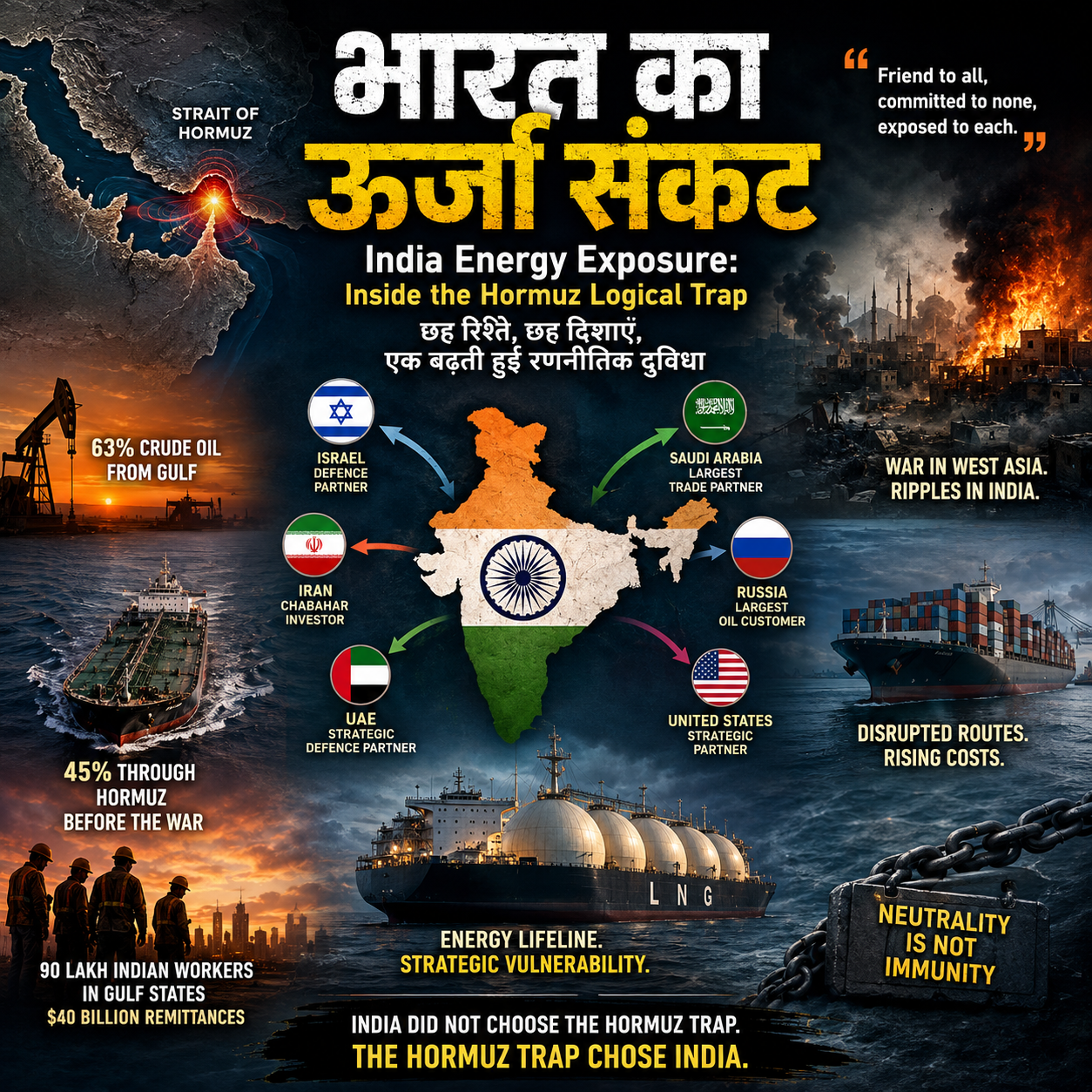
India Energy Exposure: 63% of crude from Gulf, 45% through Hormuz before the war. Nine million workers in Gulf states. UAE Strategic Defence Partnership signed 19 days before the war. India is inside the Hormuz Logical Trap whether it chose to be or not. The structural facts of India’s energy dependency are documented with precision. India’s Standing Committee on Petroleum and Natural Gas confirmed that over 63% of Indian crude oil imports come from Persian Gulf countries — Iraq, Saudi Arabia, Kuwait, and UAE — countries drawn directly into the war. Before the war, approximately 45% of India’s crude transited Hormuz. The IEA confirmed that Bangladesh, India, and Pakistan imported almost two-thirds of their total LNG supplies via Hormuz in 2025 — making India among the world’s most structurally exposed economies to any Hormuz disruption.
India’s response has been rapid and consequential. India’s Petroleum Minister Hardeep Singh Puri confirmed to the Lok Sabha that India increased non-Hormuz sourcing to approximately 70% of crude imports, up from 55% before the war — primarily through expanded Russian oil purchases shipped through the Mediterranean and Suez Canal. India reportedly purchased 30 million barrels of Russian crude at premiums of $2-8 per barrel over Brent — paying above-market for the diversion — paying above-market prices for the diversion, absorbing additional freight costs, and stretching strategic petroleum reserves that stood at 5.33 million metric tonnes — approximately nine and a half days of crude oil requirements. India Briefing confirmed that 28 Indian-flagged vessels with 778 Indian seafarers were operating in the Persian Gulf as of March 11 2026 — under enhanced security procedures, inside an active war zone, carrying India’s energy supply chain.
The India Energy Exposure is not only about what flows through Hormuz. It is about what flows back through the Gulf in the opposite direction. Blog 24 (India Hormuz Trap) established the nine-relationship architecture — the network of simultaneous Indian interests in West Asia that make genuine neutrality structurally impossible. Nine Million Indian workers in Gulf states send approximately $40 billion in annual remittances that constitute India’s primary current account stabiliser. Blog 12 documented how the Hormuz disruption threatens food security across the region. Every Indian worker in the Gulf whose employer closes because of the energy crisis is a remittance that does not arrive, a family in Kerala or Tamil Nadu that cannot service its loan, a rupee that does not cross into the domestic economy.
📌 The Nine-Relationship Trap India Entered Before the War Began
Israel defence partner. Iran Chabahar investor. UAE Strategic Defence Partnership. Saudi Arabia’s largest trade partner. Russia’s largest oil customer. Every relationship pulls a different direction. The India Hormuz Trap — documented before the war confirmed it.
India Energy Exposure: Six Relationships, Six Directions
Israel — defence partner. India is Israel’s largest arms customer and one of its most significant diplomatic supporters in the non-Western world. India-Israel defence trade reached $2.4 billion in 2024-25, making India the largest single-country market for Israeli defence exports — a relationship that creates visible alignment in Iranian threat assessments regardless of India’s diplomatic neutrality declarations. The 2026 war was launched jointly by the US and Israel. India’s defence relationship with Israel makes India an implicit co-belligerent in Iranian threat matrices — the IRGC Mosaic Reckoning Blog 39 established that local commanders act on their own threat assessments without waiting for central authorisation. Indian ships with Israeli defence equipment on board, Israeli-supplied surveillance systems on Indian naval vessels — these are real signals in an IRGC local threat matrix regardless of India’s diplomatic neutrality statements.
Iran — Chabahar investor and energy relationship. India invested $85 million in the Chabahar port development — Iran’s primary connectivity to Afghanistan and Central Asia, India’s primary land route bypass of Pakistan. Iran allowed Indian ships through Hormuz during the war’s active phase — Tehran’s Ambassador to India confirmed Iran allowed some Indian vessels to sail through Hormuz after New Delhi gave harbour to three Iranian warships and conducted multiple high-level diplomatic interactions. India’s External Affairs Minister Jaishankar held at least three conversations with his Iranian counterpart. India’s Prime Minister Modi spoke directly with Iranian President Pezeshkian on March 12. The Chabahar relationship and the diplomatic engagement produced a Hormuz accommodation — but it required India to harbour Iranian warships in Indian ports, which is the precise act that marks India as a non-hostile state in Iranian operational planning.
UAE — Strategic Defence Partnership signed January 19 2026. Nineteen days before Operation Epic Fury. The UAE-India Strategic Defence Partnership Letter of Intent — signed while the Iran nuclear negotiations in Islamabad were still active — created a formal security architecture between India and a state that Washington used as an operational base for the war. UAE remains one of India’s key energy suppliers while India is UAE’s largest trading partner — a $100 billion bilateral trade relationship that the rupee-dirham settlement framework is beginning to denominate outside the dollar clearing system. Three Indian nationals were injured at Fujairah’s oil facility on May 4 — the India Energy Exposure has its human expression in the Hormuz Logical Trap’s most recent escalation.
Saudi Arabia — diplomatic and energy relationship. Saudi Arabia is India’s second largest crude supplier. India’s diplomatic engagement with Saudi Arabia has been managed carefully through the war — supporting the ceasefire, avoiding comment on Saudi Arabia’s divergence from UAE on the ceasefire’s desirability, maintaining the relationship that supplies approximately 17% of India’s crude imports.
Russia — largest oil customer. India’s strategic autonomy in practice has been most visible in the Russian oil relationship. India purchased Russian crude throughout the Ukraine war, expanded purchases during the Hormuz crisis, and is now the world’s largest buyer of Russian Urals crude by volume. This relationship is India’s primary Hormuz bypass — Russian oil routes through the Mediterranean and Suez Canal do not touch Hormuz. But it has exposed India to American secondary sanctions pressure and is the primary commercial reason India will not formally join the China Sanctions War — India’s banking sector cannot absorb OFAC retaliation the way China’s alternative architecture can.
Washington — the relationship that constrains all others. India’s tactical non-alignment is calibrated precisely to stop short of the formal OFAC challenge that the China Sanctions War represents. Blog 55 (China Sanctions War) established India’s precise limit: India buys Russian oil, builds rupee-dirham settlement, signs UAE defence partnerships — but stops exactly at the dollar clearing system boundary because India’s banking sector remains dollar-dependent and cannot absorb secondary sanctions. Washington knows this. The India Energy Exposure is partly the exposure of a state whose tactical non-alignment has left it without a formal security guarantee from any party to the conflict.
The India Energy Exposure’s closing argument is the series’ most precise illustration of the Dagdhabeej thread applied to a non-combatant state. Every relationship India built to manage its energy security, its diaspora, its defence supply chains, and its strategic autonomy simultaneously creates a vulnerability in a different direction. The UAE partnership marks India in Iranian threat matrices. The Chabahar investment marks India as non-hostile to Iran in Washington’s threat matrices. The Russian oil purchases attract OFAC pressure. The Israeli defence relationship attracts Iranian attention. The nine million workers in Gulf states create a humanitarian dependency that prevents India from taking any position that might accelerate the crisis. India did not choose the Hormuz Logical Trap. The Hormuz Logical Trap chose India — through the structural consequence of being the world’s most relationship-dependent major power in a region where all the relationships are now at war with each other.
📌 The Gulf Dollar Toll India Pays on Every Oil Import
On $100 billion of UAE-India trade in 2024, six dollar toll dimensions extracted $750 million to $3 billion — paid to Washington without Washington being party to a single transaction. India is building the rupee-dirham settlement that begins to bypass it.
Next: India Strategic Neutrality — Blog 58 in West Asia’s Endless War examines how India is managing the six-direction exposure the India Energy Exposure has documented — the precise calibration of tactical non-alignment that extracts maximum benefit from every relationship by never closing any option permanently, and the question of whether that calibration can survive in a world where the China Sanctions War has forced every actor to choose. Part of the West Asia’s Endless War Series on hinduinfopedia.com.
Feature Image: Click here to view the image.
Videos
Glossary of Terms
- Hormuz Logical Trap: A strategic condition where no participating or affected country can fully escalate, withdraw, or remain unaffected from the West Asia conflict due to overlapping economic, military, and geopolitical dependencies.
- India Energy Exposure: A term coined in this blog describing India’s structural vulnerability arising from dependence on Gulf energy, remittances, maritime routes, and competing regional partnerships.
- Nine-Relationship Trap: The framework describing India’s simultaneous strategic relationships with Israel, Iran, UAE, Saudi Arabia, Russia, Washington, and other regional actors that pull India in conflicting directions.
- Strategic Neutrality: India’s calibrated foreign policy approach of maintaining relations with competing global and regional powers without formally aligning with any military bloc.
- OFAC: Office of Foreign Assets Control, a US Treasury agency responsible for enforcing American sanctions and financial restrictions globally.
- IRGC: Islamic Revolutionary Guard Corps, Iran’s elite military and ideological force responsible for strategic defence and regional operations.
- IRGC Mosaic Reckoning: A concept referenced from Blog 39 describing decentralized Iranian operational doctrine where local commanders independently assess and respond to perceived threats.
- Chabahar Port: An Iranian port developed with Indian investment to provide India direct access to Afghanistan and Central Asia while bypassing Pakistan.
- Operation Epic Fury: The military campaign referenced in the blog as the US-Israel coordinated strike that escalated the regional conflict into a broader war structure.
- Rupee-Dirham Settlement Framework: A bilateral trade mechanism allowing India and UAE to settle trade transactions in local currencies instead of the US dollar.
- Secondary Sanctions: Penalties imposed by the United States on third-party countries, companies, or banks conducting business with sanctioned entities.
- Dagdhabeej Thread: A recurring conceptual framework in the series referring to self-reinforcing strategic consequences where every solution creates new vulnerabilities.
- Hormuz Bypass Strategy: India’s diversification effort to reduce dependence on the Strait of Hormuz through Russian crude imports routed via the Mediterranean and Suez Canal.
- Strategic Defence Partnership: A formal bilateral defence cooperation arrangement involving military coordination, security collaboration, and defence technology engagement.
- Current Account Stabiliser: An economic factor that helps maintain balance in a country’s foreign exchange flows; in this blog, Gulf remittances play that role for India.
#India #Hormuz #Iran #Israel #Gulf #Oil #Energy #Russia #UAE #Geopolitics #WestAsia #Sanctions #Modi #Trade #HinduinfoPedia
West Asia’s Endless War: Why This Series Exists
[…] भारत / GB […]
[…] https://hinduinfopedia.com/india-energy-exposure-a-reckoning-of-west-asias-endless-war-57/ […]
[…] Read […]