

The War Ledger: A Reckoning of West Asia’s Endless War (85)
Part 85 of the West Asia’s Endless War Series
भारत / GB
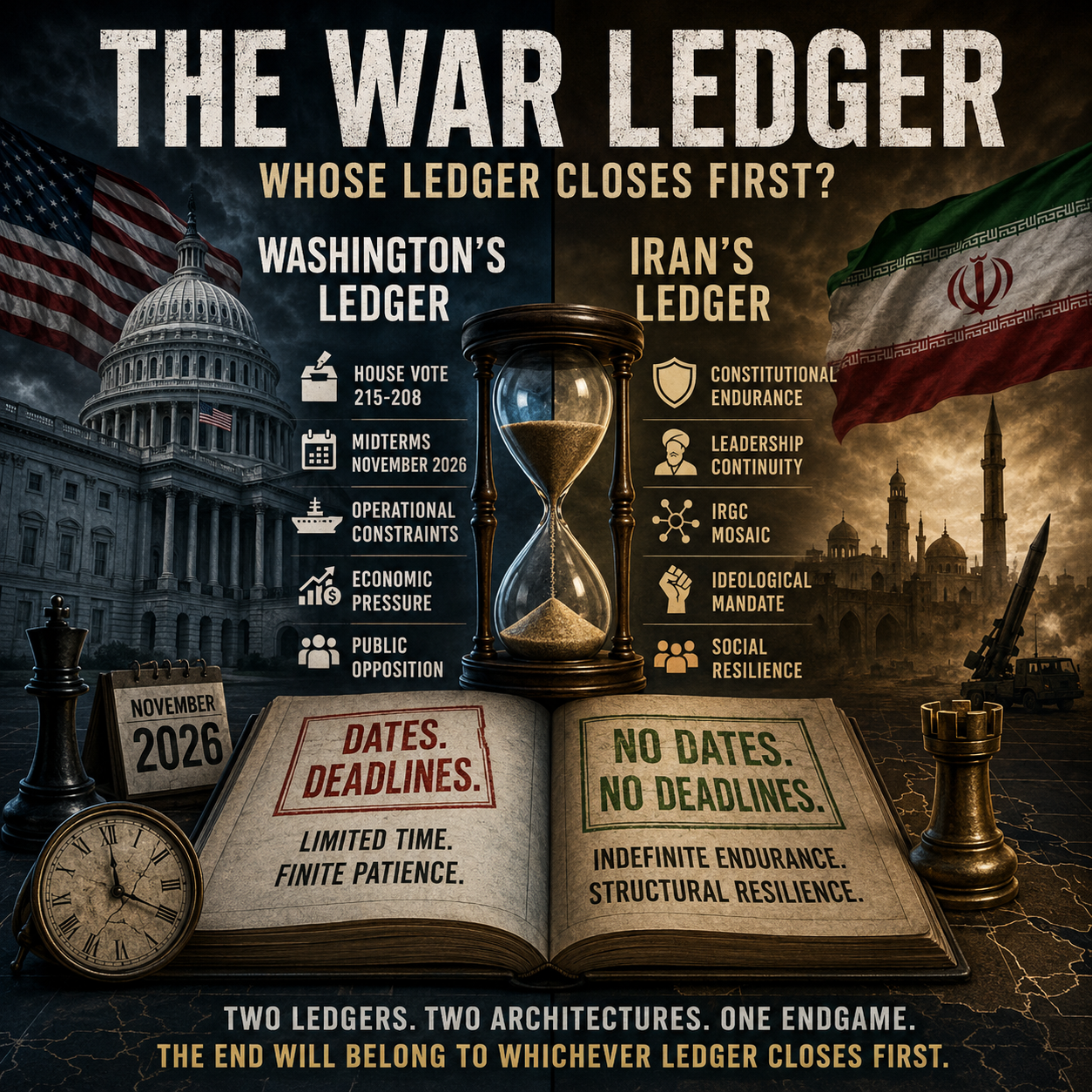
Washington’s War Ledger Has Dates on It. Iran’s Does Not. The House Voted 215-208 to End the War. Independents Oppose It 60-31. The Midterms Are November 2026. Iran’s Constitutional Architecture Was Designed to Sustain Indefinite Pressure. The Endgame Will Not Be Decided by Negotiation. It Will Be Decided by Whose Ledger Closes First.
Blog 84 (The War Doctrine Shift) documented Iran’s formal shift from strategic patience to active deterrence — a doctrine declared in January 2026, activated by Operation Epic Fury, and expressed most fully in the June 3 strikes on Kuwait’s airport and the US Fifth Fleet headquarters in Bahrain. Blog 85 examines the war’s arithmetic: two ledgers, two different constraint architectures, and the question of which side’s limits arrive first.
The War Ledger: Washington’s Side
The War Ledger: Washington has fixed clocks — House voted 215-208 to end the war, midterms November 2026, 60% of independents opposing the war. Iran has no equivalent fixed timetable. The endgame is decided by whose ledger closes first. Washington’s ledger has dates. Iran’s does not. Washington’s constraints are institutional, electoral, and operational — each with a fixed date or measurable threshold.
Entry One — The House vote.
A bipartisan majority in the Republican-led House voted 215 to 208 on June 4 2026 to end the war with Iran — the clearest Congressional rebuke yet of the President’s handling of the conflict. Four Republicans joined Democrats. Republicans who voted for the resolution cited discomfort with the lack of Congressional authorisation and fear that the war’s unpopularity and economic fallout could harm the GOP’s chances at keeping control of Congress in November. The vote is described as largely symbolic — the Senate has not yet passed its equivalent and Trump has indicated he would veto. But the symbolic value is precise: a Republican-controlled House voted to end a Republican President’s war. The War Ledger’s first entry on Washington’s side is dated June 4 2026.
Entry Two — The midterm elections.
Al Jazeera documented that the Iran war stands to fundamentally reshape US domestic politics ahead of the November midterms — with all 435 House seats and 35 Senate seats on the ballot and Republicans controlling both chambers by narrow margins. Independent voters oppose US military action against Iran by 60 to 31 percent according to a Quinnipiac University survey — and independent voters in Pennsylvania swing districts are already telling reporters the war reminds them of Iraq and Vietnam. The 2006 midterms — conducted during the Iraq War — produced a Democratic wave that flipped both chambers. The structural parallel is documented. The midterms are fixed in November 2026. The War Ledger’s second entry has a date. CBS News documented that GOP representative Ashley Hinson said in a private exchange that the war could be a “political liability” if it continues beyond “the next couple of weeks.”
Entry Three — The operational ledger.
The Ford’s 11-month deployment — the longest since the Vietnam War — forced double maintenance delays and crew fatigue warnings from the Vice Chief of Naval Operations. Two carriers maintain deterrence presence in the Arabian Sea: sufficient to claim presence, insufficient for offensive operations at Operation Epic Fury’s scale. Blog 79 (The Imprisoned Emperor) documented the command structure purged of 12 senior officials during active combat — the Army Chief of Staff fired by phone during a meeting, the DIA Director removed for honest reporting. The operational ledger’s entries are not dated but they are measurable: two carriers, depleted command structure, Ford in maintenance, crew fatigue. The capacity for sustained escalation is diminished from Day 1’s level.
Entry Four — The economic ledger.
Oil prices rose immediately on February 28 and have remained elevated through the Hormuz partial closure. Reuters documented that the widening Middle East conflict sent oil and natural gas prices higher, caused volatility in global markets, and raised concerns about broader economic impact — with Republican strategists warning that cost of living increases from the war would feature in Democratic campaign attacks through November. The economic ledger compounds: each month of the Hormuz partial closure adds to the inflation that midterm voters will take to the ballot box in November. The War Ledger’s fourth entry is indexed to an election date.
📌 The Trap That Makes Every Clock More Expensive
Five walls, no exit — the Hormuz Logical Trap that ensures each tick of Washington’s institutional and electoral clocks adds cost without adding resolution.
The War Ledger: Iran’s Side
Iran’s side of the War Ledger is real but differently structured. Iran has constraints — economic, demographic, and political. They are slower-dated than Washington’s institutional clocks and they do not arrive on fixed electoral timetables.
Entry One — The economic pressure.
Iran’s rial has been under sustained pressure since the war began — sanctions compounding the war’s direct economic costs simultaneously. The Iranian population bears both simultaneously. The domestic protests that preceded the war in late 2025 demonstrated that economic pressure produces political expression inside Iran. This is a genuine constraint. But the Iranian constitutional architecture was specifically designed to absorb this pressure — the Mustad’afin mandate converts external economic pressure into domestic legitimacy demonstrations. Blog 65 (Iran’s War Logic) established that the three doctrines make compliance structurally impossible regardless of economic pressure applied. The economic entry on Iran’s ledger is real. It is slower and less precisely dated than Washington’s.
Entry Two — The succession risk.
Mojtaba Khamenei was appointed within 72 hours of the Supreme Leader’s assassination — the succession mechanism functioned as designed. But Mojtaba’s legitimacy is untested by sustained domestic discontent at scale. A Supreme Leader who inherited his position under fire rather than through the conventional Assembly of Experts process faces a legitimacy question that his father never faced. This is the War Ledger’s most uncertain entry on Iran’s side — genuinely inferential rather than documentable with the precision Washington’s entries carry.
Entry Three — The proxy cost.
Gaza’s civilian casualties and the sustained proxy operations across Lebanon, Iraq, and Yemen impose costs on Iran’s domestic political position — the population that funds the proxy architecture through the economic burden of sanctions does not always share the ideological enthusiasm for its maintenance. This is a real constraint. It is also the constraint the IRGC Mosaic was specifically designed to manage: distributed proxy operations whose individual costs are low enough to be sustainable across the organism’s distributed architecture even when the cumulative burden is significant.
The War Ledger: Which Side Closes First
The War Ledger’s comparative assessment requires honesty about what the record supports and what remains inferential. Washington’s constraints are documented with precision: the House vote has a date (June 4 2026), the midterms have a date (November 2026), the operational ledger has measurable entries (Ford in maintenance, two carriers, depleted command structure), the economic ledger has an electoral deadline. Iran’s constraints are real but undated: economic pressure that the constitutional architecture was designed to absorb, a succession risk that is inferential rather than documented, proxy costs distributed across an architecture specifically built to make them sustainable.
The structural comparison the War Ledger produces is not that Iran has no constraints. It is that Iran’s constraints do not arrive on fixed timetables while Washington’s do. Blog 25 (Why Iran Will Not Blink) established Iran’s civilisational depth and constitutional design for indefinite pressure. Blog 64 (Iran’s Revolutionary Doctrine) established the Mustad’afin mandate that converts pressure into legitimacy. The organism that was designed to outlast pressure is facing a state whose pressure-application capability expires on a November ballot date.
Axios documented that across interviews, press conferences and social media, Trump floated and erased timelines, predicted the war’s end or promised new escalation — the endgame a murky, ever-moving target. The War Ledger’s closing entry is the series’ most honest single observation: the endgame will not be decided by who wins the argument. It will not be decided by which negotiating framework proves more acceptable. It will be decided by the arithmetic of two constraint architectures — one with dates on it and one without. Blog 82 (Every Solution Fails) documented 73 years of solutions each deepening the condition. The War Ledger documents why: each solution ran into Washington’s fixed institutional clocks before it could resolve the condition — and the next solution began with a new administration inheriting the unresolved condition. The organism outlasts. The ledger closes. The endgame arrives not as a decision but as the accumulated weight of dates Washington could not avoid and Iran did not share.
📌 The Doctrine Shift That Is Accelerating Washington’s Ledger
Iran’s June 3 escalation — Kuwait airport, US Fifth Fleet Bahrain, era of hit and run declared over — adding entries to Washington’s War Ledger faster than the Via Media can absorb them.
Next: Order Without Enforcer — Blog 86, the series’ closing argument, examines what the world looks like after the Hormuz war’s status quo is accepted: a rules-based international order whose primary enforcer has demonstrated the limits of its enforcement capability, a four-power world with no agreed rules and no capable enforcer, and whether the global commercial architecture that every actor in the system depends on can sustain itself when the enforcement mechanism has been tested and found insufficient. Part of the West Asia’s Endless War Series on hinduinfopedia.com.
Feature Image: Click here to view the image.
Videos
Glossary of Terms
- The War Ledger: The key phrase of the blog and a strategic framework comparing the cumulative political, economic, institutional, and operational constraints facing Washington and Iran during the ongoing West Asia conflict.
- Constraint Architecture: The underlying structure through which a state experiences limits on its ability to sustain conflict, including political institutions, public opinion, economics, military capacity, and constitutional design.
- Operation Epic Fury: A military operation referenced in the series as marking a major escalation in the Iran–United States confrontation and the transition from strategic patience to active deterrence.
- Strategic Patience: Iran’s long-standing doctrine of avoiding direct large-scale retaliation while relying on deterrence, proxies, and gradual pressure to achieve strategic objectives.
- Active Deterrence: A doctrine described in the series in which Iran responds more directly and visibly to perceived threats rather than relying solely on indirect measures.
- Hormuz Partial Closure: The disruption or restriction of maritime traffic through the Strait of Hormuz, affecting global energy markets and international trade flows.
- Mustad’afin Mandate: An ideological principle within Iran’s revolutionary framework emphasizing support for the oppressed and resistance against perceived domination by powerful states.
- IRGC Mosaic: A term used in the series to describe the distributed and layered structure of the Islamic Revolutionary Guard Corps and its associated regional networks.
- Supreme Leader Succession Mechanism: The constitutional and institutional process through which leadership continuity is maintained following the death or removal of Iran’s Supreme Leader.
- Operation Ledger: The measurable military component of the War Ledger, including force availability, deployments, command effectiveness, logistics, and readiness.
- Electoral Clock: A recurring concept in the series referring to democratic political deadlines, especially elections, that place time constraints on policymakers and military campaigns.
- Institutional Clock: Time-bound pressures generated by legislative oversight, constitutional requirements, public accountability, and governmental procedures.
- Fifth Fleet Headquarters: The principal United States naval command facility in Bahrain responsible for maritime operations across the Persian Gulf and surrounding waters.
- Ford Deployment: The extended deployment of the USS Gerald R. Ford carrier strike group, used in the blog as a measure of operational strain and force sustainability.
- Hormuz Logical Trap: A unique concept coined within the series describing a strategic condition in which every available policy option increases costs while failing to produce a decisive resolution.
#Iran #USA #MiddleEast #War #Politics #Congress #Elections #Oil #Hormuz #Geopolitics #Military #Strategy #HinduinfoPedia
West Asia’s Endless War: Why This Series Exists
Refer to Various Arks Referred to in the Blog
https://hinduinfopedia.com/proof-of-endless-war-master-reference-table/
[…] भारत / GB […]
The comparison between U.S. electoral pressures and Iran’s long-term endurance really highlights how different political timelines shape conflict decisions. It makes me wonder how often short-term political deadlines push leaders to act in ways that might not align with broader strategic goals. This perspective adds a lot of depth to how we interpret ongoing tensions in West Asia.
Greetings from HinduinfoPedia.
This is a sharp observation.
Our entire 87 parts series is way different from all other analysed of the West Asia endless war.
Keep engaging on our blogs to get an entirely different perspective of the world
[…] Blog 85 (The War Ledger) established that the endgame will be decided by whose constraints arrive first — Washington’s fixed institutional and electoral clocks against Iran’s slower-dated economic and demographic pressures. Blog 86 is the series’ closing argument: what the world looks like when the enforcer of the rules-based international order has demonstrated the limits of its enforcement capability — and what order, if any, fills the space that demonstration has created. […]
[…] https://hinduinfopedia.com/the-war-ledger-a-reckoning-of-west-asias-endless-war-85/ […]