

Every War Solution Fails: A Reckoning of West Asia’s Endless War (82)
Part 82 of the West Asia’s Endless War Series
भारत / GB
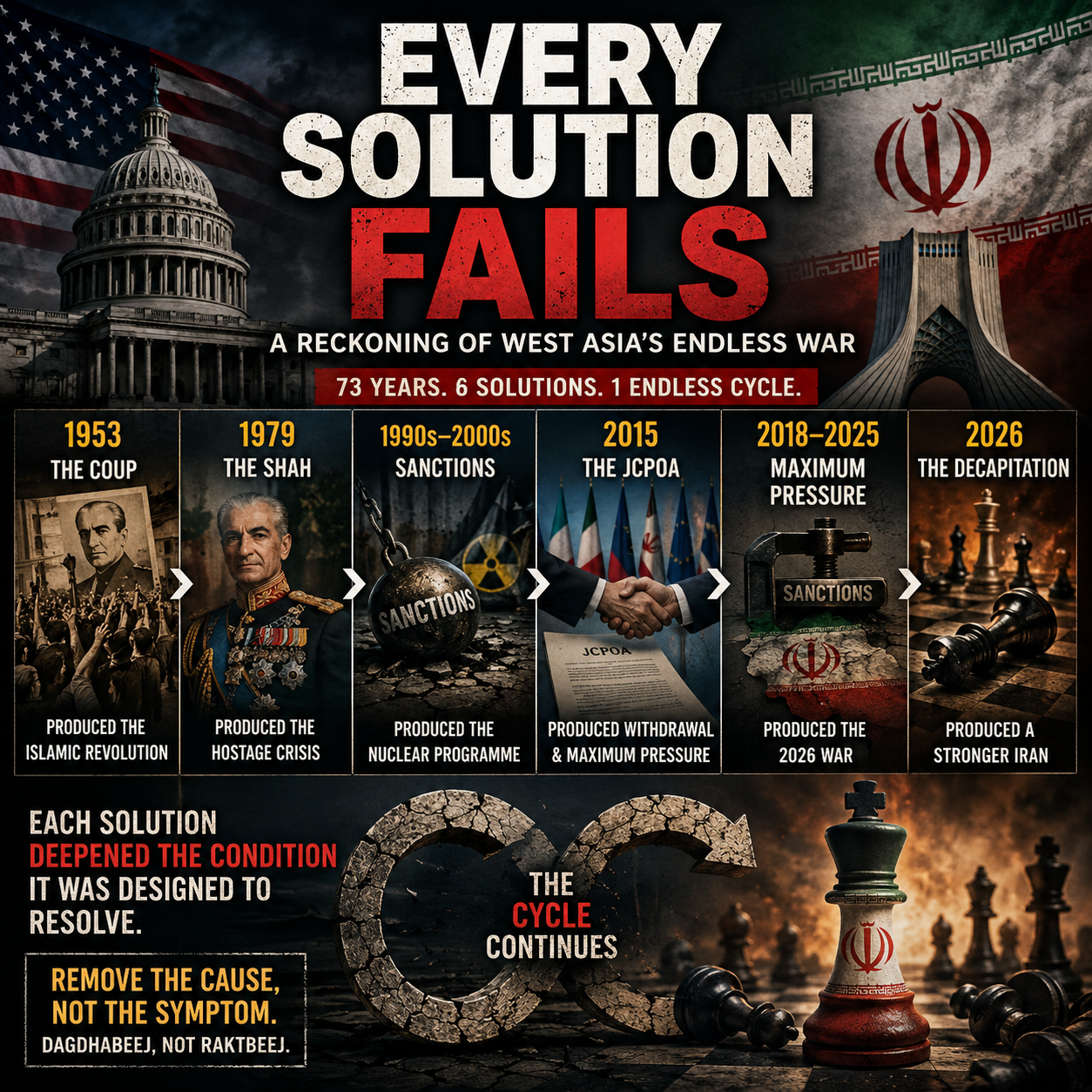
The 1953 Coup Produced the Islamic Revolution. The Shah Produced the Hostage Crisis. Sanctions Produced the Nuclear Programme. The JCPOA Produced Withdrawal and Maximum Pressure. Maximum Pressure Produced the 2026 War. The Decapitation Produced a More Non-compliant Iran. Each Solution Washington Applied to the Iran Problem Deepened the Condition It Was Designed to Resolve.
Blog 81 (The Series Proven) documented the convergence: two independent analysts from within the Western establishment arrived at the same conclusions the series reached through structural analysis. Blog 82 assembles the complete historical argument those conclusions rest on — the 73-year documented record of Washington applying solutions to the Iran problem, each of which produced a more resistant, more capable, and more hostile Iranian state than the one it was designed to manage. Every War Solution Fails is not an argument against action. It is an argument about what the record shows when each action’s outcome is traced to its consequence.
Every War Solution Fails: The Documented Sequence
Every War Solution Fails: The 1953 coup produced the Islamic Revolution. The Shah produced the hostage crisis. Sanctions produced the nuclear programme. The JCPOA produced withdrawal and maximum pressure. Maximum pressure produced the 2026 war. The decapitation produced a more violent Iran.
The sequence is documented across 73 years — each solution generating the condition that made the next solution necessary, each next solution generating a more intractable version of the original condition.
Solution One — The 1953 Coup.
The CIA-orchestrated coup of 1953 removed Prime Minister Mohammad Mosaddegh, who had nationalised Iran’s oil, and restored the Shah as a pro-Western monarch aligned with American commercial and strategic interests. The objective was narrow and immediate: remove the nationalist who took the oil, restore the leader who would return it. It succeeded on its own terms.
What it did not account for was the invoice. The Shah ruled for 26 years — and each year of that rule deposited something into the account that would eventually be collected. The repression that built the revolutionary movement. The SAVAK’s methods that made the revolutionaries ungovernable. The American flags burning outside the embassy that became the revolutionary’s permanent visual vocabulary. The 1979 Islamic Revolution, the 444-day Embassy hostage crisis, the severing of diplomatic relations that has never been restored — and the Mustad’afin constitutional mandate that Article 154 now encodes as permanent state doctrine — all of it was the 1953 solution’s invoice, paid 26 years later. The solution to Mosaddegh produced everything Mosaddegh was not — and built the organism that every subsequent solution has failed to resolve.
Solution Two — The Shah.
The Shah was not only Washington’s client. He was Washington’s solution — a modernising, pro-Western monarch who would industrialise Iran, maintain regional stability, and serve as the Gulf’s primary American security guarantor. NPR documented the US-Iran timeline’s central paradox: the United States and Iran were close allies until the Iranian Revolution — the revolution that the Shah’s rule produced. Britannica documents the foundational pattern: US intervention in Iranian affairs became a sore point for Iranians, particularly after the 1953 coup — and each subsequent intervention deepened that antagonism rather than resolving it. The solution produced the problem it was designed to prevent: an Iran governed by a hostile ideology, constitutionally committed to opposing American interests globally, and possessing the organisational depth of a revolutionary movement that had spent 26 years building against the client Washington had installed.
Solution Three — Sanctions.
The sanctions architecture Washington built after 1979 — expanded dramatically under every subsequent administration — was designed to produce economic pressure sufficient to change Iranian behaviour. The sanctions put the Iranian rial into freefall and prompted destabilising protests in late 2025 — but the Iranian state survived each cycle, and Iran’s nuclear programme advanced through every sanction period rather than being constrained by it. The solution to Iranian behaviour produced a nuclear programme — Iran’s primary strategic leverage — that sanctions were then used to address through a negotiated deal, which was then abandoned, producing maximum pressure, which produced the war the deal was designed to prevent. The sanctions cycle is the series’ most complete illustration of Every War Solution Fails: each application of the instrument produced the condition requiring a more ambitious application of the same instrument.
Solution Four — The JCPOA.
The JCPOA of 2015 — negotiated by the US, UK, France, Germany, China, Russia, and the EU — limited Iran’s uranium enrichment for 15 years in exchange for sanctions relief. Trump withdrew in 2018, reimposed sanctions, and Iran responded by stockpiling 440 kilograms of highly enriched uranium — more than before the deal. The solution that constrained the nuclear programme produced, through its abandonment, a more advanced nuclear programme than existed before the solution was applied. The condition the JCPOA resolved was worse after the JCPOA’s removal than before the JCPOA’s creation. US News documented that Trump’s 2018 withdrawal from the JCPOA led Iran to exceed every enrichment limit the deal had imposed within two years.
📌 The Decapitation Template That Completed the Sequence
Three applications — Mossadegh 1953, Soleimani 2020, Khamenei 2026. Each produced a more resistant organism. The template is the final entry in the Every War Solution Fails sequence.
Every War Solution Fails: Why Each Solution Deepens the Condition
The Every War Solution Fails pattern is not accidental and it is not the result of incompetent policy design. Each solution Washington applied to the Iran problem was rationally designed for the condition it was addressing. The 1953 coup solved the Mosaddegh problem. The Shah solved the post-coup stability problem. Sanctions solved the post-revolution engagement problem. The JCPOA solved the sanctions-escalation problem. Maximum pressure solved the JCPOA-compliance problem. Operation Epic Fury solved the maximum-pressure-plateau problem. Each solution was rational in isolation. Each solution was counterproductive in sequence.
The Dagdhabeej principle — documented in the Patanjali Yoga Sutra tradition and established by the series in Blog 69 (Palestine Cause or Instrument) — identifies the seed that has been roasted until it cannot germinate. The series applied it to the Palestinian ecosystem: UNRWA’s hereditary status, the Martyr Fund, the martyrdom curriculum are the three germination essentials that must be removed for the Raktbeej condition to end. The Every War Solution Fails argument applies the same principle to the Iran problem: each Washington solution that did not remove the three foundational conditions of Iranian resistance — the Mustad’afin constitutional mandate, the Velayat-e Faqih governance model, the IRGC Mosaic distributed architecture — was a solution applied to the symptom rather than the cause. Blog 65 (Iran’s War Logic) established why the three conditions make compliance structurally impossible. The Every War Solution Fails sequence documents 73 years of solutions applied without addressing those three conditions.
The DDT analogy that Blog 77 (Manufactured Extremism) applied to the jihadist ecosystem applies equally here. Each sanction cycle eliminated the less resistant expressions of Iranian political opposition and selected for the more resistant ones. Each decapitation eliminated the less operationally capable IRGC commanders and left the more operationally capable ones. Each military strike destroyed the less survivable elements of Iran’s infrastructure and left the more survivable distributed architecture intact. Blog 77 documented the same mechanism applied to the jihadist ecosystem. The Iran problem and the jihadist problem share the same structural property: each suppression cycle selected for resistance. Every War Solution Fails is the outcome of 73 years of suppression cycles, each of which strengthened what it was designed to eliminate.
Every War Solution Fails: What This Means Going Forward
The Every War Solution Fails argument does not conclude that Washington should have done nothing. It concludes that the solutions Washington applied were constitutively incapable of resolving the condition because they were designed to manage Iranian behaviour without addressing the structural conditions governing that behaviour. The distinction matters because the same solutions are available for the next cycle: the Via Media Reckoning (Blog 80) documented Washington’s current managed status quo — Iran collecting tolls, two carriers maintaining deterrence presence, Cuba as the replacement front page. The managed status quo is itself a solution. Its outcome, given the 73-year documented sequence, is predictable: the condition will require the next solution, which will deepen it further, which will require the solution after that.
Washington’s Global Control War (Blog 46) established the commercial architecture that requires the confrontation’s continuation. The Hormuz Logical Trap (Blog 56) established the five walls that make every exit unavailable.
Every War Solution Fails connects them: the commercial architecture produces the solutions, the solutions deepen the condition, the deepened condition requires the commercial architecture’s next application.
The Council on Foreign Relations’ documented timeline of US-Iran relations confirms the sequence: each instrument applied produced the condition requiring the next, more extreme instrument. The sequence is self-sustaining not because Washington is malevolent but because the instrument Washington has available — economic pressure, diplomatic isolation, military force, regime change — addresses the behaviour without addressing the constitutional, institutional, and civilisational conditions that produce the behaviour. The Raktbeej and Starfish Thesis on hinduinfopedia.com identified the organism’s three properties — distributed function, decentralised intelligence, replicative resistance — that make it immune to the instruments Washington has applied. Every War Solution Fails is the 73-year empirical record confirming the thesis: an organism designed to replicate under pressure has replicated under 73 years of pressure, and each application of pressure has produced a more capable organism than existed before the application.
📌 The Raktbeej Condition the Solutions Maintained
The organism in which destruction produces replication rather than elimination — and the 73-year empirical record of Washington’s solutions confirming the mechanism.
Next: Who Decides Endgame — Blog 83 in West Asia’s Endless War examines the question that Every War Solution Fails leaves open: if no solution Washington has applied has resolved the Iran problem, and the structural conditions make the available instruments constitutively incapable of resolving it, who has the authority, the capability, and the strategic interest to decide what the endgame looks like — and whether any actor in the current configuration is positioned to deliver it. Part of the West Asia’s Endless War Series on hinduinfopedia.
Feature Image: Click here to view the image.
Videos
Glossary of Terms
- Every War Solution Fails: The central thesis of the blog and a key phrase in the series, describing a recurring pattern in which policy measures intended to solve the Iran problem instead generate new conditions that require further intervention.
- Mohammad Mosaddegh: Iran’s democratically elected Prime Minister who nationalised the country’s oil industry before being removed in the 1953 coup backed by American and British intelligence services.
- 1953 Coup: The covert operation that overthrew Mosaddegh and restored the Shah to power, becoming a defining event in modern US-Iran relations.
- Shah of Iran: Mohammad Reza Pahlavi, the pro-Western monarch who ruled Iran until the 1979 Islamic Revolution and served as Washington’s principal regional ally.
- SAVAK: Iran’s intelligence and security organisation under the Shah, widely known for surveillance and repression of political opponents.
- Islamic Revolution: The 1979 revolution that overthrew the Shah and established the Islamic Republic of Iran under clerical leadership.
- Mustad’afin Constitutional Mandate: The constitutional principle within the Islamic Republic that commits Iran to supporting the “oppressed” worldwide, particularly reflected in Article 154.
- Velayat-e Faqih: The Iranian system of governance in which ultimate political and religious authority is vested in the Supreme Jurist, forming the ideological foundation of the Islamic Republic.
- IRGC (Islamic Revolutionary Guard Corps): Iran’s elite military and ideological force established after the revolution to protect the Islamic Republic and advance its strategic interests.
- IRGC Mosaic Distributed Architecture: A series term describing the decentralised organisational structure of the IRGC, designed to preserve operational continuity even under sustained military pressure.
- Sanctions Architecture: The extensive network of economic restrictions imposed on Iran by the United States and its partners to influence Iranian behaviour and strategic decisions.
- JCPOA (Joint Comprehensive Plan of Action): The 2015 nuclear agreement between Iran and major world powers that limited Iran’s nuclear activities in exchange for sanctions relief.
- Maximum Pressure: The American strategy implemented after withdrawal from the JCPOA, relying on intensified sanctions, diplomatic isolation, and coercive measures against Iran.
- Decapitation Strategy: A military and political approach focused on eliminating key leaders or command structures in the expectation that the targeted organisation will weaken or collapse.
- Dagdhabeej Principle: A concept derived from Indian philosophical tradition and adapted in the series to describe the removal of foundational causes so that a problem cannot regenerate.
- Raktbeej Condition: A unique term coined in the series, referring to a phenomenon in which attempts at suppression generate replication, adaptation, or expansion of the targeted system.
- Starfish Thesis: A series concept describing systems that survive pressure through distributed functions, decentralised decision-making, and the ability to regenerate after losses.
- DDT Analogy: A recurring series framework comparing political and militant adaptation to biological resistance, where repeated suppression selects for increasingly resilient survivors.
- Operation Epic Fury: The series’ designation for the military escalation phase discussed as a response to the perceived limitations of the maximum-pressure strategy.
- Via Media Reckoning: A series concept describing a managed status quo in which confrontation is contained rather than resolved, postponing rather than eliminating future crises.
1) Top Searched Short #Tags
#Iran #USIran #MiddleEast #WestAsia #Geopolitics #JCPOA #Sanctions #IRGC #IranWar #Diplomacy #Conflict #History #ForeignPolicy #Strategy #HinduinfoPedia
West Asia’s Endless War: Why This Series Exists
Refer to Various Arks Referred to in the Blog
https://hinduinfopedia.com/proof-of-endless-war-master-reference-table/
[…] भारत / GB […]
[…] Blog 82 (Every War Solution Fails) established the 73-year documented sequence — each solution Washington applied deepened the condition it was designed to resolve. Blog 83 examines the question that sequence leaves open: if every available instrument has been applied and the condition persists, who has the authority, the capability, and the strategic interest to produce an endgame? The answer the current configuration produces is precise and uncomfortable: no single actor can deliver the endgame, and every actor with a stake in the outcome has structural reasons to prevent the endgame another actor might deliver. […]
[…] https://hinduinfopedia.com/every-war-solution-fails-a-reckoning-of-west-asias-endless-war-82/ […]
[…] ब्लॉग 82 (हर समाधान असफल होता है) ने 73 वर्षों के अभिलेखित क्रम को स्थापित किया था। वाशिंगटन ने जिन उपायों का उपयोग किया, उन्होंने उसी स्थिति को और गहरा किया जिसे वे समाप्त करना चाहते थे। ब्लॉग 83 उस प्रश्न की जांच करता है जो इस क्रम से उत्पन्न होता है। यदि उपलब्ध सभी साधन प्रयुक्त हो चुके हैं और स्थिति बनी हुई है, तो अंतिम परिणाम लाने की शक्ति, क्षमता और रणनीतिक हित किसके पास है? वर्तमान व्यवस्था का उत्तर स्पष्ट है। कोई एक पक्ष अंतिम परिणाम नहीं दे सकता। साथ ही प्रत्येक पक्ष के पास ऐसे संरचनात्मक कारण हैं जो दूसरे पक्ष द्वारा लाए जा सकने वाले समाधान को रोकते हैं। […]
[…] decided by the arithmetic of two constraint architectures — one with dates on it and one without. Blog 82 (Every Solution Fails) documented 73 years of solutions each deepening the condition. The War Ledger documents why: each […]