

Decapitation Template History: A Reckoning of West Asia’s Endless War (75)
Part 75 of the West Asia’s Endless War Series on hinduinfopedia.com
भारत / GB
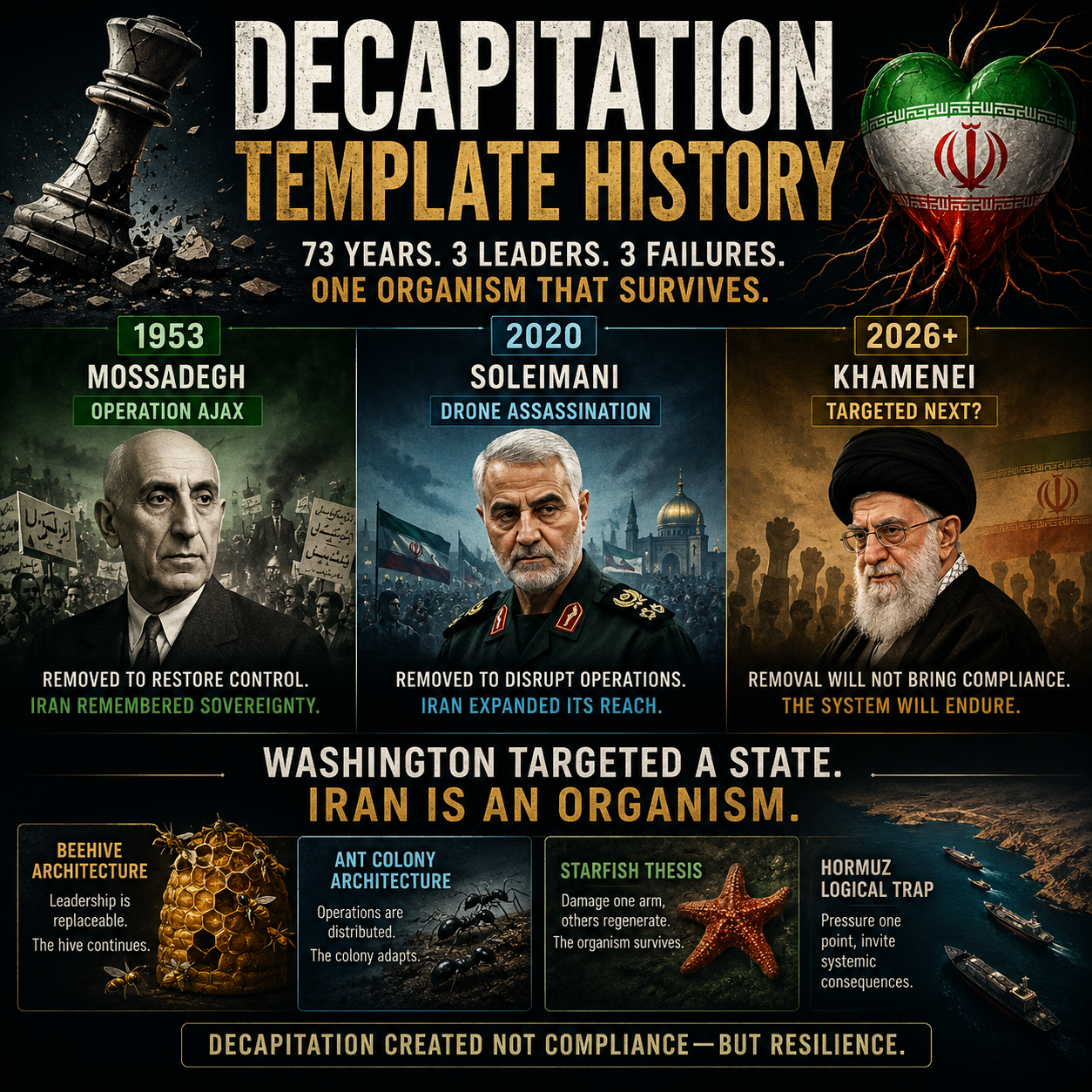
Washington Targeted a State. Iran Is an Organism. The Decapitation Template Has Been Applied Three Times in Seventy-Three Years — Mossadegh 1953, Soleimani 2020, Khamenei 2026. Each Application Produced a More Resistant, More Capable, and More Hostile Iran. You Do Not Kill a Beehive by Killing the Queen. The Template Is the Knife. Iran Is the Starfish. Each Cut Produces More Arms.
Blog 74 (Islamic NATO Reckoning) examined the alliance architecture the Hormuz war has produced on the Sunni side — its three internal contradictions and its structural inability to survive operational activation. Blog 75 examines the strategic doctrine that produced the war itself: the decapitation template — the belief that removing a leadership will produce the compliance that military pressure alone cannot. The Decapitation Template History is the documented record of this template’s application across seven decades, three targets, and zero instances of the compliance it was designed to produce. The explanation for the pattern is not in the three applications. It is in the fundamental misidentification of what was being targeted.
Decapitation Template History: Washington Targeted a State. Iran Is an Organism.
Decapitation Template History: Washington targeted a state. Iran is an organism. The decapitation template applied three times — Mossadegh 1953, Soleimani 2020, Khamenei 2026 — each produced a more resistant Iran. You do not kill a beehive by killing the queen. The template is the knife. Iran is the starfish. The decapitation template rests on a single assumption: that the entity being targeted is organised around a leader whose removal will change its behaviour. The assumption is correct when applied to states — political systems in which individual leadership makes consequential choices that successors might not make. The assumption is categorically wrong when applied to an organism — a system whose behaviour is governed by doctrine, institutional architecture, and distributed operational capacity that persists regardless of which individual occupies any given position.
The Iranian Islamic Republic is not a state in the conventional analytical sense. It is an organism — a system trained across forty-seven years of maximum external pressure to function without dependence on any individual component. Three biological analogies identify its three structural properties precisely.
The beehive:
Remove the queen, the colony does not die. The workers continue foraging, producing honey, defending the hive, raising larvae. The queen’s removal triggers the succession mechanism — a new queen emerges, the colony continues. The Velayat-e Faqih governance model is Iran’s beehive architecture: the Supreme Leader is the queen, but the colony’s function — the Mustad’afin constitutional mandate, the proxy architecture, the IRGC operations — does not depend on which specific jurist occupies the position. Mojtaba Khamenei was appointed within 72 hours. The hive continued.
The ant colony:
No central command. Each ant operates on local information and chemical signals without instruction from the apex. Remove the queen ant — the colony reorganises. Remove any individual ant — irrelevant. The operational capacity is in the system, not the individual. The IRGC Mosaic (Blog 39) — 31 independent commands, each operating on doctrine and standing orders — is Iran’s ant colony architecture. Soleimani’s removal produced no reduction in proxy network operational capacity because the network ran on distributed doctrine, not on Soleimani’s individual direction.
The starfish:
The Raktbeej and Starfish Thesis on hinduinfopedia.com established this precisely — the organism in which destruction produces replication. Cut a starfish arm: the arm grows a new starfish, the starfish grows a new arm. Iran’s proxy architecture is the starfish: each proxy is an autonomous arm. Remove Hamas leadership, new leadership emerges from within the ecosystem. Remove Hezbollah’s commander, a trained cadre replaces him. Each decapitation attempt is the oyster fisherman’s knife — triggering the replication it seeks to stop.
The decapitation template has been applied to Iran three times. Each time it was applied to the organism as if it were a state. Each time the organism’s three properties — distributed function, decentralised intelligence, replicative resistance — produced the outcome the template was designed to prevent.
📌 The Three Doctrines That Make the Organism Immune
Mustad’afin constitutional mandate, Velayat-e Faqih governance, IRGC Mosaic architecture — three structural properties that persist regardless of which individual occupies any position. The organism’s design, not its leadership’s resilience.
Decapitation Template History: Three Applications, Three Invoices
Application One — Mossadegh 1953.
Mohammad Mosaddegh was Iran’s democratically elected Prime Minister — a secular nationalist who nationalised the Anglo-Iranian Oil Company in 1951, redirecting Iranian oil revenues from British corporate extraction to Iranian state development. Report documented the CIA’s 2013 declassified confirmation of its role in the 1953 coup — Operation Ajax — that overthrew Mossadegh and restored the Shah. Remove the nationalist who took the oil. Restore the monarch who returns it. The template’s first application was not to the organism — the Islamic Republic did not yet exist. It was to the secular democratic state that preceded it. The assumption was correct in one sense: Mossadegh’s removal did change Iran’s behaviour. What it changed Iran’s behaviour into was the twenty-six years of anti-Shah revolutionary organisation that produced the Islamic Republic — the organism that the second and third applications would find immune to the same template. The Decapitation Template History’s first invoice: remove a democratic nationalist leader to recover oil access, receive the organism that replaced him as the invoice twenty-six years later.
Application Two — Soleimani 2020.
General Qasem Soleimani was the commander of the IRGC Quds Force — the organism’s primary instrument for proxy warfare and the four-country architecture that Blog 64 documented. On January 3 2020, a US drone strike at Baghdad International Airport killed Soleimani. Remove the architect of the proxy architecture — the network will dissolve without its builder. The template applied to the organism’s ant colony dimension: remove the queen ant, the colony collapses. Esmail Qaani was appointed IRGC Quds Force commander within hours. Reuters documented one year after the assassination that Iran’s proxy network was stronger than before the killing. The colony had not noticed the queen was gone — it was never running on the queen’s direction. Iran retaliated with ballistic missile strikes on the Ain al-Assad airbase — the largest ballistic missile attack on US forces in history. The Iraqi parliament voted to expel US forces from the country that hosted the assassination. The Decapitation Template History’s second invoice: remove the architect of the proxy network, receive a strengthened proxy network, the largest missile attack on US forces in history, and a parliamentary vote to expel US forces from the host country.
Application Three — Khamenei 2026.
The assassination of Supreme Leader Ali Khamenei in Operation Epic Fury’s opening strikes on February 28 2026 was the template’s most ambitious application — the first targeted killing of an Iranian Supreme Leader in the Islamic Republic’s history. Remove the beehive’s queen — the colony’s function will cease without the apex organism. Mojtaba Khamenei was appointed by the Assembly of Experts within 72 hours. The Hormuz closure was implemented within 24 hours of the strikes. The Fujairah ballistic missile strikes followed five weeks later. The organism’s three properties operated exactly as designed: the beehive found a new queen, the ant colony continued on distributed doctrine, the starfish grew new arms from the stumps the decapitation created. Blog 65 (Iran’s War Logic) established the precise reason: the Velayat-e Faqih’s legitimacy is demonstrated through survival under pressure. Removing the leader proved the model’s resilience rather than its fragility — administering the legitimacy proof the organism required to demonstrate its invulnerability to the template designed to destroy it. The Decapitation Template History’s third invoice: remove the Supreme Leader, receive an organism that has demonstrated to its own population and to the global Muslim community that it can absorb the assassination of its most sacred office and continue operating.
Decapitation Template History: The Categorical Error
The Decapitation Template History’s pattern is not a series of intelligence failures, execution failures, or successor miscalculations. It is the consistent output of a categorical error: applying a state-assassination instrument to an organism. The error is not tactical. It is definitional. Washington has spent seventy-three years trying to change Iran’s behaviour by removing individual leaders. Iran’s behaviour is not a function of individual leadership. It is a function of constitutional mandate, institutional architecture, and distributed operational capacity that persists regardless of which individual occupies any given position.
The medical analogy that the previous version of this blog used — removing the hospital administrator does not close the hospital — understates the organism’s resilience. The correct analogy is removing the queen from a beehive that was specifically bred to continue functioning without a queen. The organism was not accidentally resilient to the template. It was architecturally designed to be immune to it — forty-seven years of maximum external pressure having progressively eliminated every component of the original Iranian state that was not organism-grade resilient. What remains after seventy-three years of the decapitation template’s application is the organism’s most resistant expression: the components that survived every previous application, selected and hardened by each successive attempt. Washington’s Global Control War has been, among its other functions, a seventy-three-year breeding programme for the most resilient expression of Iranian resistance. The Hormuz Logical Trap is the organism’s current form — the product of every decapitation the template has applied and the resistance each decapitation selected for. Blog 76 (Iran Decapitation Template) examines the 2026 application in its specific operational detail — what was targeted, what was expected, and what the organism produced in the 72 hours that confirmed the template’s failure for the third consecutive time.
📌 The IRGC Mosaic That Survived All Three Decapitations
31 independent commands, distributed architecture designed to survive decapitation — the ant colony dimension of the Iranian organism that made all three template applications produce the same outcome.
Next: Iran Decapitation Template — Blog 76 in West Asia’s Endless War examines the 2026 application in its specific operational detail — what Operation Epic Fury’s decapitation component targeted, what it expected, what the organism produced in the 72 hours after Khamenei’s assassination, and why the beehive, the ant colony, and the starfish all activated simultaneously to produce the Hormuz closure rather than the compliance the template was designed to deliver. Part of the West Asia’s Endless War Series on hinduinfopedia.com.
Update on June 4, 2026
The June 3 2026 strikes confirmed this precisely. Three months after Operation Epic Fury’s decapitation of the Supreme Leader, the IRGC simultaneously struck the US Fifth Fleet headquarters in Bahrain, a regional American airbase, and Kuwait’s international airport — while introducing the Persian Gulf Strait Authority as an institutional toll mechanism and declaring the era of hit and run over. The organism that the template was designed to eliminate had, in three months, formalised its Hormuz authority, expanded its strike geography to civilian infrastructure, and declared a new offensive doctrine. Each cut produced more arms — documented in real time.
Feature Image: Click here to view the image.
Videos
Glossary of Terms
- Decapitation Template: A strategic doctrine based on the belief that removing a state’s leadership will weaken, fragment, or compel the targeted system into compliance.
- Decapitation Template History: The blog’s central concept examining three major applications of leadership-removal strategy against Iran across seventy-three years and the outcomes they produced.
- Operation Ajax: The 1953 CIA- and MI6-backed operation that overthrew Iranian Prime Minister Mohammad Mossadegh and restored Shah Mohammad Reza Pahlavi.
- Mohammad Mossadegh: Iran’s democratically elected Prime Minister who nationalized the Anglo-Iranian Oil Company and was removed during Operation Ajax in 1953.
- Velayat-e Faqih: The Iranian system of governance in which a senior Islamic jurist serves as Supreme Leader and ultimate constitutional authority.
- Mustad’afin Constitutional Mandate: The Islamic Republic’s ideological commitment to defending and supporting the oppressed, forming a key element of its revolutionary identity.
- IRGC (Islamic Revolutionary Guard Corps): Iran’s parallel military and security institution tasked with protecting the Islamic Revolution and projecting Iranian influence abroad.
- IRGC Mosaic: A term developed in this series describing Iran’s distributed command architecture of semi-autonomous operational units designed to survive decapitation attempts.
- Quds Force: The external operations branch of the IRGC responsible for foreign operations, proxy coordination, and strategic influence activities.
- Qasem Soleimani: The commander of the IRGC Quds Force whose assassination by a US drone strike in January 2020 forms the second case study in the blog.
- Organism Model: The blog’s analytical framework describing Iran as a self-preserving system governed by doctrine, institutions, and distributed capacity rather than by individual leaders.
- Beehive Architecture: The analogy used to explain succession resilience, where removal of the apex leader triggers replacement without disrupting the system’s core functions.
- Ant Colony Architecture: The analogy used to explain distributed operational capability, where local units continue functioning without direct guidance from a central authority.
- Starfish Thesis: A concept developed in the series describing systems that regenerate after attempts at destruction, with each loss producing adaptation rather than collapse.
- Hormuz Logical Trap: A term coined in this series describing the strategic dilemma created by Iran’s ability to leverage the Strait of Hormuz in response to external pressure.
#Iran #WestAsia #MiddleEast #Geopolitics #IRGC #Hormuz #Mossadegh #Soleimani #Khamenei #Strategy #War #History #HinduinfoPedia
West Asia’s Endless War: Why This Series Exists
Refer to Various Arks Referred to in the Blog
https://hinduinfopedia.com/proof-of-endless-war-master-reference-table/
[…] भारत / GB […]
[…] Blog 75 (Decapitation Template History) established the categorical error: Washington targeted a state, Iran is an organism. Three applications of the decapitation template — 1953, 2020, 2026 — each produced a more resistant Iran because the template applied a state-assassination instrument to a system with distributed function, decentralised intelligence, and replicative resistance. Blog 76 examines the 2026 application in its specific operational detail — what Operation Epic Fury targeted, what it expected at each level, and what the organism produced in the 72 hours that confirmed the template’s third consecutive failure against the beehive, the ant colony, and the starfish simultaneously. […]
[…] https://hinduinfopedia.com/decapitation-template-history-a-reckoning-of-west-asias-endless-war-75/ […]
[…] institutional consequence: the President who launched the war against an organism whose survival of decapitation Blog 75 documented has simultaneously applied the decapitation criterion to his own command structure — removing […]
[…] बाद भी टिके रहने की क्षमता का उल्लेख ब्लॉग 75 में किया गया था। उसी समय उन्होंने […]
[…] it got stronger. It is now a more vicious, a stronger regime than before.” This is the Decapitation Template History argument (Blog 75) stated through bomb damage assessment rather than doctrine analysis. The template produced a […]
[…] it got stronger. It is now a more vicious, a stronger regime than before.” This is the Decapitation Template History argument (Blog 75) stated through bomb damage assessment rather than doctrine analysis. The template produced a […]
[…] Read: Decapitation Template History → […]
[…] the Iran war’s outcome with the same analytical attention Iran spent 47 years developing. Blog 75 (Decapitation Template History) established that Iran’s IRGC Mosaic was built specifically by studying Washington’s […]
[…] दृष्टि से ईरान ने 47 वर्षों तक किया था। ब्लॉग 75 (डिकैपिटेशन टेम्पलेट हिस्ट्री… ने स्थापित किया था कि ईरान की […]