

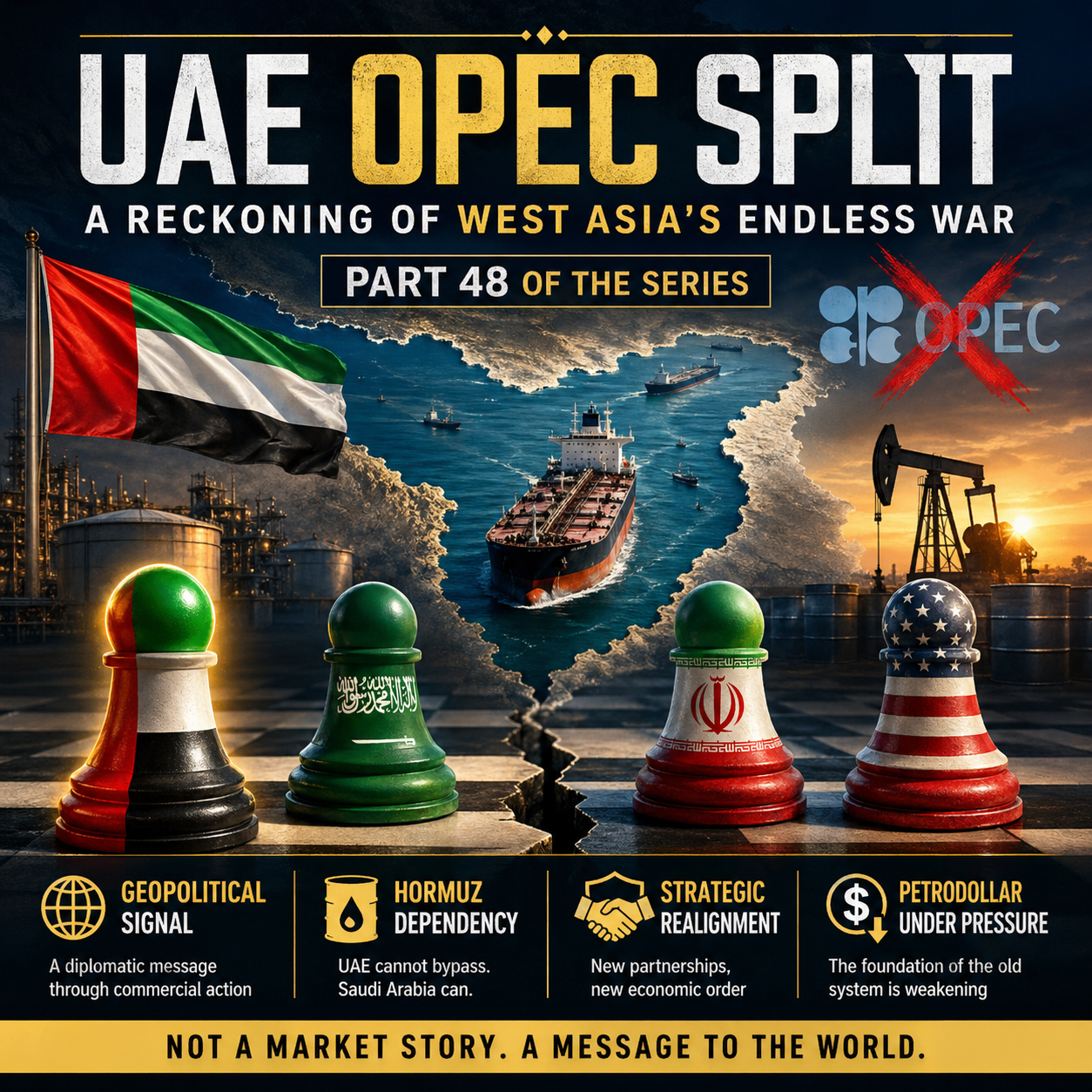
UAE OPEC Split: A Reckoning of West Asia’s Endless War (48)
Part 48 of the West Asia’s Endless War Series
भारत / GB
The UAE Did Not Announce a Policy Change. It Delivered a Diplomatic Note Through Commercial Action — Simultaneously to Iran, to Saudi Arabia, and to Washington.
Blog 47 established the China Oil Revenge — how China spent a decade building the alternative to the petrodollar architecture and collected the harvest as Washington’s war dismantled the system it was designed to defend. Blog 48 examines today’s breaking development: the UAE exits OPEC and OPEC+ effective May 1 2026, ending 59 years of membership, timed precisely as Iran’s new Hormuz proposal is being considered and the second round of Islamabad talks is being arranged. The UAE OPEC Split is not a market story. It is a diplomatic communication — delivered without a phone call, readable by every party that needs to read it.
UAE OPEC Split: Why UAE, Not Saudi Arabia
UAE OPEC Split: 59 years of membership ended May 1 2026 without consulting Saudi Arabia. The exit communicates more to Iran than any phone call could. The commercial logic of the UAE OPEC Split begins with geography — specifically with the geography of Hormuz and the absence of a bypass.
Blog 11 established the Hormuz chokehold — the strait through which 20% of global oil passes. Saudi Arabia has an alternative. Saudi Arabia’s East-West pipeline carries 5 million barrels per day to Yanbu on the Red Sea coast — Saudi Arabia can route its exports entirely around Hormuz when necessary. It has done so before. The UAE has no such alternative. The Habshan-Fujairah pipeline carries approximately 1.5 million barrels per day — less than a third of UAE’s production capacity of 4.85 million bpd. The majority of UAE’s oil must transit Hormuz. Every day Hormuz stays closed, UAE bleeds. Every day Hormuz stays closed, Saudi Arabia is commercially inconvenienced but not existentially threatened.
This single geographic fact explains positions that every media analysis conflated. The UAE’s oil production slumped 44 to 50% per day following the Hormuz closure — a collapse in revenue from an existential export dependency. Saudi Arabia, with its Red Sea bypass, absorbed an inconvenience. UAE absorbed a catastrophe. Saudi Arabia, therefore, could rationally push for the war to continue until regime change in Iran. UAE — absorbing 537 ballistic missiles, 2,256 drones, and 26 cruise missiles, with production halved and revenue collapsing — needed the ceasefire immediately. UAE welcomed the ceasefire warmly. Saudi Arabia was unhappy with it. These were not two Gulf states diverging randomly. They were two states with different geographic exposure to the same closure, arriving at rational but opposite positions.
Inside OPEC+, the UAE was producing approximately 30% below its production capacity of 4.85 million bpd — constrained by Saudi-led production quotas designed to manage global prices for the collective’s benefit. The UAE’s production capacity is currently 4.85 million bpd, and as part of OPEC+ the UAE had been producing close to 30% below that ceiling — leaving billions of dollars of potential revenue uncaptured every month while Saudi-led discipline held the collective price. Bloomberg confirmed the UAE’s exit May 1 after six decades was a significant loss for the group, which had spent years balancing global oil markets — UAE accounting for roughly 12% of the group’s overall supply before the conflict.
📌 The Gulf Betrayal That Made This Exit Rational
The four-pillar dependency that Washington’s war broke simultaneously — and why the Gulf states that were most damaged are now most urgently repositioning.
UAE OPEC Split: The Saudi-UAE Cold War Formalised
UAE Energy Minister Suhail Al Mazrouei confirmed that the UAE did not consult Saudi Arabia before announcing the exit. “This has nothing to do with any of our brothers or friends within the group,” he stated. The diplomatic language is precise — the denial of consultation is itself the communication. States that have close, functional relationships consult on decisions of this magnitude. The formal denial that consultation occurred is the formal acknowledgement that the relationship has changed.
The Saudi-UAE rupture predates the Iran war and runs deeper than OPEC quotas. The UAE and Saudi Arabia had joined a coalition to fight against Yemen’s Iran-backed Houthi rebels in 2015. Al Jazeera reported that the coalition broke down into recriminations in late December when Saudi Arabia bombed what it described as a weapons shipment bound for Yemeni separatists backed by the UAE. Rystad Energy noted that losing a member with 4.8 million barrels per day of capacity “takes a real tool out of the group’s hands.” The economic competition has been equally sharp — both states compete for the same investors, the same talent, the same regional headquarters of international corporations. Saudi Arabia’s Vision 2030 and UAE’s various development programmes are competing architectures for post-oil regional economic leadership. And now, with the OPEC exit, the commercial competition has been formalised: UAE will produce freely while Saudi Arabia manages OPEC’s collective discipline. Every barrel UAE sells above its old quota is a barrel at a price Saudi Arabia helped maintain — without Saudi Arabia receiving the corresponding production share.
The UAE OPEC Split’s most consequential structural argument is the one Blog 51 (India Strategic Neutrality) will examine in full: two incompatible Gulf security alignments have now formed. Saudi Arabia is building a Saudi-Pakistan-Turkey security architecture under the SMDA framework — a Sunni-nationalist collective defence structure. UAE signed a Strategic Defence Partnership Letter of Intent with India on January 19 2026, creating a UAE-India-Israel non-Islamist security alignment. These two alignments are not compatible. Saudi Arabia’s primary security partner is Pakistan — India’s nuclear adversary. UAE’s primary strategic partner is India — which sits across from Pakistan in every security calculus. The OPEC exit is the commercial expression of a security divergence that was already structural.
UAE OPEC Split: The Message Without Words
The UAE OPEC Split’s most precise analytical dimension is what the exit communicates to Iran without a direct communication being made. Direct Iran-UAE talks are politically impossible at the moment — Iran fired 537 ballistic missiles, 2,256 drones, and 26 cruise missiles at UAE, killed 13 people, injured 224, and slumped oil production about 44% to 1.9 million barrels per day. The Islamabad Reckoning documented UAE’s conditions for any normalisation: Anwar Gargash stated that any deal with Iran would need to include guarantees that Iran would not attack again and reparations for the damage caused. No direct meeting is possible yet.
But the OPEC exit, timed precisely as Iran’s new Hormuz proposal is being considered, delivers four messages simultaneously without a phone call being made. First: UAE is not Saudi Arabia’s instrument — it did not consult Riyadh, demonstrating independent decision-making capacity. Second: UAE is not Washington’s instrument — it is producing freely, not following coalition coordination. Third: UAE needs Hormuz open — its 5 million bpd production target requires free navigation, making UAE’s commercial interest and Iran’s stated demand structurally convergent. Fourth: UAE can engage separately from the US-Iran framework — the OPEC exit demonstrates that UAE acts on national interest, not bloc loyalty.
The IRGC Mosaic Reckoning established that Iran’s distributed command architecture means central Tehran does not fully control local commanders. Iran’s Foreign Minister Araghchi understands this — which is why his regional tour has run through Oman (Iran’s traditional Gulf back channel) rather than directly to Abu Dhabi. The indirect architecture is already operating: Iran communicates through Oman, messages reach UAE through the Gulf’s established quiet diplomacy. UAE’s Energy Minister confirmed the decision’s timing was chosen to have minimum impact on the oil market and on OPEC friends, adding: “Our exit at this time is the right time for it, because it will have a minimum impact on the price and it will have a minimum impact on our friends at OPEC.” The care taken to minimise damage to the collective is itself a signal that UAE is not burning its bridges but repositioning within existing relationships.
The UAE OPEC Split connects directly to the dollar pricing architecture. The Gulf Dollar Exit Reckoning established that the petrodollar arrangement’s enforcement floor was the collective OPEC management framework. UAE leaving OPEC means its bilateral contracts with India (rupee-dirham settlement under the Strategic Defence Partnership) and China (yuan-denominated purchases through existing swap agreements) are now unconstrained by OPEC coordination requirements. The dollar denomination of oil contracts does not fall on May 1. But the institutional architecture that made it mandatory has just lost its third-largest enforcer. The Petrodollar Drain Reckoning in Blog 49 examines what fifty years of mandatory dollar denomination actually cost the Gulf — the calculation that makes the exit not just commercially rational but historically overdue.
📌 The Ummah Dimension of This Exit
Iran attacked a fellow OPEC Muslim state. OPEC provided zero institutional protection. The UAE OPEC Exit is Blog 7 (Ummah Delusion) confirmed at the institutional level — Muslim solidarity offered no shield when the missiles fell.
The UAE OPEC Split’s closing argument is the one the Ummah framing obscures. Iran attacked UAE. UAE is leaving OPEC. The Islamic institutional framework provided zero protection and zero remedy. Blog 7 (Ummah Delusion) established that Muslim solidarity fractures at the Shia-Sunni line every time it is operationally tested. The UAE OPEC Exit confirms this at the institutional level rather than the political: OPEC — the organisation that made Gulf oil collectively powerful for six decades — could not protect one of its own members from being attacked by another. The response is not ideological confrontation. It is commercial and strategic independence — the Sunni Gulf’s operational answer to strategic pressure, built through bilateral partnerships with India, Israel, and the dollar-alternative architecture that fifty years of petrodollar obligation prevented. The UAE OPEC Split is the Gulf Betrayal Reckoning’s commercial conclusion: the arrangement that was supposed to provide collective security provided neither collection nor security. The UAE has drawn the logical inference.
Next: Petrodollar Drain Reckoning — Blog 49 in West Asia’s Endless War asks the question the UAE OPEC exit makes urgent: What did fifty years of mandatory dollar denomination actually cost? A Gulf sovereign wealth fund that invested $100 billion in US Treasuries in 1974 holds approximately $100 billion in real purchasing power today—zero real gain across fifty years, as three dollar debasement cycles consumed every cent of the nominal yield. In a mechanism strikingly similar to how the British Raj turned India’s revenue into a foreign asset and extracted a “commission” for every transaction, the petrodollar architecture has turned Gulf oil production into a dollar-preservation tool for Western liquidity. The UAE has effectively served the eviction notice: the era of wealth extraction for the benefit of a distant imperial treasury is over. Part of the West Asia’s Endless War Series on hinduinfopedia.com.
Feature Image: Click here to view the image.
Videos
[…] भारत / GB […]
[…] https://hinduinfopedia.com/uae-opec-split-a-reckoning-of-west-asias-endless-war-48/ […]
[…] mechanism that UAE and India began operationalising for gold, crude oil, and food products in 2023. Blog 48 (UAE OPEC Split) established that the OPEC exit removes the collective enforcement floor for dollar oil pricing. The […]
[…] Read […]
[…] across individual blogs — Blog 47 (China Oil Revenge), Blog 42 (Russia Passive Dividend), Blog 48 (UAE OPEC Split), Blog 58 (India Strategic Neutrality). Blog 68 examines all three in parallel — not what each […]