

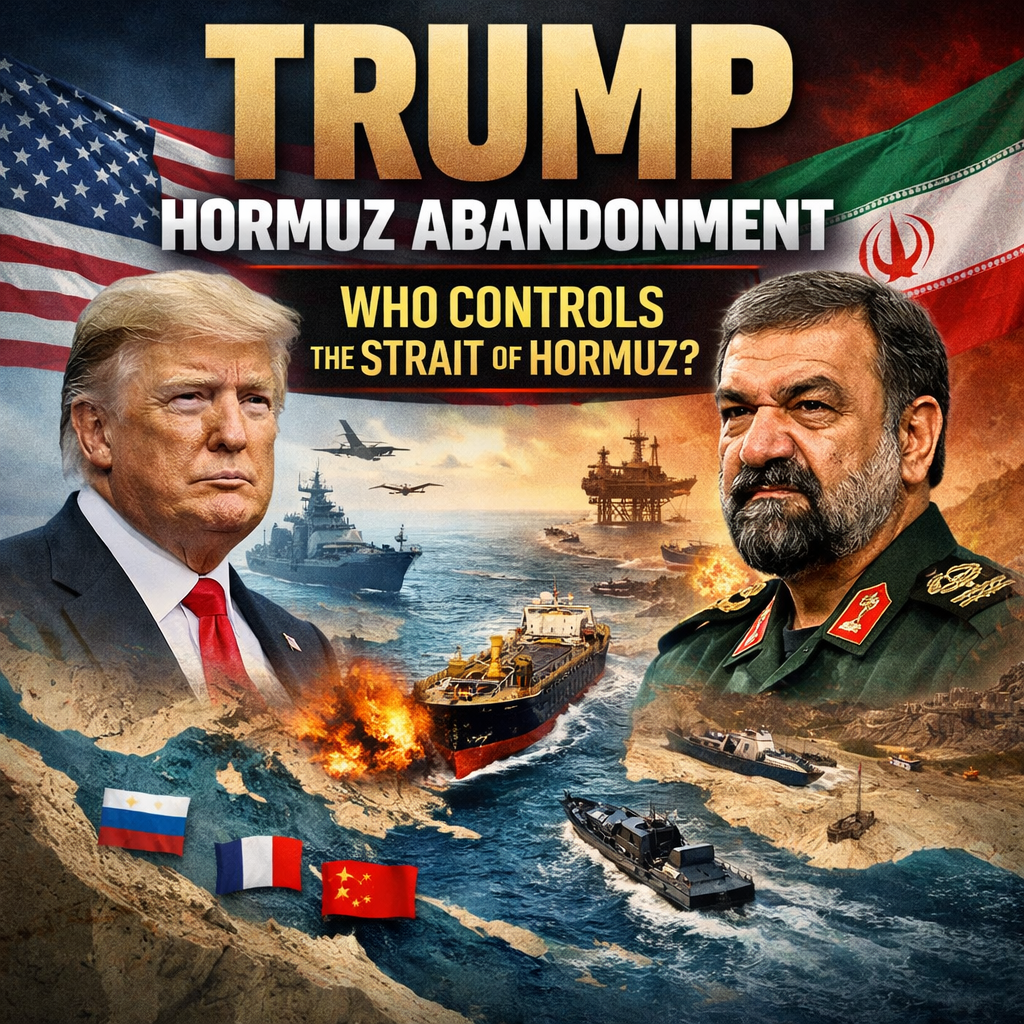
Trump Hormuz Abandonment: A Reckoning of West Asia’s Endless War (22)
Part 22 of the West Asia’s Endless War Series on hinduinfopedia.com
भारत / GB
He Started the War. He Closed the Strait. Then He Told the World It Was Their Problem.
Trump Hormuz Abandonment: Background and Consequences
This series has already built its argument across 21 blogs- building the architecture of the Hormuz crisis — tracing the oil leverage, the civilisational memory, the theological fracture, the petrodollar system, and the strategic patience of a Persian state that does not think in election cycles but in centuries. That framework was not constructed as theory. It was built in anticipation of a moment like this — when the United States, having triggered the conflict, steps back from its consequences and reframes responsibility as someone else’s burden. That moment has now arrived when we analyse why Trump Hormuz Abandonment matters for the consequences of the war and the world at large. This blog examines that shift not as rhetoric, but as doctrine in action.
The Trump Hormuz Abandonment Doctrine, Stated in Plain English
Trump Hormuz Abandonment: on the evening of April 1, 2026, the President of the United States delivered a prime-time address to the nation about a war he started 33 days earlier. In it, he announced something that will be studied in geopolitical classrooms for decades. He declared that the countries of the world that receive oil through the Strait of Hormuz must take care of that passage themselves, saying “we will be helpful, but they should take the lead in protecting the oil that they so desperately depend on”. He told allies to “go to the strait and just take it, protect it, use it for yourselves”, adding that Iran had been “essentially decimated” and the hard part was done. The Trump Hormuz Abandonment was not a slip of the tongue. It was a doctrine — stated, repeated, and reinforced. He repeated it three times in three days before the formal address, and his Defence Secretary confirmed it the following morning.
This blog does not cover whether the doctrine is wise or legal. It covers what it means — for the global order, for America’s alliances, for the countries that depend on Hormuz, and for Iran, which is watching all of it from inside a war it has not lost.
What the Trump Hormuz Abandonment Actually Says
Strip the rhetoric and the Trump Hormuz Abandonment doctrine contains four specific claims, each with its own implication.
First, the US does not need Hormuz. “The United States imports almost no oil through the Hormuz Strait and won’t be taking any in the future. We don’t need it,” Trump said. This is factually defensible — the US is the world’s largest oil producer and is insulated from Gulf supply. What it omits is that oil is a globally priced commodity. Brent crude has peaked at $126 per barrel, Dubai crude reached an unprecedented $166 per barrel, and US gasoline has crossed $4 per gallon for the first time since 2022 Ukraine–Russia war. Americans are paying the price whether or not their oil comes from the Gulf.
Second, the strait will open naturally once the war ends. Trump claimed it would “just open up naturally” and that gas prices would “rapidly come back down” — a claim met with immediate skepticism from economists and analysts. Iran’s new supreme leader Mojtaba Khamenei — son of Ali Khamenei, killed in the opening strikes — has declared the strait will remain closed as a tool of pressure. There is no mechanism by which it opens “naturally” if Iran chooses to keep it shut.
Third, reopening is the responsibility of the users. At the G7 meeting in France, Secretary of State Rubio told allies the US doesn’t need their help to fight the war but wants them to join a maritime task force to police the strait after it is over. In other words: the US starts the war, degrades Iran’s capabilities, and then hands the bill for securing the aftermath to allies who opposed the war, were not consulted before it started, and are now being told their energy security is their own problem.
Fourth, the US will end the war in two to three weeks regardless. “We are going to hit them extremely hard over the next two to three weeks. We’re going to bring them back to the Stone Ages where they belong,” Trump said, claiming core strategic objectives were “nearing completion”. Military and foreign policy experts told multiple outlets that degrading Iran’s offensive capabilities is not the same as resolving the Hormuz closure — which requires Iranian political agreement, not just the destruction of naval assets.
The Alliance Collapse: Who Refused, Who Hedged, Who Has No Choice
The Trump Hormuz Abandonment produced an immediate and documented collapse of allied solidarity — the most comprehensive rebuff of an American president’s military demand since the Iraq War. The responses came quickly and were unambiguous.
German Defence Minister Boris Pistorius dismissed Trump’s request bluntly: “What does Trump expect a handful of European frigates to do in the Strait of Hormuz that the powerful US Navy cannot do? This is not our war; we have not started it.” Australia, Japan, Poland, Sweden, and Spain said they had no intention of sending military ships. Japan’s Prime Minister told parliament that operations in the Strait of Hormuz might not pass legal muster under Japan’s strict laws limiting overseas military deployments. South Korea said it needed time for deliberation. France said it would consider escorting ships only if the conflict stabilised first — meaning after the crisis was already over.
The EU’s foreign policy chief Kaja Kallas said the strait was “out of NATO’s area of action” and that “nobody is ready to put their people in harm’s way”. When Trump threatened that allied refusal would be “very bad for the future of NATO”, French President Macron called Trump’s idea of “forcibly liberating” the strait “unrealistic” and rebuked his inconsistencies publicly. Richard Haass, president emeritus of the Council on Foreign Relations, summarised the position with precision: in an inversion of the old Pottery Barn rule, Trump was telling his allies — “We broke it, but you own it.”
The only country that moved quietly toward engagement was the United Kingdom — Starmer discussed offering mine-hunting drones and maintained the UK would not be drawn into the wider war. Even this limited offer had been preceded by Trump publicly telling Starmer not to bother sending aircraft carriers weeks earlier, writing on Truth Social: “We don’t need people that join Wars after we’ve already won!”
The Oil Clock: What Trump’s Timeline Ignores
This doctrine rests on the assumption that the economic damage is temporary and manageable. The data does not support this. The IEA coordinated the largest emergency release of crude reserves in history — 400 million barrels — and the oil market shrugged it off, with Brent hitting new highs every now and then before climbing the continued to rise despite intervention. Geopolitical strategist Marko Papic estimated that by mid-April the world will have lost close to 10 million barrels per day of effective supply — double the current disruption — as strategic reserves, exempted Russian oil, and other buffers run dry simultaneously [March 28 2026].
Bloomberg Economics estimates that at $170 per barrel, the impact on inflation and growth roughly doubles — a stagflationary shock that shifts everything from the path of central banks to the outcome of midterm elections. United Airlines CEO Scott Kirby has said he is planning for $175 oil through 2027. The Shell CEO described disruptions that started in South Asia moving to Southeast Asia, Northeast Asia, and into Europe as April progresses — a physical cascade that no amount of reserve releases can stop.
The gap between Trump’s claim that the strait will “open naturally” and this physical reality is not a communication problem. It is a strategy problem. There is no plan. Senator Mark Warner said Trump and his administration “have offered a moving target of justifications for this war of choice — none matched by the serious planning required to manage its predictable consequences”. There is no plan — and this address was its public face.
Trump Hormuz Abandonment: What Iran Understands That Washington Does Not
The Trump Hormuz Abandonment is being read in Tehran with care. Iran’s former IRGC commander Mohsen Rezaei was direct: “Even if the whole world comes together, they cannot reopen the Strait of Hormuz. The strait has a geographical position that multiplies the capability of the forces seeking to close it by 10.” That multiplier does not remain static. It increases further under pressure: when central leadership is degraded, the network fragments into semi-autonomous nodes — ideologically aligned, operationally independent, and capable of sustaining disruption without waiting for central command. Russia’s foreign ministry stated that any initiative on Hormuz passage must involve the consent of the nations that border it — meaning Iran — making any unilateral allied operation diplomatically impossible before it starts. On April 2, Bahrain called on the UN Security Council to authorise military force to reopen the strait; Russia, China, and France all expressed opposition.
What Iran understands is that the Trump Hormuz Abandonment is a gift to itself. It tells Tehran that Washington intends to end the war without resolving the Hormuz question — meaning Iran retains its primary leverage asset after the bombs stop falling. It tells the world that America’s allies will not fight to reopen the strait. It tells India, Japan, South Korea, and Europe that their energy security is now contingent on their own diplomatic engagement with a country the US has just spent five weeks bombing. And it tells every future adversary of the United States that the threat of Hormuz closure is a viable strategic deterrent — one that can survive even a direct US military campaign.
Blog 11 of this series argued that Hormuz was the weapon Iran chose over missiles. The Trump Hormuz Abandonment proves it was the right choice. The missiles have been degraded. The strait remains closed. The leverage remains intact.
The next blog in this series is Iran Selective Blockade: A Reckoning of West Asia’s Endless War (39) — which examines what Iran’s “open to friendly nations” claim actually looks like in operational reality. Two Indian tankers, one Pakistani vessel, payments in Chinese yuan, ships struck at random, 22 vessels stranded. The selective blockade is not a humanitarian gesture. It is a toll-gate — and understanding who controls it, on what terms, and to what end is the key to understanding what comes after the war ends.
Feature Image: Click here to view the image.
Videos
Glossary of Terms
- Strait of Hormuz: A narrow maritime passage between the Persian Gulf and the Gulf of Oman through which a significant portion of global oil supply flows.
- Trump Hormuz Abandonment: A doctrine in which the United States shifted responsibility for securing the Strait of Hormuz to countries dependent on it.
- Petrodollar System: A global financial arrangement where oil trade is primarily conducted in US dollars, reinforcing the dollar’s dominance.
- Civilisational Memory: The long-term historical consciousness of a nation that shapes its strategic thinking and behavior.
- G7 (Group of Seven): A coalition of seven major industrial economies that coordinate on global economic and political issues.
- Supreme Leader: The highest authority in Iran’s political and religious structure, guiding national strategy and policy.
- Strategic Leverage: The ability of a state to influence outcomes by controlling critical resources or positions.
- Global Oil Pricing: The system where oil prices are determined by international markets, affecting all economies regardless of domestic production.
- Allied Solidarity: The unity and coordinated response expected among allied nations during geopolitical crises.
- Decentralised Networks: Operational structures that function through semi-autonomous units without reliance on central command.
- Forward Defence: A strategic doctrine where threats are addressed beyond national borders to prevent conflict at home.
- Stagflation Shock: A situation where high inflation coincides with stagnant economic growth, often triggered by supply disruptions.
#Hormuz #Trump #Iran #Oil #Geopolitics #Energy #GlobalCrisis #USPolicy #MiddleEast #HinduinfoPedia
Previous Blog
- https://hinduinfopedia.com/war-zone-in-hormuz-a-reckoning/
and https://hinduinfopedia.in/?p=25537 - https://hinduinfopedia.com/hormuz-world-war-ladder-a-reckoning-of-west-asias-endless-war-2/
and https://hinduinfopedia.in/?p=25545 - https://hinduinfopedia.com/west-asia-war-ethics-a-reckoning-of-west-asias-endless-war-3/
and https://hinduinfopedia.in/?p=25550 - https://hinduinfopedia.com/west-asia-war-economics-a-reckoning-of-west-asias-endless-war-4/
and https://hinduinfopedia.in/?p=25557 - https://hinduinfopedia.com/nuclear-pretext-of-west-asia-war-a-reckoning-of-west-asias-endless-war-5/
and https://hinduinfopedia.in/?p=25588 - https://hinduinfopedia.com/nuclear-hypocrisy-of-usa-a-reckoning-of-west-asias-endless-war-6/
and https://hinduinfopedia.in/?p=25593 - https://hinduinfopedia.com/ummah-delusion-during-war-a-reckoning-of-west-asias-endless-war-7/
and https://hinduinfopedia.in/?p=25614 - https://hinduinfopedia.com/western-narrative-war-a-reckoning-of-west-asias-endless-war-8/
and https://hinduinfopedia.in/?p=25650 - https://hinduinfopedia.com/global-south-war-narrative-a-reckoning-of-west-asias-endless-war-9/
and https://hinduinfopedia.in/?p=25680 - https://hinduinfopedia.com/israel-survival-logic-a-reckoning-of-west-asias-endless-war-10/
and https://hinduinfopedia.in/?p=25755 - https://hinduinfopedia.com/chokehold-oil-economics-a-reckoning-of-west-asias-endless-war-11/
and https://hinduinfopedia.in/?p=25763 - https://hinduinfopedia.com/chokehold-food-security-a-reckoning-of-west-asias-endless-war-12/
and https://hinduinfopedia.in/?p=25786 - https://hinduinfopedia.com/chokehold-industrial-chain-a-reckoning-of-west-asias-endless-war-13/
and https://hinduinfopedia.in/?p=25816 - https://hinduinfopedia.com/gulf-war-responsibility-blockade-a-reckoning-of-west-asias-endless-war-14/
and https://hinduinfopedia.in/?p=25854 - https://hinduinfopedia.com/un-institutional-paralysis-a-reckoning-of-west-asias-endless-war-15/
and https://hinduinfopedia.in/?p=25885 - https://hinduinfopedia.com/colonial-order-endless-war-a-reckoning-of-west-asias-endless-war-16/
and https://hinduinfopedia.in/?p=25935 - https://hinduinfopedia.com/new-colonial-enforcement-in-war-a-reckoning-of-west-asias-endless-war-17/
and https://hinduinfopedia.in/?p=25953 - https://hinduinfopedia.com/petrodollar-betrayal-and-west-asia-war-a-historical-reckoning-18/
and https://hinduinfopedia.in/?p=25965 - https://hinduinfopedia.com/saudi-petrodollar-war-a-reckoning-of-west-asias-endless-war-19/
and https://hinduinfopedia.in/?p=25992 - https://hinduinfopedia.com/shia-sunni-war-roots-a-reckoning-of-west-asias-endless-war-20/
and https://hinduinfopedia.in/?p=26016 - https://hinduinfopedia.com/persian-civilisation-war-a-reckoning-of-west-asias-endless-war-21/
and https://hinduinfopedia.in/?p=26043
Follow us:
- English YouTube: https://www.youtube.com/@Hinduofficialstation
- Hindi YouTube: https://www.youtube.com/@HinduinfopediaIn
- X: https://x.com/HinduInfopedia
- Instagram: https://www.instagram.com/hinduinfopedia/
- Facebook: https://www.facebook.com/Hinduinfopediaofficial
- Threads: https://www.threads.com/@hinduinfopedia
[…] भारत / GB […]
[…] https://hinduinfopedia.com/trump-hormuz-abandonment-a-reckoning-of-west-asias-endless-war-22 and https://hinduinfopedia.in/?p=26073 […]
[…] https://hinduinfopedia.com/trump-hormuz-abandonment-a-reckoning-of-west-asias-endless-war-22 and https://hinduinfopedia.in/?p=26073 […]
[…] Read: Trump Hormuz Abandonment → […]
[…] पढ़ें: ट्रंप हॉर्मुज़ परित्याग → […]
[…] https://hinduinfopedia.com/trump-hormuz-abandonment-a-reckoning-of-west-asias-endless-war-22 and https://hinduinfopedia.in/?p=26073 […]
[…] https://hinduinfopedia.com/trump-hormuz-abandonment-a-reckoning-of-west-asias-endless-war-22 and https://hinduinfopedia.in/?p=26073 […]
[…] https://hinduinfopedia.com/trump-hormuz-abandonment-a-reckoning-of-west-asias-endless-war-22 and https://hinduinfopedia.in/?p=26073 […]
[…] Trump Hormuz Abandonment: A Reckoning of West Asia’s Endless War (22) https://hinduinfopedia.com/trump-hormuz-abandonment-a-reckoning-of-west-asias-endless-war-22/ […]
[…] Read […]