

Palestine’s Peace Process Invoice: A Reckoning of West Asia’s Endless War (73)
Part 73 of the West Asia’s Endless War Series
भारत / GB
Oslo Gave Guns. Those Guns Were Turned on Israeli Civilians. Gaza 2005 Gave Territory. That Territory Was Converted Into October 7’s Tunnel Network. The Peace Process Has Been One-Directional: Israel Gives Land and Legitimacy. The Ecosystem Converts Both Into the Next War’s Infrastructure. The Invoice Is the Same Whether the Payment Is Military or Diplomatic.
Blog 72 (Palestine: The Elimination Doctrine’s Invoice) documented the military dimension — each Arab attempt to eliminate Israel through force produced a more territorially extensive Israel. Blog 73 examines the civilian dimension of the same pattern: each Israeli territorial concession through the peace process was converted by the Raktbeej (or starfish biological system) ecosystem into preparation for the next elimination attempt rather than into the Palestinian state the concession was designed to enable. The Palestine’s Peace Process Invoice is the Elimination Doctrine’s Invoice’s complement — the same doctrine, the same outcome, through the negotiating table rather than the battlefield.
Palestine’s Peace Process Invoice: What Each Concession Produced
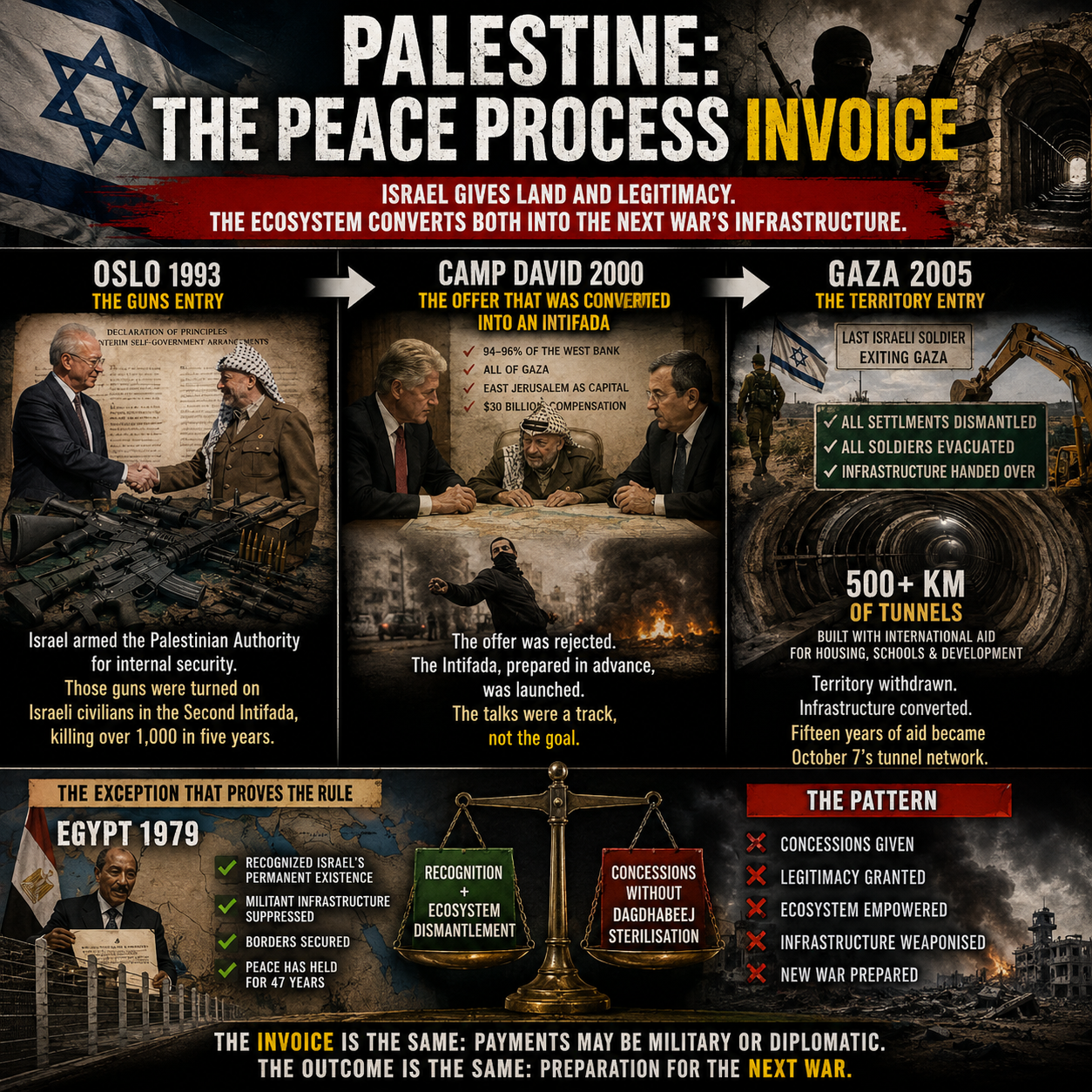
Palestine’s Peace Process Invoice: Oslo gave guns turned on Israeli civilians. Gaza 2005 gave territory converted into October 7’s tunnel network. Every concession was used to prepare the next war. The peace process has been one-directional: Israel gives land, the ecosystem converts it into the next war’s infrastructure. The Palestine’s Peace Process Invoice argument requires distinguishing between the Egyptian peace — the exception — and the Palestinian peace process — the pattern. Egypt’s case is the exception that proves the rule: Egypt made a genuine strategic decision to recognise Israel’s permanent existence, received the entire Sinai in exchange, and the peace has held for forty-seven years. Anwar Sadat was assassinated by the Egyptian Islamic Jihad for making that decision — demonstrating precisely why the same decision has not been made by Palestinian leadership: it requires dismantling the ecosystem’s theological foundation, which is also the leadership’s only source of political legitimacy, and the cost is visible in what happened to the leader who made it.
The Palestinian peace process has not produced a Palestinian state. It has produced a sequence of Israeli concessions, each converted by the Raktbeej (or starfish biological system) ecosystem into military or political infrastructure for the next elimination attempt. The Palestine’s Peace Process Invoice documents each entry.
Oslo 1993 — The guns entry.
The Oslo Accords were the first formal recognition of the PLO by Israel and the first Israeli acceptance of Palestinian self-governance. Israel permitted the Palestinian Authority to import weapons for internal security purposes — small arms, ammunition, and police equipment — establishing the PA’s capacity to maintain order in Palestinian-controlled areas. The concession was genuine and substantial: Israel legitimised its primary adversary, gave it governance authority over Palestinian populations, and armed it. The Peace Process Invoice’s first entry: Oslo armed the PA. The Second Intifada 2000-2005 deployed those arms against Israeli civilians in suicide bombings that killed over 1,000 people in five years. The weapons given for internal security governance were turned against the population on whose behalf governance authority had been granted. The invoice: give guns for governance, receive guns in civilian markets.
Camp David 2000 — The offer that was converted into an Intifada.
Blog 71 documented the Camp David offer’s terms — 94-96% of the West Bank, all of Gaza, East Jerusalem as capital, $30 billion compensation. Blog 73’s dimension is not the rejection but what the rejection produced. Palestinian negotiators subsequently acknowledged that the Second Intifada had been prepared in advance of the Camp David talks. The negotiating process was not a genuine attempt to reach a state — it was a parallel track to an armed campaign whose launch was contingent on the talks’ outcome. When the offer was rejected, the prepared Intifada was launched. The Palestine’s Peace Process Invoice’s second entry: attend negotiations with a prepared armed campaign, receive the offer’s rejection as the trigger for the campaign’s activation.
Gaza 2005 — The territory entry.
Ariel Sharon’s unilateral withdrawal from Gaza was the peace process’s most complete Israeli concession. Every Israeli settlement dismantled. Every Israeli soldier evacuated. Gaza’s infrastructure handed to the Palestinian Authority intact — greenhouses, institutional buildings, and utility connections. The greenhouses were destroyed within days of the handover. The institutional infrastructure was converted into Hamas’s governance apparatus after the 2006 electoral victory and 2007 military coup. The territory’s underground layer was systematically developed into the tunnel network whose construction consumed the international aid flowing into Gaza for fifteen years — aid intended for housing, schools, and economic development redirected into military infrastructure. Reuters documented that Hamas’s Gaza tunnel network exceeded 500 kilometres — longer than the London Underground — constructed from concrete that international donors provided for civilian infrastructure. The Peace Process Invoice’s third entry: give territory intact, receive territory as the world’s most elaborate underground military base. Gaza 2005 was October 7 2023’s construction period.
📌 The Military Invoice the Peace Process Complements
Five entries in the Elimination Doctrine’s Invoice — each Arab military attempt producing a larger Israel. The Palestine’s Peace Process Invoice is the same pattern through civilian and diplomatic channels.
Palestine’s Peace Process Invoice: The Ecosystem That Converts Concessions Into Weapons
The Peace Process Invoice’s pattern — every concession converted into preparation for the next elimination attempt — is not the result of Palestinian bad faith in the conventional diplomatic sense. It is the structural output of the Raktbeej (or starfish biological system) ecosystem that Blog 69 (Palestine Cause or Instrument) established. The ecosystem’s three germination essentials — UNRWA hereditary status as earth, Martyr Fund as fertiliser, martyrdom curriculum as water — produce a political environment in which state-building is structurally subordinate to resistance maintenance. Every leader who has received a territorial concession has operated within this ecosystem. The concession arrives in an environment where accepting it as a step toward permanent coexistence would require dismantling the ecosystem’s foundations. The ecosystem converts the concession instead — into military infrastructure, into political capital for the next resistance cycle, into the next generation of fighters recruited through the martyrdom curriculum.
The Martyr Fund dimension of the Palestine’s Peace Process Invoice is the most precisely documented. The US State Department documented that the Palestinian Authority’s Martyr Fund — the “Pay for Slay” programme — paid pensions to the families of individuals killed while conducting attacks on Israelis, with payment amounts indexed to the severity of the attack and the length of any prison sentence served. The fund operated throughout the Oslo period — throughout the Camp David negotiations — and continues to operate. It is funded partially through international donor contributions to the Palestinian Authority’s general budget. The peace process that gave the Palestinian Authority international legitimacy and donor financing simultaneously funded the payment architecture that financially incentivises the attacks the peace process is designed to prevent. The Peace Process Invoice’s most structurally embedded entry: every dollar of international aid to the Palestinian Authority that flows into the general budget contributes to the financial incentive structure that sustains the ecosystem the peace process claims to be resolving.
The Peace Process Invoice’s closing argument returns to the Egypt exception and what it proves. Egypt made the strategic decision to accept Israel’s permanent existence. Egypt recovered its territory from Israel and its borders through 18 meters deep underground wall. Egypt’s economy developed. Egypt’s population was not recruited into the next generation of fighters through a martyrdom curriculum.
The Egyptian peace is not proof that Israel refuses to make territorial concessions — Israel returned 61,000 square kilometres including oil fields. It is proof that the peace process works when the ecosystem’s three germination essentials are absent. Sadat’s assassination by the Egyptian Islamic Jihad demonstrates what happens when the ecosystem’s theological foundation is challenged — and why the Palestinian leadership operating within the ecosystem cannot make the same decision without facing the same consequence. The historical foundation that makes Israeli insistence on prior ecosystem dismantlement comprehensible — rather than an obstacle to peace — is the same foundation that makes the Egypt exception’s lesson the most important single data point in the Palestine’s Peace Process Invoice: peace is available. The ecosystem prevents its acceptance. The invoice accumulates not because Israel refuses to pay but because the payment is converted into the next invoice before the settlement clears. The Dagdhabeej sterilisation — as Blog 69 established — is the only instrument that stops the conversion. Not another concession. The roasting of the seed that converts concessions into weapons.
📌 The India 1947 Control Group — What the Ecosystem’s Absence Produces
Same displacement trauma. No UNRWA. No Martyr Fund. No martyrdom curriculum. Space-faring economy within two generations. The proof that the ecosystem — not the trauma — is the variable that determines the outcome.
Next: Islamic NATO Reckoning — Blog 74 in West Asia’s Endless War examines the Saudi-Pakistan-Turkey SMDA as an attempted Islamic collective defence architecture — its operational void, its nuclear umbrella creating existential conflict with Pakistan’s own 30-40 million Shia, and whether an alliance formed against Washington’s revealed conditionality can survive the internal contradictions written into its founding architecture. Part of the West Asia’s Endless War Series on hinduinfopedia.com.
Feature Image: Click here to view the image.
Videos
Glossary of Terms
- Palestine’s Peace Process Invoice: A framework used in this blog to argue that Israeli territorial and diplomatic concessions were repeatedly converted into military or political infrastructure for future conflict instead of producing stable peace.
- Elimination Doctrine: A recurring concept in the series describing repeated attempts to eliminate Israel militarily or politically, which the series argues instead strengthened Israel territorially or strategically.
- Raktbeej Ecosystem (or starfish biological system): A term coined in this series referring to a self-replicating militant-support structure sustained through institutions, funding systems, and ideological indoctrination that regenerate conflict across generations.
- UNRWA: United Nations Relief and Works Agency for Palestine Refugees in the Near East, established in 1949 to provide services to Palestinian refugees and their descendants.
- Martyr Fund: A Palestinian Authority payment system providing financial support to families of Palestinians killed, injured, or imprisoned in conflict-related actions against Israel.
- Pay for Slay: A phrase used by critics of the Martyr Fund to describe financial payments linked to attacks on Israeli civilians or security personnel.
- Oslo Accords: Agreements signed between Israel and the Palestine Liberation Organization (PLO) in 1993–1995 establishing limited Palestinian self-governance in parts of the West Bank and Gaza.
- PLO (Palestine Liberation Organization): An umbrella political and militant organization founded in 1964 claiming to represent the Palestinian people internationally.
- Second Intifada: A violent Palestinian uprising against Israel from 2000 to 2005 involving suicide bombings, armed clashes, and Israeli military operations.
- Camp David 2000 Summit: US-mediated negotiations between Israeli Prime Minister Ehud Barak and Palestinian leader Yasser Arafat aimed at resolving final-status issues between Israel and the Palestinians.
- Gaza Withdrawal 2005: Israel’s unilateral disengagement from Gaza involving the evacuation of Israeli settlements and military forces from the territory.
- Hamas: A Palestinian Islamist militant and political organization that took control of Gaza in 2007 after conflict with the Palestinian Authority.
- October 7 Attacks: The large-scale Hamas-led assault on Israel on October 7, 2023, involving cross-border infiltration, killings, hostage-taking, and attacks on civilians and military targets.
- Dagdhabeej Sterilisation: A term coined in this series derived from Hindu mythology, used metaphorically to describe the permanent dismantling of systems that regenerate militancy and conflict.
- Egypt Exception: A phrase used in the blog to describe Egypt’s peace treaty with Israel as a counterexample where recognition of Israel’s permanence and suppression of militant infrastructure produced lasting peace.
#Palestine #Israel #Gaza #Hamas #Oslo #MiddleEast #WestAsia #War #PeaceProcess #UNRWA #Intifada #HinduinfoPedia
West Asia’s Endless War: Why This Series Exists
Refer to Various Arks Referred to in the Blog
https://hinduinfopedia.com/proof-of-endless-war-master-reference-table/
[…] भारत / GB […]
[…] Blog 73 (Palestine: The Peace Process Invoice) completed the four-blog Palestine arc — establishing that the peace process has been one-directional, that every Israeli territorial concession was converted by the Raktbeej ecosystem (Starfish organic mechanism) into preparation for the next elimination attempt, and that genuine resolution requires the Dagdhabeej sterilisation of the three germination essentials rather than another offer of territory. Blog 74 examines the alliance architecture that the Hormuz war’s most consequential structural shift has produced on the Sunni side: the Strategic Mutual Defence Agreement signed between Saudi Arabia and Pakistan on September 17 2025, with Turkey’s observer status, promising Article 5-equivalent collective defence for a Sunni-majority bloc. The Islamic NATO Reckoning is the examination of what the SMDA promises, what it actually delivers, and what its internal contradictions reveal about whether an alliance formed against Washington’s revealed conditionality can survive the irresolvabilities of its own founding members. […]
[…] ब्लॉग 73 (फिलिस्तीन: शांति प्रक्रिया का … ने फिलिस्तीन से जुड़ी चार ब्लॉगों की शृंखला पूर्ण की। इस शृंखला ने स्थापित किया कि शांति प्रक्रिया एकतरफा रही। शृंखला ने यह भी दिखाया कि इज़राइल द्वारा किया गया प्रत्येक भूभागीय त्याग रक्तबीज तंत्र (स्टारफिश जैविक प्रणाली) द्वारा अगले समाप्ति प्रयास की तैयारी में बदल दिया गया। इस शृंखला ने यह निष्कर्ष भी रखा कि स्थायी समाधान के लिए दग्धबीज द्वारा तीन अंकुरण आधारों के निष्क्रियकरण की आवश्यकता है, न कि एक और भूभागीय प्रस्ताव की। ब्लॉग 74 उस गठबंधन संरचना का परीक्षण करता है जो होरमुज युद्ध के बाद सुन्नी पक्ष में सबसे बड़ा संरचनात्मक परिवर्तन बनकर उभरी। 17 सितंबर 2025 को सऊदी अरब और पाकिस्तान के बीच सामरिक पारस्परिक रक्षा समझौता हस्ताक्षरित हुआ। तुर्किये को इसमें पर्यवेक्षक स्थिति मिली। यह समझौता सुन्नी-बहुल समूह के लिए अनुच्छेद 5 के समान सामूहिक रक्षा का आश्वासन देता है। इस्लामी नाटो समीक्षा इस बात का परीक्षण है कि एसएमडीए क्या वचन देता है, वास्तव में क्या उपलब्ध कराता है, और इसके भीतर उपस्थित अंतर्विरोध क्या प्रकट करते हैं। यह परीक्षण यह भी देखता है कि वाशिंगटन की शर्तयुक्त सुरक्षा नीति के विरुद्ध बना यह गठबंधन अपने ही संस्थापक सदस्यों की अनसुलझी समस्याओं के साथ कितना समय टिक सकता है। […]
[…] https://hinduinfopedia.com/palestines-peace-process-invoice-a-reckoning-of-west-asias-endless-war-73… […]