

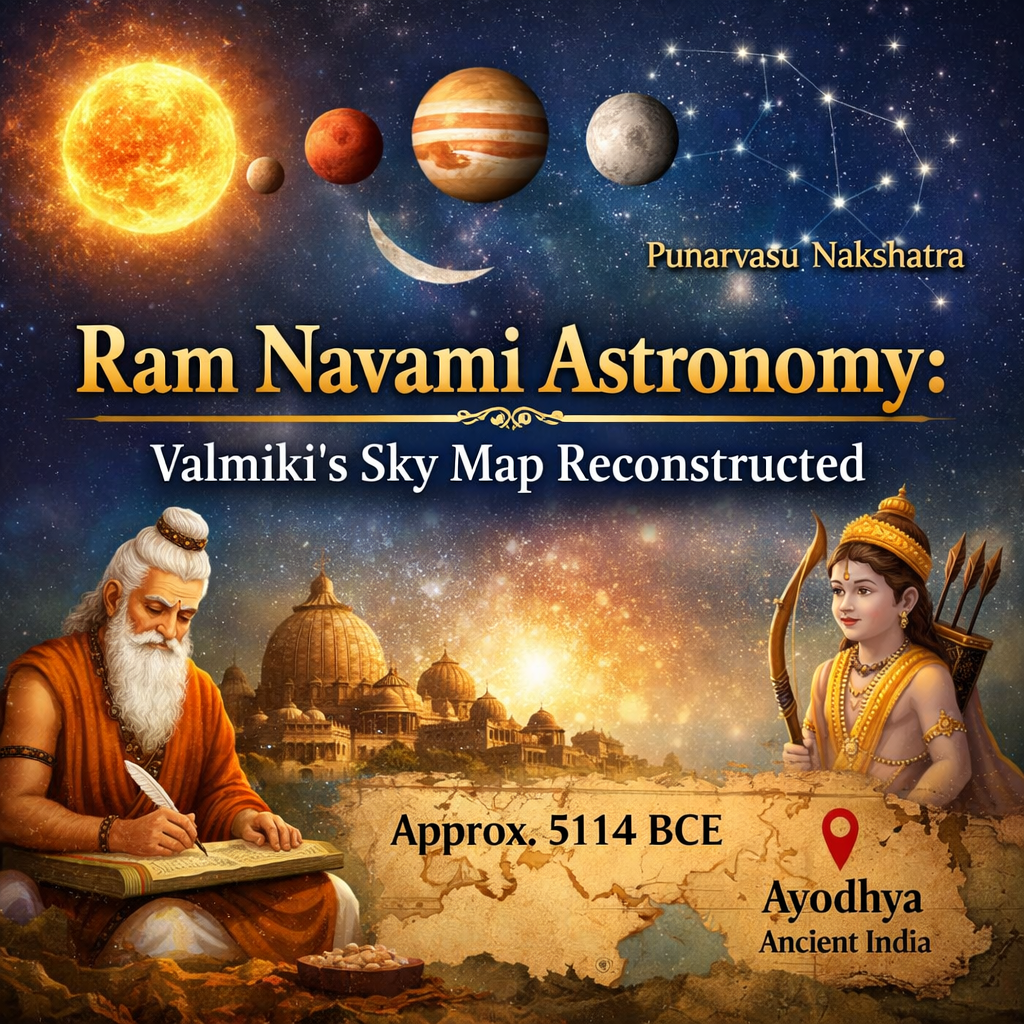
Ram Navami Astronomy: Valmiki’s Sky Map Is Not a Myth
भारत / GB / 
The Cosmic Calendar and Ram Navami Astronomy
The Internal Seeking That Scales to Cosmos
Ram Navami Astronomy demonstrates the power of Sanatana Dharma’s core direction: internal seeking through practice until one experientially knows. This seeker orientation does not stop at introspection. Instead, it progressively expands the sphere of “me” — beginning with the observation of one’s own thoughts, emotions, reactions, and personality traits, then extending to immediate neighbourhood and community as an extension of the self. One learns how to create better harmony in the “lane” by refining shared behavior and relationships. As this sphere continues to enlarge, it naturally embraces the environment, natural cycles, seasons, and eventually the vast cosmos itself. Environment and cosmology cease to be distant “outside” objects; they become part of the larger living “me.” This lived expansion naturally births precise knowledge systems like the cosmic Panchanga calendar, enabling accurate tracking of interlocking lunar and solar rhythms without artificial corrections. This same observational continuity extends into textual tradition, where such lived knowledge is recorded with specific astronomical detail rather than abstract description.
This lived process, rooted in the cyclical and eternal nature of time — with its repeating yugas and kalpas rather than a single linear creation followed by final elimination — empowered ancient seers to observe and map planetary motions with extraordinary precision. Because the cosmos was experienced as an extension of their own expanded self, the rishis treated celestial phenomena not as remote events to be feared or merely obeyed, but as intimate rhythms to be studied, recorded, and harmonized with daily life. Generations of careful observation, cross-verified through lived practice and transmitted orally before being codified in texts like the Vedanga Jyotisha and Surya Siddhanta, resulted in highly accurate calculations of planetary positions, eclipses, solstices, and luni-solar cycles. This same seeker-driven approach allowed Valmiki to encode a detailed sky map at the moment of Bhagwan Ram’s birth — a cosmic snapshot that modern planetarium software can still reconstruct and verify thousands of years later.
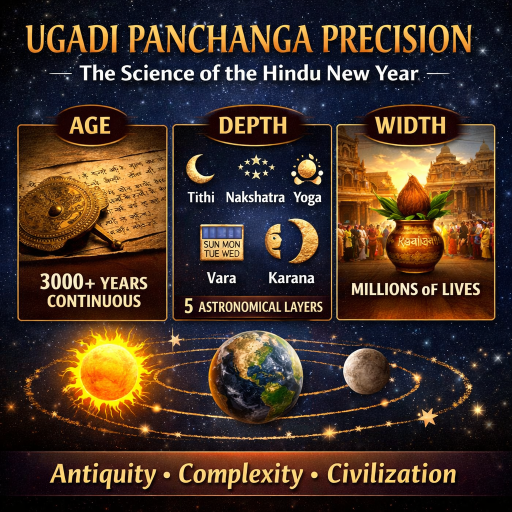
This continuity of observation is not confined to a single event but extends into a living calendrical system that remains in use.
Valmiki’s Precise Planetary Description
One of the most explicit instances of this recorded precision appears in the Valmiki Ramayana, where a specific celestial configuration is described at the moment of Rama’s birth.
Valmiki Ramayana (Bala Kanda 18.8–10) records the birth of Bhagwan Rama with remarkable astronomical precision. The text states:
ततो यज्ञे समाप्ते तु ऋतूनां षट् समत्ययुः ।
ततश्च द्वादशे मासे चैत्रे नावमिके तिथौ ॥ १.१८.८ ॥नक्षत्रे ऽदितिदैवत्ये स्वोच्चसंस्थेषु पञ्चसु ।
ग्रहेषु कर्कटे लग्ने वाक्पताविन्दुना सह ॥ १.१८.९ ॥प्रोद्यमाने जगन्नाथं सर्वलोकनमस्कृतम् ।
कौसल्या अजनयद्रामं सर्वलक्षणसंयुतम् ॥ १.१८.१० ॥tato yajñe samāpte tu ṛtūnāṁ ṣaṭ samatyayuḥ |
tataśca dvādaśe māse caitre nāvamike tithau || 1.18.8 ||nakṣatre ’ditidaivatye svoccasaṃstheṣu pañcasu |
graheṣu karkaṭe lagne vākpatāvindunā saha || 1.18.9 ||prodyamāne jagannāthaṁ sarvalokanamaskṛtam |
kausalyā ajanayad rāmaṁ sarvalakṣaṇasaṃyutam || 1.18.10 ||
This describes Rama’s birth on Chaitra Shukla Navami (ninth day of the bright fortnight in Chaitra month), under Punarvasu nakshatra (whose presiding deity is Aditi), when five planets were in their exalted (uccha) positions: Sun in Mesha (Aries), Mars in Makara (Capricorn), Jupiter in Karka (Cancer), Venus in Meena (Pisces), and Saturn in Tula (Libra). Jupiter (Vakpati) was in conjunction with the Moon in Cancer lagna (ascendant), around midday as the day was advancing. Kausalya gave birth to Rama, the lord of the universe endowed with all auspicious signs.
This unique cosmic configuration forms a verifiable sky map. Modern planetarium software, using the planetary longitudes described, reconstructs the alignment and proposes dates such as approximately 5114 BCE (noon view from Ayodhya coordinates). The description has remained consistent for millennia precisely because Sanatana’s internal seeking treated the cosmos as an extension of the expanded “me.”
Panchanga vs Gregorian: Living Cosmic Harmony
Ram Navami Astronomy shows that when the sphere of “me” expands to cosmic scales, one observes and harmonizes with living rhythms rather than imposing external fixes.
On Ram Navami 2026 (Chaitra Shukla Navami, Madhyahna muhurat ~11:14 AM–1:46 PM IST on March 26), the tithi and alignments continue this tradition of precise, experiential timekeeping.
Expansion Culminates in Vasudhaiva Kutumbakam
As the “me” fully expands, narrow distinctions dissolve.
The Maha Upanishad (6.71) states: “This is mine, that is another’s — say the small-minded. For the noble-hearted, the entire world is one family” (vasudhaiva kutumbakam).
This consciousness arises from internal seeking that sees immanent divinity even in the snake that bites or one who hates.
Rama’s life embodies this: dharma as lived harmony across scales. External celebrations — temple processions, Rama katha, or bhajans — serve as supports for purification, but authenticity demands practicing the teachings until they transform perception.
Why Ram Navami Astronomy Matters Today
In an era of deepening environmental disconnect, climate disruption, and increasingly rigid, artificial calendars that force time to conform to human convenience, Sanatana’s approach offers a powerful living model.
Ram Navami Astronomy demonstrates this wisdom in action. The same internal seeking that enabled Valmiki to record an exact planetary configuration millennia ago continues to power the cosmic Panchanga calendar, which harmonizes lunar, solar, and stellar rhythms through natural adhika masa adjustments instead of deleting or adding dates. This is not abstract philosophy but a practical epistemology: knowledge verified through lived embodiment, not blind repetition or external dogma.
When the sphere of “me” expands to cosmic scales, one no longer sees the universe as something separate to be controlled, but as an intimate extension of self — worthy of careful observation, reverence, and harmonious alignment. This expansion ultimately culminates in the profound realization “Aham Brahmasmi” — “I am Brahman” — the direct experiential knowing that the individual self is one with the ultimate reality that pervades all existence.
Ram Navami Astronomy thus reaffirms that Sanatana’s internal direction produced verifiable cosmic wisdom long before many linear frameworks emerged. On this Chaitra Shukla Navami, as we celebrate the birth of Maryada Purushottama, the festival invites us to move beyond mere external celebrations and truly practice the seeker’s path: expand our own “me,” verify truth through direct experience, and restore harmony with the living rhythms of the cosmos.
Call to Action: This Ram Navami, take one concrete step toward expanding your sphere of “me.” Observe the night sky on the evening of March 26, 2026, note the Moon’s position, or simply spend a few minutes in quiet self-inquiry asking, “Where does my sense of ‘I’ end and the larger world begin?” Let Rama’s birth remind us that true dharma and true knowledge arise only when we practice what we seek to know.
For those who wish to examine this continuity in more concrete detail: Explore the cultural and devotional dimensions: Read at HinduInfopedia.org. To understand scientific relevance of Sanatana visit HinduinfoPedia.com
Feature Image: Click here to view the image.
Videos
Glossary of Terms
Related Blogs of Navami And Shri Rama
Related Blogs of “Not a Myth” Series
Not a Myth Series: A Living Archive of Sanatana Knowledge Systems
Follow us:
- English YouTube: https://www.youtube.com/@Hinduofficialstation
- Hindi YouTube: https://www.youtube.com/@HinduinfopediaIn
- X: https://x.com/HinduInfopedia
- Instagram: https://www.instagram.com/hinduinfopedia/
- Facebook: https://www.facebook.com/Hinduinfopediaofficial
- Threads: https://www.threads.com/@hinduinfopedia
[…] भारत / GB / […]
[…] भारत / GB / […]